



This article is written by the Memly team, and the comparison includes Memly. Prices for Memly, Anki, Quizlet, and Brainscape were checked on the official pages and the US App Store on October 5, 2026.
An AI flashcard app uses AI to auto-generate flashcards and suggest optimal review timing based on the forgetting curve (the well-known pattern in which we forget newly learned information rapidly unless we review it). The difference from traditional flashcard apps is that they cut the effort of card creation while automatically building review schedules grounded in memory research. If you're weighing whether to abandon paper cards or manual Anki decks altogether, our analysis of flashcards vs AI-powered memorization lays out the efficiency gap in detail.
As of 2026, there are many AI flashcard apps on the market, but they vary widely in algorithm generation, supported materials, and pricing. Two of the five below ship no AI card generation of their own, which is worth knowing before the category label does your thinking for you. For a deeper look at how AI-powered memorization works, see What Is AI-Powered Memorization? A Complete Guide to How It Works, Its Effects, and the Best Tools.
Choosing as a student? See our picks for students.
How to Choose an AI Flashcard App: 5 Key Criteria
Four of these five you can settle in a minute on the app's own pricing page. The fifth only shows itself after a week of use. For a more detailed guide on choosing, see our AI Flashcard App Selection Guide.
1. AI Generation Accuracy
How accurately the AI generates flashcards directly impacts learning efficiency. The more input formats supported (text, PDF, images, audio, video), the wider the range of study materials you can use as-is. It's also important to check whether the app correctly handles specialized terminology in your target language.
2. Review Algorithm
The algorithm that determines "when to review" is the heart of any flashcard app. From SM-2 (a scheduling formula developed in 1987) to FSRS 6.0 (the Free Spaced Repetition Scheduler, developed in 2025), there are significant differences in memory prediction accuracy across generations. Newer algorithms offer better optimization tailored to individual memory patterns.
3. Supported Materials and Platforms
Can you turn a textbook PDF directly into flashcards? Can the app read handwritten notes from a photo? The breadth of supported materials directly affects the effort required for card creation. Also check which platforms are supported: iOS, Android, and/or Web.
4. Pricing Structure
Check what the free plan includes and what only unlocks on a paid tier before committing. A gap of a few dollars a month often decides whether AI generation is available at all, which affects study efficiency more than the price difference suggests. For long-term use, compare annual costs rather than monthly ones.
5. UI and Usability
This is the one that decides whether the app gets opened on a bad day, and no spec sheet reports it. Simplicity of the study screen, ease of card editing, and clarity of progress tracking are all things you only learn by trying the app yourself.
Top 5 AI Flashcard Apps [Comparison Table]
| App | AI Generation | Algorithm | Supported Materials | Pricing | Platforms |
|---|---|---|---|---|---|
| Memly | Fully automatic (PDF/image/YouTube/audio) | FSRS 6.0 | PDF, image, YouTube, audio, text | Free / Plus $4/mo / Pro $8/mo | iOS / Android / Web |
| Anki | Manual + add-ons | SM-2 (default) / FSRS built in | Text, image (extendable via add-ons) | PC free / iOS $24.99 (one-time) | Windows / Mac / Linux / iOS / Android |
| Quizlet | Partial (Plus and above) | Proprietary algorithm | Text, image | Free / Plus $9.99 or $44.99 (US App Store, Oct 5, 2026; billing period not shown) | iOS / Android / Web |
| Brainscape | None (manual creation) | CBR (Confidence-Based Repetition) | Text, image | Free / Pro $7.99/mo billed annually | iOS / Android / Web |
| RemNote | Auto-conversion from notes | Modified SM-2 | Text, PDF, Markdown | Free / Pro $8/mo | Windows / Mac / Linux / iOS / Android / Web |
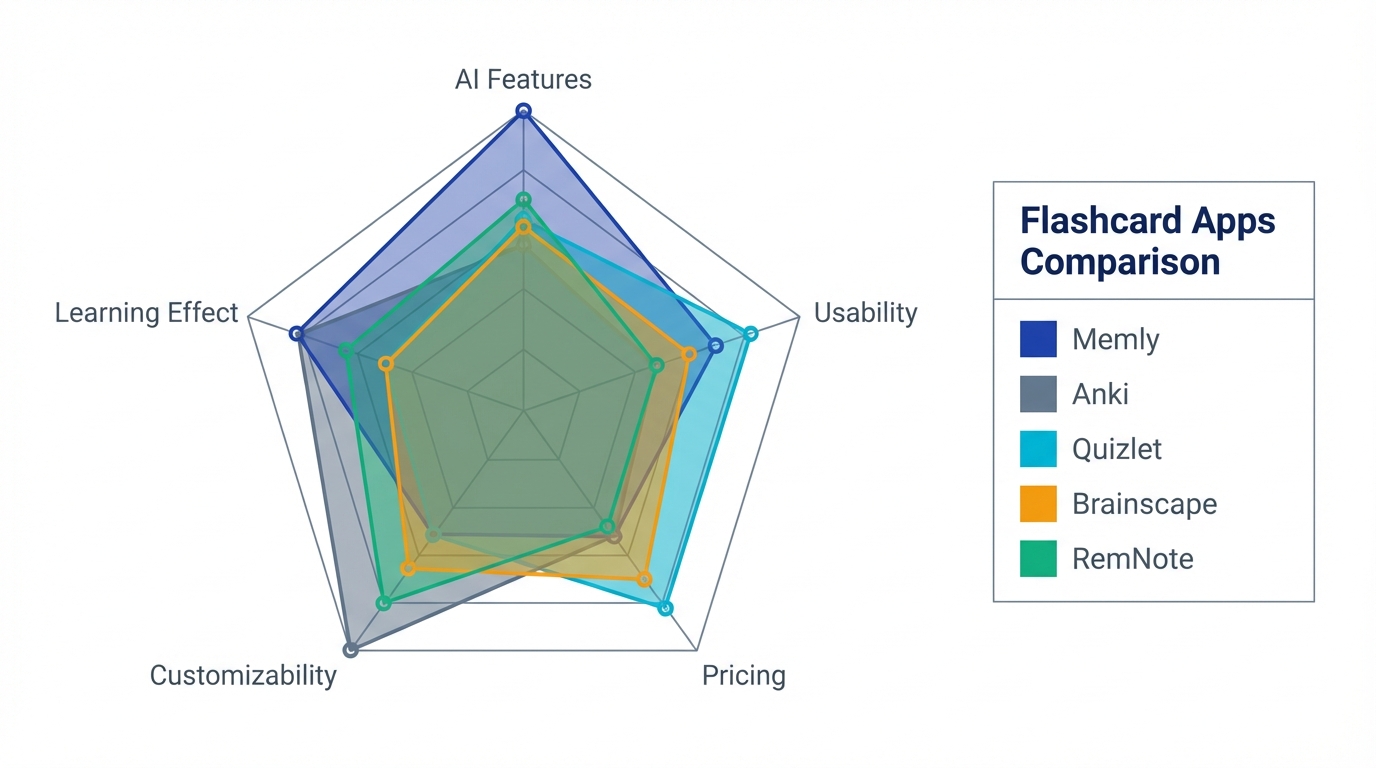
The supported-materials column separates these apps more than the pricing column does. Only one of the five reads YouTube videos or audio; three read nothing but text and images. If your materials are lecture recordings, that column has already decided for you.
1. Memly -- AI Auto-Generation x FSRS 6.0 for Maximum Retention
Features
Memly is a flashcard app that combines fully automatic AI flashcard generation with the FSRS 6.0 algorithm. Simply upload materials in various formats -- PDF, image, or audio (or paste a captioned YouTube link) -- and the AI analyzes the content to automatically generate optimal flashcards.
For review scheduling, it uses FSRS 6.0, the 4th-generation algorithm developed in 2025. It uses 21 parameters, with the same values for every user, and calculates each card's next review from that card's answer history. For a detailed explanation of FSRS 6.0, see Memly's FSRS 6.0 Algorithm Explained.
The app is optimized for multiple languages, delivering high accuracy in card generation from diverse study materials including specialized terminology and technical content.
Pricing
- Free plan: Try AI generation with your own material, with no payment details required to get started; no card limit, and an initial AI allowance that does not refill monthly
- Plus plan: $4/month -- Monthly AI usage, unlimited cards, full algorithm features
- Pro plan: $8/month -- Higher monthly AI usage, priority support
These are web prices. On the US App Store, Plus is $3.99 and Pro $7.99 a month (checked October 5, 2026).
Best For
- Those who want to eliminate card creation effort entirely
- Those who want efficient retention with automatic review scheduling
- Users who study from diverse materials like PDFs and YouTube lecture videos
- Working professionals and students preparing for exams or language study
Considerations
- Free plan has a limit on the number of generated cards (an initial AI allowance that does not refill monthly; stored cards are not capped)
- Advanced customization (fine-grained card template editing) is not as flexible as Anki
- Released in 2024, so the shared deck community is not as large as Anki's
2. Anki -- The Classic App with Unmatched Customizability
Features
Anki is an open-source flashcard app that has been in development since 2006 and is synonymous with flashcard learning. Its greatest strength is unparalleled customizability. You can freely design card templates, display layouts, and field structures, and extend functionality infinitely through add-ons (plugins).
While its default algorithm is SM-2, FSRS has been built into Anki since version 23.10 (October 2023) and can be enabled in the deck options -- no add-on needed. Anki also boasts a massive library of shared decks created by users worldwide, covering specialized fields like medicine, languages, and law. For a detailed feature comparison with Anki, see Memly vs. Anki: A Thorough Comparison.
Pricing
- PC (Windows / Mac / Linux): Free
- AnkiDroid (Android): Free
- AnkiMobile (iOS): $24.99 (one-time purchase)
Best For
- Those who want fine control over card design and display
- Medical students and language learners who want to use community shared decks
- Technically curious users who enjoy extending functionality with add-ons
- PC-centric learners (PC version is completely free)
Considerations
- Initial setup and card creation are time-consuming with a steep learning curve
- AI auto-generation is not built in and depends on add-ons
- The UI is dated and can be intimidating for beginners
- The iOS version costs $24.99 and is not available for free
3. Quizlet -- Team Learning and Gamification
Features
Quizlet is a major flashcard service used by over 60 million people worldwide. Its team learning features and game elements are outstanding, with match games, test mode, live quizzes, and other engaging ways to learn.
Plus and above plans offer AI-assisted card generation from text. However, supported materials are limited to text and images -- direct generation from PDFs or videos is not available. For a detailed comparison with Quizlet, see Memly vs. Quizlet: A Thorough Comparison.
Pricing
- Free: Basic card creation and study features
- Quizlet Plus: $9.99 or $44.99 on the US App Store (checked October 5, 2026; billing period not shown) -- AI generation, ad-free, offline study
Best For
- Those who want to study with classmates or teams
- Students who enjoy game-based memorization
- Users who already find relevant study sets shared on Quizlet
- Those who want a simple UI to get started easily
Considerations
- The proprietary review algorithm is not as precisely optimized for the forgetting curve as FSRS
- AI generation is limited to paid plans and text input only
- AI-heavy features sit behind the paid Plus plan
- Ads are displayed on the free plan
4. Brainscape -- Efficient Learning Through Confidence Ratings
Features
Brainscape uses a CBR (Confidence-Based Repetition) algorithm where users rate their confidence on each card on a 5-point scale, and the app adjusts review frequency based on those ratings. By consciously evaluating your own understanding, you simultaneously develop metacognitive skills (your ability to gauge how well you actually know something).
The UI is polished, with learning progress displayed in a visually intuitive way. It has a track record of adoption by educational institutions and corporate training programs, making it a reliable service. For a head-to-head look at how its confidence-based approach stacks up against Quizlet, see Quizlet vs Brainscape.
Pricing
- Free: Basic features, limited card creation
- Pro: $7.99/month billed annually (brainscape.com/pricing, checked October 5, 2026) -- Unlimited card creation, access to all shared decks
Best For
- Those who want to objectively assess their understanding as they learn
- Organizations considering adoption for corporate training or education
- Those who appreciate a polished UI for a pleasant study experience
Considerations
- No AI auto card generation feature
- Content and community are less robust outside the English-speaking world
- The CBR algorithm relies on self-reporting, so accuracy depends on the user
- Pricing is in USD, so costs may vary with exchange rates
5. RemNote -- Integrated Notes and Flashcards
Features
RemNote is an integrated tool that combines a note-taking app with a flashcard app. As you take notes, simply highlight specific sections to automatically generate flashcards. "Taking notes" and "making flashcards" happen in a single workflow, eliminating the double effort.
It manages review schedules using a modified SM-2 algorithm and supports knowledge structuring through note-linking features. Think of it as an app that combines the note-taking experience of Notion with the spaced repetition mechanics of Anki.
Pricing
- Free: Basic features, note creation and flashcard functionality
- Pro: $8/month -- Unlimited PDF import, advanced search, priority support
Best For
- Those who want to create flashcards while taking notes simultaneously
- Researchers and graduate students who want to organize and manage knowledge structurally
- Users familiar with note-taking apps like Notion or Obsidian
- Those who want to manage lecture notes and reviews in one place
Considerations
- Rich note-taking features make it more complex than dedicated flashcard apps
- Does not support AI auto-generation from images, video, or audio
- Some users report that the mobile app can be slow
- Pricing is in USD, so costs may vary with exchange rates
Best Apps by Learning Goal
So which one, then? The answer moves with what you are studying for far more than with which app is objectively strongest.
| Learning Goal | Recommended App | Reason |
|---|---|---|
| Certification exams (TOEIC, CPA, etc.) | Memly | AI auto-generation from PDF materials for efficient card creation, optimal reviews with FSRS 6.0 |
| Medical and pharmaceutical studies | Anki | Extensive medical shared decks, advanced card templates with image and audio support |
| Classroom or team-based study | Quizlet | Rich live quiz and team features, ideal for group learning |
| Research and deep academic study | RemNote | Unified notes and flashcards for simultaneous knowledge structuring and retention |
| Corporate training and education | Brainscape | Confidence-based comprehension tracking, proven adoption in educational settings |
| Busy professionals studying in spare time | Memly | Cards ready just by uploading materials, efficient reviews in short sessions |
Memly appears twice on that table for one reason: both rows describe someone whose materials already exist as files and whose study time arrives in fragments. For a broader app comparison, see our 2026 Flashcard App Comparison.
Frequently Asked Questions
Q. Do AI flashcard apps actually work?
Yes. Spaced repetition based on the forgetting curve is one of the most well-validated memory techniques in cognitive science. By having AI optimize review timing to individual memory patterns, you can achieve higher retention rates than with a one-size-fits-all schedule.
Q. Which AI flashcard apps are free?
Anki's PC and Android versions are completely free. Quizlet, Brainscape, and RemNote also offer free plans, but AI generation and some advanced features are limited to paid tiers. Memly offers a free plan to test its features.
Q. Should I choose Anki or Memly?
If you prioritize customizability and are willing to invest time in card creation, Anki is a great fit. If you want to skip card creation and start learning immediately with automatic review scheduling, Memly is the better choice. For a detailed comparison, see Memly vs. Anki: A Thorough Comparison.
Q. What's the difference between FSRS 6.0 and SM-2?
SM-2 is an algorithm developed in 1987 that applies the same formula to all users. FSRS 6.0 is a spaced repetition algorithm released in 2025 that uses machine learning to optimize 21 parameters per user, calculating review intervals precisely fitted to each person's forgetting curve. There is a significant gap in memory prediction accuracy between the two.
Q. Do I need to use a flashcard app every day?
Daily use is ideal, but not mandatory. Spaced repetition algorithms automatically adjust even if your review timing is slightly off. However, gaps of two weeks or more cause review cards to pile up significantly, so we recommend building a habit of at least 5-10 minutes per day.
Q. Can I use multiple apps at the same time?
You can, but we don't recommend it. Splitting review schedule management across apps prevents any single algorithm from optimizing effectively. Start by consolidating into one app and trying it for 2-3 weeks before making a decision.
Q. Can I study on just my phone?
Memly, Quizlet, and Brainscape all work well on smartphones alone. Anki has mobile apps too, but advanced card editing and add-on management require the PC version. RemNote works on mobile but note-taking is more comfortable on a PC or tablet.
Q. Which app is best for younger students?
Quizlet is the most approachable thanks to its simple UI and game elements. Once study habits are established, transitioning to Memly for AI-powered efficiency is worth considering. Anki's complexity makes it better suited for tech-savvy high school students and older learners.
Conclusion: Choose the One That Fits You
Each AI flashcard app has clear strengths and weaknesses, and there is no single "best app" for everyone. Pick the one that fits your learning goals, study style, and budget, then stay with it long enough for the algorithm to learn your memory.
The best app is the one you open every day. FSRS 6.0 needs a few weeks of your actual ratings before its 21 parameters describe anyone in particular.
If you're unsure, start with a free plan or trial and try it for yourself. After 2-3 weeks of use, you'll naturally know whether it's the right fit.
To learn more about how AI-powered memorization works, see What Is AI-Powered Memorization? A Complete Guide to How It Works, Its Effects, and the Best Tools.
Sources and dates checked
All checked on October 5, 2026.
- Quizlet Plus: US App Store listing
- Brainscape Pro: brainscape.com/pricing
- AnkiMobile: US App Store listing
- Memly: US App Store listing and the web pricing
