


This article is written by the Memly team, and the comparison includes Memly. Prices and features were checked on each company's official pages and the US App Store on October 5, 2026.
If you want a free Quizlet-style app, Knowt (free unlimited learn mode) and Anki (free on desktop and Android, no AI) are the closest swaps; Memly fits if you want cards made from your own notes with a review date and an exam-date plan. Brainscape, Gizmo and RemNote also have free plans, and each limits something different on it (Brainscape its certified decks and AI cards, Gizmo its AI imports, RemNote its PDFs and AI credits).
Quizlet was long the go-to free flashcard app. Its free plan now limits some study modes and keeps more of them behind a subscription, which leaves many learners asking whether it is still worth paying for.
Quizlet itself is still free to download. Quizlet Plus is an in-app purchase listed on the US App Store at $9.99 and $44.99 (checked October 5, 2026; the store does not show the billing period). What the free plan includes changes over time, so check Quizlet's help center for the current free-plan limits before you move your sets.
Want cards made from your own notes, with a review date for each? Try Memly free. No credit card required. The free plan includes an initial AI allowance that does not refill monthly.
Quizlet Alternatives at a Glance
The table lines up what each app gives you without paying, how it makes cards with AI, how it schedules reviews, where it runs, and what the paid plan costs. Prices are in US dollars, taken from each company's pricing page or its US App Store listing on October 5, 2026.
| App | Free plan | AI card creation | Review scheduling | Platforms | Paid plan price |
|---|---|---|---|---|---|
| Knowt | Flashcards free to create, share and study, with unlimited learn mode | AI flashcards from notes, PDFs and lecture videos; AI summarizers for PDFs, video, images and slides are listed under Ultra | Learn mode, spaced repetition mode, practice tests | Web, iOS, Android | Ultra $24.99/month, or $149.99/year billed upfront |
| Anki | Free on Windows, macOS and Linux; AnkiDroid (Android) and AnkiWeb sync are free | None built in; you write cards or download shared decks | SM-2 by default; FSRS built in since Anki 23.10 | Desktop, Android, iPhone/iPad, web (AnkiWeb) | AnkiMobile (iPhone/iPad) $24.99 one-time on the US App Store |
| Brainscape | "Free forever" Basic: unlimited flashcards you type, imports, 2,500 pre-loaded flashcards | Basic: "Use AI to make 100s of flashcards"; Pro: unlimited | Confidence-Based Repetition (you rate each card 1 to 5) | Web, iOS, Android | Pro $7.99/month billed annually |
| Gizmo | Unlimited cards, decks and quizzing; 10-minute wait after losing 15 hearts; 2 Magic Imports a day, 20 minutes apart | Magic Import from PDFs, recordings, notes, photos, slides, websites, Quizlet and Anki | Spaced repetition in Memorise mode | Web, iOS, Android | Unlimited: yearly or weekly plan, student discount for eligible users (price shown at sign-up) |
| RemNote | Unlimited notes and flashcards; 3 annotated PDFs; 1 exam in the Exam Scheduler; 250 AI credits a month | AI cards from text, PDFs and slides (limited on Free) | Spaced repetition; Exam Scheduler | Windows, macOS, Linux, iOS, Android, web | Pro $8/month billed yearly ($96); Pro with AI $18/month billed yearly ($216) |
| Memly | Initial AI allowance that does not refill monthly; no card limit on any plan; flip-card review, the exam-date plan and CSV import stay free. Try Memly free | From PDFs, Word files, slides, photos, YouTube links (videos with captions), web pages, audio files and in-app recordings | FSRS 6.0 with the same parameters for every user, from each card's answer history; exam-date plan | Web, iOS, Android (synced) | Plus $4/month or $36/year, Pro $8/month or $72/year on the web; US App Store: Plus $3.99 or $35.99, Pro $7.99 or $69.99 |
Quizlet is left out of the table because the Memly vs. Quizlet comparison further down covers it row by row. If you are a student choosing a first study app rather than replacing Quizlet, our picks for students start from that question instead.
The Six Alternatives, App by App
Knowt
Knowt's homepage describes its flashcards as free to "create, share, and study for completely free with unlimited learn mode." Its FAQ adds that you can bring existing Quizlet sets over and study them with learn mode, a matching game, spaced repetition or practice tests, and that AI can make flashcards from lecture videos, PDFs and notes. For someone whose habit was Quizlet's Learn mode on shared sets, this is the shortest move.
The paid tier is Ultra: $24.99 a month, or $149.99 billed upfront for a year ($12.99 a month), according to knowt.com/plans. Ultra adds an ad-free experience, AI summarizers for PDFs, video, images and PowerPoint, a lecture-recording summarizer, a podcast generator and a voice tutor. The US App Store lists several Ultra options (weekly, monthly and annual) at different prices, so compare the price shown where you subscribe.
Anki
Anki costs nothing on Windows, macOS and Linux, AnkiDroid for Android is free, and syncing through AnkiWeb is free too. The one paid piece is AnkiMobile for iPhone and iPad, a one-time $24.99 on the US App Store (checked October 5, 2026). The full cost picture is in our breakdown of what Anki costs.
Anki has no built-in AI card creation: you write cards yourself or download shared decks, which makes it the plain choice for readers looking for a Quizlet alternative with no AI. Scheduling uses SM-2 by default, and FSRS has been built in since Anki 23.10. Anki imports plain-text files separated by commas, semicolons or tabs, so a Quizlet text export can go in after a little cleanup. For a direct comparison of the two, see Anki vs Quizlet; if you are leaving Anki instead, see the best Anki alternatives.
Brainscape
Brainscape's pricing page lists a Basic plan that is "Free forever": you can type unlimited flashcards, import existing ones, "use AI to make 100s of flashcards," and study 2,500 pre-loaded flashcards plus anything you made or that was shared with you. Pro costs $7.99 a month billed annually ($95.88 a year) or $19.99 billed monthly, and adds unlimited AI flashcards, unlimited Brainscape-Certified flashcards, and images and sounds on cards. The US App Store lists Brainscape Pro at $19.99, $59.99 and $95.99 and a Lifetime option at $199.99 (billing period not shown).
Brainscape schedules reviews with Confidence-Based Repetition: after each card you rate how well you knew it on a scale of 1 to 5. Our Quizlet vs Brainscape comparison goes through that system and the certified decks in more detail.
Gizmo
Gizmo's help article "Is it free?" (dated August 28, 2026) says the core features are free: unlimited cards, decks and quizzing. What the free plan limits is pace. After losing 15 hearts while quizzing you wait 10 minutes, and Magic Import, Gizmo's AI import from PDFs, recordings, notes, photos, slides, websites, Quizlet and Anki, is limited to 2 a day with 20 minutes between imports. Gizmo's pages do not all list the same limit: "What do I get with Gizmo Unlimited?" (August 11, 2026) mentions only the 20-minute wait.
Gizmo Unlimited removes those limits. The help center describes two plans, yearly and weekly, plus a student discount for eligible users; the price appears when you sign up. Gizmo can also import a Quizlet set from its URL. For how Gizmo compares with a free scheduler, see Anki vs Gizmo.
RemNote
RemNote keeps notes and flashcards in one app. Its free plan includes unlimited notes and flashcards, 3 annotated PDFs, 1 exam in its Exam Scheduler and 250 AI credits a month, according to remnote.com/pricing. Pro is $8 a month billed yearly ($96), removes the PDF and exam limits and raises AI credits to 1,000 a month; Pro with AI is $18 a month billed yearly ($216) with 20,000 AI credits a month. The US App Store lists RemNote's plans at different prices from the website.
Memly
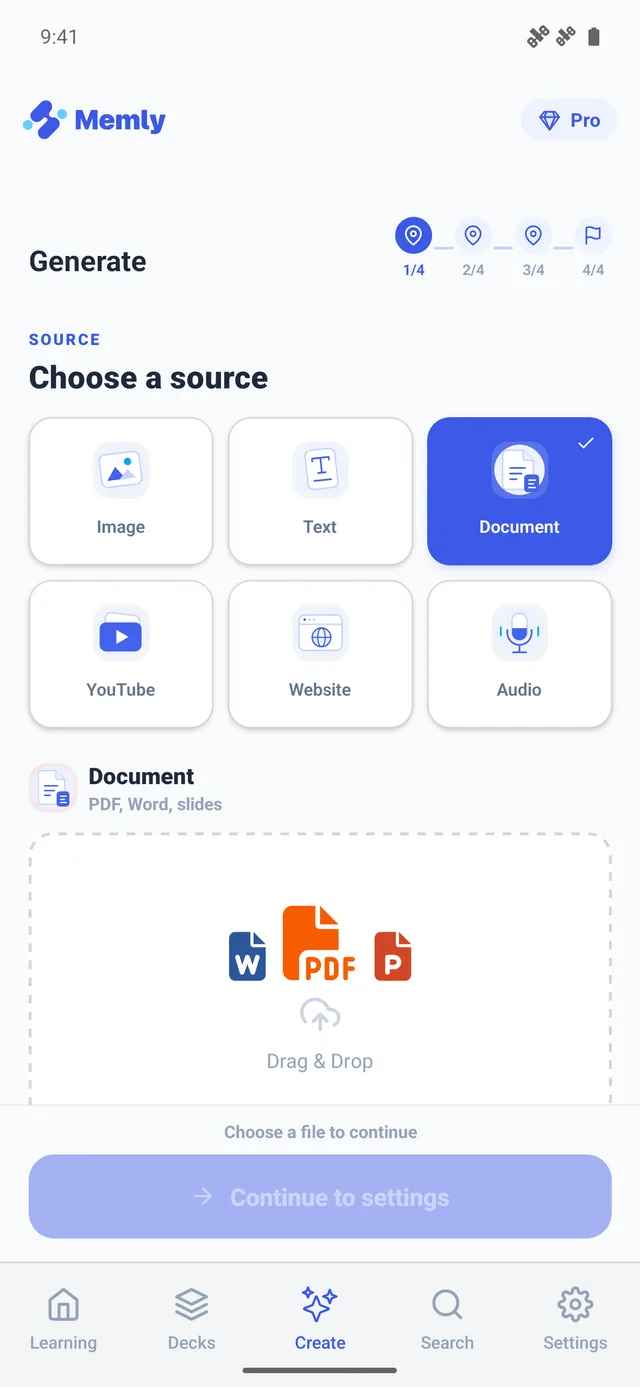
Memly is the app made by the team writing this article, so read this entry with that in mind. It starts from your own material: upload a PDF, Word file or slide deck, take photos, paste a YouTube link (videos with captions) or a web page, upload an audio file, or record a lecture in the app, and Memly's AI drafts question-and-answer cards that you check and edit before saving. FSRS 6.0 then sets each card's next review from that card's answer history, using the same parameters for every user. If you set an exam or deadline, Memly works out how many cards to study each day.
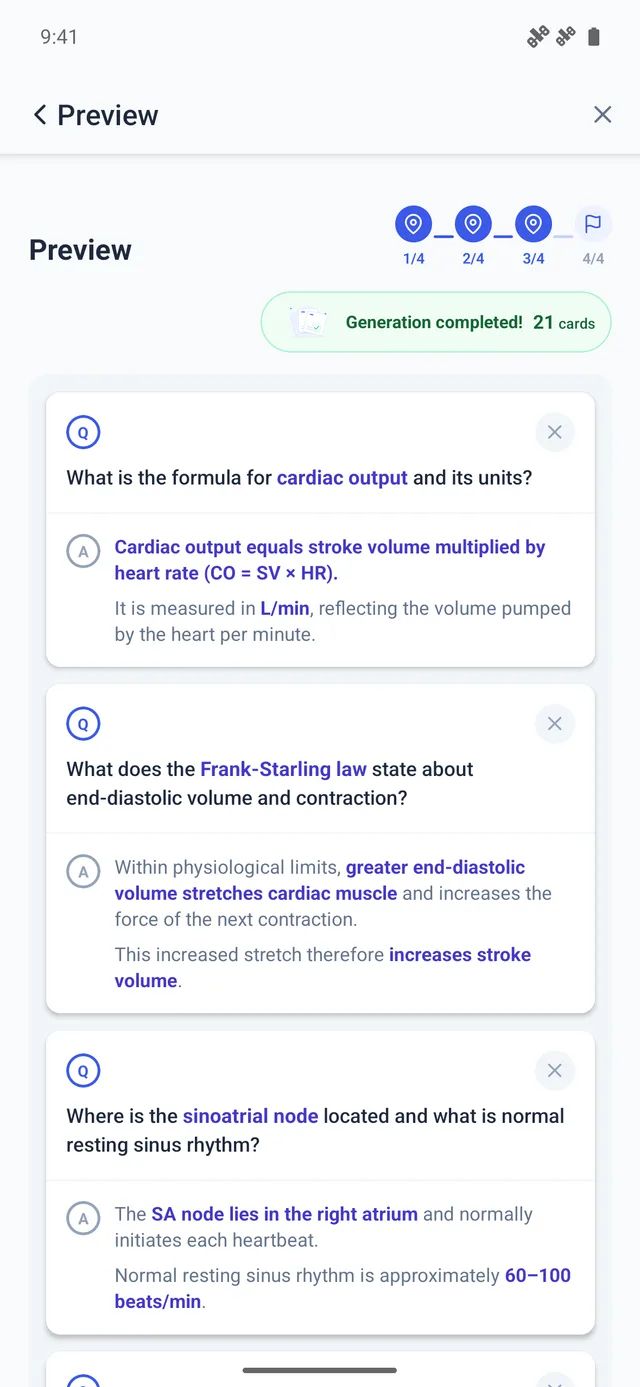
Screens are from a demo account. The handout was written by Memly, and the cards were actually generated by Memly in September 2026. Progress figures are set for illustration.
On the free plan, AI card creation uses an initial allowance that does not refill monthly. There is no card limit on any plan, and flip-card review, the exam-date plan and CSV import stay free. Plus costs $4 a month or $36 a year on the web, and Pro $8 a month or $72 a year; on the US App Store, Plus is $3.99 or $35.99 and Pro $7.99 or $69.99 (checked October 5, 2026).
Memly is not a good fit for every Quizlet user. It has no library of sets shared by other users (Memly publishes a small number of free public decks), you need a connection to study (on mobile, only Review Radio playback works offline), there is no classroom game like Quizlet Live, and the free AI allowance is a one-time amount. It is also a newer app with a smaller community than Quizlet or Anki.
The rest of this page puts Memly and Quizlet side by side in more detail. Both apps are good at something, but not at the same thing. For a broader overview of AI-powered memorization, see What Is AI-Powered Memorization? How It Works, Its Effectiveness & Best Tools [2026 Guide].
Memly vs. Quizlet in 30 Seconds
The difference comes down to three points.
- Memly is an individual-learning-focused app that excels in AI-powered auto-generation and automatic review scheduling with the FSRS 6.0 algorithm
- Quizlet is a community-driven platform that shines in team learning, classroom use, gamification, and a massive library of shared study sets
- In terms of pricing, Memly offers better cost-effectiveness for individual learners, while Quizlet has an edge for group use
| Category | Memly | Quizlet |
|---|---|---|
| Strength | AI full auto-generation, FSRS 6.0 | Team learning, game features |
| Monthly Price (Individual) | From $4 | Plus $9.99 or $44.99 on the US App Store (billing period not shown) |
| Ideal User | Efficiency-focused individual learners | Groups and classroom users |
Detailed Comparison: Features, Pricing, and Usability
Ten categories, and the winner changes row by row depending on what you are optimizing for.
| Category | Memly | Quizlet |
|---|---|---|
| AI Generation | Full auto-generation from PDF, image, YouTube, audio | AI study tools tied to paid plans (check Quizlet for the current list) |
| Learning Algorithm | FSRS 6.0 (schedules each card from its answer history) | Quizlet's own study modes and scheduling; details are not published |
| Pricing (cheapest paid) | $4/month (Plus) | Plus: $9.99 or $44.99 on the US App Store (billing period not shown) |
| Team/Classroom Learning | Focused on individual learning | Rich classroom features including Quizlet Live |
| Game Elements | Basic study modes | Rich study modes: Learn, Test, Match, and more |
| Supported Materials | PDF, image, YouTube, audio, text | Mostly text-based sets (check Quizlet for current import options) |
| Offline | Not supported (Review Radio playback only) | Offline study has been a paid-plan feature (check Quizlet for current details) |
| UI/Usability | Modern, simple design | Familiar, proven UI |
| Learning Analytics | Predicted retention for each card and across a deck | Progress tracking in its study modes |
| Support | Contact form on the Memly website | Help center articles |
One row decides more than the rest: supported materials. If what you actually have is a lecture recording or a long PDF, Quizlet may leave you turning it into text yourself before anything else can happen, and that is where many people quietly stop studying. If what you have is a list of terms you plan to drill with classmates, that row barely matters and the classroom features do.
AI Features Compared
Memly's AI Features
Memly's standout feature is that it drafts flashcards from many kinds of material. Textbook PDFs, lecture recordings, photos of whiteboard notes, podcast audio files: upload them (or paste the link to a captioned YouTube lecture) and the AI analyzes the content and drafts question-answer pairs.
By eliminating the need to manually create cards, Memly solves the biggest bottleneck of flashcard apps: "spending so much time making cards that actual review falls behind." Because the cards are drafted from your own material, they follow its terminology, and you check and edit them before saving.
Quizlet's AI Features
Quizlet has added AI study tools in recent years, and which of them are free, paid or still offered changes over time. We could not confirm the current list from Quizlet's own pages, so check what your Quizlet plan includes today before you count on an AI feature.
Quizlet's sets are built mainly from text. If direct card generation from video or audio files is not available on your plan, turning lecture content into cards means transcribing it and typing it in yourself.
AI Features Summary
| AI Feature | Memly | Quizlet |
|---|---|---|
| Auto Card Generation | Available on all plans | Tied to paid plans; check Quizlet for current details |
| Supported File Formats | PDF, image, YouTube, audio, text | Text-centric; check Quizlet for current options |
| App Languages | English, Japanese and Korean | Several interface languages; check Quizlet for the list |
| AI Chat Support | No chat; AI explanation and mnemonic you can generate for a card | AI tutor features have changed over time; check Quizlet |
Differences in Learning Algorithms
The core value of a flashcard app lies in the algorithm that accurately predicts "when and what to review." This difference has a major impact on long-term learning efficiency. For more on algorithm generations and details, see our AI-powered memorization explainer.
Memly: FSRS 6.0
Memly uses FSRS (Free Spaced Repetition Scheduler) 6.0, a version of the open-source algorithm. Spaced repetition is the technique of reviewing material at gradually widening intervals so it sticks in long-term memory. FSRS 6.0 models memory with 21 parameters (Memly uses the same values for every user) and calculates review timing from each card's answer history.
- Answer history built in: The more you answer a card, the more data its next review date is calculated from
- Target retention rate: You can set your desired retention rate, such as "I want to remember 90% of the time"
- Power-function model: FSRS 6.0 describes forgetting with a power-function curve rather than a plain exponential one
Quizlet: Proprietary Algorithm
Quizlet has its own study modes and scheduling, and it does not publish the details the way the open FSRS project does. That is why this article compares the two on how they work for you, not on measured accuracy.
- Simplicity: Familiar study modes that beginners can pick up quickly
- Long-established: A widely used app with years of refinement behind it
- Built around sets: Shared sets and classroom use come first
If you want a published, open scheduling algorithm that sets each card's next review from your answers, Memly's FSRS 6.0 is the clearer fit. On the other hand, if you prefer simplicity without worrying about algorithm settings, Quizlet's straightforward approach is a perfectly valid choice.
Pricing Comparison
Memly Pricing
| Plan | Monthly Price | Key Features |
|---|---|---|
| Free plan | Free | Try AI generation with your own material, basic card creation, and review; initial AI allowance that does not refill monthly; no card limit |
| Plus | $4 | Monthly AI generation allowance; saving cards through MCP |
| Pro | $8 | Higher monthly AI allowance than Plus; saving cards through MCP |
These are web prices. Billed yearly, Plus is $36 and Pro is $72. On the US App Store, Plus is $3.99 or $35.99 and Pro is $7.99 or $69.99 (checked October 5, 2026).
Quizlet Pricing
| Plan | Monthly Price | Key Features |
|---|---|---|
| Free | Free | Card creation and study with ads; some study modes are limited |
| Plus | $9.99 or $44.99 on the US App Store (checked October 5, 2026; billing period not shown) | Ad-free and fuller study modes; offline study and AI features have been tied to paid plans (check Quizlet for the current list) |

Key Pricing Takeaways
For individual learners, the most practical comparison is between Memly Plus ($4/month) and Quizlet Plus ($9.99 on the US App Store, billing period not shown). Memly costs less than half as much, and Plus adds a monthly AI generation allowance on top of the FSRS 6.0 scheduling every plan uses.
For classroom or team use, a monthly per-seat comparison misses most of the value. Quizlet's teacher-focused plans include classroom management tools and group learning features like Quizlet Live, which are built for schools and have no equivalent on the Memly side.
Who Quizlet Is For vs. Who Memly Is For
Quizlet Is For You If...
- You study in classrooms or teams: Quizlet Live and class features are perfect for energizing group learning
- You enjoy game-based learning: Diverse study modes like Learn, Test, and Match help maintain motivation
- You want to use existing study sets: Access a massive library of study sets created by users worldwide
- You want to share cards with study partners: Robust sharing features make it easy to collaborate
- You mainly study English-language materials: English content is overwhelmingly abundant, especially beneficial for English learners
Memly Is For You If...
- You want to use your existing materials as-is: Just upload PDFs, images, or audio (or paste a captioned YouTube link) and the AI auto-generates cards
- You want research-based reviews: FSRS 6.0 schedules each card from its answer history
- You're studying for exams or specialized subjects: Cards drafted from your own technical material, which you edit before saving, and an exam-date plan for exam prep
- You prioritize cost-effectiveness: AI card generation from $4/month, with FSRS scheduling on every plan
- You study in English, Japanese or Korean: The app is available in all three languages
Both lists describe real people. The deciding question is which one describes your last three study sessions, not which one describes the learner you intend to become. For a broader app comparison, see our 2026 Flashcard App Comparison.
Moving Your Quizlet Sets
"I want to switch to Memly, but what happens to my Quizlet data?" That's a perfectly reasonable concern. Exporting removes nothing from the Quizlet side, so the move stays reversible right up until you cancel the subscription.
The alternatives take your sets in different ways. Gizmo's Magic Import reads a Quizlet set from its URL (on the free plan, with 20 minutes between imports), and Knowt says you can bring existing Quizlet sets over. Memly, Anki and Brainscape work from a file instead: Memly imports CSV, Anki imports text separated by commas, semicolons or tabs, and Brainscape's free plan includes importing existing flashcards. Whichever app you pick, move only sets you created or have permission to use.
Step 1: Export Your Study Sets from Quizlet
Open your Quizlet study set page and use the "Export" function to download as a text file. You can select custom delimiters, allowing output in CSV or TSV format.
Step 2: Import into Memly
Arrange the exported file into Memly's CSV template (front and back columns) and import it into a deck. Only the front and back text comes across; images, audio, and study history are not carried over.
The free Quizlet converter does the arranging for you: paste the terms and definitions, check how each line splits in the preview, and download a CSV with front and back columns, the format Memly's CSV import reads. Then import it into a free Memly account; CSV import does not use the AI allowance. Moving to Anki instead? The CSV to Anki converter turns the same file into a tab-separated text file Anki can import.
Step 3: Study History Starts Fresh
Imported cards start as new cards with no study history. FSRS 6.0 calculates each card's next review from your answers, so review frequency may be slightly higher right after migration and the intervals widen as you keep answering.
Migration tip: Check your Quizlet subscription renewal date and complete the migration beforehand to avoid unnecessary costs. We recommend trying Memly's free plan first to confirm it works for you before making a full switch.
Frequently Asked Questions
Is there a free Quizlet alternative with learn mode?
Yes. Knowt's homepage says its learn mode is free and unlimited, and Gizmo's free plan includes unlimited quizzing in Memorise mode, with a 10-minute wait after you lose 15 hearts. Memly has no mode called Learn: its flip-card review and exam-date plan are free, while multiple-choice practice uses the AI allowance (checked October 5, 2026).
Can I migrate my Quizlet data to Memly?
Yes, for the text. Export your data as text using Quizlet's export feature, arrange it into Memly's CSV template (front and back), and import it. Images, audio, and study history are not carried over.
Does Memly have a feature like Quizlet Live?
At this time, Memly is focused on individual learning and does not include a real-time group competition feature like Quizlet Live. If classroom group learning is your primary goal, Quizlet is the better fit.
Comparing just the free plans, which is better?
Quizlet's free plan includes ads and limits some study modes. Memly's free plan is ad-free and lets you try AI generation with your own material. For a quick test with your own material, Memly is ideal; for browsing existing study sets, Quizlet's free plan is more suitable.
Which algorithm is better: FSRS 6.0 or Quizlet's?
Anki's documentation says that with FSRS you do fewer reviews than with Anki's default algorithm (SM-2) to reach the same retention (see the Anki FAQ on spaced repetition algorithms). That compares FSRS with SM-2, not with Quizlet, whose scheduling details are not published. Whether a more precise algorithm translates into better results also depends on how often and how consistently you study. Those who review daily are most likely to feel the benefit.
I'm currently on a Quizlet paid plan. Should I switch to Memly?
If you frequently use Quizlet's team learning features or game modes, there's no need to switch. Conversely, if you find yourself "studying alone most of the time," "spending too long creating cards," or "feeling like the review timing is off," try Memly's free plan before deciding.
Can I use both apps together?
Absolutely. For example, you could use Quizlet for classroom group learning and Memly for individual review at home. Using each app for what it does best is a smart learning strategy.
Which is better for studying in languages other than English?
Memly's app is available in English, Japanese and Korean, and Quizlet also offers several interface languages. We have not measured how either app's AI performs on non-English material, so the practical test is to try both on a page of your own notes in the language you study and compare the cards.
Conclusion: Choose the App That Fits You
Memly and Quizlet are both excellent flashcard apps, but they have different design philosophies. Quizlet is a "learn with fun" platform built around community and gamification, while Memly is an "efficient memorization" tool built on AI card generation and the FSRS scheduling algorithm.
- For group learning and gamification: Quizlet
- For AI auto-generation and research-based reviews: Memly
If you're undecided, try Memly's free plan first. Upload your own study materials and judge the generation quality directly; most people can tell within minutes whether it fits. For more on recommended AI flashcard apps, see our Best AI Flashcard Apps roundup. For another Quizlet comparison, see Quizlet vs Brainscape.
To test it on the notes you already have, start Memly free on the web, or get the app on the App Store or Google Play. No credit card required; the free plan includes an initial AI allowance that does not refill monthly.
Sources and Dates Checked
All pages below were checked on October 5, 2026.
- Quizlet: US App Store listing
- Knowt: homepage and FAQ, plans, US App Store listing
- Anki: official site, AnkiMobile on the US App Store, manual (FSRS), manual (importing text files)
- Brainscape: pricing, US App Store listing
- Gizmo: Is it free?, What do I get with Gizmo Unlimited?, What is Magic Import?, How do I import from Quizlet?
- RemNote: pricing, US App Store listing
- Memly: pricing, US App Store listing
Quizlet, Knowt, Anki, Brainscape, Gizmo and RemNote are trademarks of their owners. Memly is not affiliated with them.
