



If you're currently studying with paper flashcards or Anki, you may be wasting over 40% of your study time on card creation alone. Making 1,000 cards by hand takes roughly 50 hours. AI can generate the same volume in under an hour. Fifty hours is more than a full working week spent writing out questions before a single review happens.
The 200-Year History of Flashcards and Why the Format Never Changed
Flashcards trace their origins to the early 19th century. Learners worldwide have used the same simple format (question on the front, answer on the back) for over 200 years.
In 1972, Sebastian Leitner devised the Leitner System, adding a structured review mechanism. In 2006, Anki appeared, combining digitization with a spaced repetition algorithm (SM-2). Quizlet made sharing flashcards easy, bringing a social dimension to studying.
However, these advancements are extensions of the same concept. The underlying structure hasn't changed in 200 years: create cards, review them in order, self-assess correctness.
3 Limitations of Traditional Flashcards
1. Review Timing Is Self-Directed
With paper flashcards, "when to review" is entirely up to you. Even with the Leitner System, the box-movement rules are fixed and don't reflect your personal memory patterns.
As a result, most learners either "waste time reviewing cards they already know" or "fail to notice cards they've forgotten." Manually managing more than 1,000 cards exceeds the limits of human cognitive ability.
2. Card Creation Takes Too Much Time
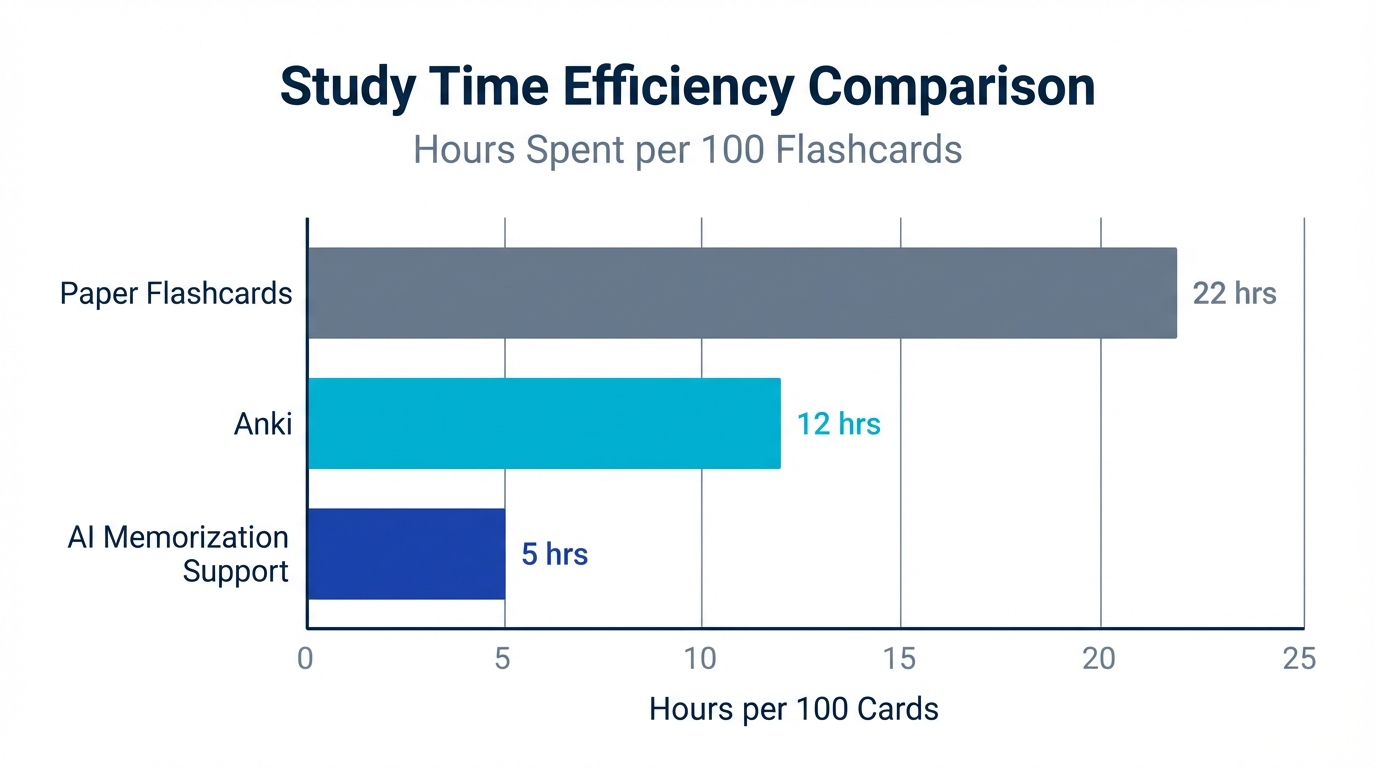
The biggest barrier to flashcard use is the effort of creating them. Research shows it takes an average of 2–3 minutes to create one effective flashcard. Making 1,000 cards requires 30–50 hours.
That's time you could have spent actually learning. When card creation eats into review time, you fall into the "flashcard trap", where preparation crowds out the practice it was supposed to serve.
3. No Personalization
Traditional flashcards deliver the same experience to every learner. But memory retention speed varies dramatically between individuals. One person might memorize something in 3 repetitions while another needs 7. A fixed system can't adapt to these individual differences.
What Changes with AI-Powered Memorization Support
All three limits come from what the format leaves to the human: choosing when to review, writing every card, and adapting to nobody in particular. That is why AI-powered memorization support can leave the 200-year-old format untouched and still change the arithmetic completely.
| Criteria | Paper Flashcards | Anki (SM-2 by default) | AI Memorization Support (Memly) |
|---|---|---|---|
| Card creation time | 2–3 min per card (handwritten) | 1–2 min per card (typed) | AI auto-generation (seconds per card) |
| Review timing management | Entirely manual | Automated via SM-2 | High-precision prediction via FSRS 6.0 |
| Personalization | None | Limited (4-level rating) | Reflects each card's answer history (21 parameters, same for every user) |
| Memory prediction accuracy | None | Moderate | Outperforms SM-2 in 99.6% of cases |
| Managing 1,000+ cards | Impractical | Requires manual configuration | Fully automated |
| Automatic weak-point detection | Impossible | Basic statistics only | AI auto-analyzes and focuses review |
| Cost | Card supplies only | PC free / iOS paid | Free plan available |
One row does most of the work: card creation time. Seconds instead of minutes, repeated a thousand times over, is where the hours come from. Learning that takes 1,000 hours with traditional flashcards can achieve equal or better results in approximately 500–600 hours with AI memorization support. Those 400–500 hours you get back could be spent on other studies, work, or personal interests.
Is "Anki Is Enough" Still True in 2026?
Anki is undeniably an excellent tool. It's open source, has a rich plugin ecosystem, and offers unmatched customization. Especially after adding support for FSRS (the Free Spaced Repetition Scheduler, a modern algorithm that predicts when you're about to forget a card), it has made significant algorithmic strides.
The friction that remains sits around the algorithm rather than inside it:
- Complex initial setup: deck creation, field configuration, and card template customization all come before the first review, so the learning curve is significant
- Manual card creation: No built-in AI auto-generation, so every card must be created by hand
- English-centric UI: Can be less user-friendly in non-English environments
- SM-2 by default: Switching to FSRS 6.0 requires manual configuration
Power users who enjoy Anki's customization will thrive with it. However, for those who want to skip configuration and focus on learning, minimize card creation effort, or prefer a polished user experience, an AI-powered memorization support tool is the better fit.
| Comparison | Anki + SM-2 | Anki + FSRS | Memly (FSRS 6.0) |
|---|---|---|---|
| Algorithm accuracy | Baseline | Major improvement over SM-2 | FSRS 6.0 built-in |
| Setup time | Several hours+ | Several hours+ (plus FSRS config) | 30 seconds |
| Auto card generation | None | None | PDF, image, and text supported |
| Language optimization | Plugin-dependent | Plugin-dependent | Native multilingual support |
The setup row decides most cases. Several hours of configuration is a bill that arrives while motivation is at its peak and familiarity with the tool is at its lowest, which is the worst possible moment to be asked for it.
When You Should Make the Switch
If any of the following apply to your current memorization method, it's time to consider switching to AI-powered memorization support.
- You spend more than 30% of your study time creating cards
- You have 1,000+ cards and don't know which ones to review
- You frequently "can't recall" things you thought you'd memorized
- You lose motivation to review and abandon your cards for weeks at a time
- Your exam is approaching and you need maximum efficiency
- Anki's configuration is so complex that you spend more time on setup than studying
If even one of these applies, switching to AI memorization support will reliably improve your study efficiency. If three or more apply, you may be wasting enormous amounts of time with your current approach.
The switching cost is small. Account creation takes 30 seconds, and uploading your existing study materials is enough for the AI to generate cards. Nothing about your current setup gets destroyed, so you can go back if it doesn't work for you.
Conclusion
Flashcards have been the gold standard of memorization for 200 years, and their core principle, repetition of questions and answers, remains valid. What has changed is how that principle gets executed.
Paper cards can't carry high volume, and Anki digitized the problem without removing the typing. What is new is that the cards no longer have to be written by the person who has to study them.
In the time it takes you to create one card by hand, AI can generate 15. That difference looks small in a single day, but it adds up to dozens of hours per month and hundreds of hours per year. Over 5,000 learners have already started using that saved time for actual learning. Memly is free to try. Upload just one study resource you're currently using and see for yourself how good the AI-generated cards are.
For how AI-assisted memorization works end to end, read our pillar guide on AI-powered memorization support. For study techniques beyond flashcards, check out 5 Scientifically Proven Study Methods. To compare specific apps, see our AI flashcard app guide and 2026 flashcard app comparison.
