



Every scheduling algorithm before this one assumed your forgetting curve had the same shape as everyone else's. Intervals stretched and shrank card by card, but the decay underneath was one fixed shape for everyone. FSRS 6.0 is the first version whose model allows that shape to differ from person to person: when its parameters are optimized on one person's review history, the curve is fitted to that person. Memly, an AI-powered learning app, now runs FSRS 6.0, but it does not run that per-person optimization. It uses one shared parameter set for every user, so what adapts in Memly is each card's schedule, calculated from that card's own answer history. Spaced repetition, the method underneath all of this, schedules reviews at gradually widening intervals so you revisit material right before you would forget it.
What Is FSRS 6.0? Review Scheduling Built on the Science of Memory
FSRS (Free Spaced Repetition Scheduler) is an open-source spaced repetition algorithm that combines machine learning with insights from cognitive science. Memly uses FSRS 6.0, a version released in 2025. The official benchmark also documents FSRS-7. This article explains the FSRS 6.0 version implemented by Memly.
Background: Why FSRS Was Created
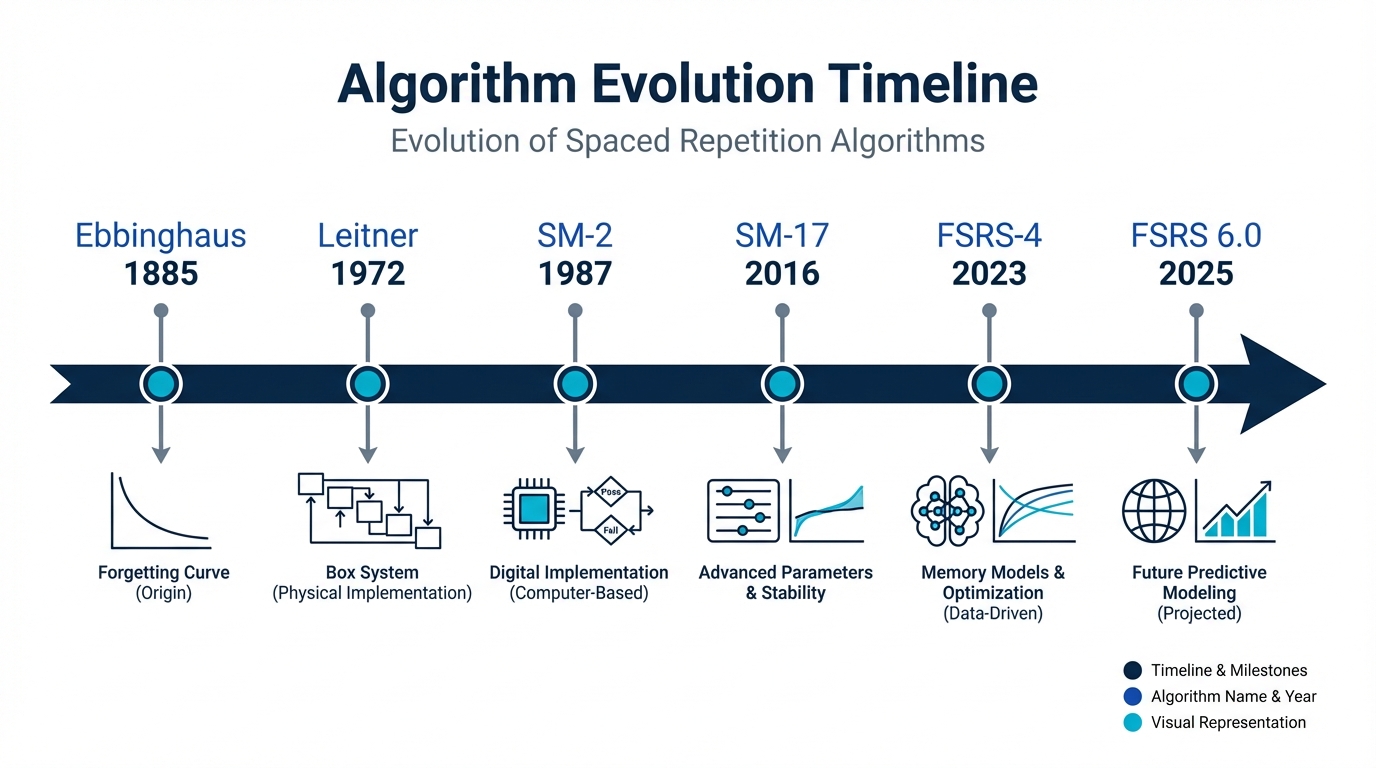
Forty years is a long run for software, and SM-2, developed in 1987, earned it: it still schedules reviews in many learning apps. Its limitation was that it did not leverage modern machine learning, so nothing it scheduled fed back into the next schedule.
FSRS was developed by Jarrett Ye (of MaiMemo Inc.) and achieves dramatic performance improvements by combining cutting-edge machine learning with insights derived from over 1.7 billion review records.
Five Revolutionary Features of FSRS 6.0
1. Fully Personalized Forgetting Curves
Traditional algorithms applied the same forgetting curve to every user. FSRS 6.0 introduces a new parameter (w20) that can generate a forgetting curve unique to you.
- The w20 parameter is adjustable within a range of 0.1 to 0.8
- For most users, it is optimized to below 0.2
- For the first time, the shape of the forgetting curve can differ for each individual
A curve unique to you requires fitting the parameters to your own reviews. Anki's built-in optimizer does this; Memly currently uses the same parameter values for all users.
2. Dramatically Improved Same-Day Review Accuracy
FSRS 6.0 models the shift from short-term to long-term memory explicitly, which is what lets it predict the effect of several reviews on the same day and time them.
- Parameters w17 and w18 control the impact of your grades (the rating you give each card, such as Again, Hard, Good, or Easy, after recalling it)
- Parameter w19 adjusts the rate of stability change
- Good/Easy ratings are guaranteed not to decrease stability
3. Overwhelming Prediction Accuracy: 99.6% Superiority
In benchmark testing, FSRS 6.0 demonstrated superior memory prediction accuracy for 99.6% of users compared to the traditional SM-2 algorithm. Even compared to FSRS-5, improvements were confirmed for 88.2% of users.
4. Three-Dimensional Memory Management with the DSR Model
FSRS 6.0 manages memory through three independent components:
- Difficulty: Tracks the inherent difficulty of each card on a scale of 1 to 10
- Stability: The time it takes for memory retention to drop from 100% to 90%
- Retrievability: The probability of successful recall at the current moment
Stability is measured in days, not confidence: a card at stability 40 has a 90% chance of coming back forty days from now.
5. Adaptive Parameter Optimization
FSRS 6.0 has twenty-one parameters that can be fitted to one person's review history. When and how that fitting runs depends on the app.
Memly currently uses the same parameter values for every user and calculates each card's schedule from that card's answer history.
Why Memly Chose FSRS 6.0
By adopting FSRS 6.0, the number of reviews needed to achieve the same retention rate is reduced by 20-30%. On an annual basis, this translates to savings of hundreds of hours of study time.
- Prevention of over-studying: Eliminates unnecessary reviews and reduces learner burden
- Optimal timing: Places reviews just before forgetting occurs, maximizing memory retention
- Difficulty adjustment: Calculates the optimal interval individually for each card
Real-World Use Cases
Results in Language Learning
When mastering 10,000 English vocabulary words, the difference compared to traditional methods is striking:
| Metric | Traditional Method | FSRS 6.0 (Memly) |
|---|---|---|
| Time Required | 2 hours/day x 18 months | 1.5 hours/day x 12 months |
| Total Study Time | Approx. 1,080 hours | Approx. 540 hours |
| Time Reduction | - | Approx. 50% |
The line to read is the total: the same 10,000 words in half the hours.
Application in Professional Exam Preparation
For professional certification exams such as bar exams and medical licensing exams, FSRS 6.0 is particularly effective in the following areas:
- Differentiated retention targets based on importance (e.g., constitutional law at 95%, commercial law at 85%)
- Efficient memorization of past exam question patterns
- Full-syllabus review in the final weeks, scheduled by predicted recall rather than by topic order
Scientific Basis: The Evolution of the Forgetting Curve
FSRS 6.0 represents the culmination of approximately 140 years of memory research:
| Year | Model | Approach |
|---|---|---|
| 1885 | Ebbinghaus Forgetting Curve | Exponential function model |
| 2022 | FSRS v3 | Improved exponential function |
| 2023 | FSRS v4-5 | Transition to power function |
| 2025 | FSRS 6.0 | Personalizable power function |
The FSRS 6.0 retrievability formula is a power function of the following form:
R(t,S) = (1 + FACTOR x t/S)^(-w20)Here, t is the elapsed time, S is the memory stability, FACTOR is a constant chosen so that R equals 90% when t equals S, and w20 is the decay parameter that, when fitted to one person's reviews, represents that individual's forgetting characteristics. This formula enables the evolution from a one-size-fits-all forgetting curve to one that can be optimized for each individual (Memly uses one shared value for every user).
Benchmark Results
These are the results of a large-scale validation using data from 20,000 Anki users. Log loss and RMSE measure prediction error, so lower is better. The rightmost column shows the share of users for whom FSRS-6 predicted recall more accurately than each algorithm:
| Algorithm | Log Loss | RMSE | Users where FSRS-6 wins |
|---|---|---|---|
| FSRS-6 | 0.30 | 0.052 | - |
| FSRS-5 | 0.33 | 0.058 | 88.2% |
| FSRS-4.5 | 0.34 | 0.061 | 92.1% |
| SM-2 | 0.41 | 0.089 | 99.6% |
Read the last column. An average gain can hide a minority who did worse; at 99.6% against SM-2, you are unlikely to be one.
Frequently Asked Questions
Is FSRS 6.0 actually better than traditional methods?
Yes, and the evidence is specific. A large-scale validation using data from 20,000 users showed that FSRS 6.0 outperforms the SM-2 algorithm in 99.6% of cases. On average, a 20-30% reduction in study time is achievable.
How much data is needed?
A minimum of 1,000 reviews is recommended for full optimization, but partial optimization is possible with as few as 400 reviews. Accuracy improves the more you use it. These figures apply to apps that fit the parameters to your own history, such as Anki's optimizer. Memly uses one shared parameter set, so it needs no warm-up data.
Can it be used for short-term cramming?
Yes, it can. Special parameter sets are available for short-term learning, supporting intensive study sessions before exams. However, standard spaced repetition is recommended for building long-term memory.
Conclusion
FSRS 6.0 in Memly changes what decides your review queue. Instead of one fixed interval ladder, each card's own answer history sets its timing through FSRS's 21-parameter model.
That moves studying from "keep repeating until it sticks" to reviewing each card at the point where recall is about to fail. Because almost none of those reviews land on cards you would have remembered anyway, the same hours cover more material, which is where the 20-30% reduction in study time comes from.
The FSRS development team is also considering more specialized versions, such as FSRS-F (which factors in fatigue) and FSRS-S (which specializes in short-term memory). Neither is finished; Memly will move when they are. The assumption they drop next will look as obvious in hindsight as the one 6.0 dropped: that your forgetting curve is everyone else's.
For how AI-powered memorization support works end to end, see our article "What Is AI-Powered Memorization Support? A Complete Guide to How It Works, Its Effectiveness, and the Best Tools." To learn how AI flashcard apps use algorithms like FSRS, read How AI Flashcard Apps Work. For a direct comparison between Memly and Anki, see Memly vs Anki.
