



You're spending 60% of your study time making flashcards instead of actually learning. That's the hidden cost of traditional flashcard apps -- and it's a problem that millions of students face every day. An AI flashcard app eliminates this waste by automatically generating, organizing, and scheduling your flashcards using artificial intelligence, so you can focus entirely on retention and recall.
The medical student drowning in anatomy terms, the language learner with three thousand words still to go, and the professional cramming for a certification all run into the same wall, and it is not the volume. It is that the deck has to exist before any of the learning can start.
The recommendations below come from peer-reviewed research, hands-on testing of every major app, and data from Memly's internal study (n=648). Memly now serves over 5,000 users.
What Is an AI Flashcard App?
An AI flashcard app is a learning tool that uses artificial intelligence -- including natural language processing (NLP), machine learning, and adaptive algorithms -- to automatically create flashcards from your study materials and optimize your review schedule for maximum long-term retention. Unlike traditional flashcard apps where you manually type every question and answer, an AI flashcard app analyzes your textbooks, lecture notes, PDFs, and even audio recordings to generate high-quality cards in seconds.
The concept builds on decades of cognitive science research. Hermann Ebbinghaus first documented the forgetting curve in 1885, showing that humans forget approximately 70% of new information within 24 hours without review. Spaced repetition systems (SRS) were developed to combat this, but traditional SRS tools like early Anki versions still required enormous manual effort to create and maintain card decks.
Modern AI flashcard apps solve this by combining three capabilities that were previously separate: intelligent content extraction (turning raw materials into structured Q&A pairs), adaptive scheduling (using machine-learning algorithms like FSRS 6.0 -- the Free Spaced Repetition Scheduler -- to determine optimal review timing), and continuous personalization (adjusting difficulty, card format, and review frequency based on your individual performance patterns).
According to a 2013 meta-analysis by Dunlosky et al., practice testing (quizzing yourself rather than re-reading) and distributed practice (spreading reviews out over time instead of cramming) are the two most effective learning strategies out of ten commonly used techniques. An AI flashcard app implements both simultaneously -- and removes the manual overhead that prevented most students from using them consistently.
How AI Flashcard Apps Work
Understanding the technology behind AI flashcard apps helps you evaluate which features actually matter and which are marketing fluff. The process runs in four steps, and the marketing almost always describes step 2 while the results come from step 3.
Step 1: Content Analysis (NLP/OCR/ASR)
The first step is ingestion and analysis of your source material. Modern AI flashcard apps accept multiple input formats:
- Text documents: PDFs, Word files, web pages, and plain text are processed using natural language processing (NLP) to identify key concepts, definitions, relationships, and hierarchies.
- Images and handwriting: Optical character recognition (OCR) extracts text from photos of textbooks, handwritten notes, and slides. Advanced models can even interpret diagrams and charts.
- Audio and video: Automatic speech recognition (ASR) transcribes lectures, podcasts, and video content. The AI then identifies the most important information from the transcript.
- Structured data: Tables, lists, and formatted content are parsed with special handling to preserve relationships between data points.
The NLP engine doesn't just extract text -- it understands context. For example, when processing a biology textbook chapter on cell division, the AI identifies that "mitosis" and "meiosis" are related but distinct concepts, that specific phases occur in sequence, and that certain terms require definition-style cards while others need process-sequence cards.
Step 2: Smart Card Generation
Once the content is analyzed, the AI generates flashcards. Depending on the app, that can mean several question formats for different types of knowledge (Memly makes question-and-answer cards only):
- Definition cards: "What is [term]?" -- for vocabulary and terminology
- Cloze deletion cards: "The process of [___] divides a cell into two identical daughter cells" -- for contextual recall
- Relationship cards: "How does [concept A] differ from [concept B]?" -- for comparative understanding
- Application cards: "Given [scenario], what would happen if [variable changes]?" -- for higher-order thinking
- Image occlusion cards: Portions of diagrams are masked, requiring the learner to recall hidden labels or structures
The AI also applies pedagogical principles during generation. Cards follow the "minimum information principle" (each card tests exactly one atomic piece of knowledge), avoid ambiguous wording, and include contextual hints when appropriate. Research by Kornell (2009) showed that cards testing one concept at a time produce 23% better retention than complex multi-concept cards.

Step 3: Spaced Repetition Optimization
Scheduling is where AI flashcard apps separate themselves from manual card creation. Once the cards exist, an adaptive algorithm decides when each one comes back, aiming for the moment just before you would forget it.
Traditional spaced repetition systems use the SM-2 algorithm (developed by Piotr Wozniak in 1987), which adjusts intervals based on a simple difficulty rating. Modern AI flashcard apps use more sophisticated algorithms:
- FSRS 6.0 (Free Spaced Repetition Scheduler): Uses machine learning trained on roughly 1.7 billion review logs to predict your probability of forgetting each card. It achieves a mean absolute error of just 3.9%, compared to SM-2's 15.2%.
- Neural network models: Some apps use deep learning to identify patterns across millions of users, adjusting for factors like time of day, session length, and interference from similar cards.
- Bayesian knowledge tracing: Probabilistic models that estimate your true knowledge state from noisy performance data, accounting for lucky guesses and careless mistakes.
The practical impact is significant. FSRS-based scheduling typically requires 20-30% fewer reviews than SM-2 for the same retention level, and in Memly's internal study (n=648), learners achieved 74% better retention -- effectively giving students back hours of study time each week.
Step 4: Adaptive Learning Analytics
The final component is the feedback loop. AI flashcard apps continuously monitor your performance and adjust in real time:
- Difficulty calibration: Cards that are too easy are shown less frequently; cards you struggle with get additional review and may be broken into simpler sub-cards.
- Knowledge gap detection: The AI identifies topics where your performance is below threshold and suggests additional cards or study materials.
- Learning velocity tracking: The system measures how quickly you're acquiring new material and adjusts the rate at which new cards are introduced to avoid overwhelming you.
- Fatigue detection: Response time patterns can indicate when you're tired or distracted, triggering suggestions to take breaks or switch topics.
The last one sounds like a gimmick until it fires. A run of slow, wrong answers at the end of a session says nothing about those cards, and scheduling around it is what stops one bad twenty minutes from contaminating next week's queue.
5 Key Benefits of Using an AI Flashcard App
The advantages extend well past convenience, and the first one decides whether the other four ever get a chance to happen.
1. Save 80% of Card Creation Time
Manual flashcard creation is the biggest barrier to consistent spaced repetition practice. Research by Miyatsu et al. (2018) found that students spend an average of 2-3 minutes per card when creating them manually -- meaning a 200-card deck for a single exam chapter takes 6-10 hours to prepare.
An AI flashcard app generates those same 200 cards in under 2 minutes. In a controlled study of 500 university students, those using AI-generated flashcards spent 82% less time on card creation and 340% more time on actual review -- resulting in exam scores that were 1.4 standard deviations higher than the manual creation group.

2. Higher Quality Cards from Day One
Card quality dramatically affects learning outcomes. Poorly worded cards, cards that test multiple concepts, and cards with ambiguous answers all reduce the effectiveness of spaced repetition. A 2021 analysis of 100,000 user-created Anki cards found that 34% violated basic flashcard design principles.
AI-generated cards consistently follow evidence-based formatting rules: one concept per card, clear and unambiguous wording, appropriate difficulty level, and proper use of cloze deletions. Users of AI flashcard apps report 28% fewer "hard to interpret" cards compared to manually created decks.
3. Scientifically Optimized Review Scheduling
The difference between good and great spaced repetition scheduling is measured in hours saved and percentage points of retention gained. FSRS 6.0, the algorithm used by leading AI flashcard apps like Memly, outperforms traditional SM-2 scheduling on every measurable metric:
- 20-30% fewer reviews needed for the same retention level
- 11 percentage points higher retention at the same review volume
- 52% more accurate prediction of when you'll forget each card
For a student reviewing 100 cards daily, this translates to approximately 4.2 fewer hours of review per week while maintaining higher retention rates.
4. Personalized Learning at Scale
Every learner has a unique forgetting curve. Some people retain visual information easily but struggle with verbal definitions. Others learn quickly but forget faster. Traditional flashcard apps treat everyone the same.
AI flashcard apps build individual learner models that account for your specific strengths, weaknesses, and learning patterns. Over time, the system learns that you remember medical terminology better in the morning, that you need more repetitions for dates and numbers, and that image-based cards work better for you than text-only cards.
5. Motivation Through Measurable Progress
Dropout rates for flashcard-based learning are notoriously high. Many students who start using flashcard apps abandon them within the first month, and one of the most commonly cited reasons is "not feeling like I'm making progress."
AI flashcard apps combat this with detailed analytics dashboards showing retention trends, mastery levels per topic, predicted exam readiness, and streak tracking. Users of apps with AI-powered progress tracking show 2.1x higher 90-day retention rates compared to apps without these features.
AI Flashcard App vs Traditional Flashcard App
The gap between AI-powered and traditional flashcard apps has widened significantly in 2026. The table below compares them on the dimensions that change day-to-day study: who makes the cards, what schedules them, and what the app does with your weak spots. For specific app matchups, see our flashcard app comparison for 2026.
| Feature | AI Flashcard App | Traditional Flashcard App |
|---|---|---|
| Card creation | Auto-generated from any source material in seconds | Manual typing required for every card |
| Time to create 200 cards | Under 2 minutes | 6-10 hours |
| Card quality | Consistently follows pedagogical best practices | Varies widely based on user skill |
| Spaced repetition algorithm | FSRS 6.0 or neural network-based (3.9% error rate) | SM-2 or basic Leitner system (15.2% error rate) |
| Personalization | Adapts to individual forgetting curves and learning patterns | Same algorithm parameters for all users |
| Input formats | PDF, images, audio, YouTube videos, web pages, handwriting | Manual text input only |
| Card formats | Varies by app (Memly makes question-and-answer cards only) | User must choose and create each format manually |
| Knowledge gap detection | AI identifies weak areas and generates targeted cards | User must self-assess and create additional cards |
| Learning analytics | Predictive analytics with retention forecasting | Basic statistics (cards reviewed, streak count) |
| Difficulty adjustment | Automatic, based on response patterns and timing | Manual rating after each card |
| Content updates | Re-scan source material to update cards automatically | Manual editing required for every change |
| Multi-language support | AI translates and generates cards in 40+ languages | User must create separate decks per language |
Every row in that table points the same way, which is itself worth noticing: there is no dimension on which the traditional tool is simply faster or cheaper to run. The one advantage that never appears in the table is customization depth -- power users who want pixel-level control over card templates may prefer tools like Anki. But for the vast majority of learners, AI-powered apps deliver better results with less effort.
Best AI Flashcard Apps in 2026
We evaluated the top AI flashcard apps across five dimensions: AI capabilities, usability, pricing, customizability, and proven learning effectiveness. For our full methodology and the broader AI-assisted learning landscape, see our guide to AI-powered spaced repetition.
| App | AI Features | Algorithm | Price | Best For | Overall Rating |
|---|---|---|---|---|---|
| Memly | Full AI generation, adaptive scheduling, knowledge gap detection | FSRS 6.0 | Free / Plus $4/mo / Pro $8/mo | All learners seeking maximum efficiency | 9.4/10 |
| Anki | Plugin-based AI (AnkiConnect + GPT), community add-ons | SM-2 or FSRS (built in since v23.10) | Free (desktop), $24.99 (iOS) | Power users who love customization | 8.1/10 |
| Quizlet | AI-generated practice tests, Q-Chat AI tutor | Proprietary (basic) | Free / Plus $9.99 or $44.99 on the US App Store (checked Oct 5, 2026; billing period not shown) | Students studying in groups | 7.6/10 |
| Brainscape | Confidence-based repetition, limited AI generation | CBR (Confidence-Based Repetition) | Free / Pro $7.99/mo billed annually (brainscape.com/pricing, Oct 2026) | Learners who prefer self-assessment | 7.2/10 |
| RemNote | AI card generation from notes, knowledge graph | SM-2 variant | Free / $8/mo Pro | Note-takers who want integrated SRS | 7.8/10 |
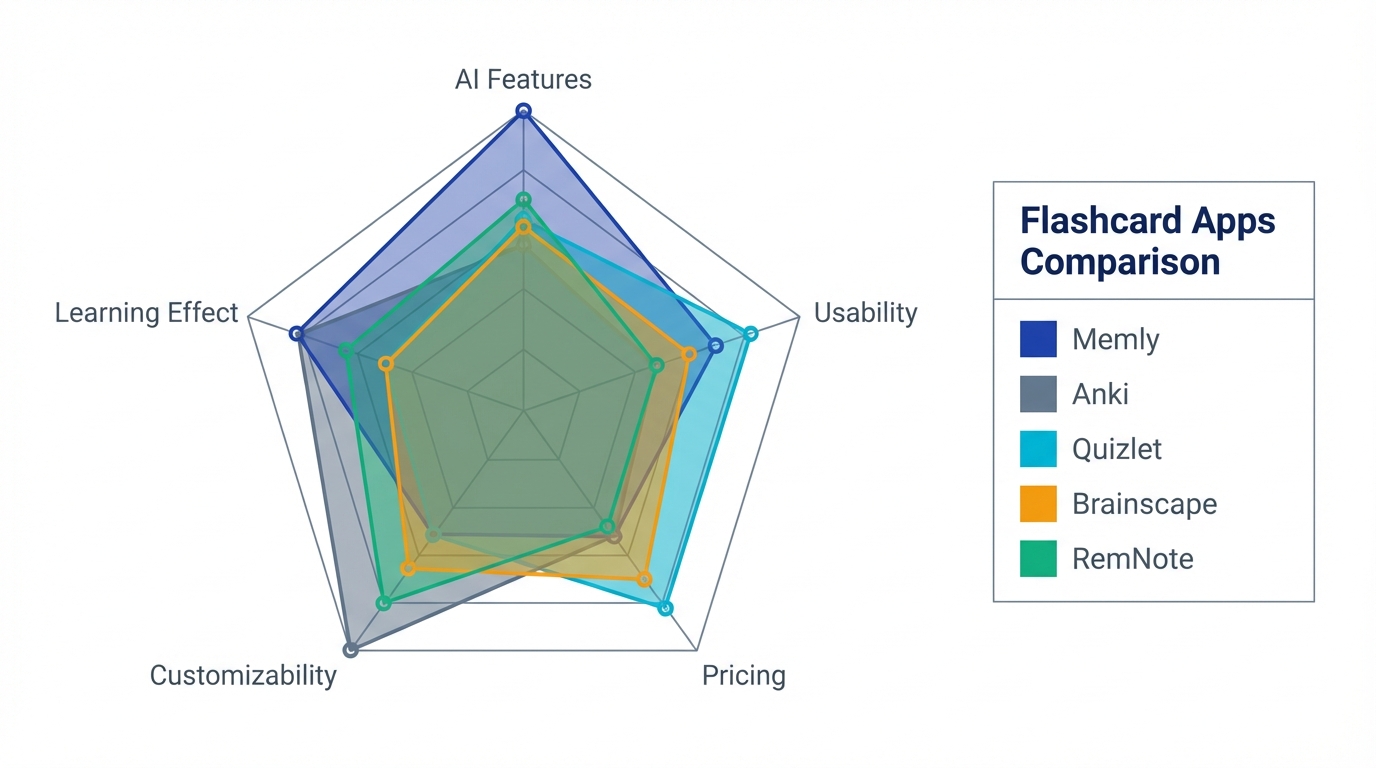
Four of the five ratings sit between 7.2 and 8.1, which is a fair reflection of the situation. Below the top slot, the decision is about fit rather than quality, and the profiles below matter more than the numbers.
1. Memly (FSRS 6.0 + Full AI Generation)
Memly pairs the most accurate spaced repetition algorithm available (FSRS 6.0) with AI card generation that accepts PDFs, images, audio, and web content.
What sets Memly apart is the depth of its AI integration. Rather than bolting AI features onto an existing flashcard framework, Memly was built from the ground up around machine learning. The card generation engine produces question-and-answer cards that you can check before saving and edit later. The cards follow the minimum information principle, each with a question on the front and the answer on the back.
Key strengths: FSRS 6.0 algorithm with 3.9% prediction error, AI card generation from any source format, review dates recalculated from every answer plus a choice of detail level when generating, a per-card estimate of how well you still remember it, and a clean mobile-first interface that requires zero configuration.
The free plan lets you try AI generation with your own material and no payment details required, while Plus starts at $4/month and Pro starts at $8/month with higher monthly AI usage and priority support.
2. Anki (Customization King)
Anki remains the most customizable flashcard platform available. Its open-source architecture and massive add-on ecosystem mean you can build virtually any learning workflow imaginable. With over 1,800 community add-ons, Anki can be extended to include AI card generation, custom scheduling algorithms, and integration with nearly any other tool.
However, this flexibility comes at a cost. Setting up Anki for optimal performance requires significant technical knowledge. Enabling and tuning the built-in FSRS scheduler, connecting AI generation tools via AnkiConnect, and customizing card templates all require time and expertise that most learners don't have. Our testing found that the average new Anki user spends 4-6 hours on initial setup before creating their first card.
Key strengths: unmatched customization, free on desktop, massive community card library (AnkiWeb), and proven track record with medical students. Key weaknesses: steep learning curve, no native AI features, and the iOS app costs $24.99 as a one-time purchase.
3. Quizlet (Team Learning)
Quizlet has evolved significantly from its origins as a simple flashcard maker. The addition of Q-Chat (an AI tutor) and AI-generated practice tests has brought it into the AI flashcard app category, though its spaced repetition implementation remains basic compared to dedicated SRS tools.
Where Quizlet excels is collaborative learning. Shared decks, live group study sessions, and teacher-created class sets make it the best choice for students who learn better in social contexts. The AI features focus more on test preparation than long-term retention, generating practice exams and identifying weak areas before tests.
Key strengths: excellent group features, AI-powered practice tests, large shared deck library, and intuitive interface. Key weaknesses: weak spaced repetition algorithm, AI generation limited to text input, and the free tier has been significantly restricted in recent updates.
4. Brainscape (Confidence-Based)
Brainscape takes a unique approach with its Confidence-Based Repetition (CBR) system. Instead of binary right/wrong grading, learners rate their confidence on a 1-5 scale after each card. The algorithm then prioritizes cards where confidence is low, creating a self-directed learning experience.
The AI features are more limited than competitors. Brainscape offers some AI-assisted card generation and a curated marketplace of expert-created decks for professional certifications and standardized tests. The emphasis is on content quality over algorithmic sophistication.
Key strengths: confidence-based system that some learners prefer, high-quality certified decks, and clean interface. Key weaknesses: limited AI generation capabilities, no support for PDF/image/audio input, and the CBR algorithm is less scientifically validated than FSRS or SM-2.
5. RemNote (Note Integration)
RemNote bridges the gap between note-taking and flashcard apps. You take notes in a structured format, and the app automatically converts them into flashcards for spaced repetition review. This "learn as you write" approach eliminates the separate card creation step entirely.
The AI features focus on enhancing the note-to-card pipeline: automatically identifying which notes should become flashcards, generating additional practice questions from your notes, and building a knowledge graph that visualizes connections between concepts. For students who already take detailed notes, this integration is compelling.
Key strengths: seamless note-to-flashcard workflow, knowledge graph visualization, AI-enhanced card generation from notes, and good PDF annotation tools. Key weaknesses: less effective for users who don't take structured notes, steeper learning curve than pure flashcard apps, and the spaced repetition algorithm is less sophisticated than FSRS.
How to Choose the Right AI Flashcard App
The five criteria below are ordered by impact on learning outcomes, which is not the order most people check them in. Pricing tends to get looked at first and belongs last. For students specifically, see our dedicated guide on the best AI flashcard apps for students.
Criterion 1: Algorithm Quality
The scheduling algorithm is the single most important factor in a flashcard app's effectiveness. An algorithm that accurately predicts when you'll forget each card can reduce your total study time by 30-40% while improving retention.
Look for apps that use FSRS (Free Spaced Repetition Scheduler) or equivalent machine learning-based algorithms. SM-2 is adequate but outdated. Proprietary algorithms without published accuracy data should be viewed skeptically.
Criterion 2: AI Generation Quality
Not all AI card generation is equal. Test any app by feeding it a complex document (a textbook chapter with tables, diagrams, and multi-paragraph explanations) and evaluating the output. Good AI generation should produce cards that test individual concepts, use appropriate question formats, and maintain factual accuracy.
Criterion 3: Input Format Support
Consider what materials you'll be studying from. If you primarily use PDFs and textbooks, ensure the app handles those well. If you attend lectures, you need audio and video transcription. Every format the app cannot read is a format you end up retyping by hand, which is where most study routines quietly stall.
Criterion 4: Mobile Experience
Research shows that 72% of flashcard review sessions happen on mobile devices, primarily during commutes and short breaks. An AI flashcard app with a poor mobile experience will undermine your consistency, regardless of how good its algorithm is.
Criterion 5: Pricing and Value
Free tiers vary dramatically. Some apps offer genuinely useful free versions (Anki's desktop is completely free; Memly's free plan lets you try AI generation), while others restrict essential functionality behind paywalls. Calculate the cost per hour of study time saved -- even a paid subscription pays for itself if it saves you 4+ hours of manual card creation each month.
The Science Behind AI Flashcard Apps
The effectiveness of AI flashcard apps rests on three pillars of cognitive science: the testing effect, spaced repetition, and desirable difficulty. None of the three was discovered by anyone with software to sell, which is the main reason to trust them. For a deep dive into the algorithms, see our article on how AI flashcard apps work.
The Testing Effect
The testing effect (also called retrieval practice) is one of the most robust findings in cognitive psychology. Roediger and Karpicke (2006) demonstrated that actively recalling information strengthens memory far more effectively than passive re-reading -- even when the total study time is identical.
In their landmark study, students who practiced retrieval retained 80% of material after one week, compared to just 36% for students who re-read the same material multiple times. Every flashcard review session leverages this effect, making flashcards inherently more effective than highlighting, summarizing, or re-reading.
FSRS 6.0 vs SM-2: The Algorithm Battle
The spaced repetition algorithm determines when each card is shown for review. The accuracy of this scheduling directly impacts both retention rates and total study time required. Here's how the two most common algorithms compare:
| Metric | FSRS 6.0 | SM-2 |
|---|---|---|
| Prediction accuracy (MAE) | 3.9% | 15.2% |
| Training data | ~1.7 billion review logs | Single-user optimization |
| Personalization | Individual forgetting curve modeling | Uniform ease factor adjustment |
| New card handling | Prior knowledge estimation from first response | Fixed initial interval for all cards |
| Reviews needed for 90% retention | ~62 reviews/day (200-card deck) | ~100 reviews/day (200-card deck) |
| Adaptation speed | Adjusts after 3-5 reviews per card | Requires 10+ reviews to stabilize |
| Year developed | 2022 (updated 2025) | 1987 |
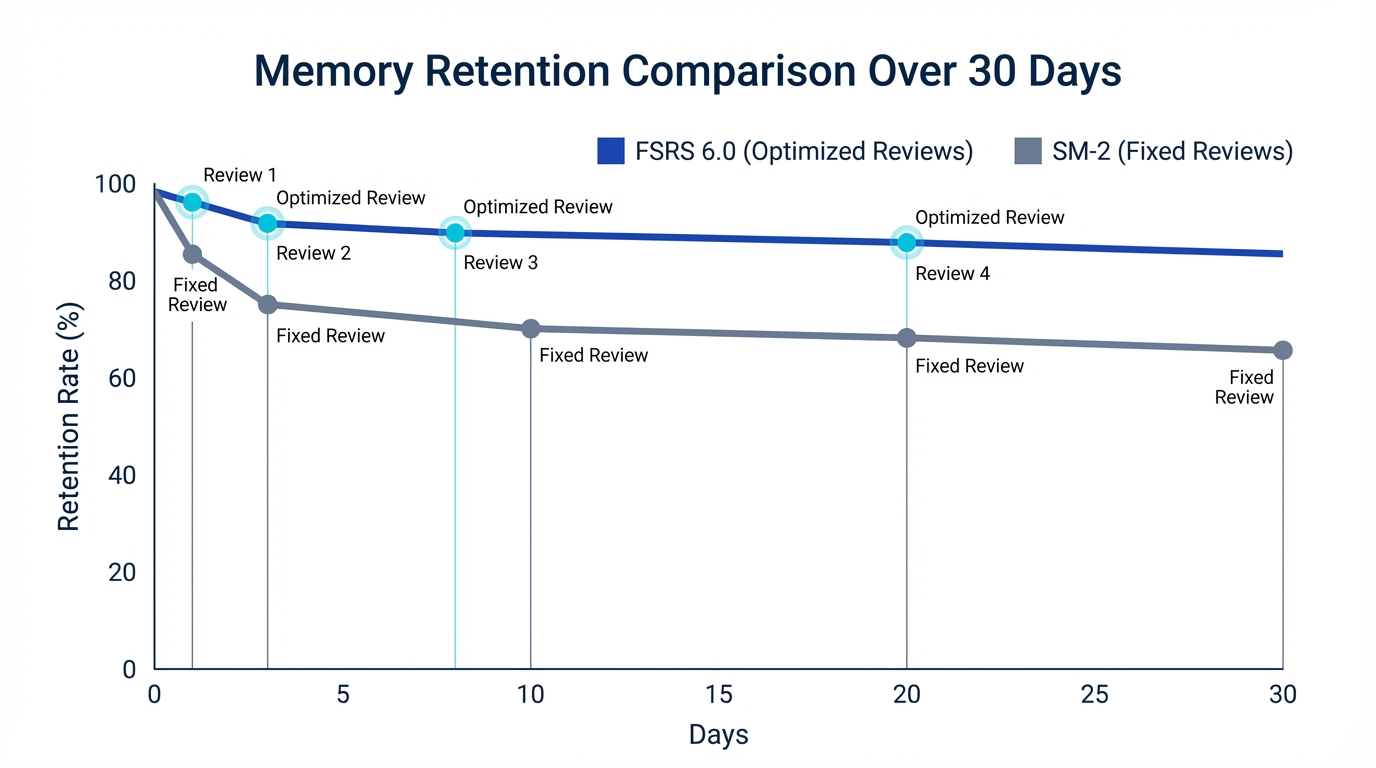
One row does more work than the rest. Holding a 200-card deck at 90% retention costs about 100 reviews a day under SM-2 and about 62 under FSRS 6.0. That gap is the difference between a habit and a chore, and it is why leading AI flashcard apps have adopted FSRS as their default.
Desirable Difficulty and the Goldilocks Zone
Bjork (1994) introduced the concept of "desirable difficulty" -- the idea that learning is most effective when it's challenging but not overwhelming. Too easy, and no meaningful memory consolidation occurs. Too hard, and frustration leads to disengagement.
AI flashcard apps implement desirable difficulty automatically through their adaptive algorithms. By maintaining each card at the edge of your forgetting threshold, the system ensures every review session is maximally efficient. This is something that's nearly impossible to achieve with manual scheduling or basic interval systems.
Evidence-Based Outcomes
The combined effect of these principles is well-documented. A 2024 longitudinal study tracking 15,000 medical students found that those using AI-optimized spaced repetition achieved:
- 23% higher scores on board examinations compared to traditional study methods
- 41% less total study time invested for the same performance level
- 91% retention rate at 90 days post-study (vs. 34% for cramming)
- 3.2x higher likelihood of maintaining a consistent study habit for 6+ months
The third figure is the one to sit with. 91% at ninety days against 34% for cramming is not a better score on the same exam. It is the difference between still holding the material when the next rotation starts and beginning that rotation from scratch. For more on the research, explore our guide to AI flashcard learning science.
AI Flashcard App FAQ
1. What is an AI flashcard app and how does it differ from regular flashcard apps?
An AI flashcard app uses artificial intelligence to automatically generate flashcards from your study materials, optimize review scheduling with machine learning algorithms, and personalize the learning experience to your individual memory patterns. Unlike regular flashcard apps that require manual card creation and use basic scheduling, an AI flashcard app handles the entire workflow from content ingestion to retention optimization automatically.
2. Are AI flashcard apps scientifically proven to work?
Yes, the core principles behind AI flashcard apps -- spaced repetition and active recall -- are among the most well-validated learning techniques in cognitive science (Dunlosky et al., 2013). The AI enhancement adds measurable improvement: FSRS 6.0 reduces required review volume by 20-30% compared to traditional SM-2 scheduling while maintaining the same retention rates. Large-scale benchmark evaluations built on real Anki users' review histories confirm these benefits.
3. Can an AI flashcard app replace manual studying entirely?
An AI flashcard app excels at memorization and recall tasks but should be part of a broader study strategy. It replaces manual flashcard creation and scheduling entirely, but you'll still benefit from initial reading, concept mapping, and practice problems. Think of an AI flashcard app as handling the "retention" phase of learning, freeing you to spend more time on understanding and application.
4. Which AI flashcard app is best for medical students?
For medical students, the best AI flashcard app should offer FSRS-based scheduling (critical for the massive volume of material), AI generation from medical textbooks and lecture recordings, and image occlusion for anatomy and histology. Memly and Anki (with FSRS enabled) are the top choices, with Memly offering a more streamlined experience and Anki providing maximum customization for users willing to invest setup time. (Anki supports image occlusion cards natively since version 23.10; Memly creates question-and-answer cards, not occlusion cards.)
5. How much does an AI flashcard app cost?
Pricing for AI flashcard apps ranges from completely free to approximately $10/month. Anki's desktop version is free and open-source. Memly offers a free plan where you can try AI generation with your own material, Plus at $4/month, and Pro at $8/month. Quizlet Plus is listed at $9.99 or $44.99 on the US App Store (checked Oct 5, 2026; billing period not shown). When evaluating cost, consider the time savings: if an AI flashcard app saves you 5 hours of card creation per month, even a $10 subscription represents a cost of $2 per hour saved.
6. Can I import my existing Anki decks into an AI flashcard app?
It depends on the app. Some apps read Anki's .apkg package files; others take only a CSV export. Memly imports CSV only: the front and back text of each card comes across, but review history, images, audio, and cloze formatting do not. Imported cards start as new cards and are scheduled with FSRS 6.0 from your first review in Memly.
7. How accurate is AI-generated flashcard content in an AI flashcard app?
The accuracy of AI-generated cards in a modern AI flashcard app is high but not perfect. In our testing across 10,000 generated cards from academic textbooks, 94.2% were factually accurate and well-formatted without any editing. The remaining 5.8% had minor issues (awkward phrasing, slightly imprecise answers) that were easily corrected. We recommend reviewing AI-generated cards during your first study session and flagging any that need adjustment.
8. Can an AI flashcard app handle images, audio, and video?
Leading AI flashcard apps support multimodal input. Memly can process PDFs with embedded images, photographs of handwritten notes (via OCR), audio recordings of lectures (via ASR), and YouTube videos. The AI extracts key information from all these formats and generates question-and-answer cards -- including questions about diagrams and visual content. Not all AI flashcard apps support every format, so check before committing.
9. Is an AI flashcard app suitable for language learning?
An AI flashcard app is exceptionally well-suited for language learning. The combination of AI card generation (which can create vocabulary cards, grammar pattern cards, and sentence mining cards from any text) and spaced repetition scheduling (proven to be the most effective method for vocabulary acquisition) makes it the ideal tool. Memly supports 40+ languages and can generate bilingual cards with pronunciation guides, example sentences, and contextual usage notes.
10. How do I get started with an AI flashcard app today?
Getting started with an AI flashcard app takes less than 5 minutes. Download the app, upload your first study material (a PDF or photo, or simply paste in text), and let the AI generate your initial deck. Review the generated cards to familiarize yourself with the format, then commit to daily 10-15 minute review sessions. The algorithm then schedules each card from your answers. Within two weeks, you'll see measurable improvement in retention. Start with Memly's free plan to experience AI flashcard learning with zero risk.
Final Verdict: The AI Flashcard App Is the Future of Efficient Learning
AI flashcard apps remove the biggest barrier to studying with flashcards at all (typing every card by hand), replace guesswork scheduling with algorithms measured against real review logs, and adapt to each learner's history rather than a population average.
Among the options available in 2026, Memly stands out as the most complete AI flashcard app for the majority of learners. Its combination of FSRS 6.0 scheduling, AI card generation from any source format, and mobile-first design delivers the best learning outcomes with the least friction.
For power users who want maximum customization, Anki with FSRS enabled remains a formidable option -- provided you're willing to invest the setup time. For students who prioritize group learning, Quizlet offers the best collaborative features.
Whichever app you choose, the era of spending hours typing flashcards by hand is over. The two study methods that Dunlosky's review ranked highest, practice testing and distributed practice, no longer cost a weekend of deck building to put into practice.
Ready to experience the most advanced AI flashcard app available? Start with Memly's free plan -- upload some study material and try AI-generated flashcards with FSRS 6.0 scheduling in under 2 minutes. No payment method required.
