



"No matter how many times I review, I can't remember." "The knowledge I crammed before the exam vanishes immediately." AI technology combined with cognitive science offers a groundbreaking solution to these common learner frustrations. Memly's flashcard learning system has achieved a 74% improvement in memory retention compared to traditional methods.
74% is the kind of number that invites suspicion. It comes from changing when the reviews happen, not from anything about the cards themselves.
Why Traditional Memorization Is Inefficient
Conventional study methods fail for a measurable reason. According to the "forgetting curve" discovered by German psychologist Hermann Ebbinghaus in 1885, humans forget learned information at a surprisingly rapid rate.
| Time Elapsed | Retention Rate | Forgetting Rate |
|---|---|---|
| After 20 minutes | 58% | 42% |
| After 1 hour | 44% | 56% |
| After 1 day | 33% | 67% |
| After 1 week | 25% | 75% |
| After 1 month | 21% | 79% |
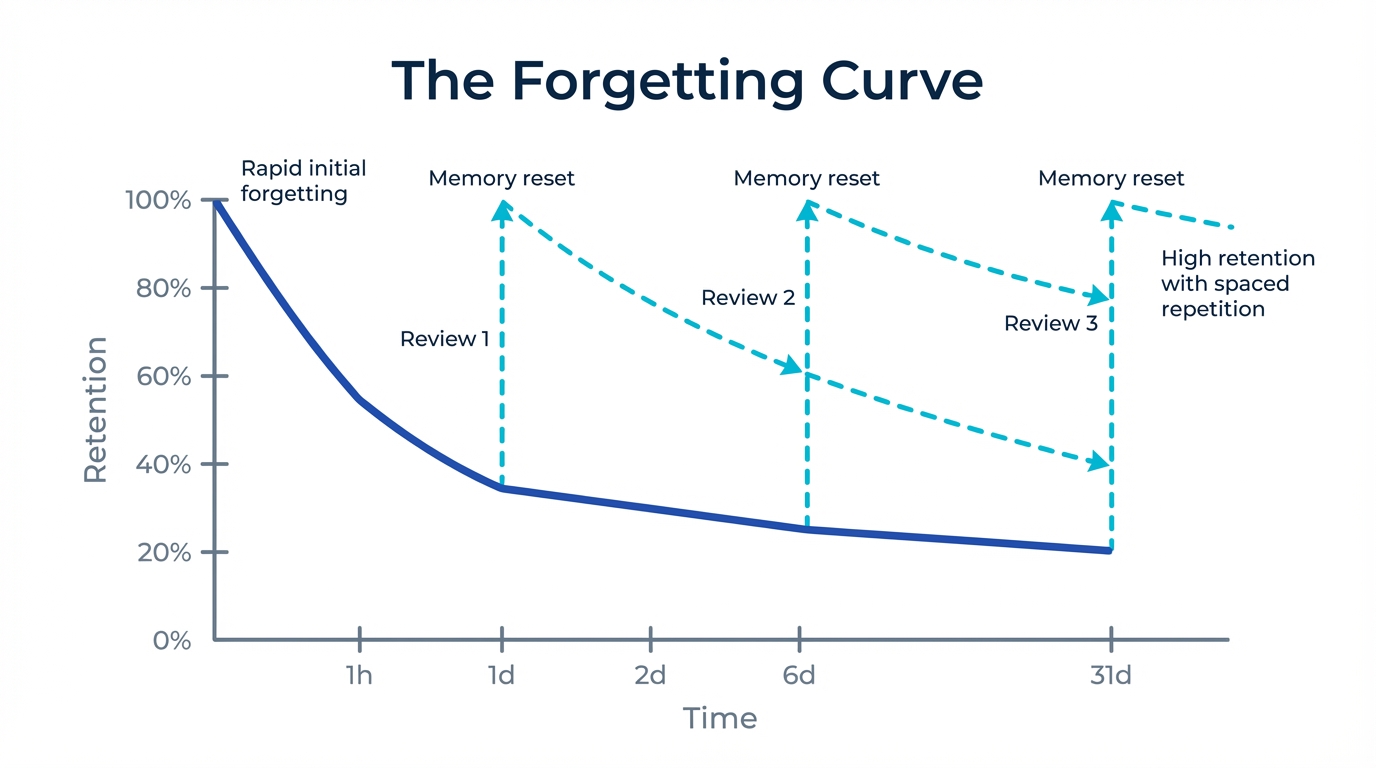
The first row is the one that stings. 42% is gone in twenty minutes, before the desk is even packed up, and about 80% has followed within a month. Summary notes and a second pass through the textbook are more input, and the curve describes what happens to input.
How Spaced Repetition Overcomes the Forgetting Curve
The most effective method for combating the forgetting curve, established in cognitive science, is spaced repetition.
It gradually extends the intervals between reviews. Reviewing at the "optimal moment" just as memory begins to fade is what lifts retention.
Spaced repetition is one of the most reproducible evidence-based learning techniques in cognitive psychology, grounded in approximately 200 years of research on long-term memory formation.
Why Reviewing at the Moment of Forgetting Is So Effective
Why would waiting help? Every instinct says to go over it again while it is still fresh. Three mechanisms explain why the instinct is wrong: the testing effect, desirable difficulty, and reconsolidation.
- Testing Effect: The act of trying to recall information itself strengthens memory. Actively retrieving information is more than three times as effective as simply reviewing it.
- Desirable Difficulty: Reviewing when some effort is required strengthens the neural pathways of memory. Reviews that are too easy are a waste of time.
- Memory Reconsolidation: Each time a memory is recalled, it is reconstructed and converted into more stable long-term memory.
Which is why the review that feels worst is doing the most work.
How AI Optimizes Review Timing
Whether spaced repetition works has never been the hard part. Working out when and what to review is. Done by hand across a few hundred cards, it becomes a second job.
Traditional Methods vs. AI Optimization
| Aspect | Traditional Methods | AI Optimization (Memly) |
|---|---|---|
| Review Timing | Fixed intervals (1 day, 3 days, 7 days) | Dynamic calculation based on each card's answer history |
| Difficulty Adjustment | Self-reported | FSRS sets each card's next review from its answer history |
| Study Order | Random or sequential | Prioritized based on forgetting probability |
| Personalization | None | Reflects each card's answer history (parameters shared by all users) |
| Prediction Accuracy | Low | Industry-leading accuracy with FSRS 6.0 |
The FSRS 6.0 Algorithm Used by Memly
Memly uses the spaced repetition algorithm FSRS 6.0 (Free Spaced Repetition Scheduler). FSRS 6.0 is a predictive model that combines machine learning with cognitive science insights, trained on over 1.7 billion review records.
Thanks to this algorithm, it is now possible to retain approximately 20-30% more information in the same study time compared to the traditional SM-2 algorithm (Anki's default; Anki has had FSRS built in since 23.10).
How Memly Puts AI Flashcards into Practice
Step 1: Automatic Card Generation from Your Content
Memly's standout feature is its ability to automatically generate high-quality flashcards from your learning materials using AI.
- PDF/Text: Simply upload your textbooks or notes, and key points are extracted to create Q&A-format cards
- Images: Charts, diagrams, and handwritten notes are recognized and converted into appropriate questions
- YouTube: The captions of a lecture video are read, and key points are turned into questions
The card-making step drops out of the evening. What is left is the upload, a scan through what came back, and then the reviewing, which was always the only part building memory.
Step 2: AI-Optimized Review Schedule
FSRS 6.0 calculates the forgetting probability for each card in real time and presents reviews at the optimal timing. Cards you learn easily have their intervals extended, while difficult cards are reviewed more intensively.
Step 3: Visualize Your Progress with a Dashboard
A dashboard that shows your learning progress, retention rates, and upcoming reviews at a glance helps you maintain motivation while studying efficiently.
What Memly User Data Shows
Memly now serves over 5,000 users. The following results come from Memly's internal study (n=648):
| Metric | Result |
|---|---|
| Memory Retention Improvement | +74% (compared to traditional study methods) |
| Study Time Reduction | -32% (time needed to acquire the same amount of knowledge) |
| Learning Continuity Rate | 89% (active rate after 30 days) |
| Average Daily Study Time | 15 minutes (short focused sessions are most effective) |
The last row is what makes the first three plausible. These are not the numbers of people studying harder, but of people studying fifteen minutes a day on a schedule they did not have to work out.
Use Case Guide by Scenario
Professional Exam Preparation (TOEIC, Bar Exam, Medical Licensing)
For certification exams that require efficiently memorizing large volumes of specialized terminology and regulations, AI flashcards are particularly impactful. Simply uploading textbooks or past exam PDFs enables focused study on the most frequently tested topics.
Language Learning
Vocabulary, grammar rules, and example sentences are turned into flashcards and reviewed at optimal intervals based on the forgetting curve. Compared to traditional vocabulary books, you can acquire approximately twice the vocabulary in the same study time.
Programming Education
Programming also involves many elements that require memorization, such as API references, design patterns, and commands. AI automatically generates questions from technical documentation, helping you retain knowledge that is ready for real-world use.
Getting Started in 3 Steps
- Create an account (30 seconds, no payment method required)
- Upload your study materials (supports PDF, text, and images)
- Start learning with AI-generated cards (feel the difference with just 15 minutes a day)
On the free plan, you can try AI card generation with your own material and no payment details required. Give it a try and experience the difference for yourself.
Conclusion
AI flashcard learning is a scientific answer to Ebbinghaus's forgetting curve. The curve itself does not move. What changes is that something is now watching it card by card and picking the day.
Which brings this back to where it started. "No matter how many times I review, I can't remember" is rarely about the number of reviews. It is about their timing. Fifteen minutes tomorrow, on cards the schedule picked, is the cheapest way to find out.
For a full overview of AI-powered memorization support, see our article "What Is AI-Powered Memorization Support? A Complete Guide to How It Works, Its Effectiveness, and the Best Tools." For a walkthrough of the available AI flashcard apps, see our complete AI flashcard app guide. For the best AI flashcard apps for students, see our top picks for every budget.
