


Playlist queued, headphones on, study session started. An hour later, what stuck was not the vocabulary list but the chorus of track four. If that stings, part of your study hour flowed away with the music, and because it felt pleasant and focused, the loss repeats itself every day without ever being noticed.
That does not make "never study with music" the right rule either.
The short version: it depends on the task. Music with lyrics competes with any work that runs on language, like memorizing terms or reading dense text. Routine review of cards you already know tolerates music far better. So: silence or ambient sound for new verbal material, familiar instrumentals for light review, and one fixed song as a start-up ritual on low-motivation days.
Why studying with music feels so productive
The genuine benefits of music are mood and boredom relief. A good track lowers the barrier to sitting down, softens the grind of repetitive work, and masks distracting café chatter. In that sense, "I study better with music" is often true, for showing up.
The trouble is that feeling good and remembering well are different outcomes. Pages flowing by smoothly does not mean the content is being stored, a gap known as the fluency illusion, and a pleasant soundtrack makes the whole session feel smoother still. So the honest answer has to be drawn task by task rather than from how the hour felt.
Why lyrics hurt memorization specifically
The logic is simple. Memorizing terms, reading a textbook, writing an essay: these jobs run on your brain's language machinery. Lyrics are also language, streaming in through your ears, and the brain cannot simply decline to process words it hears. Two streams of words end up competing for one channel.
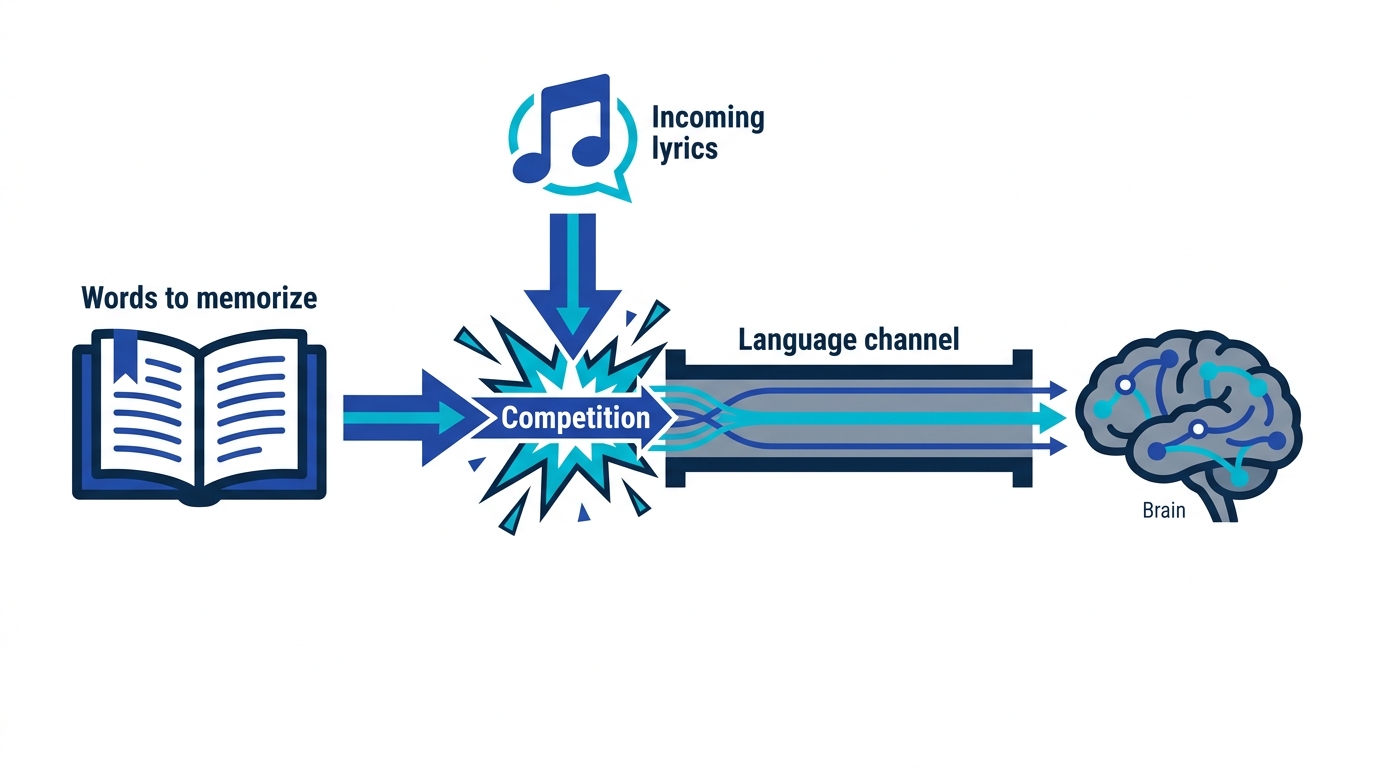
Solving math sets, copying diagrams, flipping through well-learned flashcards: these lean less on the language channel, so music collides with them far less. This is why testimonials disagree so sharply. "Music tanked my grades" and "music never hurt me" are both true, about different tasks.
And the famous claim that listening to Mozart makes you smarter? Safe to let go. A brief mood lift is the most you can count on, so picking the right task beats picking the right composer.
Task by task: should this be a music session?
| Task | Music call | Why |
|---|---|---|
| New memorization, dense reading, writing | Silence or ambient sound | The language channel should be all yours |
| Reviewing known cards, routine drills | Instrumentals are fine | Little verbal collision |
| Math practice, diagram drills | Your choice | Mood and boredom relief usually win |
| Cannot get started at all | Exactly one fixed song | Use it as a launch ritual, then cut it |
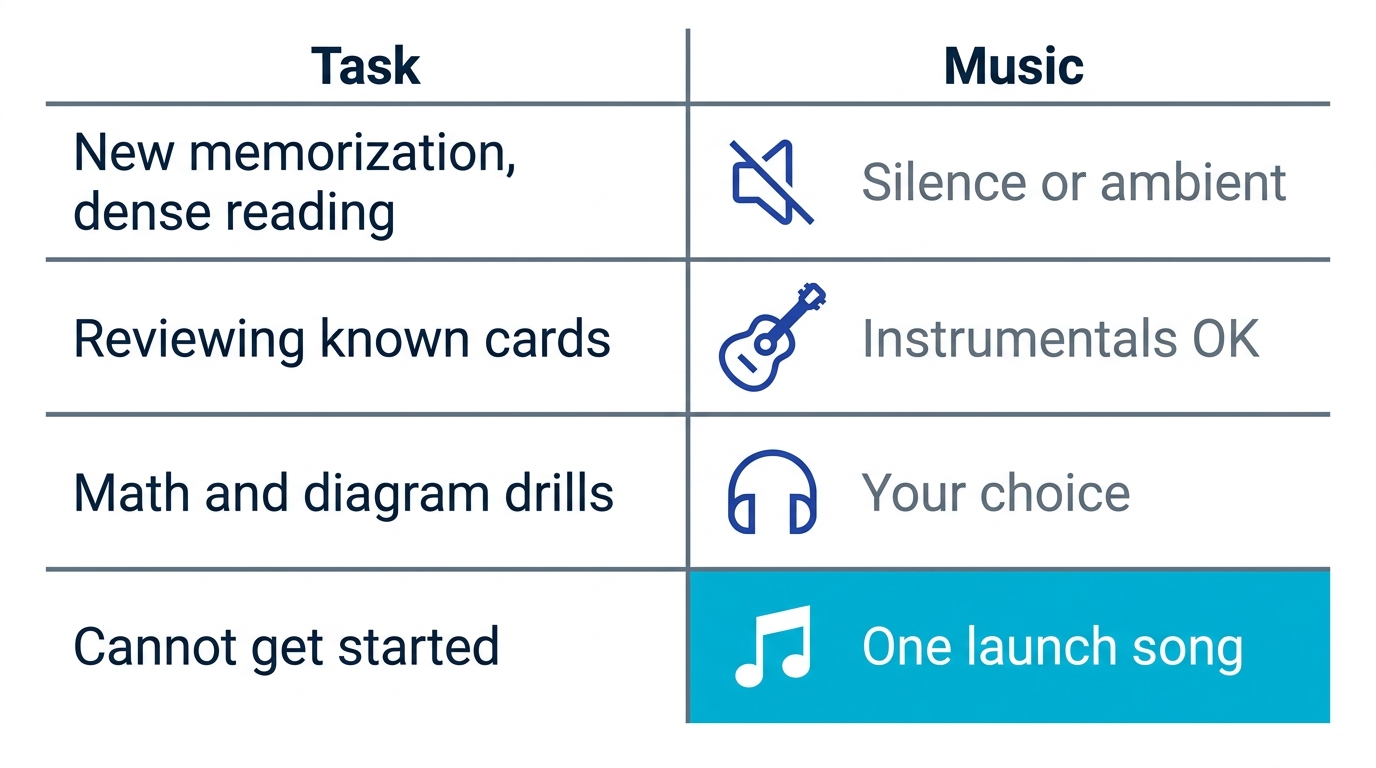
When in doubt, one question settles it: "Will I need to recall this material from a blank page later?" Yes: mute it. No: enjoy the music.
The smartest use of music is before studying, not during
Music's biggest contribution to your grades happens in the sixty seconds before the books open. Pick one song and decree: when this plays, I sit down. The song becomes a switch that deletes the deciding, and deciding is what low-motivation days die of (more on that in Why You Can't Start Studying).
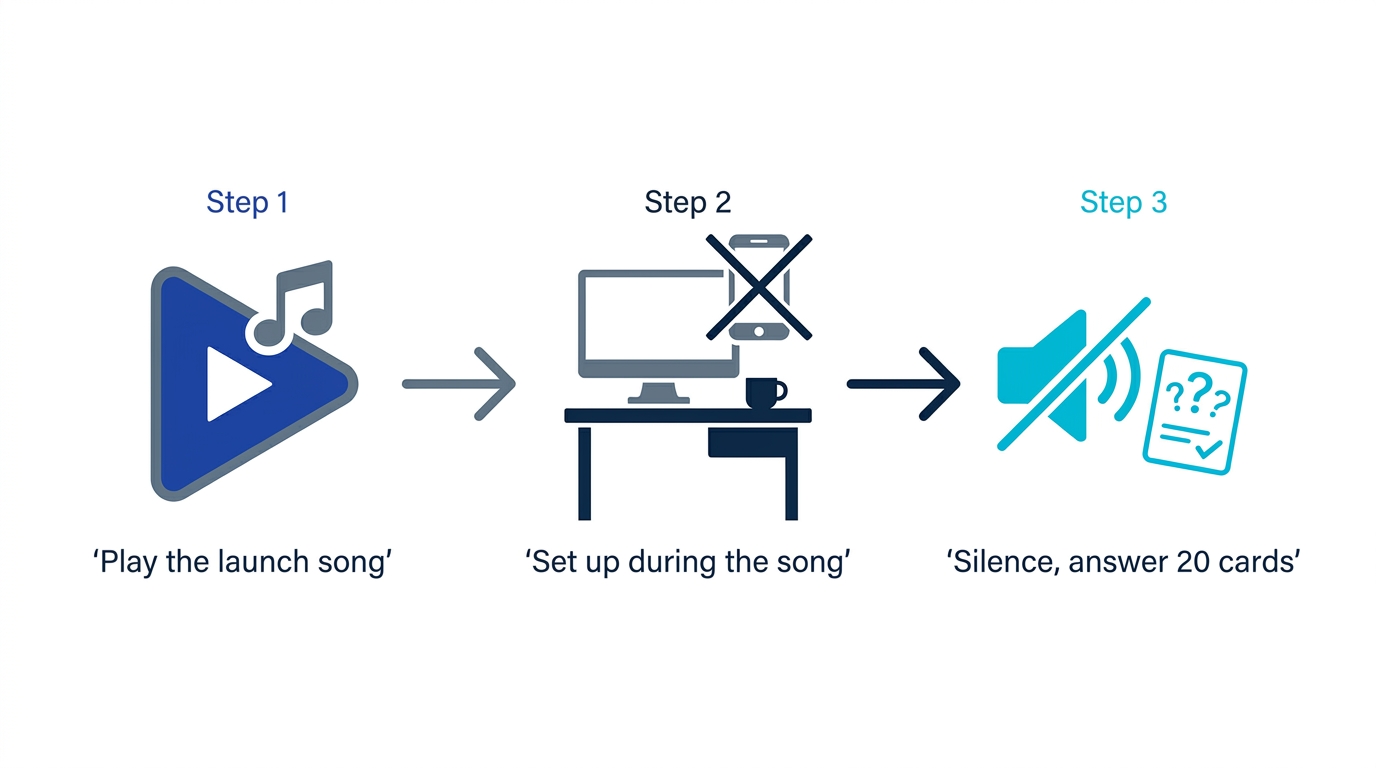
- Choose one launch song: a single track, not a playlist.
- Set up during the song: desk cleared, materials out, phone in another room (see Is Your Phone Ruining Your Studying?).
- When it ends, go silent and start tiny: answer 20 due cards.
Want something in your ears? Make it your review
If silence feels lonely but lyrics steal your focus, there is a third option: replace the music with your own review material. Memly's Review Radio turns your due flashcards into a two-host audio show, so a commute or a sink full of dishes becomes retrieval practice instead of background listening.
- At the desk: silence for new material, instrumentals for light review.
- On the move: Review Radio in your ears (see Review Radio: Listen to Your Flashcards).
- Cards build themselves: AI generates them from photos, PDFs, or text.
For the focus system around all this, see Can't Focus While Studying?, and for the full picture of AI-assisted memorization, the pillar guide AI-Assisted Memorization: How It Works and the Best Tools.
Run one experiment today
Most readers will queue the same playlist tomorrow, because comfortable habits defend themselves. But a single comparison will tell you more than any article: thirty minutes of memorization in silence versus your usual soundtrack.
Try it once today: play your launch song, then take the headphones off and answer 20 cards in silence. If what stays with you afterward is the vocabulary rather than the chorus, you have your answer. Music is not the enemy of studying; it is just usually in the wrong seat. Memly is free to try, no credit card required.
