


Time at a desk is not always focused study time. If your attention keeps drifting, try a shorter block with one clear task and a planned break. A 25-minute timer is a starting point to adjust, not a concentration standard everyone must meet.
The usual response is to try harder tomorrow. But attention does not decay out of weakness, and trying harder does not make it last longer than it lasts. What can change is how the time is cut up, and what happens in the first two minutes of each piece: a recall warmup.
The short version: design around the fact that focus does not last. Split study into 25-minute cycles with 5-minute breaks, and spend the first 2 minutes of every cycle recalling the previous cycle from memory. That warmup jump-starts concentration and doubles as spaced review.
Why long sessions degrade into "just reading"
Attention is a depleting resource. The longer you push a single unbroken session, the more your brain drifts toward the cheapest available activity, and the cheapest activity in studying is rereading: passively running your eyes over the page. Seat time keeps growing while thinking time quietly shrinks.
Worse, it still feels like studying. That is the fluency illusion at work: text flowing smoothly past your eyes reads as progress. The second half of most marathon sessions lives inside this illusion.
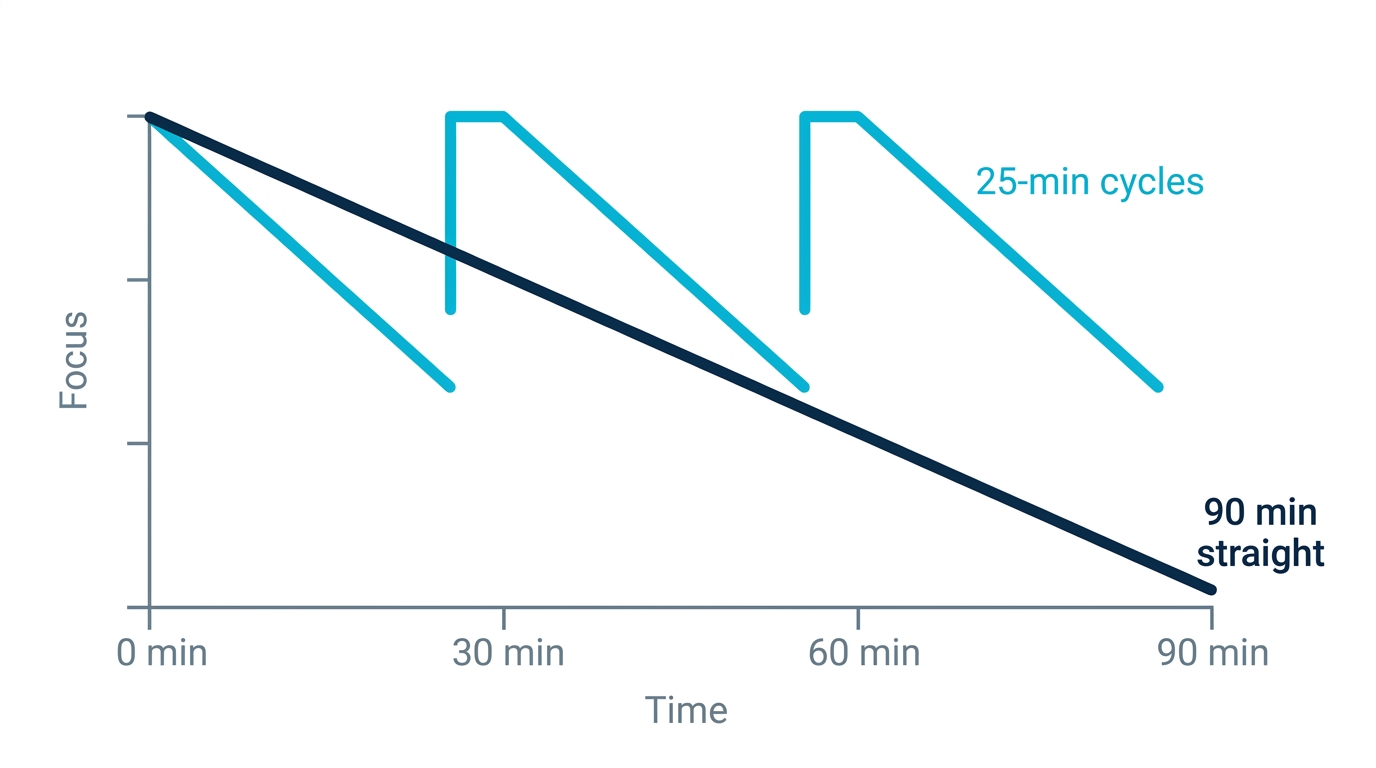
The 25-minute cycle done right: a retrieval boundary, not a kitchen timer
The 25-plus-5 time-boxing pattern, popularly known as the Pomodoro technique, is famous, but most people use it as a mere timer. The upgrade is to make the first 2 minutes of each cycle a blank-page recall of what the previous cycle covered.
- First 2 minutes: recall warmup: write down, without looking, what you learned in the previous cycle (or yesterday).
- 23 minutes: focused work: new input or problem solving.
- 5 minutes: actually leave: stand up, get water. Do not open social media; that break never ends on time.
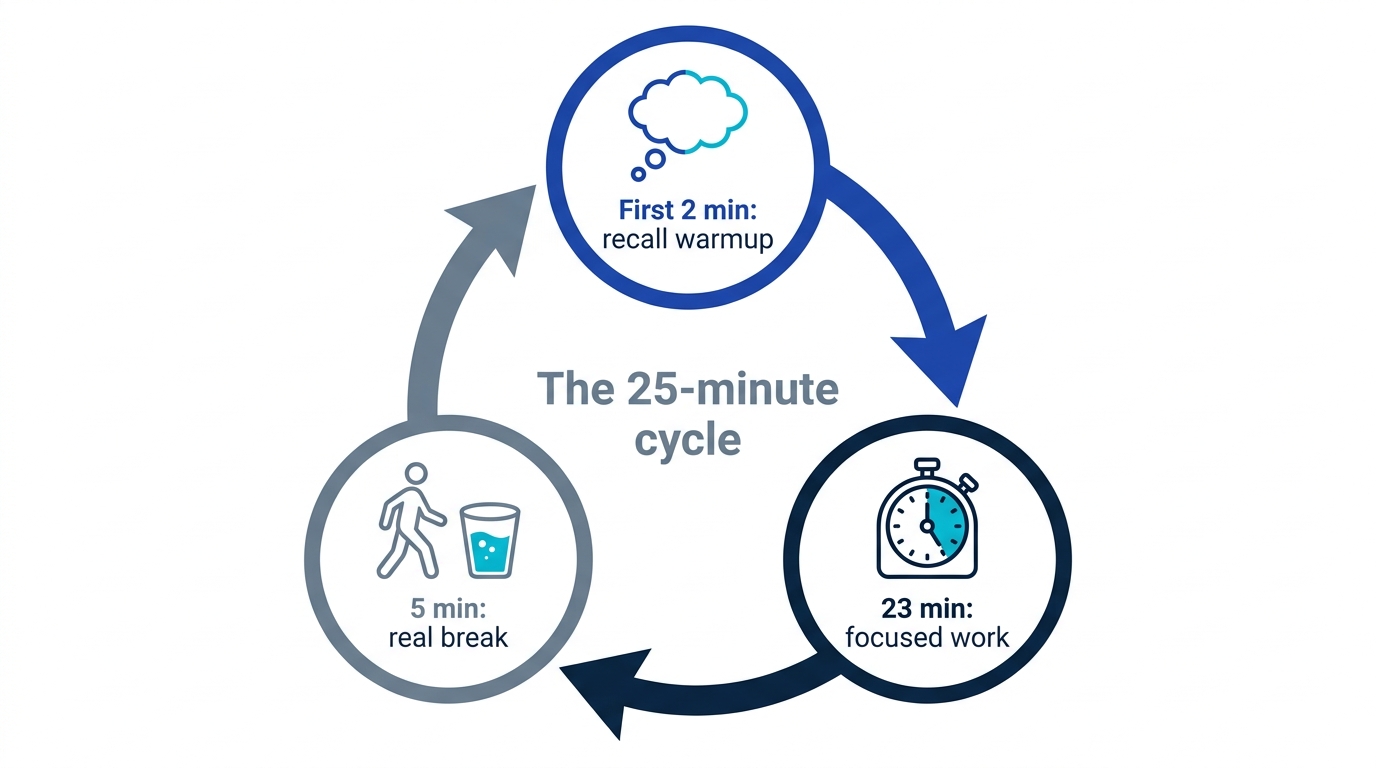
The 2-minute warmup does two jobs. First, recalling cannot be done passively, so it forces the brain to boot up in active mode instead of easing in through ten minutes of rereading. Second, each cycle's recall is itself retrieval practice, and retrieving is what strengthens the memory. Day to day, your card reviews then add the spacing layer on top: Cepeda and colleagues' 2006 meta-analysis showed that separating reviews in time improves retention.
Same 90 minutes, two different outcomes
Ninety minutes is ninety minutes, and breaks subtract from it. The objection is fair until you count what each version leaves behind.
| 90 minutes straight | 3 x 25 min + recall warmups | |
|---|---|---|
| Quality of focus | Degrades into eye-sliding by the second half | Resets at every cycle |
| Retrieval attempts | Zero (input only) | At least two (start of each cycle) |
| What survives to tomorrow | A feeling of having studied | The material you managed to write from memory |
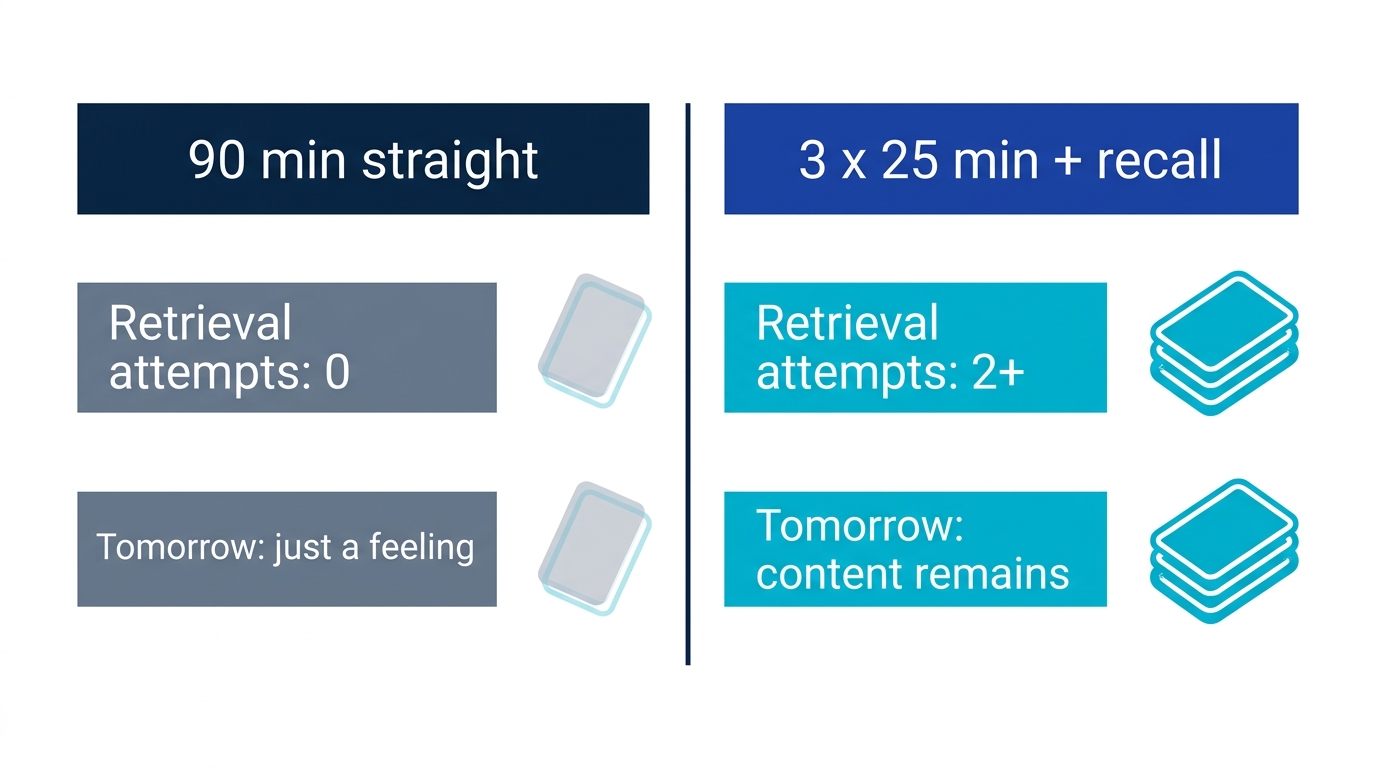
Count the retrieval attempts. Ninety unbroken minutes contain zero.
One more enemy of the cycle: your phone. Even sitting silent within sight it keeps pulling at your attention, so during deep cycles it belongs in another room. Full environment design is covered in Is Your Phone Ruining Your Studying?.
Let Memly serve the first question of every cycle
The weak point of the recall warmup is deciding what to recall; stall there and the cycle never starts. Memly automates the ignition:
- Warmup = answering due cards: the FSRS spaced repetition algorithm picks exactly the cards you are about to forget, so you start retrieving with zero decisions.
- Card your material the same day: photos, PDFs, or pasted text become question-and-answer cards automatically.
- Web, iOS, and Android: study on the laptop, reboot each cycle from your phone.
The science of when to review is in The Forgetting Curve and the Best Time to Review, and the full picture of AI-assisted memorization is in the pillar guide AI-Assisted Memorization: How It Works and the Best Tools.
Change only the first 25 minutes of today's session
Try one 25-minute block with a clear task, followed by a real break. If the block is too long or too short for the work, adjust it. Check what you completed or recalled, not just whether the timer ran to the end.
One action: before opening your materials today, spend 2 minutes writing down what you remember from last time. That alone changes the quality of the first cycle. Memly is free to try, no credit card required.
