


You finish the chapter and feel like you understand it. Then a classmate asks, "Wait, how does that actually work?" and nothing coherent comes out. Every hour you studied while merely feeling like you understood is an hour that quietly converts into lost points on exam day, because exams never ask whether something felt familiar. They ask you to produce it.
The study method that turns "can I explain this?" into a test you run on yourself, before the exam does it for you, is the Feynman Technique, named after the physicist Richard Feynman. It also has a weakness its fans rarely mention, and that is where most of its value leaks out.
The short version: the Feynman Technique is a four-step study method: (1) pick one concept, (2) explain it in plain words as if teaching a beginner, (3) mark exactly where you stumble, and (4) simplify and try again. Explaining is retrieval practice in disguise, and the stumbles map your gaps precisely.
What is the Feynman Technique? The 4 steps
The method is almost embarrassingly simple. Each step, though, catches a different kind of self-deception:
| Step | What you do | What it catches |
|---|---|---|
| 1. Pick | Choose one concept and write it at the top of a blank page | Vague scope |
| 2. Teach | Explain it in plain words, as if to a beginner, no jargon allowed | Memorized terms hiding missing understanding |
| 3. Mark the stumbles | Note every spot where you hesitate, hand-wave, or reach for jargon | The exact coordinates of your gaps |
| 4. Simplify and retry | Go back to the source, fill the gap, explain it again more simply | Whether you actually fixed it |
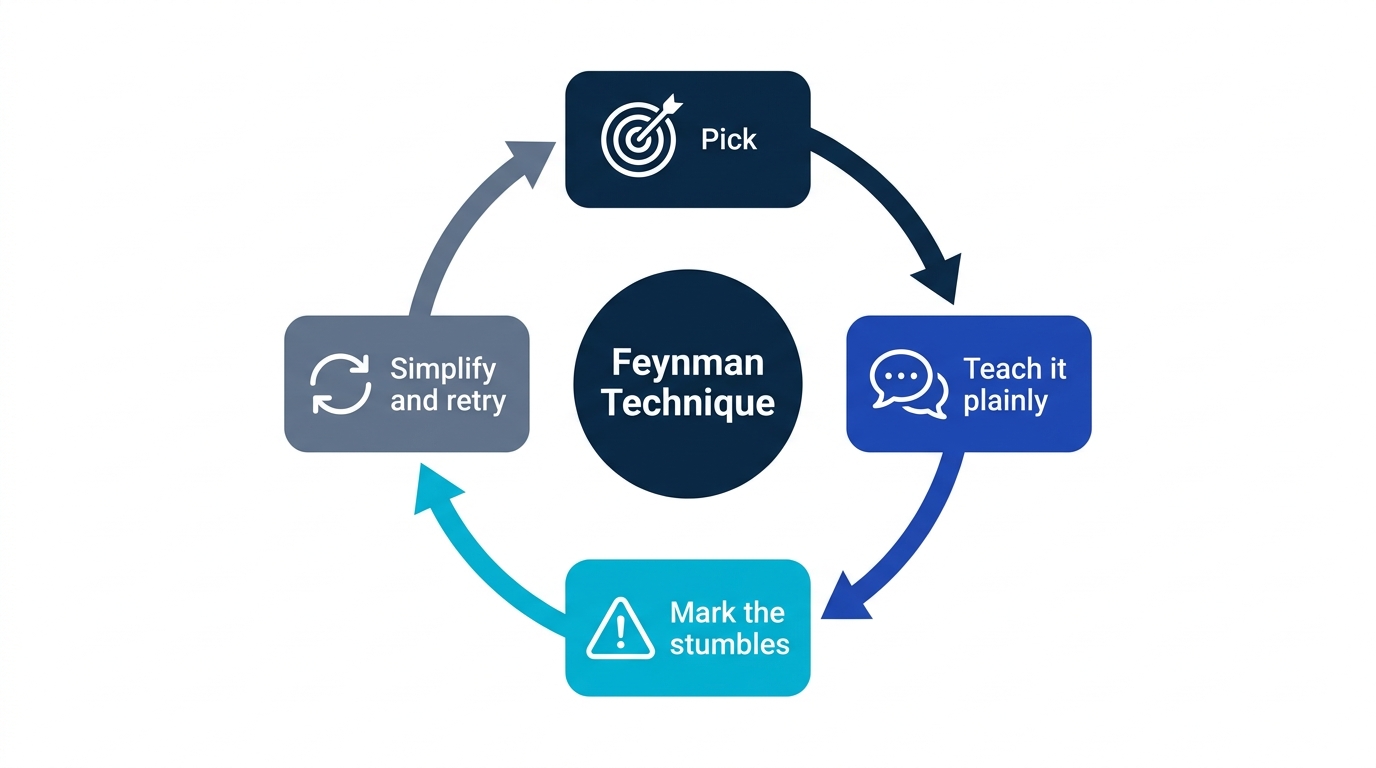
The load-bearing rule is "as if to a beginner." The moment jargon is allowed, your brain recites terminology instead of demonstrating understanding. Strip the jargon away and there is nowhere left to hide.
Why does teaching something help you learn it?
Two reasons. First, explaining is retrieval practice wearing a different outfit. Reconstructing an idea in your own words, with the book closed, puts the same productive strain on memory as a blank-page test. Rereading never forces that effort; explaining makes it unavoidable.
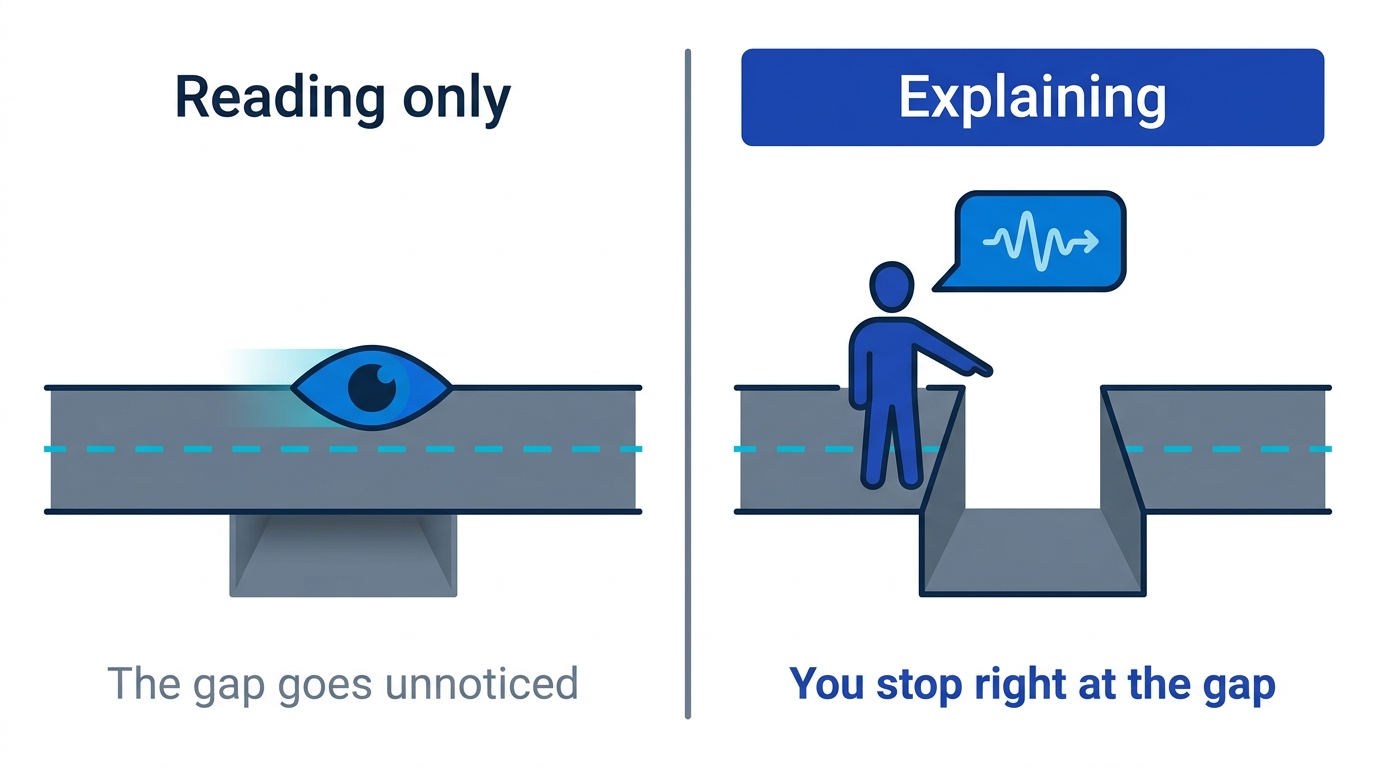
Second, the stumbles give you exact coordinates for your gaps. Textbooks read smoothly, and that smoothness creates the fluency illusion: the feeling of knowing without the substance of it. An explanation, by contrast, halts the instant it passes over a hole. Few methods locate what you do not know this precisely. Why You Forget What You Read explains why smooth reading fools you in the first place.
The honest weakness: found gaps reopen if nothing maintains them
So why is anyone still rereading? Two limits, and the second one is expensive:
- It is slow: explaining one concept properly takes several minutes. Covering an entire syllabus with nothing but Feynman passes is not realistic.
- It has no maintenance layer: a concept you could explain today still fades along the forgetting curve. The Feynman Technique is a gap detector, not a memory-retention system.
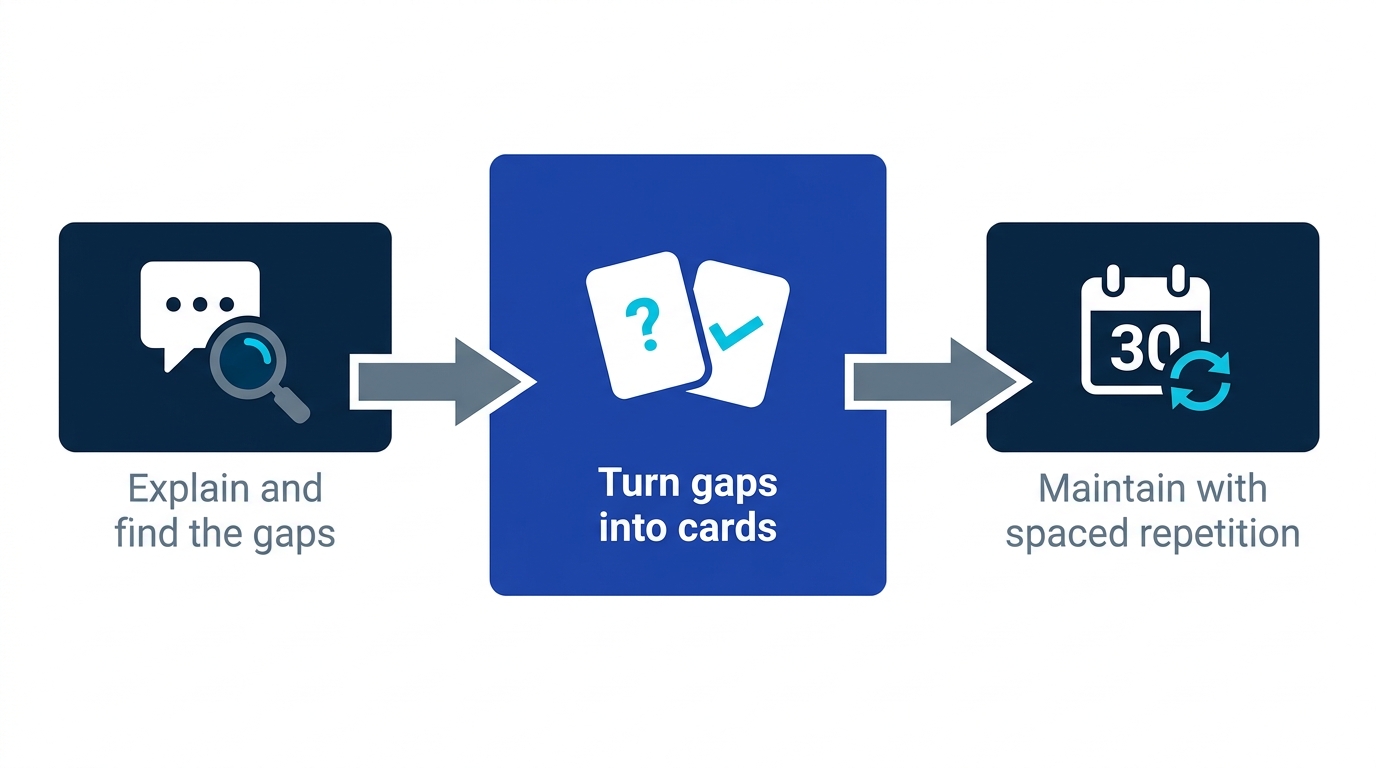
So pair it. Every gap the explanation exposes becomes a question-and-answer card on the spot. An "explain X to a beginner" card is the Feynman Technique folded into a single flashcard, and spaced repetition then demands a fresh explanation right around the time you would forget. How to write cards that actually stick is covered in How to Write Good Flashcards.
How to start today: one concept per day
- Pick one concept from today's studying: whatever felt most important is fine.
- Write or say a jargon-free explanation: blank page or phone notes, five-minute limit.
- Patch only the stumbles, then card them: no need to redo everything. The stumbles are the day's harvest.
If your hours are going in but scores are not coming out, this one-concept-a-day explanation is the smallest possible dose of output practice. See Studying Hard but Not Improving? for the full diagnosis.
Memly automates the maintenance half
- Card the gap on the spot: photograph the page or paste the text where you stumbled, and AI turns it into question-and-answer cards, including "explain this" formats.
- FSRS schedules the re-explanations: each explanation card resurfaces just as it starts to fade. In our internal study (n=648), this spaced-repetition loop improved retention by 74%.
- Web, iOS, and Android: write explanations at your desk, re-explain from your phone on the train.
For the full picture of AI-assisted memorization, see the pillar guide AI-Assisted Memorization: How It Works and the Best Tools.
Spend the last five minutes of today's session teaching
Most readers will nod at "teach it to learn it" and go right back to silent rereading tomorrow. They agree with the idea; they never actually explain anything. The difference surfaces on exam day, when producing an explanation is exactly what is asked.
Just the last five minutes of today's session: pick the most important concept and explain it with no jargon. Wherever you stumble, that is your next point gained. And if you want the stumbles carded and maintained automatically, Memly is free to try, no credit card required.
