


Right now, while you read this, the cards in your review queue are quietly sliding from "I can recall this" to "gone." Forgetting does not wait for you to sit at a desk. It happens during the round-trip commute, the ten minutes at the sink, the seven-minute walk to the station. Add those up and most people lose an hour a day of perfectly good study time. That is not laziness. Spaced repetition has always demanded the one thing those moments do not have: your eyes and your hands.
Memly's new feature, Review Radio, removes that constraint. It takes the cards that are due for review and turns them into a short two-host conversation, an audio episode you can listen to like a podcast. You press play; the rest of today's review happens through your ears, hands-free, whether you are driving, walking, or doing the dishes.
Review Radio is a Memly feature that turns the spaced-repetition cards due for review into a 5-, 10-, or 15-minute two-host audio episode you listen to like a podcast. You press play and review hands-free on a commute, walk, or workout, with no screen and no card flipping, while the AI prioritizes the cards you're about to forget.
What Review Radio is: today's review, as an episode you listen to
Review Radio automatically gathers the flashcards that are due for review and edits them into a 5-, 10-, or 15-minute audio episode. It is not a robotic text-to-speech read-aloud. Two hosts talk to each other naturally ("Do you remember this one?" … "Right, the answer is …"), so the material arrives as a conversation, not a list. If you have ever listened to NotebookLM's Audio Overview, the format will feel familiar: your own material, turned into a show.
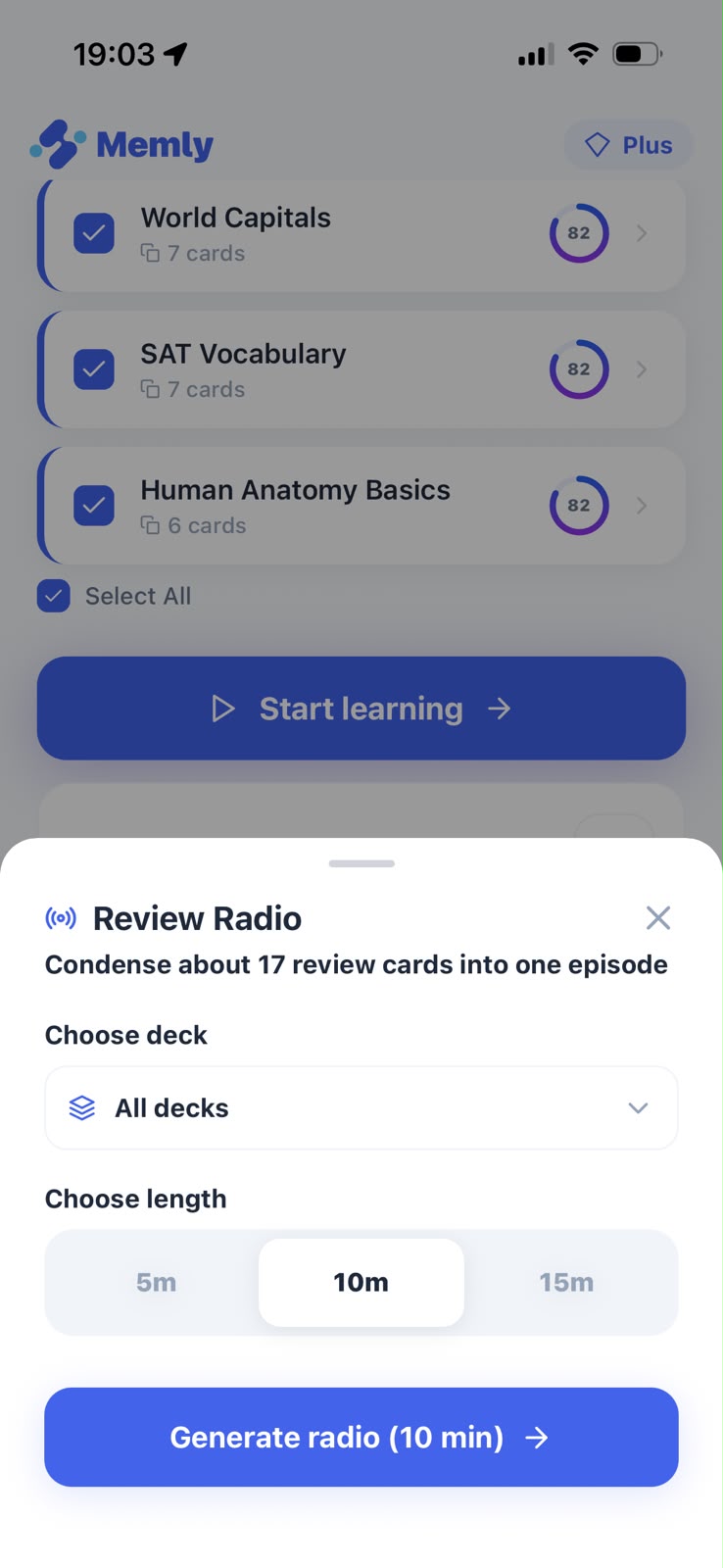
The interaction is simple. Pick a deck (or "All"), choose a length (5, 10, or 15 minutes), and tap Generate. The episode is built on the server, so you can close the app or lock your phone and the generation keeps running. There is nothing to wait around for.
Why hands-free review was impossible before
Spaced repetition is one of the most thoroughly validated learning methods in memory science. Yet most people's review queues keep piling up, and the cause is structural rather than motivational. Traditional review demands four things at once: you (1) take out your phone, (2) look at the screen, (3) flip the card, and (4) tap to grade yourself. That means your eyes, your hands, and a quiet few minutes, all simultaneously.
But the "free time" most working adults actually have is precisely the time when their eyes and hands are occupied. You are holding a rail on a packed train, walking, driving, cooking, folding laundry. So the real situation is not "I have no time." It is "I have time, but almost none of it can be used for screen-based study."
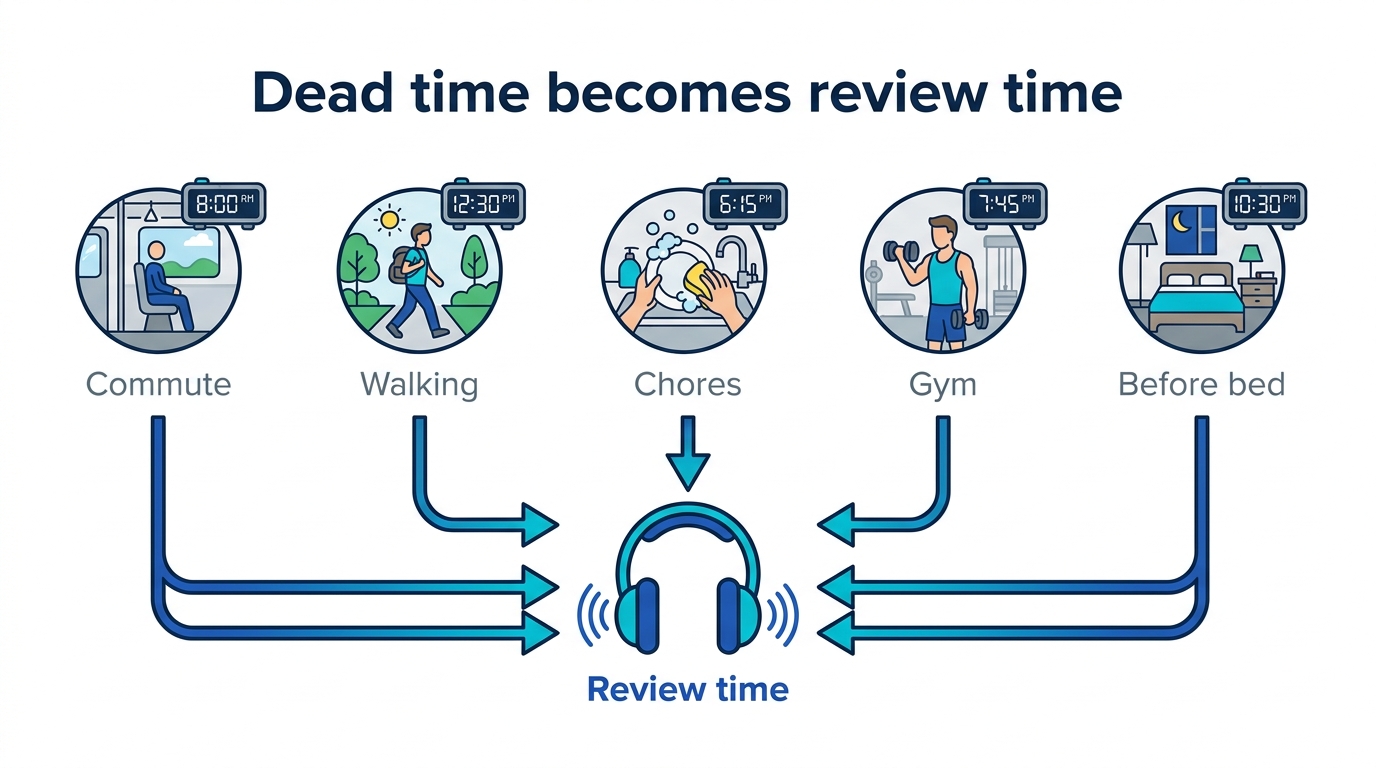
Review Radio turns that whole category of screen-unusable time into review time. The moments when only your ears are free are exactly where it does its best work. For the broader case on why these in-between minutes are so valuable, see our guide on studying during your commute.
How it works: AI picks the cards you're about to forget
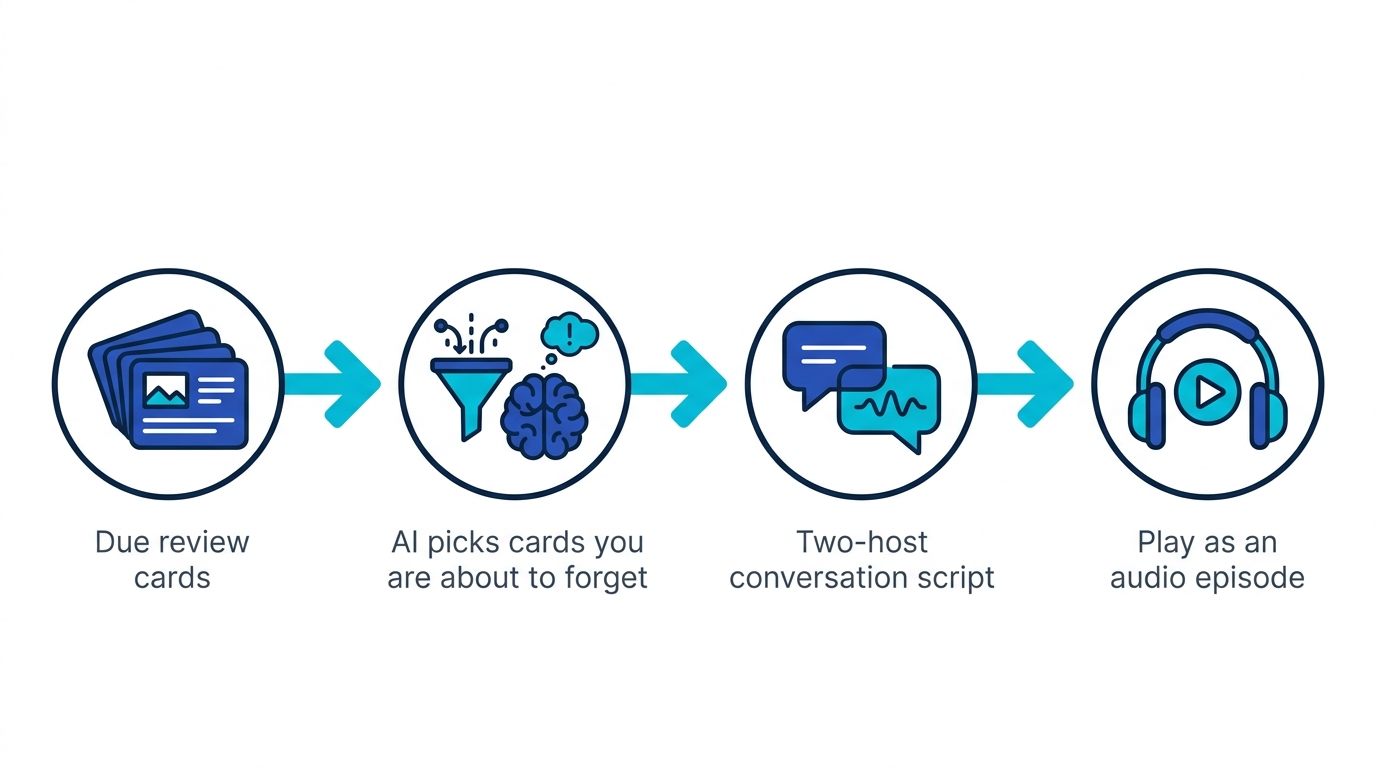
What you hear is not a straight read-out. Before it becomes an episode, your review passes through three automatic stages.
1. It prioritizes the cards you're about to forget
The first stage is choosing which cards go into the episode. From the cards that are due, Review Radio prioritizes the ones where your retrievability is dropping, that are overdue, that you've missed repeatedly, and that you find difficult. It picks them up roughly in "about-to-be-forgotten" order, aiming for the steep part of the forgetting curve, where recall still takes effort and each minute of review therefore buys more retention. It also mixes multiple decks into a single cross-deck episode, so you can review vocabulary, anatomy, and bar-exam rules together in one show.
2. It writes a two-host script from your card facts only
Next, the AI writes a script for two hosts based on the selected cards. The script is built from only the facts written on your cards, with no outside information added. Related cards are woven together into one coherent explanation, so you get a connected conversation rather than a flat recitation of flashcards.
3. It records with two native voices
Finally, the script is performed by two distinct native voices. Review Radio supports English, Japanese, Korean, and Chinese, with hosts who speak each language with natural delivery. Episodes are split into chapters and come with an auto-generated title and summary describing the topics. Because the feature avoids cards used in the last few days and in recent episodes, each show comes out a little different, so you don't get the same episode on repeat.
Not just listening: a recall pause is built in
The biggest knock on audio learning is that passive listening skips the act of recalling. Review Radio handles this by design. Before a host reveals the answer, the episode leaves a short pause for you to recall it yourself. That turns passive listening into active recall: you pull the answer out of your own head first, and that retrieval effort is what strengthens the memory trace. We look at why that pause matters so much in does audio learning actually work.
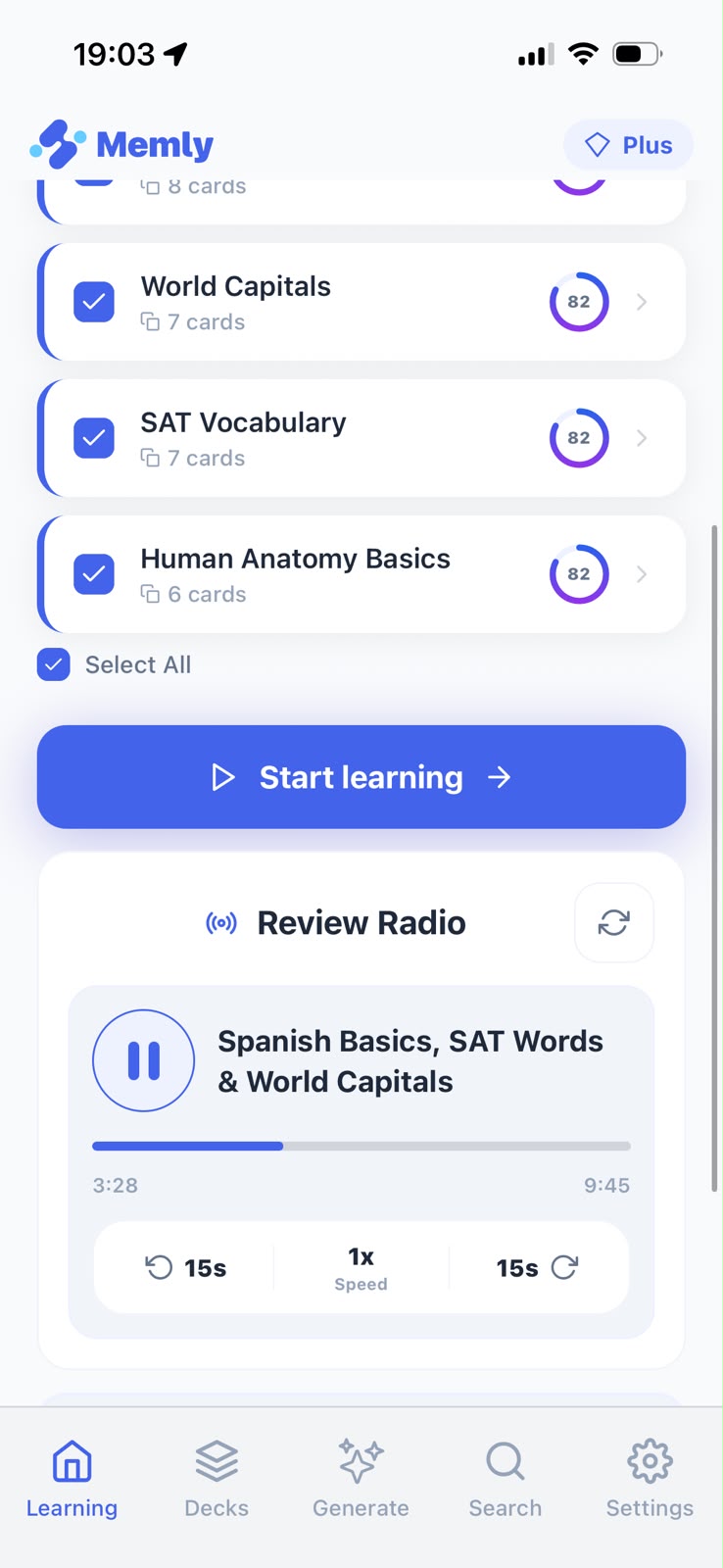
The player has all the familiar podcast controls: play/pause, back 15 seconds, forward 15 seconds, playback speed, and chapter navigation. Skip back 15 seconds when you miss something, or bump the speed to 1.5x when you are pressed for time. You listen at your own pace.
How to use it: just pick a deck and a length
You can create a Review Radio episode once enough cards are due for review. Choose from three lengths depending on the situation.
| Length | Approx. cards covered | Best for |
|---|---|---|
| 5 min | ~10 cards | Walk to the station, a short hop, a pre-sleep wind-down |
| 10 min | ~20 cards | One leg of the commute, while doing chores |
| 15 min | ~30 cards | A longer commute, a run, a catch-up day |
Start with a short episode while your queue is small, and move to longer ones as reviews accumulate. Generation uses your AI usage (credits), and it works on cards that are due for review, meaning ones you've already studied at least once, rather than brand-new cards. One tap, and the day's review is handled entirely by listening.
Who it helps most
- People with long commutes: turn a one-hour round-trip into a daily review block.
- People whose eyes tire from screens: rest your eyes and review entirely by ear.
- People whose review queues pile up: let the AI triage the backlog and turn it into an episode.
- Exam candidates with heavy memorization loads (MCAT, USMLE, bar exam, CPA): a cross-deck episode reduces the gaps across subjects.
- People with a lot of hands-busy time: chores, exercise, and driving all keep review moving when your hands are full.
What these people share is not a subject or a schedule. It is the shape of their spare time: minutes that are already spoken for by something else.
For the full picture of AI-powered memorization, see what AI-powered memorization is and how it works, and for using flashcards across high-stakes exams, see AI memorization for exam prep.
Frequently asked questions
Can I learn just by listening?
Pure passive listening is weak. But Review Radio inserts a recall pause before each answer, so active recall kicks in: you retrieve the answer in your head first. On top of that, it only handles cards that are due (the ones you're about to forget), so the spacing effect applies too. For the research behind this, see our deep dive on whether audio learning works.
Won't every episode be the same?
No. Each time you generate, it reselects the cards you're currently about to forget, and it avoids cards used in the last few days and recent episodes. So each show comes out a little different.
How many cards do I need before I can make one?
A handful of due cards is enough for a short 5-minute episode. The more cards you have due, the longer the episodes (10 or 15 min) you can choose. It works on cards that are due for review, not brand-new cards you've never studied.
Which languages are supported?
English, Japanese, Korean, and Chinese. Each language is read by native voices, so an episode doubles as listening material for language learners.
Does it take long to generate, and do I have to keep the app open?
Generation runs on the server, so you can close the app or lock your phone and it keeps going. When the episode is ready, it's there to play. No waiting around.
Can I listen while driving?
Yes, and that is the point. Because review happens entirely through audio, you never need to look at the screen. Press play before you start the car, and your due cards review themselves to you on the road.
The bottom line: give your free ears to review
The number one reason spaced repetition fails to stick is not weak willpower. It is that quiet moments with your eyes and hands free are rare in modern life. Review Radio removes that constraint. Commuting, chores, and exercise become review time with a single press of play.
Most people will read this and put today's review off again, telling themselves they will do it when a real block of time appears. But that block never comes. What comes is tomorrow's commute. Play one Review Radio episode on tomorrow's trip. Once you've finished a full day's review using nothing but your ears, it's hard to go back.
Memly is an AI flashcard app: upload a PDF or text and the AI generates your flashcards automatically, then delivers reviews at the optimal time based on your forgetting curve. Review Radio is part of that system. No credit card required, and it's free to start. If you like NotebookLM's Audio Overview, also read how to turn your daily review into a personal study podcast, and for the broader hub, start with what AI-powered memorization is.
