



A cumulative final asks about week 2 in week 15. The units from the start of term have had months to fade, while the last few lectures still feel fresh, so the recent material is what feels ready. Studying unit by unit in order tends to give the oldest material one pass, two weeks before the exam, and then nothing more.
This plan runs the other way. It starts from the whole syllabus, weights each unit by what the exam counts and how much you have lost, and keeps bringing old units back alongside recent ones until exam day. It also covers what to do when two or three finals land in the same week, and how to cut the plan down when fewer than 14 days remain.
The short version: Day 14: map every unit with its exam weight and your confidence. Days 13–8: find gaps with closed-book recall, then study in mixed sessions that pair an older unit with a recent one. Days 7–2: take cumulative practice tests and fix what they reveal. Day 1: weak cards, a short mixed set, and sleep. With several finals, split your study blocks in proportion to stakes × remaining gap, and give the last day before each exam mainly to that exam.
What makes a cumulative final different from a midterm?
A midterm usually covers a few weeks of recent material. A cumulative final changes four things at once.
- Scope: the whole term, often ten or more units, some of which you have not opened since they were taught.
- Uneven forgetting: older units have had longer to fade, yet they rarely feel urgent because you remember having understood them once.
- Questions across units: depending on the course, a final may ask you to compare ideas from different chapters or to choose a method without a chapter heading telling you which one applies.
- Several exams in one week: finals season compresses the calendar, so the plan for one course competes with the plans for the others.
If your next exam covers only part of the term, the narrower Midterm Study Plan: A Flexible 14-Day Schedule is a better fit.
Step 1: map the full syllabus and weight each unit
Before opening a textbook, write down every unit the final covers. Use the syllabus, any review sheet, what the instructor has said about weighting, and past exams if the course provides them. For each unit, record three things: its share of the exam, your confidence from 1 to 3 (3 means you can explain it and solve its problems without notes), and when you last studied it.
Then give each unit a priority score with a simple planning heuristic: priority = exam weight × (4 − confidence). This is not a formula from research. It puts heavily weighted units you cannot recall ahead of light units you already know, which is the ordering a cumulative final rewards. If the syllabus does not state weights, use the number of lecture weeks per unit or its share of the review sheet as a stand-in, and ask the instructor if you can.
| Unit (example: intro economics) | Exam weight | Confidence (1–3) | Priority score | Tier |
|---|---|---|---|---|
| 1. Supply and demand | 15% | 2 | 30 | B |
| 2. Elasticity | 10% | 1 | 30 | B |
| 3. Consumer choice | 10% | 3 | 10 | C |
| 4. Production and costs | 15% | 1 | 45 | A |
| 5. Market structures | 20% | 2 | 40 | A |
| 6. Labor markets | 10% | 2 | 20 | B |
| 7. Externalities | 10% | 3 | 10 | C |
| 8. Public goods (last two weeks) | 10% | 3 | 10 | C |
The weights and confidence ratings are invented for illustration; tiers here are A for 40 or more, B for 20–39, and C below 20. The example still shows the usual pattern. Unit 8, the freshest, ranks near the bottom, while Unit 4 from the middle of term ranks first. Without the map, most of the remaining time would likely go to the units that already feel comfortable.
Step 2: interleave older units with recent ones
If Unit 4 is the top priority, why not spend three days on it and move on? Because a unit that is finished on Day 12 may not come back before the exam, and a cumulative final does not ask its questions in unit order. Two separate ideas from learning research address this, and it helps to keep them apart.
The first is spacing: spreading study of the same material across several sessions instead of one long block. In a meta-analysis of distributed practice studies on verbal recall, Cepeda et al. (2006) found that spaced study generally led to better retention on later tests than massed study. A follow-up experiment by Cepeda et al. (2008) found that the most useful gap between sessions grew with how long the material had to be retained. For a final, the practical version is modest: each Tier A unit should appear in three or four sessions spread across the two weeks, not one long sitting.
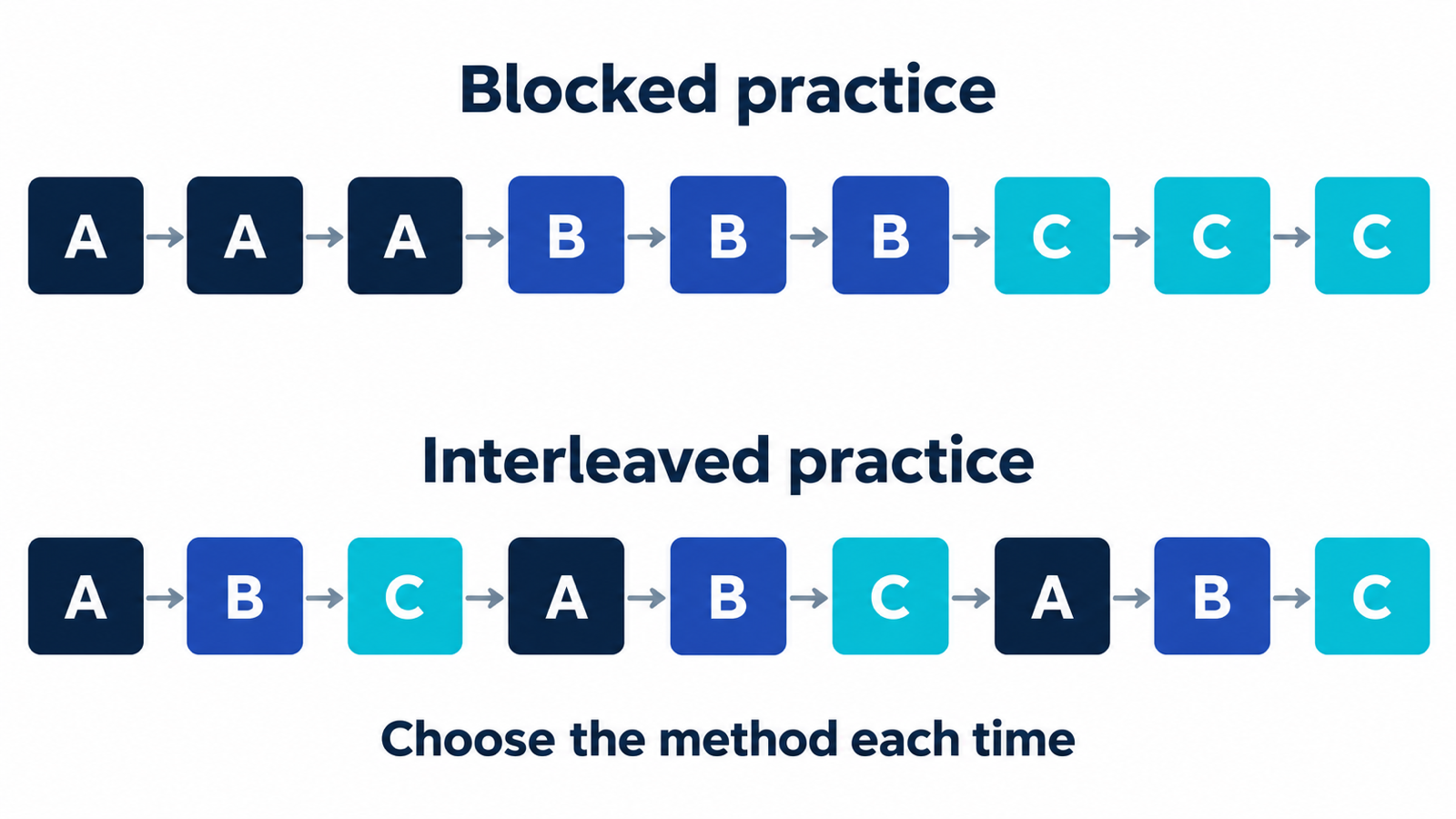
The second is interleaving: mixing problems from different topics within one session. In their review of ten study techniques, Dunlosky et al. (2013) rated interleaved practice as moderate utility, with the strongest evidence coming from math problems and category learning. The likely reason it helps is that mixed problems force you to decide which concept or method each one needs, a step that blocked practice skips because the chapter title has already told you. That deciding step is what many cumulative finals test.
Mixed sessions often feel slower than working through one chapter, because you are doing the extra work of identifying each problem. A mixed session can be as simple as one block on a Tier A unit followed by a short set of questions from three or four other units.
Step 3: use retrieval practice instead of rereading
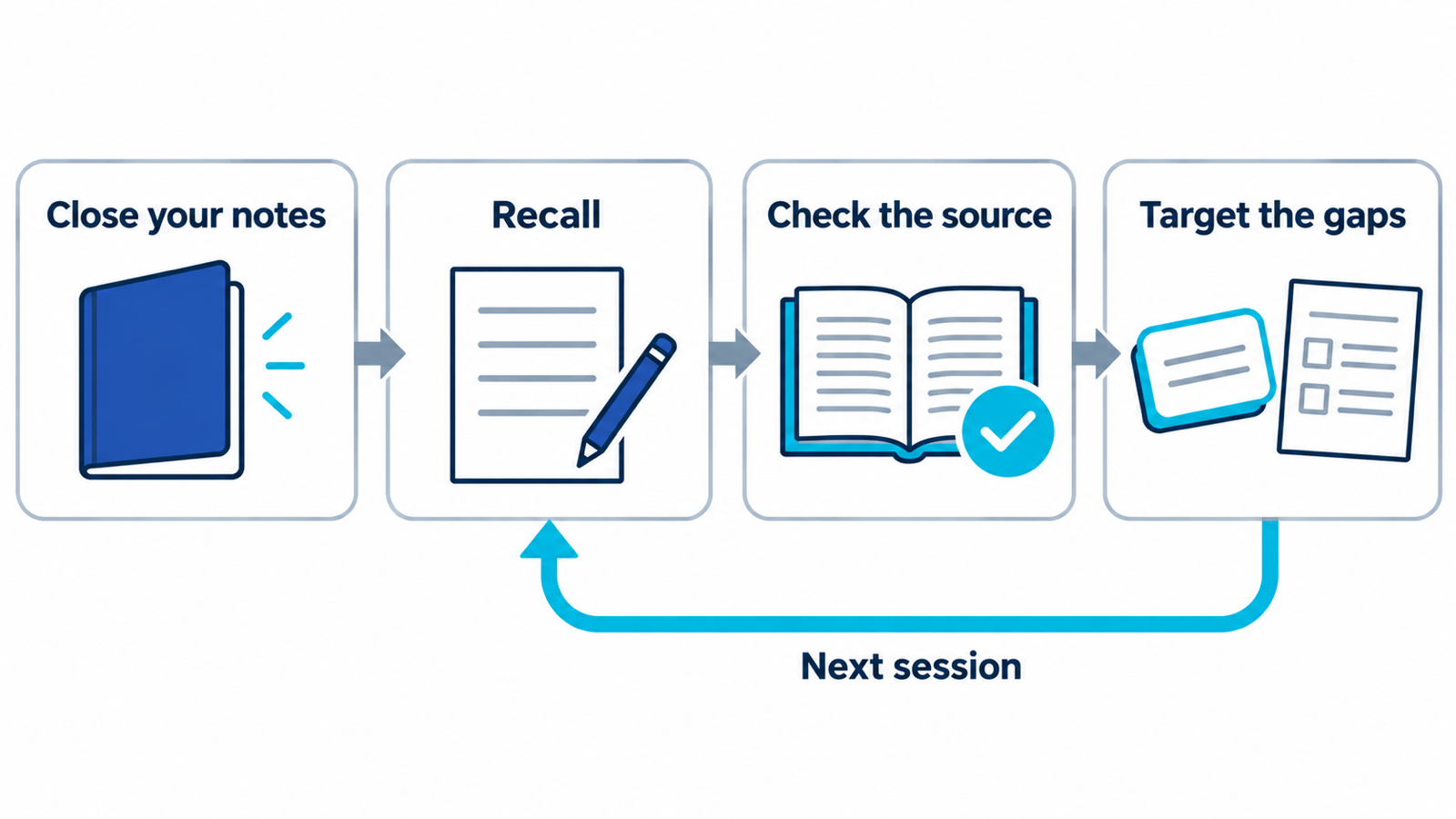
Rereading old notes feels productive, because the material looks familiar. Familiar is not the same as recallable on a blank exam page. In experiments with prose passages, Roediger and Karpicke (2006) found that students who practiced recalling the text remembered about 56% of it a week later, compared with about 42% for students who restudied it. Karpicke and Blunt (2011) found that retrieval practice also outperformed elaborative study with concept maps on a later test. Dunlosky et al. (2013) rated practice testing and distributed practice as the two high-utility techniques in their review.
These results come from specific materials and tests, so they do not promise the same gain in every course. The direction is still consistent enough to plan around: spend most study time producing answers, not reading them. Formats that suit a cumulative final:
- Closed-book recall per unit: ten minutes writing down everything you remember about one unit, then checking it against your notes. The gaps become your next cards or problems.
- Flashcards for definitions, formulas, key terms, and short facts that questions depend on.
- Mixed problem sets built from homework, quizzes, and past exams across several units.
- Cross-unit prompts: explaining how two units connect without notes, for example how a cost curve from Unit 4 shapes behavior under the market structures in Unit 5.
For a step-by-step method for working through past papers and sorting your misses, see How to Use Practice Tests: Stop Solving and Forgetting.
The 14-day cumulative final study plan, day by day
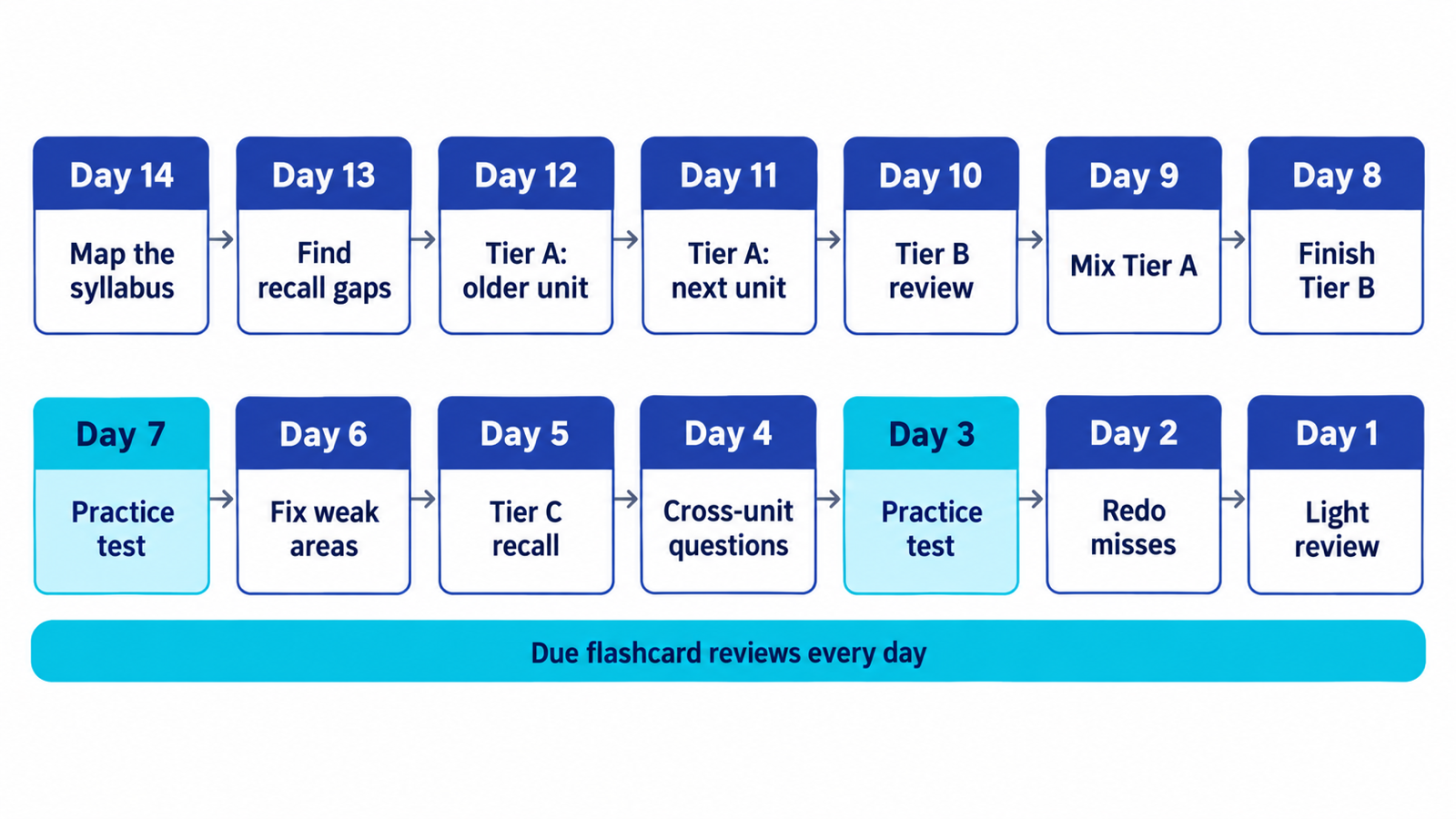
The table below puts the three steps on a calendar for one course. Day 1 is the day before the exam. It assumes roughly two to three hours a day for this course, and the tiers come from your syllabus map in Step 1. Due flashcard reviews run every day alongside the blocks shown.
| Day | Main block | Mixed retrieval block |
|---|---|---|
| 14 | Build the syllabus map; collect the review sheet, past exams, and notes | Set up a deck or card set for the course |
| 13 | Closed-book recall, about 10 minutes per unit, every unit | Mark the gaps; make cards for gaps in Tier A units |
| 12 | First Tier A unit (the older one first) | Short mixed set from units in the first half of the term |
| 11 | Second Tier A unit | Mixed set: yesterday's unit plus one recent unit |
| 10 | Tier B units, one focused pass each | Mixed set across all units |
| 9 | Problem set mixing all Tier A units | Repeat the Day 13 closed-book recall for Tier A units |
| 8 | Remaining Tier B work and new cards from Days 10–9 | Mixed set plus one cross-unit question |
| 7 | First cumulative practice test, timed and closed-book | Sort misses: knowledge gap, misread question, careless slip |
| 6 | Fix the two weakest areas from Day 7 | Card the knowledge gaps; short mixed set |
| 5 | Tier C units, one closed-book recall pass each | Mixed set weighted toward Tier A |
| 4 | Cross-unit questions: compare concepts, choose the method | Redo missed problems from Day 7 |
| 3 | Second practice test or a past exam | Correct it and card the new misses |
| 2 | Redo every missed problem from Days 7 and 3 | Weak cards only |
| 1 | Weak cards and a short mixed set; recall key formulas and definitions | Check exam logistics, stop early, sleep |
The table is a template: a problem-heavy course may need more time on problem sets, a reading-heavy one more closed-book recall. What it enforces is that no Tier A unit is studied once and left. Each one returns on Day 9, in both practice tests, and in the mixed sets in between.
How to study for several finals in the same week
The 14-day table assumes one exam. Finals season rarely offers that. When three exams fall within a few days of each other, the first question is not what to study but how much of the two weeks each course gets.
A planning heuristic that keeps the decision quick: rate each exam for stakes (1–3: how much it counts toward your grade or goals) and gap (1–3: how much of the syllabus is still weak or untouched, from your syllabus map). Then:
Points = stakes × gap. Study blocks for an exam = total blocks × (that exam's points ÷ all points).
This is a rule of thumb, not a research finding; its value is that it makes the trade-off explicit. In the example below, a student has 14 days with two study blocks a day (a block is one focused session, for example 60–90 minutes), so 28 blocks in total, and three finals in the same week.
| Final | Stakes | Gap | Points | Share | Blocks (of 28) |
|---|---|---|---|---|---|
| Chemistry (Monday) | 3 | 3 | 9 | 47% | 13 |
| History (Wednesday) | 2 | 2 | 4 | 21% | 6 |
| Statistics (Friday) | 3 | 2 | 6 | 32% | 9 |
| Total | 19 | 100% | 28 |
The formula gives the totals; the calendar decides where the blocks go. Four rules keep the split workable:
- Spread every course across the window. Running chemistry for a week and then switching to statistics repeats the one-pass problem at the level of whole courses. Touch each course at least every other day, even if only with a short set of due cards.
- Give the day before each exam mainly to that exam. In the example, Sunday goes mostly to chemistry, Tuesday to history, and Thursday to statistics.
- Redistribute after each exam. Once chemistry is over, recompute the split for the remaining courses with the same formula and the days left.
- Do not leave the last exam until last. Statistics has its final review late in the week, but its weak units still need spaced sessions in the first week.
Inside each course, the 14-day table compresses to fit its blocks. Chemistry's 13 blocks might be two for the map and diagnosis, six mixed sessions, three for practice tests and corrections, and two for the final review. History's six blocks would keep the same order with fewer mixed sessions.
Fewer than 14 days left? How to triage a cumulative final
Starting late changes what can be done, not the logic of the plan. The cuts should fall on low-weight units you already know, not on retrieval practice or sleep.
| Days left | Keep | Cut or compress |
|---|---|---|
| 10–13 | All three phases; one practice test about 4 days out | Merge the syllabus map and the closed-book diagnosis into one day |
| 6–9 | Map and diagnosis on the first day; Tier A and B in mixed sessions; one practice test 2–3 days out | Tier C gets one recall pass and no new cards |
| 3–5 | A 30-minute map; Tier A only; past exam questions and weak cards | Tier C entirely; rewriting notes; making cards for material you already know |
| 1–2 | Follow a short cram plan built on triage and retrieval | Anything outside the highest-weight gaps |
With several finals and little time, apply the stakes × gap split first and then triage inside each course. For the final two or three days before an exam, see Exam in 3 Days? The Science-Backed Way to Cram. If you are reading this with a month or more to go, the 30-day plan built on output gives the early weeks more room for practice tests.
FSRS decides when a card returns, not which final gets your time
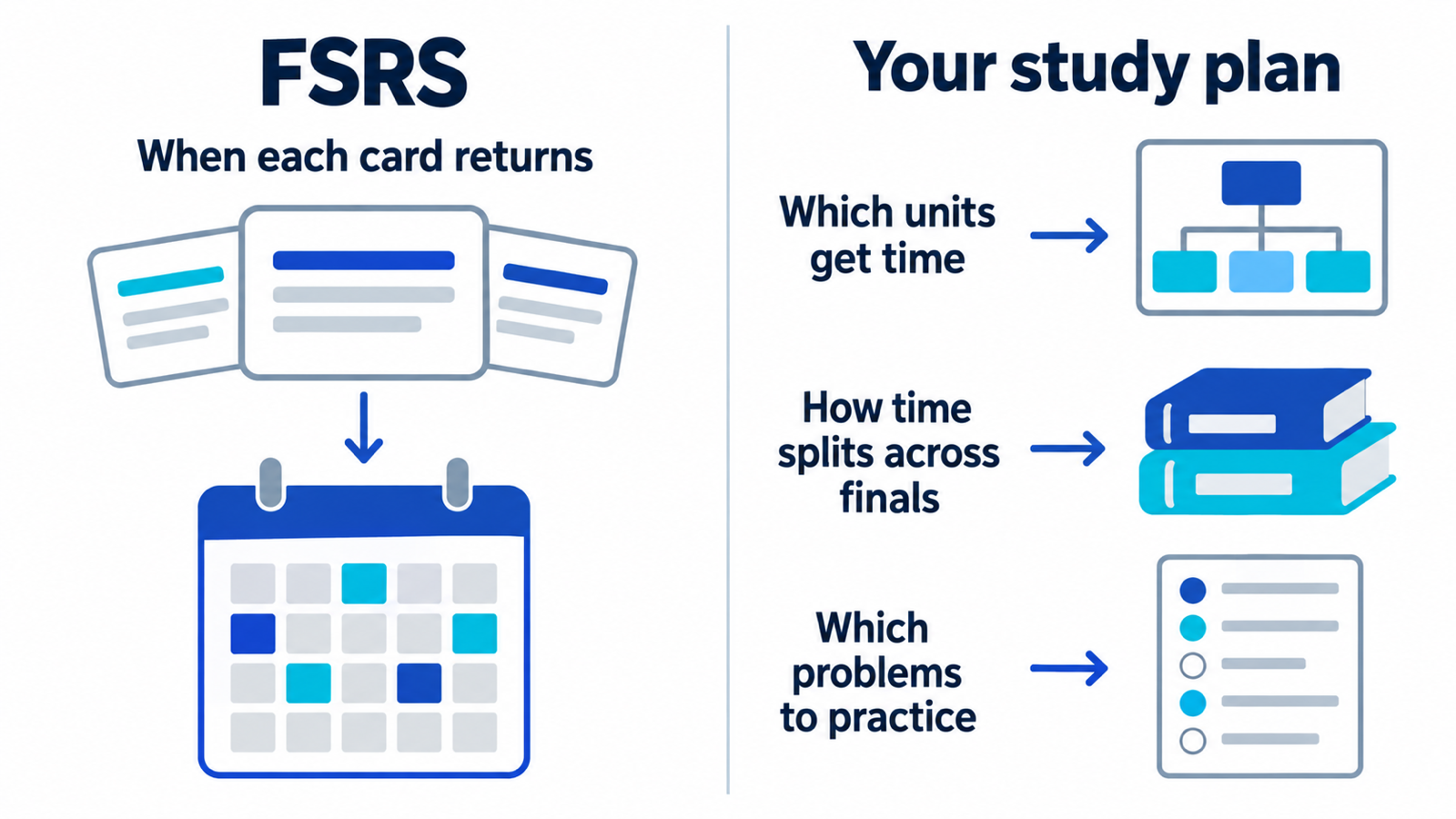
Spaced repetition apps take one part of this plan off your hands. FSRS (Free Spaced Repetition Scheduler) estimates how likely you are to recall each card from your answer history and schedules the next review for when that probability is expected to fall to a target, called desired retention. In Memly, the default target is 90%, and FSRS runs with one shared set of weights for all users rather than weights fitted to each person's history.
That scheduling answers one question: when should this card come back? It does not know that Unit 4 is 15% of the exam, that the instructor said the long question will cover externalities, or that your chemistry final comes two days before history. Those come from the syllabus map and the splitting formula.
| Decision | Who makes it |
|---|---|
| When an individual card comes back for review | The scheduler (FSRS) |
| Which units get study blocks, and in what order | You, from the syllabus map |
| How the days split across several finals | You, from stakes × gap |
| Which problems and practice tests to work through | You, from course materials |
Treat due cards as the daily floor for memorization, and let the syllabus map decide where the rest of your time goes. Cards cover definitions and facts well; problem solving and cross-unit questions still need practice sets.
Using Memly for a cumulative final
- Draft cards from course material: AI can generate questions and answers from notes, PDFs, Word and PowerPoint files, and images of handouts. Check each card against the source and your syllabus before studying it.
- One exam date per course: Memly sets an exam date on a group of decks, so each course's decks can carry their own date. From two weeks out, reviews come earlier and the recall target rises toward 95% by default, reaching it three days before the exam. Reviews are not scheduled past the exam day, and a daily target shows whether you are on track.
- A final sweep: in the last three days, the pre-exam sweep goes through every card, starting with those with the lowest predicted recall on exam day. Predicted recall is a model estimate, not a test score.
- Narrowing when time is short: if the pace cannot cover the new cards before the exam, Memly's AI can propose setting some aside until afterward. Nothing is deleted, and set-aside cards can be restored. Compare the proposal with your syllabus map before accepting it.
- Short gaps in the day: Memly runs on Web, iOS, and Android, so due cards can fit into a commute between longer blocks.
For the full picture of AI-assisted memorization, see the pillar guide AI-Assisted Memorization: How It Works and the Best Tools.
Start with the syllabus map tonight
The unit most likely to cost points on a cumulative final is often the one you are least likely to open first: taught weeks ago, half remembered, and quietly heavy on the exam. A study plan that never names it will tend to leave it for last.
Tonight, list every unit with its exam weight and a confidence score, and pick tomorrow's pair: one older Tier A unit and one recent unit. If you have several finals, rate stakes and gap for each one before you sleep. Memly is free to try, no credit card required.
Sources
- Roediger, H. L., & Karpicke, J. D. (2006). Test-enhanced learning. Psychological Science. doi.org/10.1111/j.1467-9280.2006.01693.x (checked October 11, 2026)
- Cepeda, N. J., et al. (2006). Distributed practice in verbal recall tasks: a review and quantitative synthesis. Psychological Bulletin. doi.org/10.1037/0033-2909.132.3.354 (checked October 11, 2026)
- Cepeda, N. J., et al. (2008). Spacing effects in learning: a temporal ridgeline of optimal retention. Psychological Science. doi.org/10.1111/j.1467-9280.2008.02209.x (checked October 11, 2026)
- Dunlosky, J., et al. (2013). Improving students' learning with effective learning techniques. Psychological Science in the Public Interest. doi.org/10.1177/1529100612453266 (checked October 11, 2026)
- Karpicke, J. D., & Blunt, J. R. (2011). Retrieval practice produces more learning than elaborative studying with concept mapping. Science. doi.org/10.1126/science.1199327 (checked October 11, 2026)
