


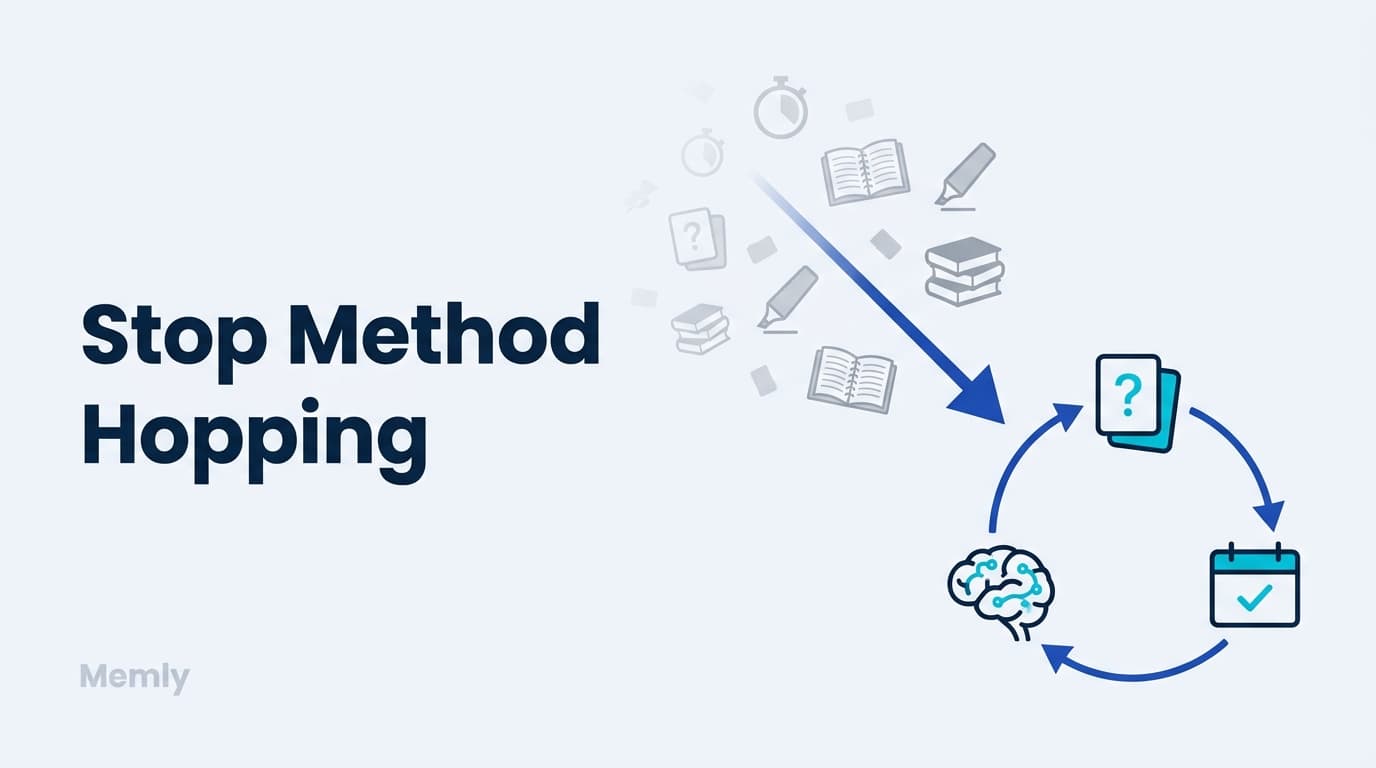
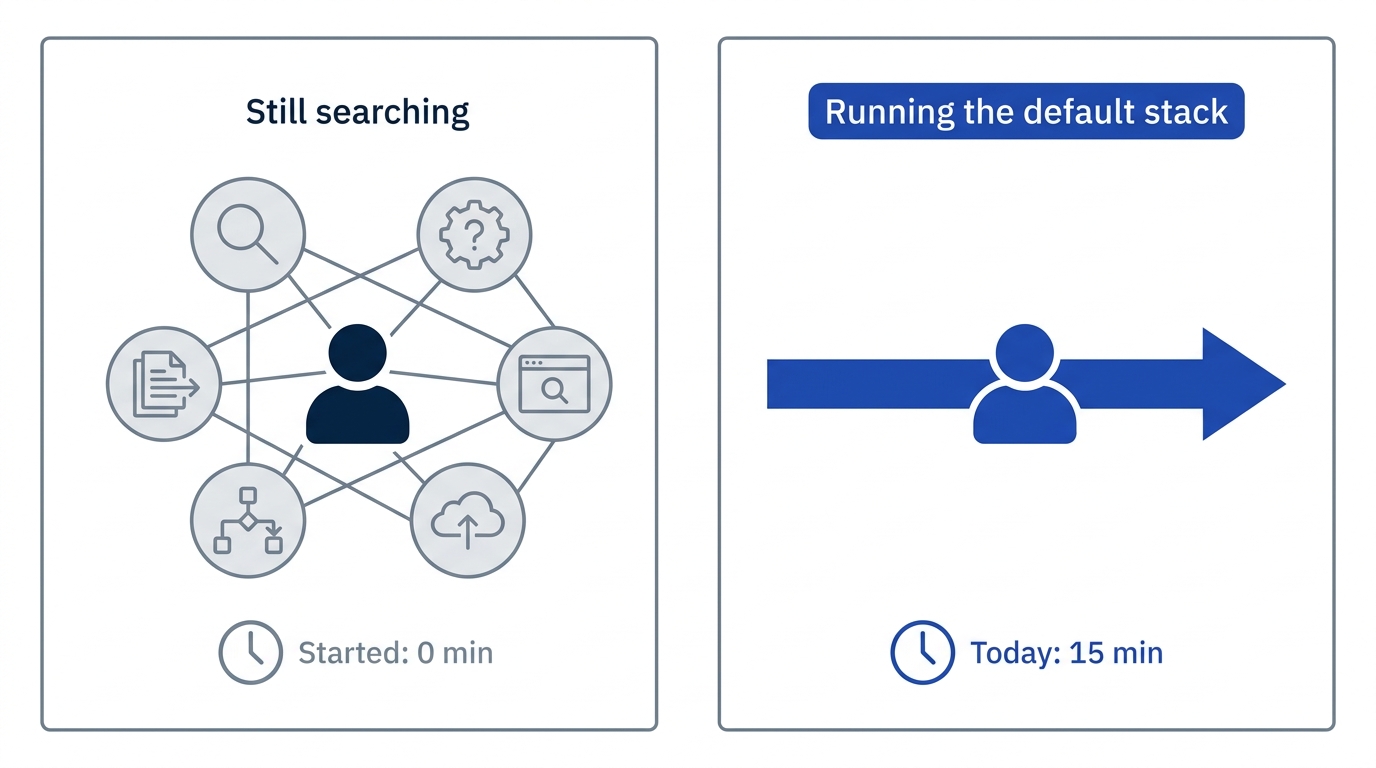
Thirty study-method articles in your bookmarks. Another hour tonight searching for "the best way to study". And today's actual studying: still zero minutes. Here is the uncomfortable arithmetic: time spent choosing a method is not study time, and every new option you collect raises the cost of choosing, which makes starting even harder tomorrow.
The short version: you do not need the perfect method. Research consistently shows most of the gain comes from just two ingredients: retrieval practice and spaced review. So run the default stack (read, recall onto a blank page, make cards, review on spaced repetition) starting today, and do not switch methods for two weeks.
Why searching for methods stops you from studying
Two mechanisms. First, more options make choosing more expensive. Pomodoro, Cornell notes, five-pass reading, blank-page recall: every option looks promising, the fear of picking wrong grows, and the decision gets postponed. Unable to choose, you escape into the one activity that requires no choice: more searching.
Second, method-shopping pays out the feeling of progress. Consuming study-advice content feels like moving forward, without the pain of an actual recall attempt. It is procrastination in productive clothing, the same starting-friction problem we traced in Study Procrastination Is a Design Problem.
So which study method is actually best?
The good news: the choice is mostly already made. In Dunlosky and colleagues' 2013 review of study techniques, practice testing (retrieval) and distributed practice (spaced review) earned the top ratings, while rereading and highlighting rated low. Next to those two pillars, the differences between named techniques are close to rounding error.
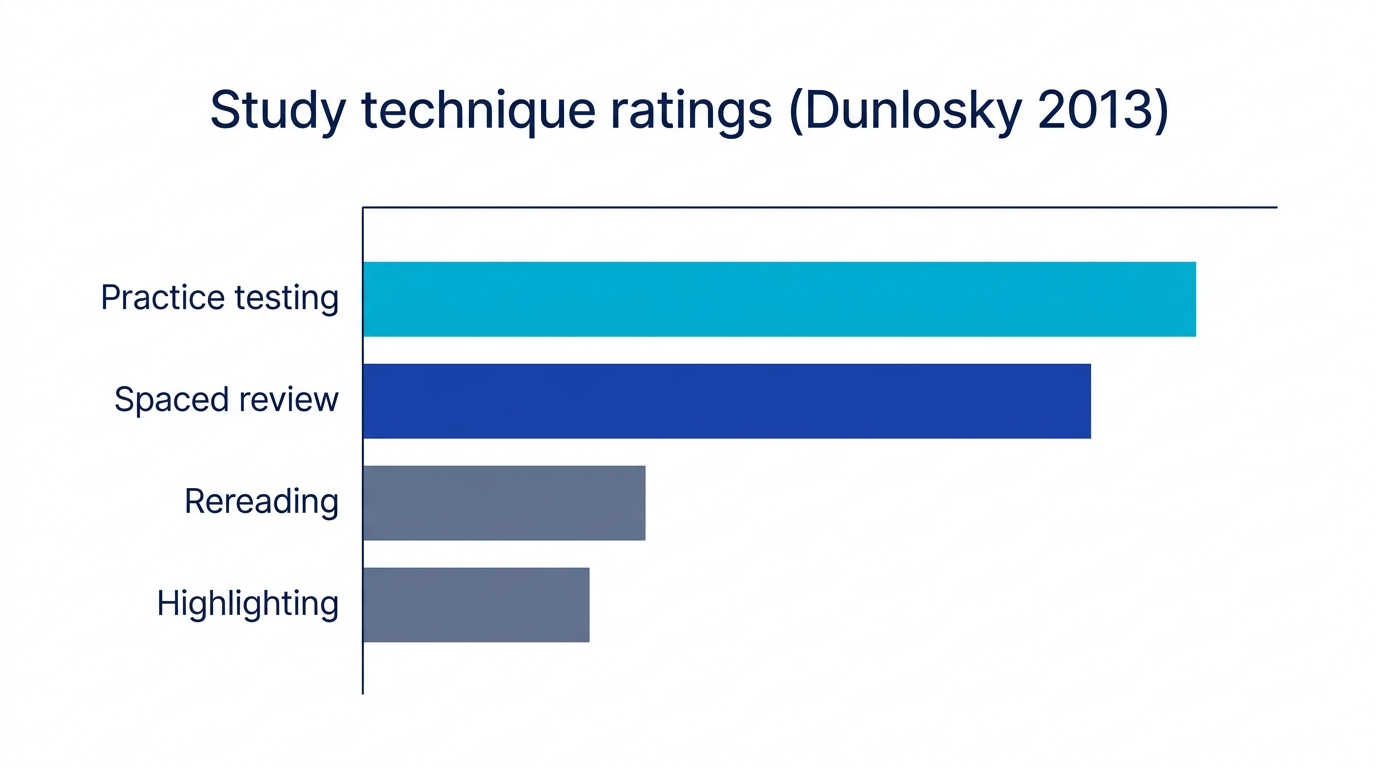
So the question worth asking about any routine is "does this make me retrieve, and does it space the attempts out". For the science across five techniques, see 5 Scientifically Proven Study Methods That Actually Work.
The default stack (start today)
- Read: one section of your material, no more.
- Close and recall: write the key points on a blank page; reread only what refused to come out.
- Make cards: turn what must be remembered into question-and-answer form.
- Run spaced repetition: let the schedule re-test you right before forgetting.
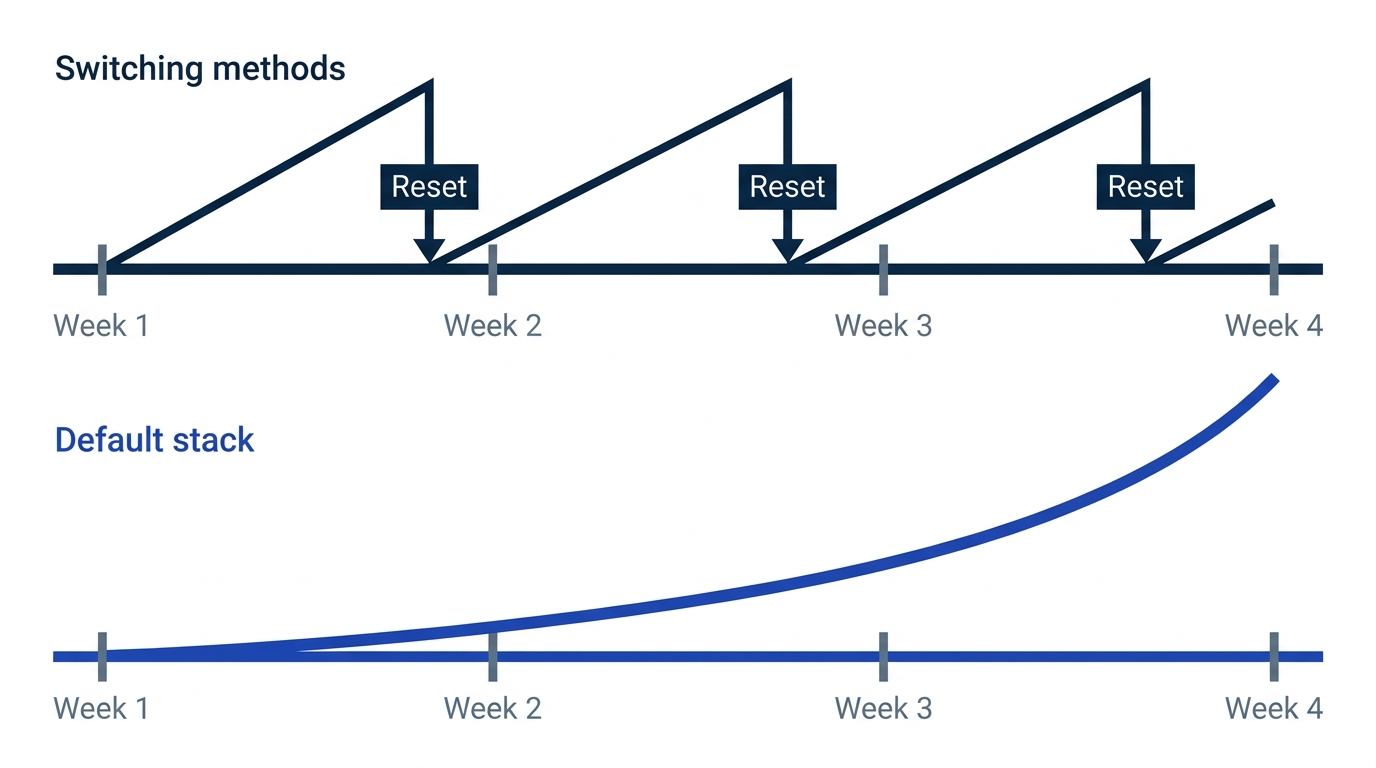
Then enforce a two-week no-switching rule. Study methods pay compound interest, and switching every three days resets the compounding before it ever gets started. Judge the method after two weeks of actual running, not after one uncomfortable session.
| A month of method-hopping | A month on the default stack | |
|---|---|---|
| Method switches | 4-5 (a reset each time) | 0 |
| Hours spent searching | Several per week | Nearly zero |
| What accumulates | Bookmarks | A deck of retrieval-tested cards |
The last row is the one that should decide it. Four weeks of hopping leaves you with a longer bookmark list; four weeks on the stack leaves you with a deck that has already tested you on the material.
If what stops you is wanting the perfect setup before starting, that trap has its own anatomy: The Perfectionism Learning Trap. The stack does not need to be perfect. It needs to be running.
Memly automates the default stack
- Card-making disappears: AI generates question-and-answer cards from photos, PDFs, or pasted text, so step 3 takes minutes.
- Spacing is fully automatic: the FSRS algorithm picks which cards you are about to forget and schedules them; step 4 needs no management.
- Web, iOS, and Android: the stack can be running before tonight's search session would even have ended.
For the full picture of AI-assisted memorization, see AI-Assisted Memorization: How It Works and the Best Tools.
One more article, or fifteen minutes of the stack
The irony is not lost on us: this, too, is a study-method article. So you have two exits. Open the next tab, in case something better is out there. Or close the search for good.
One action: read one section of the material you already own, close it, and write what you remember on a blank page. That is the whole assignment, and it is what moves tonight's number off zero. Memly runs the rest of the stack automatically; free to try, no credit card required.
