



The study method you are using right now may have been scientifically proven to be ineffective. Highlighting text, re-reading passages, rewriting notes -- these are methods used by over 90% of students, yet a large-scale study by Dunlosky et al. in 2013 rated them as "no benefit" to "low benefit." If your efforts are not paying off, it is not an ability problem. It is a method problem.
Research in cognitive psychology has revealed that the majority of study methods people believe to be effective are actually inefficient. On the other hand, the methods with strong scientific evidence are remarkably simple.
Five methods clear that bar, each replicated repeatedly in peer-reviewed psychology and cognitive science. All five can be running today, and a week is often enough to notice the difference.
Why Your "Usual Study Routine" Is Inefficient
In a large-scale review study published by Dunlosky et al. in 2013, the effectiveness of the most commonly used study methods was scientifically evaluated. The results were striking:
| Study Method | Usage Rate | Scientific Rating |
|---|---|---|
| Highlighting / Underlining | Widespread | No benefit |
| Re-reading text | Widespread | Low benefit |
| Rewriting / Summarizing notes | High | Low benefit |
| Practice testing (self-quizzing) | Low | Highest benefit |
| Spaced review | Low | Highest benefit |
The two methods that earned the top rating are also the two hardly anyone uses. Nothing in that table says you need more hours. It says the hours you already spend are pointed at the wrong things.
1. Active Recall: The Act of Remembering Is What Strengthens Memory
The most effective study method, consistently supported across cognitive science research, is active recall.
Instead of "reading" a textbook, close the book and "recall" the content. Instead of "reviewing" your notes, write out what you remember on a blank sheet. The act of "trying to remember" itself strengthens the brain's memory circuits.
Why It Works
In a 2006 experiment by Roediger & Karpicke, a group that read the same passage twice was compared with a group that read it once and then took a recall test.
| Group | Score After 5 Minutes | Score After 1 Week |
|---|---|---|
| Read twice | 81% | 42% |
| Read + Test | 75% | 56% |
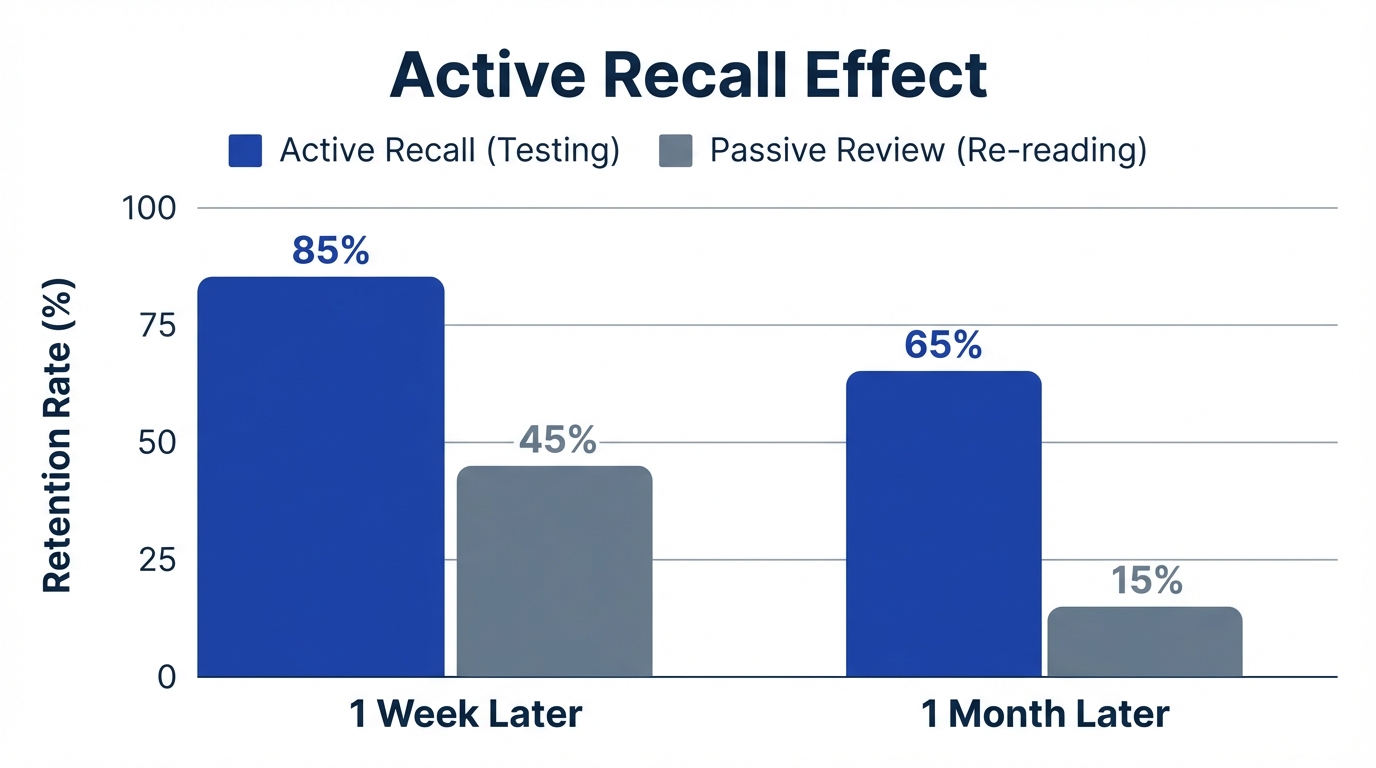
The two groups scored almost the same after 5 minutes, but a 14-point gap opened up after one week. Reading twice scored higher on the day and decayed fastest; retrieving the passage even once slowed that decay down.
Practical Tips You Can Start Today
- After reading one section of a textbook, close the book and write out the content on a blank sheet of paper
- After a class, write down three key points without looking at your notes
- Use flashcards to test yourself: the lowest-friction way to make retrieval a daily habit
Flashcards are the ideal tool for practicing active recall. The repeated act of seeing a "question" and recalling the "answer" strengthens your brain's memory pathways.
2. Spaced Repetition: Why "The Moment Before You Forget" Is the Golden Window
The second scientifically proven study method is spaced repetition. Reviewing the same material once a day over five days is far more effective for retention than reviewing it five times in a single day.
What the Forgetting Curve Teaches Us
According to the forgetting curve discovered by Ebbinghaus, memory fades rapidly from the moment of learning. However, if you review just before the memory disappears, the time before you forget it again is significantly extended.
- 1st review after 1 day: the memory then lasts about 3 days
- 2nd review after 3 days: the memory then lasts about 1 week
- 3rd review after 1 week: the memory then lasts about 3 weeks
- 4th review after 3 weeks: the memory then lasts about 2 months
Each successful retrieval makes the next forgetting slower, so the intervals keep stretching. After five or six of them the material sits in long-term memory and needs only an occasional refresh.
The Biggest Challenge: Deciding When to Review
The effectiveness of spaced repetition is clear, but the practical barrier is managing review timing. You can manually manage 10 items, but optimally scheduling reviews for 1,000 or 10,000 pieces of knowledge is beyond human capability.
Scheduling at that scale is bookkeeping, which is where software has the advantage. Memly's FSRS 6.0 algorithm (FSRS stands for Free Spaced Repetition Scheduler, a modern algorithm that predicts when you are about to forget) uses each card's answer history to calculate a forgetting probability for every card, and hands you today's due cards in the order that keeps each one from slipping. To understand how AI enhances spaced repetition, read How AI Flashcard Apps Work.
3. Interleaving: Mixing Topics Builds Real-World Application Skills
The third method is interleaving. Rather than solving the same type of problem consecutively ("blocked practice"), you mix different types of problems and solve them in random order.
Surprising Experimental Results
In a study by Rohrer & Taylor (2007), a group that practiced math problems in blocked format was compared with a group that used interleaving.
| Study Method | Accuracy During Practice | Test Score After 1 Week |
|---|---|---|
| Blocked practice (same type consecutively) | 89% | 20% |
| Interleaving (mixed) | 64% | 63% |
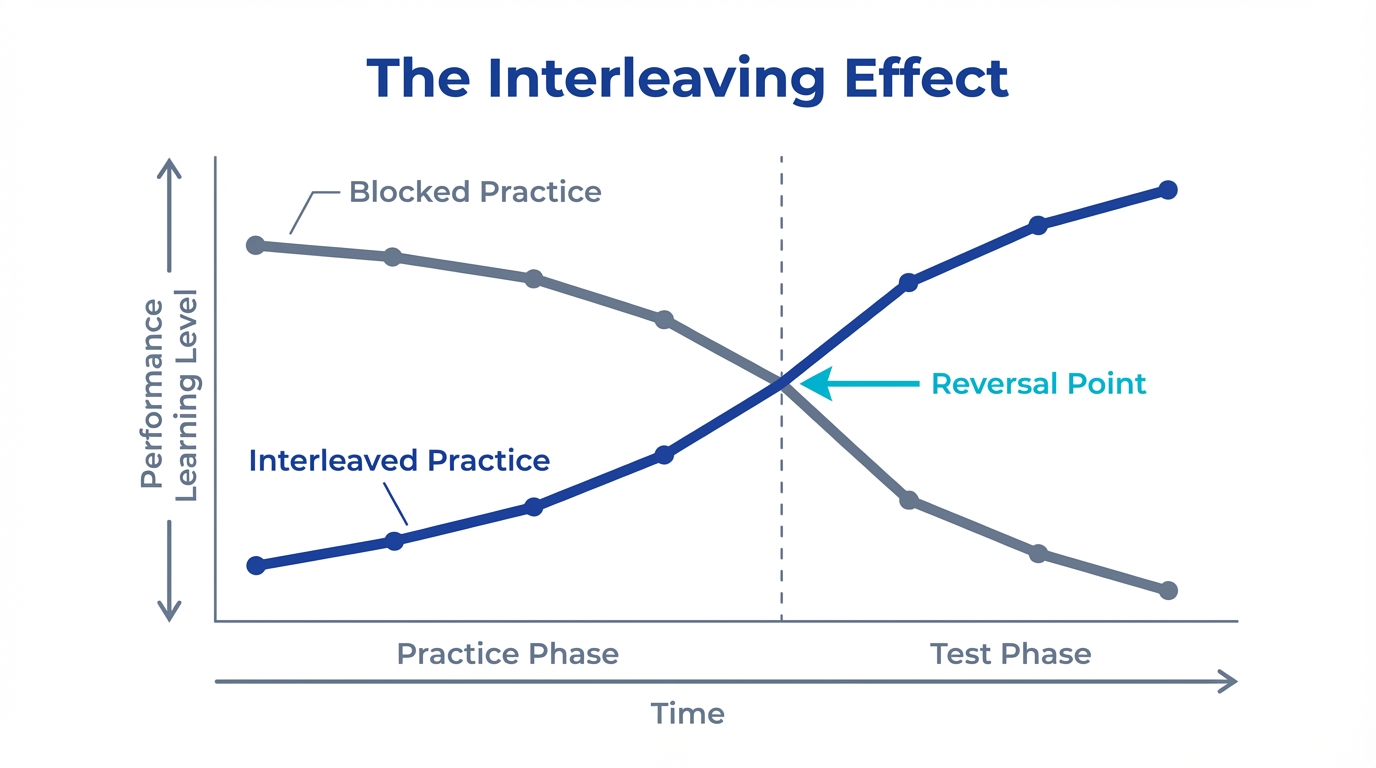
Notice that during practice, the blocked group performed better. This leads learners to mistakenly believe that blocked practice is more effective. However, on the test one week later, the interleaving group scored more than 3 times higher.
The feeling of "doing well" during practice does not necessarily indicate greater learning effectiveness. In cognitive science, this is known as the "illusion of fluency."
Practical Tips
- For language learning, alternate between grammar, vocabulary, and listening in 30-minute blocks
- For math, randomly mix problems from calculus and probability
- For certification exams, review flashcards from different subjects in a mixed order
Memly includes a feature that mixes cards from different decks, enabling you to practice interleaving naturally.
4. Elaboration: Asking "Why?" Can Double Your Memory
The fourth method is elaborative interrogation. After learning new information, you ask yourself "Why is this the case?" and "How does this connect to what I already know?"
Why It Works
Connecting new information to your existing knowledge network increases the number of "access points" to that memory. Isolated knowledge is easily forgotten, but knowledge linked to other concepts can be accessed from multiple directions, making it much harder to forget.
In a study by Pressley et al. (1987), a group that memorized facts as-is was compared with a group that thought about "why" each fact was true. The group that used elaboration had a retention rate approximately twice as high as the other group.
Synergy with Flashcards
The process of creating flashcards is itself an act of elaboration. Thinking about "how to frame this as a question" and "how to organize the answer" naturally leads to structuring and connecting information.
- Add a sentence explaining "why this is the case" to the answer side of cards
- Create cards that ask about differences between similar concepts
- Link cards containing specific examples to abstract principles
5. Dual Coding: Encoding with Both Words and Visuals
The fifth method is dual coding. When the same content is processed through both verbal and visual information, memory retention improves significantly.
Paivio's Dual Coding Theory
According to this theory proposed by Allan Paivio in 1971, the brain processes language and visuals through separate channels. Information encoded through both channels is far easier to recall than information encoded through just one.
- Text alone: one channel
- Text plus a diagram or image: two channels, which gives recall a second route in when the wording alone fails you
How to Practice It
- Draw diagrams and arrows in your notes as you study
- After learning a concept, try sketching a simple diagram that represents it
- Include images in your flashcards (Memly generates image-based cards automatically)
What Happens When You Combine All Five Methods
Each of the five methods above works on its own, and they compound when used together: retrieval creates the memory, spacing decides when to retrieve, and interleaving, elaboration, and dual coding each give that retrieval another handle to grab.
| Method | Standalone Effect | When Combined |
|---|---|---|
| Active Recall | Memory strengthening | Achieved through the Q&A format of flashcards |
| Spaced Repetition | Long-term retention | AI automatically calculates optimal timing |
| Interleaving | Improved application skills | Mixed presentation of cards from different decks |
| Elaboration | Deeper understanding | Naturally occurs during card creation |
| Dual Coding | Multi-channel memory | Visual + verbal through image-based cards |
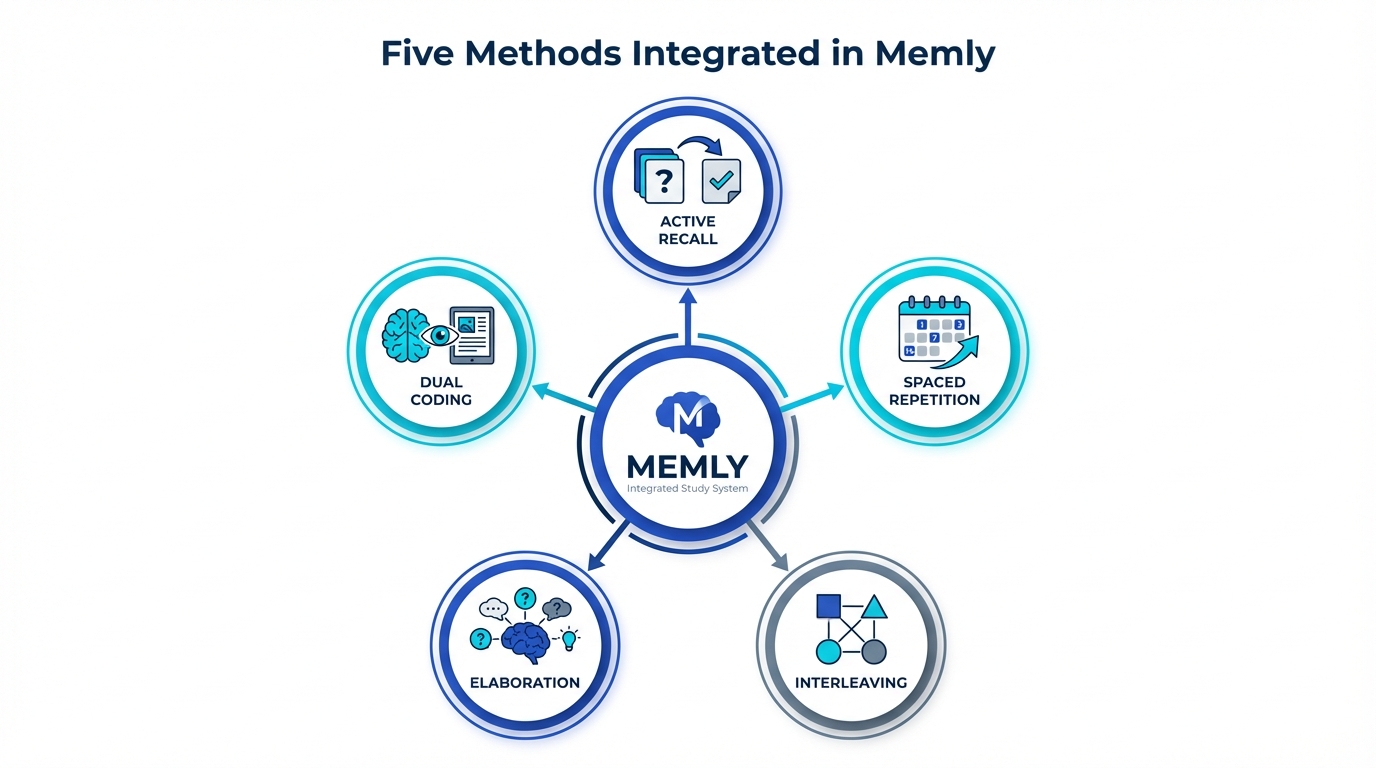
Running all five by hand collapses under its own bookkeeping. Calculating review timing, mixing card order, and adjusting difficulty across thousands of cards is not something anyone sustains for a semester.
Memly builds the five methods into one review flow.
- Active recall: AI generates flashcards from PDFs, images, and videos, so there is material to be quizzed on within minutes
- Spaced repetition: the FSRS 6.0 algorithm sets every review interval for you
- Interleaving: cards from different decks come up mixed in the same session
- Elaboration: writing and editing a card forces you to decide what the question is actually asking
- Dual coding: image-based cards pair the wording with a visual
How to Put the Right Method to Work This Week
In the Dunlosky ratings, most people spend their hours on the methods scored "no benefit" to "low benefit." The five above are the ones that scored highest, and not one of them asks for more hours than you already put in.
Knowing which five they are changes nothing by itself. Left alone, tomorrow looks exactly like yesterday: highlighter, second read-through, notes recopied.
Most people who read this will think "interesting, I'll try it sometime," and the highlighter stays in hand. So make the first step small. Pick one topic today and turn it into cards. Memly runs all five methods inside a single review flow, account creation takes 30 seconds, and no payment method is required. Fifteen minutes now, and the surprise comes not tonight but next week, when the material is still there.
For an overview of AI-powered memorization support, see our article "What Is AI-Powered Memorization Support? A Complete Guide to How It Works, Its Effectiveness, and the Best Tools." For help picking the right tool to put these methods into practice, see our AI flashcard app guide.
