


A chapter can look familiar after several readings while its key points remain difficult to recall. That gap does not, by itself, mean you have a bad memory. It means you need to check what you can explain without the text in front of you.
The short version: read to understand, then check that understanding from memory. Read a section, close the book, recall the main points, and reopen it to correct mistakes. Reading supplies the material; the self-test shows what needs more work.
The real reason you forget what you read
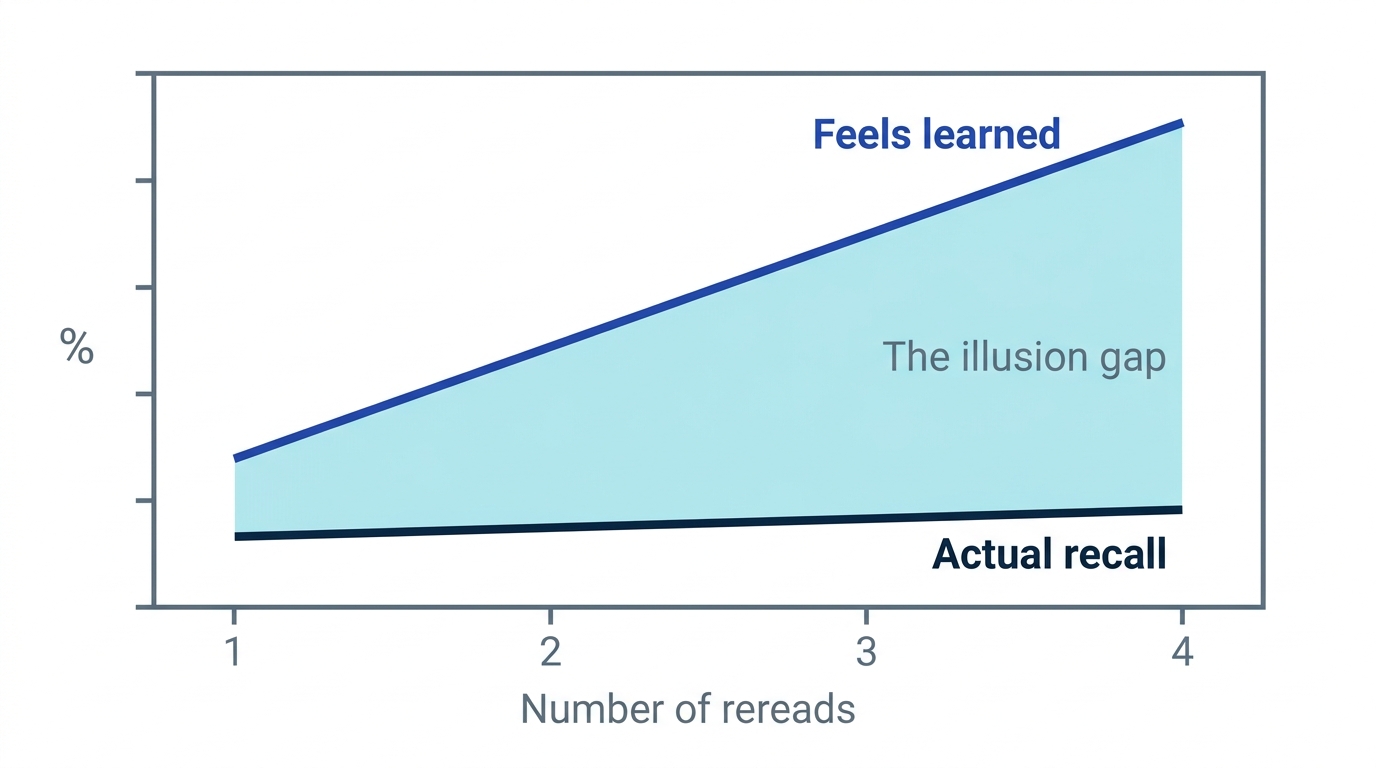
"It reads smoothly" is not "I know it": the fluency illusion
On a second or third reading, a passage often feels easier to follow. That familiarity can be mistaken for an ability to explain it later. This is the fluency illusion: using ease of reading as evidence that you can recall the material without it.
When Dunlosky and colleagues reviewed the evidence on study techniques in 2013, rereading and highlighting landed in the low-utility category, while practice testing (retrieval practice) and spaced review earned the top ratings.
| Technique | Dunlosky (2013) utility rating | How to use it |
|---|---|---|
| Practice testing | High | Answer without notes, then check feedback |
| Spaced review | High | Return to material across separate sessions |
| Rereading | Low | Clarify a passage, then check recall |
| Highlighting | Low | Mark key material without treating the mark as proof of learning |
"Low utility" does not mean useless. Rereading can help you clarify a difficult passage, and highlighting can help you find it again. The limitation is using either as your only preparation for recalling an answer later.
Recognizing and recalling are different abilities
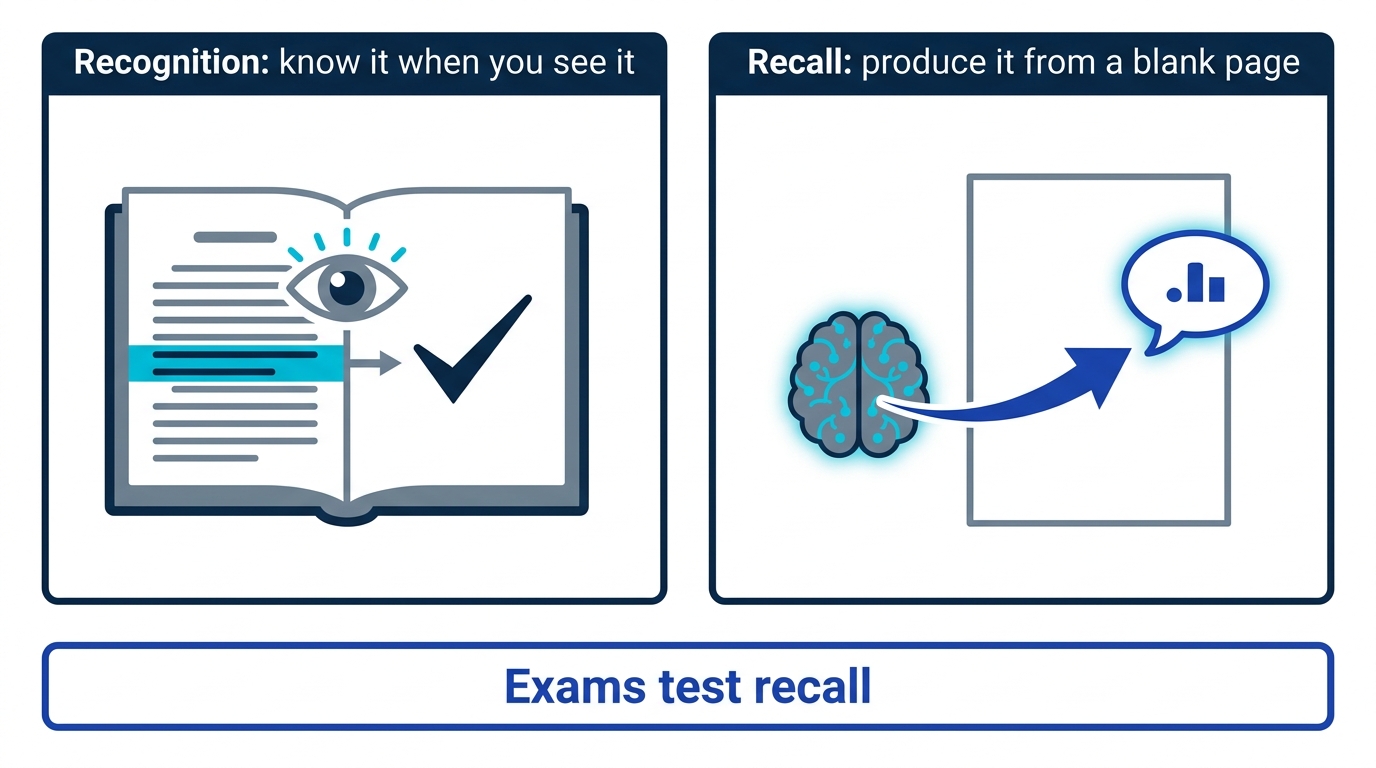
"I understand it when I read it, but I cannot answer questions." This describes a difference between recognition, identifying information when you see it, and recall, producing it from memory. Both can matter. If the task requires an explanation without notes, practise that form of recall as well as reading.
Recognition grew; recall was never practiced. Only practicing recall itself closes the gap. When study hours keep going in and results stay flat, this is usually the reason. We trace the pattern in why studying hard but not improving happens.
How to read so it sticks: the retrieval reading loop
In Roediger and Karpicke's 2006 experiments, students who practiced recalling a text outperformed rereaders a week later (roughly 56% versus 42% recall; exact numbers vary by condition; the direction is the point). This testing effect plugs straight into everyday reading:
- Read one section: a single heading's worth. Do not read long.
- Close the book and recall: say or write, from memory, what the section's key points were. Whatever refuses to come out is precisely what you have not learned yet.
- Open and check: reread only what you failed to recall. This is the moment rereading finally becomes useful.
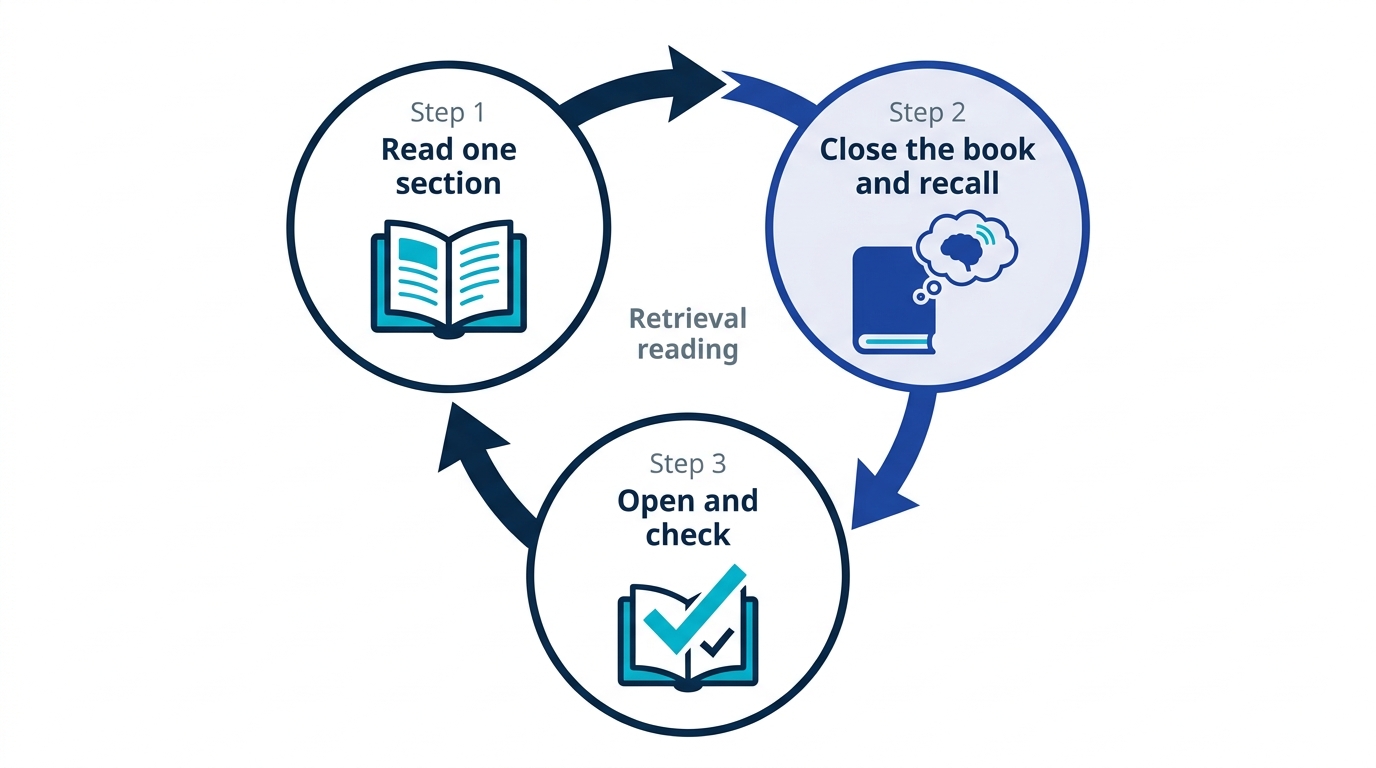
The first attempt may feel harder than rereading. Give yourself a chance to answer, then check the source and correct errors. Difficulty alone is not the goal: if you cannot recall any part of the idea, reread a smaller section and try again.
One recall is not enough: make forgetting part of the system
Even successfully recalled material fades; that is the forgetting curve doing its job. The counter is spaced repetition: recall again just as the memory starts to slip. Each successful retrieval flattens the forgetting curve and lets the next review wait longer.
The catch is bookkeeping. Tracking which point from which chapter needs recalling on which day is not a job for a human. This is the part you hand to software.
Memly turns what you read into questions automatically
- Your reading becomes your quiz: photograph a textbook page or upload a PDF or pasted text, and AI generates question-and-answer flashcards from it. No card-writing sessions.
- Review timing is suggested for you: the FSRS scheduler uses your past answers to estimate when a card should return.
- Web, iOS, and Android: read at your desk, recall on the train.
The loop itself does not change. You still read the section, close it, and try to produce it. What changes is that nothing depends on you remembering which chapter was due today.
For the full picture of AI-assisted memorization, see the pillar guide AI-Assisted Memorization: How It Works and the Best Tools, and for the science of what actually works, see 5 Evidence-Based Study Methods That Actually Work. If most of what you read is lecture notes and slides, the same recall-first approach applies — see how to turn lecture notes and slides into flashcards.
Skip the "one more reread" today
You do not need to stop reading or turn every sentence into a card. Begin with one important section and check whether you can explain its main point. If you want to save the weak points for later, follow our guide to writing clear flashcard questions.
Next time you open a book, try it with one section. Read it, close the book, and see what you can pull back out. And when you want that loop to run itself, photograph the page and hand it to Memly. Free to try, no credit card required.
