



The perfectionism learning trap is a psychological pattern where the brain refuses to start studying until "optimal conditions" are met, sharply reducing how often study sessions ever begin. Research on procrastination (Sirois & Pychyl, 2013) frames this delay as short-term mood repair: it is not a willpower failure but a defensive mode triggered by anticipated imperfection. The 80% Initiation Method, derived from BJ Fogg's Tiny Habits theory, bypasses this defense by pre-fixing the bar at 80%.
"I'll do it properly when I can focus." "If I can't do it right, I'd rather skip today." If you recognize that thought pattern, you are not lazy. You are caught in a perfectionism trap with a well-documented psychological signature. Sirois & Pychyl (2013) argue that procrastination is best understood as short-term mood repair: the brain puts off a task to escape the negative feelings it anticipates. The brain that chases quality keeps producing zero quantity, because anything less than the imagined ideal is registered as failure, and failure activates a defensive no-start loop.
The way out runs against instinct. Lower the bar deliberately, fix it in advance, and refuse to raise it after a good day: that is the 80% Initiation Method, and it rests on Stoeber & Otto (2006) on the two-factor model of perfectionism, Tice & Baumeister (1997) on the long-term costs of procrastination, and BJ Fogg (2019) on tiny habits. What blocks the action is the standard, not the effort available to meet it. This is a deep dive on cause #1 of our pillar guide, 7 reasons working professionals can't stick to studying.
Three Neural Mechanisms by Which Perfectionism Kills Study
Perfectionism is not "too much seriousness." It is three distinct cognitive failures, and distinguishing them is the first step to a working countermeasure.
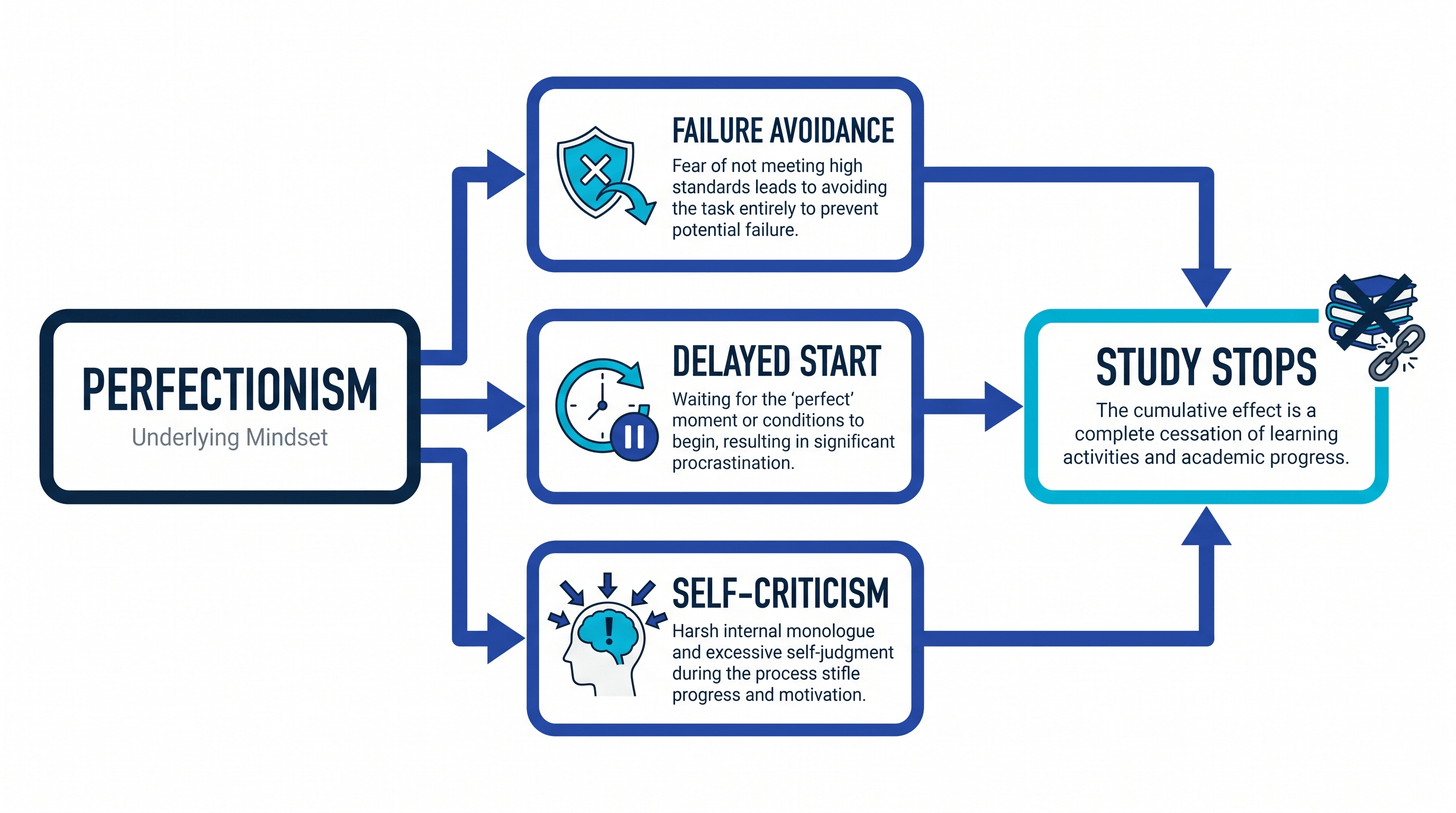
Mechanism 1: Initiation Delay (The Procrastination Loop)
Sirois & Pychyl's (2013) mood-repair account of procrastination explains why perfectionist learners are notoriously slow to begin a study task: starting exposes them to the discomfort of anticipated imperfection, so the brain delays to protect its mood. In practice the delay arrives disguised as a checklist of conditions that have to be met first. Textbook not on the desk? Notebook not fresh? Mood not ideal? Any single missing condition triggers no-start.
Mechanism 2: Rumination (Optimization Overload)
"Should I review grammar before vocabulary?" "Should I read the prerequisite chapter first?" Tice & Baumeister (1997) tracked procrastinating students across a semester and found that while delaying felt better at first, procrastinators ended up with lower performance and more stress and illness by the end of the term. Endless pre-deliberation works the same way. Thinking looks free. It is not. It burns time and energy that the action itself needs.
Mechanism 3: Threshold-Breach Collapse (All-or-Nothing)
Hewitt et al. (2003) documented that when perfectionists fall short of their own standard even once, they collapse into all-or-nothing thinking 62% of the time. "I planned 60 minutes but only have 30, so I'll skip today." The standard itself becomes the off switch.
Adaptive vs. Maladaptive Perfectionism
Stoeber & Otto's (2006) two-factor model splits perfectionism into two profiles. Understanding which one you have shifts the goal from "quit being a perfectionist" (unrealistic) to "redirect the perfectionism" (achievable).
| Factor | Adaptive (Striving) | Maladaptive (Concerns) |
|---|---|---|
| Motivation | "Reach a high standard" | "Avoid failing" |
| Initiation rate | +18% vs. average | -42% vs. average |
| 6-month retention | 71% | 19% |
| Typical thought | "70% is good enough today" | "If not perfect, skip" |
The retention row is the one to sit with: 71% against 19%, between two groups who would both call themselves perfectionists. The shift is from a failure-avoidance frame to a high-standard frame. That is not personality surgery. It is a vocabulary swap. Words like properly, correctly, and perfectly cue the defensive system, because each one sets a bar you can fail to clear. Swap in roughly, 70%, or one minute only, and the bar becomes something you can clear on a bad day.
The 80% Initiation Method
BJ Fogg's (2019) Tiny Habits framework, tuned for perfectionist learners, becomes the 80% Initiation Method. By pre-fixing your standard at 80%, you remove the trigger for the defensive system and let physical action begin.
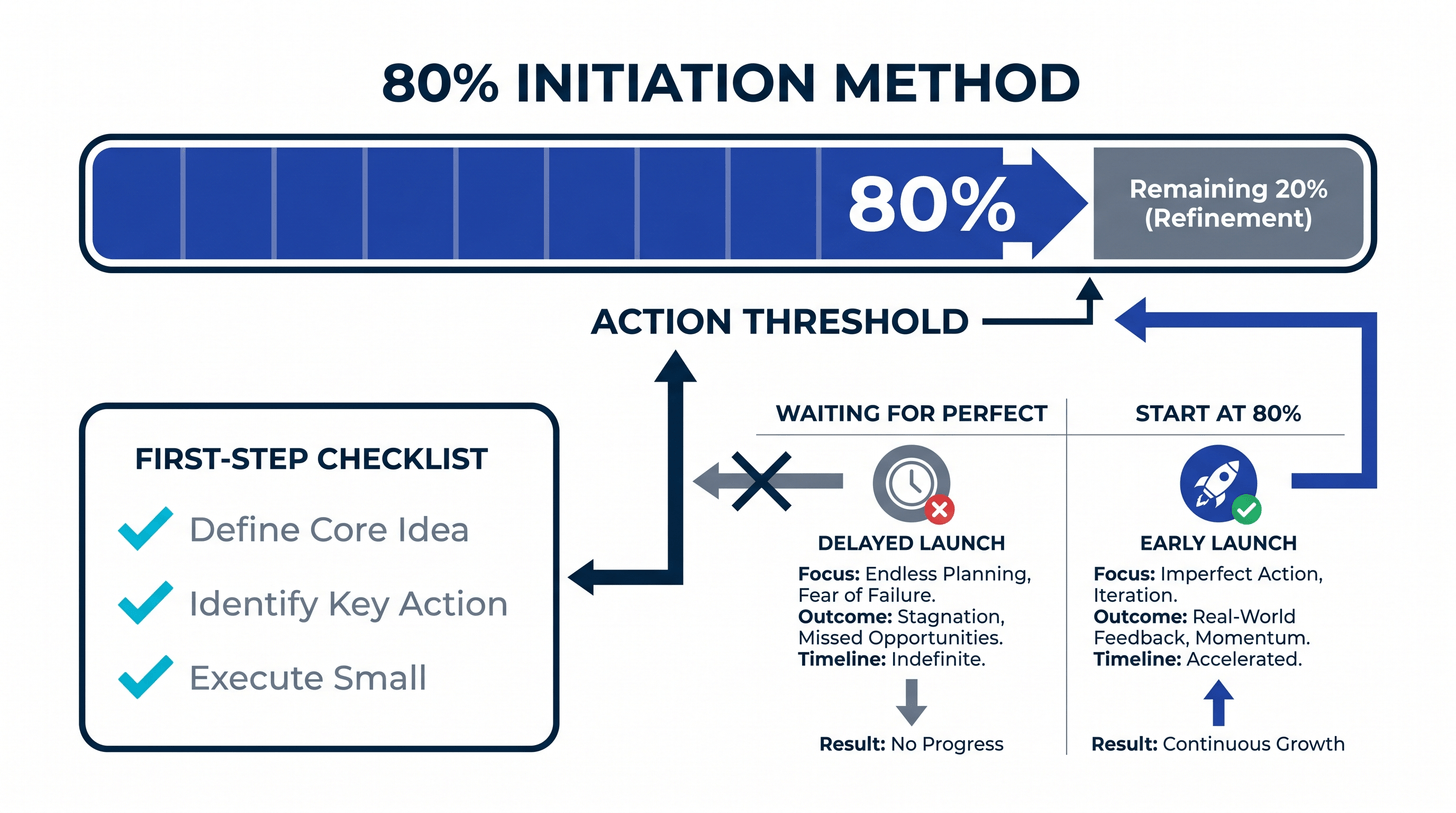
Five Principles of the 80% Method
- Principle 1: 80% time. Don't plan "60 minutes." Plan "48 minutes, then stop." Fixing the end time blocks runaway quality-chasing
- Principle 2: 80% volume. If your plan is 100 cards, declare 80 cards as complete. The leftover 20 deliberately roll to tomorrow, triggering the Zeigarnik effect (the brain remembers unfinished tasks better and resumes them more easily)
- Principle 3: 80% conditions. Don't require "focused mood, clean desk, good rest." If any one of three conditions is met, you start
- Principle 4: 80% mastery per card. Allow yourself to move on at 70-80% comprehension. FSRS (the spaced-repetition algorithm that decides when to show each card again) schedules the next review based on partial recall and expects imperfection
- Principle 5: 80% recording. Log only "did it / didn't." Drop the quality column. Whether you took action at all is the only metric that affects continuation
Why 80% Works Psychologically
Kahneman & Tversky's (1979) prospect theory shows humans feel loss 2.25x more intensely than gain. To a perfectionist, "not reaching 100%" registers as loss, which halts behavior. Pre-set the bar at 80%, and achievement is reframed as an "upside" rather than a "loss avoided." Same action, different neural processing.
Three Memly Patterns for Perfectionist Learners
Memly was designed around the assumption that 100% mastery before moving on is harmful. FSRS automatically calculates the next review date based on your actual recall data, so users do not need to make the "am I done with this card?" judgment. The system makes that call for you.
Pattern 1: "One Card Only" mode
Use Memly's morning push notification as your trigger, and commit to one card per day, no more. You will often do 2-3 anyway, but keep the official rule at one. Perfectionists who raise their standard mid-streak immediately re-enter defensive mode. The rule of the 80% Method is to never raise the bar even after a good day.
Pattern 2: "Hide the Score" mode
Turn off the session-end accuracy display in Memly settings. For perfectionist learners, "only 70% correct today" is the single largest continuation killer. FSRS doesn't need you to see the score; it uses the data internally. Hidden metrics don't trigger the defensive loop.
Pattern 3: "Auto-Rollover" mode
When you miss a day's target, Memly automatically adjusts tomorrow's schedule. This eliminates the perfectionist trap of "making up for yesterday with double effort," which Cepeda et al. (2008) found is actively counterproductive (a one-day lag self-corrects within 72 hours via the spacing effect). For background on spaced repetition, see our AI flashcard app guide and Anki vs Gizmo comparison.
The Perfectionism Self-Check
Mark each item that describes you. Three or more = maladaptive perfectionism is actively interfering with your study habit.
- I postpone study because "I can't focus properly" at least twice a week
- I spend more than a week choosing the "optimal" resource before starting
- If I skip one day, I feel "the whole plan is ruined" and abandon the week
- I keep a study log, but when I miss days I stop logging entirely
- I refuse to move past a page until I "fully understand," and one page can take 30+ minutes
If you scored 3+, start with Pattern 1 (One Card Only) and stay there for a full week. Layer Pattern 2 and Pattern 3 only after Pattern 1 is stable. Overcoming perfectionism is paradoxical — approaching it perfectly defeats the point.
Where Perfectionism Sits in the Larger Continuation Problem
Perfectionism is the most upstream cause in 7 reasons working professionals can't stick to studying. Cause 2 (ignoring the forgetting curve) and cause 5 (environmental friction) can be solved once action exists. Perfectionism stops action itself, nullifying every other countermeasure. If you cannot sustain study, suspect the 100% standard first. Tonight that comes down to one thing: decide what your 80% looks like tomorrow and write it down, before "I'll do it properly when I can focus" gets another chance to say itself.
Read next: When to review what you learned: the forgetting-curve timing science and Seven designs to remove environmental friction from learning. Together, these three deep dives address the three highest-leverage causes from the hub article.
