


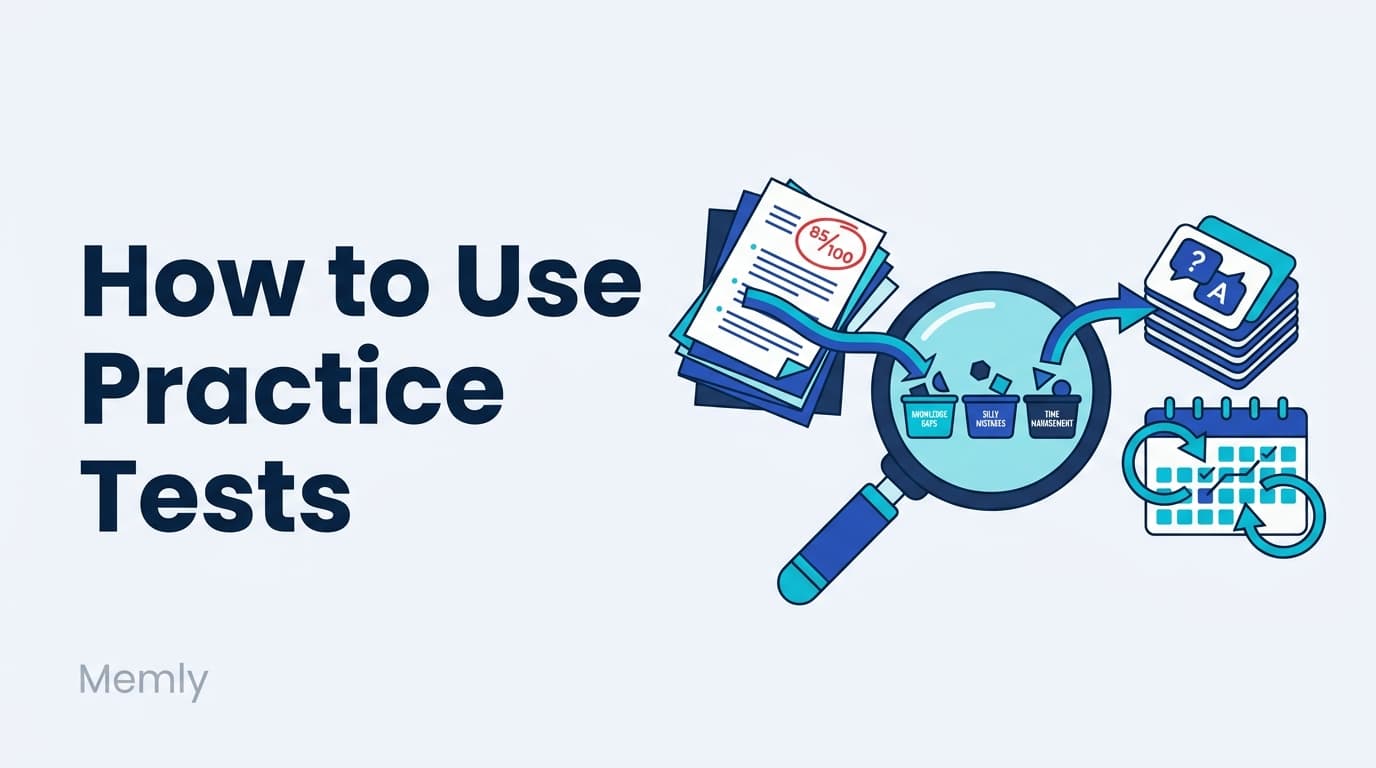
Finishing practice tests is useful, but the review matters too. If you read an explanation, recognise it, and move on, you may not yet know whether you can solve the problem independently. Keep track of why answers went wrong, practise the missing skill, and retry after a gap.
The short version: treat practice tests as tests, not as reading material. Solve under real conditions, classify every miss by its cause, turn only the knowledge gaps into flashcards, keep those alive with spaced repetition, and re-solve later as a genuine check. The value is not in solving; it is in what you do after solving.
Why practice tests are scientifically the best material
Everyone says to do past papers. Almost nobody says why, which is how they end up being read instead of taken.
In Dunlosky's large 2013 review of study techniques, the top-rated method was practice testing, recalling knowledge from memory. Solving a past paper under exam conditions is practice testing in its purest form. In Roediger and Karpicke's 2006 experiments, students who practiced recall remembered more a week later than students who reread (roughly 56% versus 42%; estimates vary by condition, the direction is the point).
Past papers add something no other material has: they show you exactly how the exam asks. One activity gives you retrieval practice and reconnaissance at the same time. That is why they are too valuable to waste.
The wasteful pattern nine out of ten people follow
Solve, grade, read the explanations, feel that satisfying "ah, I see," move to the next set. The failure is hiding inside the "ah, I see": understanding an explanation is recognition (it makes sense when shown) rather than recall (you can produce it yourself), and a few days later the same question stops you again. We trace this trap in Why You Forget What You Read.
Every wrong answer is treasure your practice test dug up for you. Reading the explanation and moving on is burying it again.
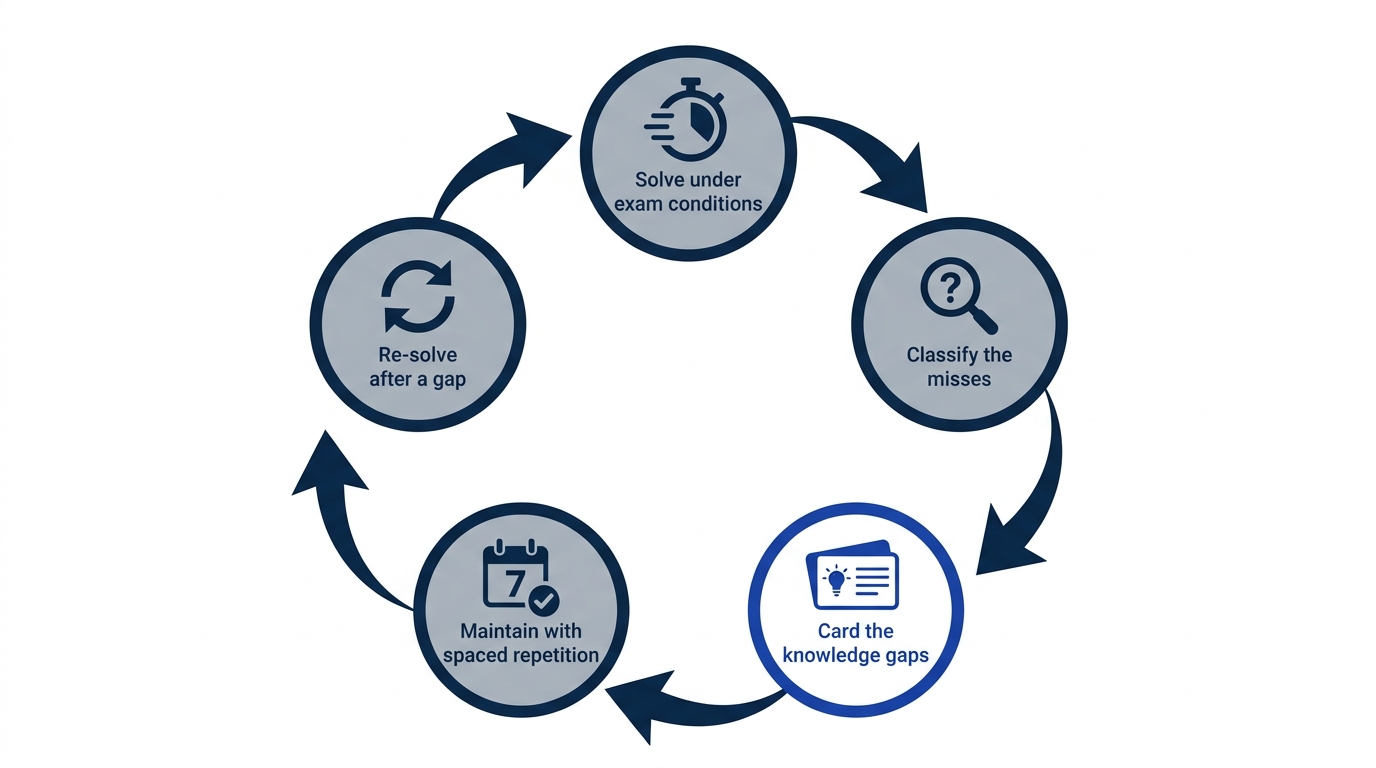
The five-step protocol that wastes nothing
So the protocol has one job: make sure nothing you dug up gets buried again.
- Solve under real conditions: timed, closed book. Skip this and it stops being a test and becomes busywork.
- Classify every miss by cause: knowledge gap, application error, or careless slip (details below).
- Turn knowledge gaps into cards: not the question itself, but the fact or rule it tested, phrased as question and answer.
- Keep them alive with spaced repetition: the cards resurface just before you would forget, all the way to exam day.
- Re-solve after a gap: weeks later, the same test tells you whether the holes are actually filled.
Three kinds of misses, three different treatments
Step two is where people balk. Sorting your own mistakes feels like paperwork when you could be solving another set instead.
| Type of miss | What went wrong | Treatment |
|---|---|---|
| Knowledge gap | You never knew it, or forgot it | Make a flashcard, maintain with spaced repetition |
| Application error | You knew it but used it wrong | Solve similar problems; card the "which tool for which situation" rule |
| Careless slip | You knew it and still dropped it | Log your slip patterns; build a fixed final-check routine |
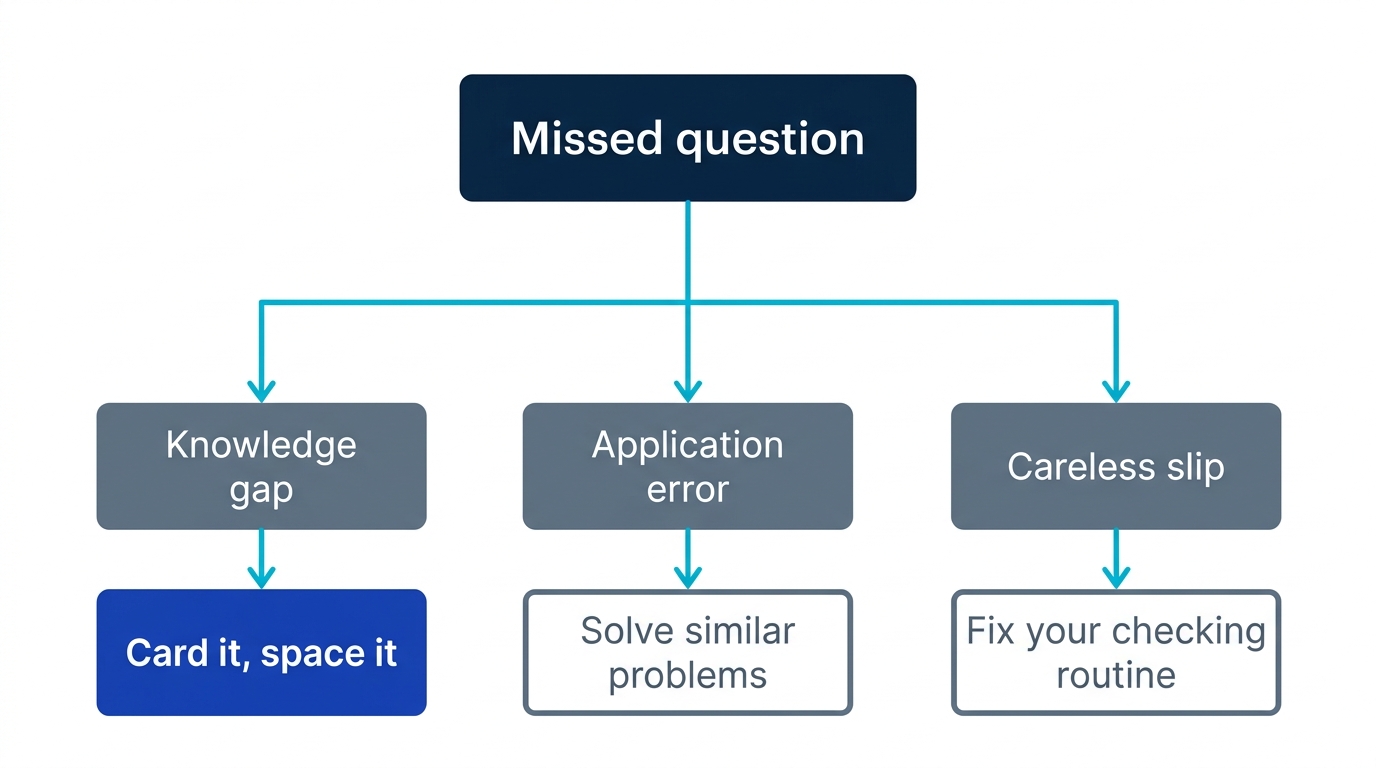
Skip the classification and "read all the explanations" treats every miss the same: too weak for knowledge gaps, overkill for careless slips, optimal for nothing. Classification takes ten seconds per question. Ten seconds of diagnosis multiplies the value of every review minute.
How many passes, and what each one is for
| Pass | Purpose | What you do |
|---|---|---|
| First pass | Diagnosis | Learn where you stand and how the exam asks; start classifying and carding |
| Second pass | Verification | Re-solve to check that the carded holes are actually filled |
| Third pass and beyond | Exam simulation | Practice time allocation and your checking routine, not perfection |
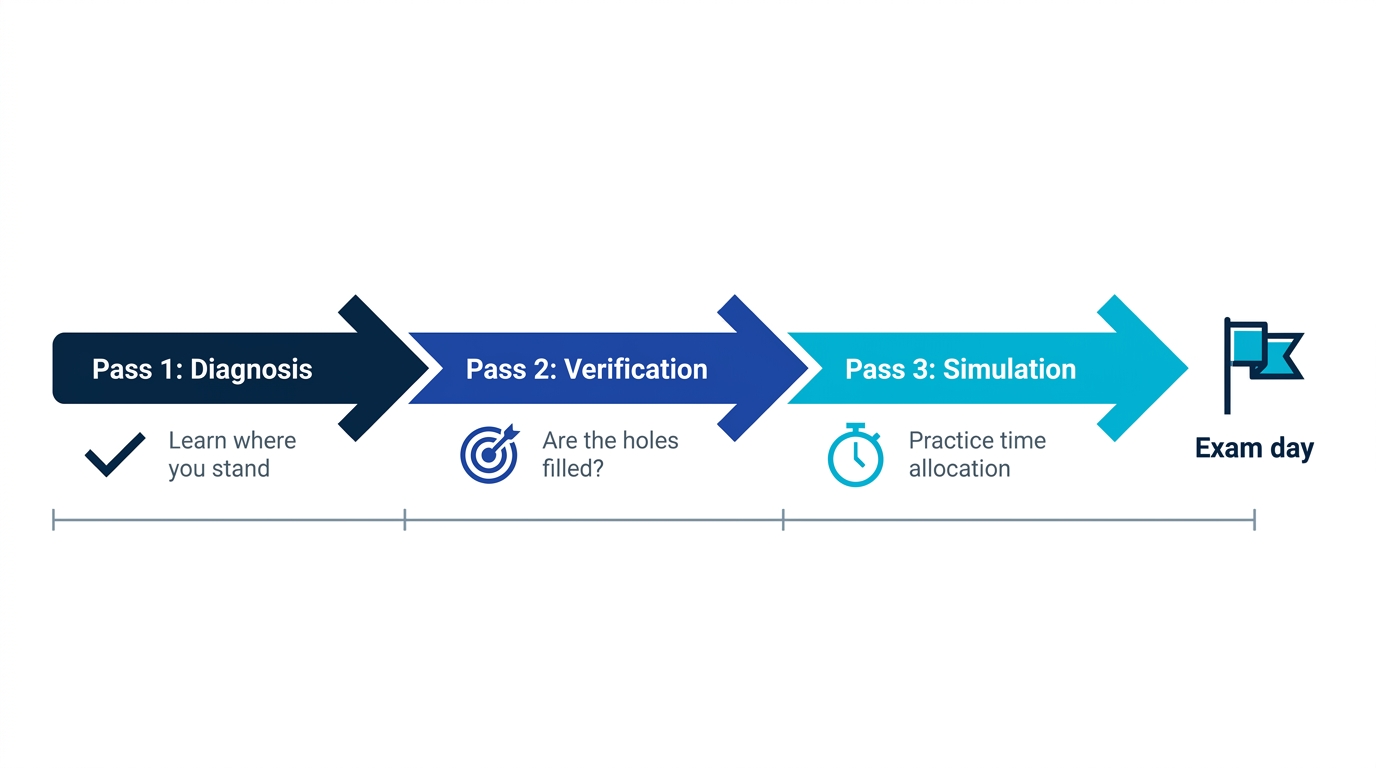
How many years or sets you need depends on the exam, but the principle does not: fully digesting one set beats superficially solving five. For how this fits into certification prep, see Certification Exams and AI-Assisted Memorization.
Memly turns miss-to-card into a thirty-second habit
- Photograph the explanation page: shoot the solution page or your notes for a missed question, and AI converts the underlying knowledge into question-and-answer cards. Card-making effort stops being the reason you skip it.
- FSRS keeps holes filled until exam day: cards resurface as you start to forget, so a gap found in pass one is still closed months later.
- Web, iOS, and Android: solve at your desk, review the cards on the train.
For the full picture of AI-assisted memorization, see the pillar guide AI-Assisted Memorization: How It Works and the Best Tools. If your exam is already close, start with Exam in 3 Days? The Science-Backed Way to Cram.
Stop the solve-and-forget cycle with your next test
On the next practice test, keep a short note of why each missed answer went wrong. Choose one recurring error to work on first, then retry a similar problem later. The aim is a better next attempt, not a perfect record of every mistake.
Solve your next practice test exactly as usual. Change only what happens after: classify your misses into the three types, then photograph the explanation pages of the knowledge gaps and turn them into cards. That single change makes the whole set yours. Memly is free to try, no credit card required.
