


Every year, many test-takers attempt the TOEFL, IELTS, GRE, MCAT, bar exam, or CPA exam and fall short. Most who don't pass assume they "didn't study enough," but the real cause is often different. Even with the same study hours, the difference between passing and failing often comes down to memorization method. The variable that separates the two groups is when each item gets reviewed, and that is exactly what AI-powered memorization support takes over.
As of 2026, AI-powered memorization support is becoming common in exam preparation. What changes from one exam to the next is not the method but the arithmetic: how many items, spread across how many months, held at what retention target.
Why So Many Test-Takers Fail at Memorization
The most common failure pattern in exam preparation is passive learning: reading textbooks repeatedly or making neat summary notes. In the 2013 review of study techniques by Dunlosky and colleagues, rereading and summarizing were rated low-utility, because they never force the retrieval that strengthens a memory trace.
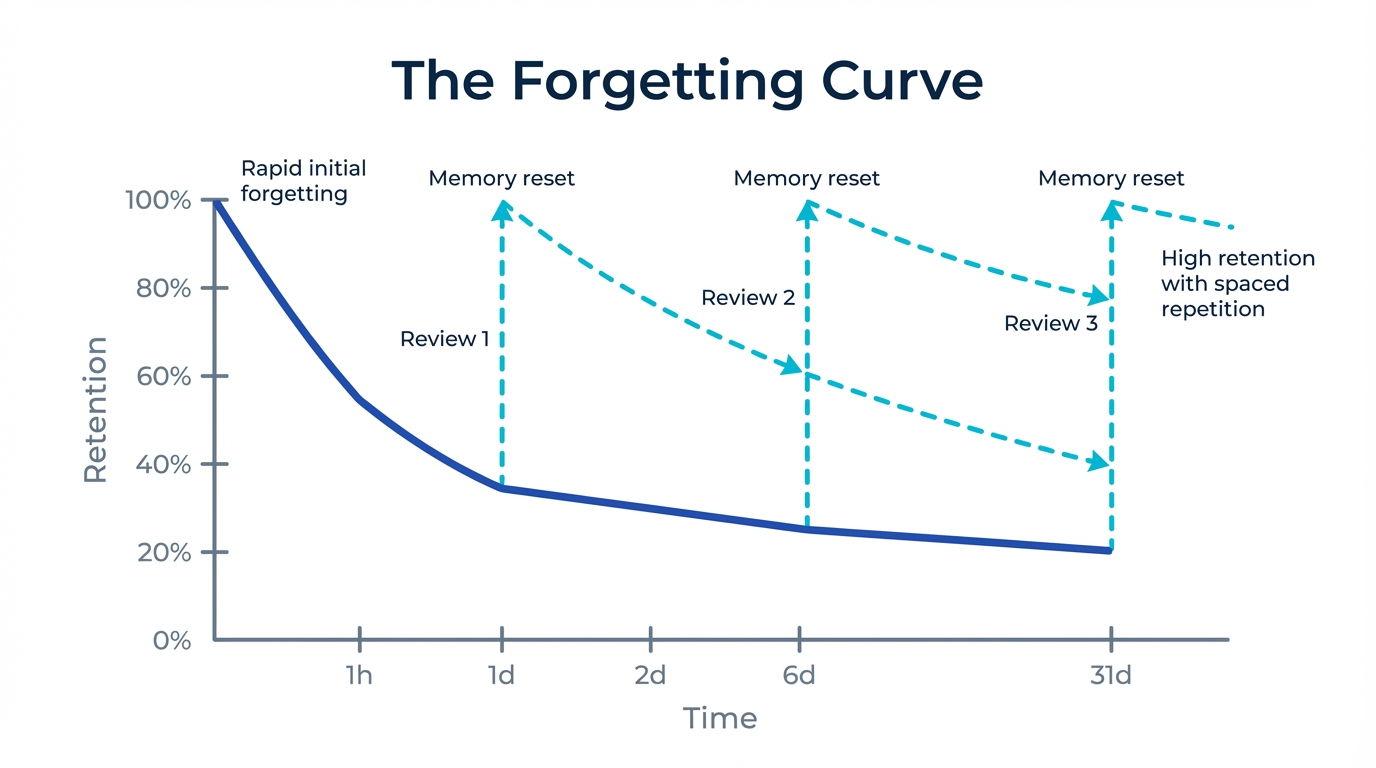
Even more concerning is the problem of review timing. Most test-takers fall into one of two extremes: reviewing after they've already forgotten, or reviewing while they still remember perfectly. Both are inefficient. The optimal moment for memory retention is "just as you're about to forget," but manually managing this timing across thousands of items is impossible.
| Failure Pattern | Why It's Inefficient | What It Costs You |
|---|---|---|
| Rereading textbooks | Passive processing doesn't stick in memory | Much of the study time leaves little lasting memory |
| Rewriting notes | Time spent on formatting, not reviewing | Hours of card creation before a single review happens |
| Last-minute cramming | Only short-term memory; fades during the exam | About 75% forgotten within one week (Ebbinghaus) |
| Self-timed reviews | Ignores the forgetting curve, leading to inefficient repetition | More review sessions for the same result |
The second row is the one candidates underestimate: the hours of card creation spent before a single review happens. If any of these apply to you, you are losing study time right now. A six-month delay in passing costs another round of exam fees and study materials, and, more than either of those, six months of your time.
3 Reasons AI-Powered Memorization Support Transforms Exam Prep
AI-powered memorization support changes traditional memorization in three ways.
Reason 1: Fully Automated Review Scheduling Based on the Forgetting Curve
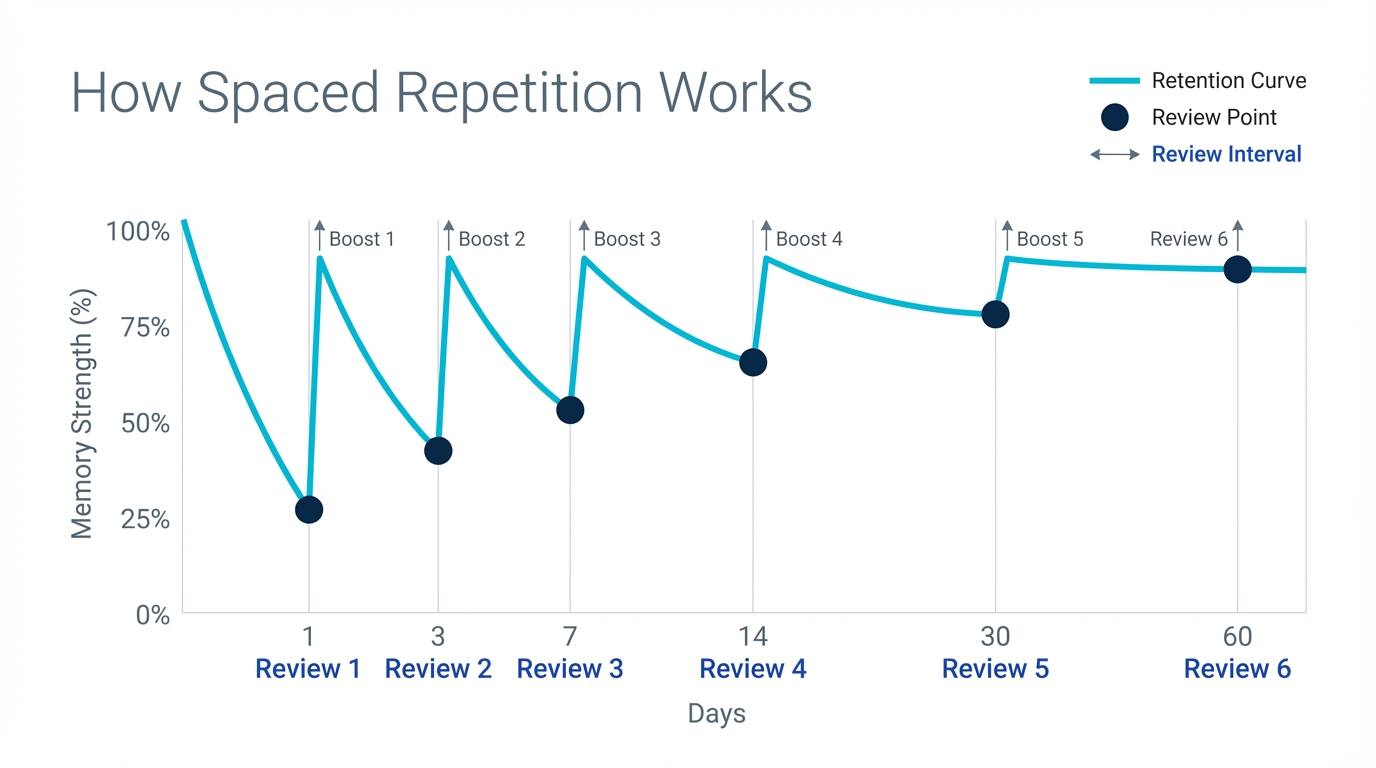
AI calculates the forgetting probability of each item in real time and presents reviews at the "optimal moment just before you forget." In Memly's internal study (n=648, 2025), retest accuracy was 74% higher than with traditional repetition. Tracking review timing across thousands of items is impossible to do by hand, and this is the part that becomes fully automated.
Reason 2: AI Auto-Generates Flashcards from Your Study Materials
Simply upload your textbooks or PDFs, and AI extracts key points to automatically generate Q&A-format flashcards. Card creation that used to take hours of typing can shrink to minutes of checking.
Reason 3: Automatic Weak-Point Detection and Targeted Reinforcement
AI analyzes your answer patterns and automatically identifies weak areas. Difficult cards are repeated at shorter intervals while easy cards are spaced further apart. This lets you concentrate your limited study time on the areas that matter most.
Exam-Specific Strategy Guide
TOEFL / IELTS Preparation
In language proficiency exams, vocabulary directly impacts your score. To aim for a high TOEFL or IELTS score, you need a large vocabulary, often several thousand words or more, and AI-powered memorization support helps you acquire it efficiently.
The table below is a qualitative guide, not a measurement. How long vocabulary takes depends on your starting level and how much time you study each day.
| Target Score | Vocabulary Load | What AI Memorization Support Changes |
|---|---|---|
| TOEFL 80 / IELTS 6.0 | Core academic vocabulary | Cards come from your own reading and reviews are scheduled for you |
| TOEFL 100 / IELTS 7.0 | A larger range, including less common academic words | Words you keep missing come back sooner, so time goes where you need it |
| TOEFL 110+ / IELTS 8.0+ | A very large range, including nuance and collocations | Example sentences and context are built into each card |
| GRE Verbal 160+ | A long tail of rare, abstract words | Word lists become decks in minutes, and spacing handles the long tail |
The bottom row is the heaviest: GRE Verbal rewards a long tail of rare words, which is where automatic scheduling saves the most effort. With Memly, you upload a vocabulary PDF and the AI generates the flashcards, complete with definitions, example sentences, and context. Even 15 minutes of daily study adds a steady stream of new words over a month. For these three exams the core list is already built: TOEFL Academic Vocabulary 500, IELTS Academic Vocabulary 500 and GRE High-Value Vocabulary 400 are free decks you can import instead of typing out.
Bar Exam Preparation
The bar exam demands vast knowledge spanning constitutional law, contracts, torts, criminal law, civil procedure, evidence, and property law. Precise memorization of statutes, case holdings, and legal doctrines can involve a very large number of items.
| Subject | Example Deck Size | Example Review Intensity | Key Memorization Items |
|---|---|---|---|
| Constitutional Law | ~2,000 cards | Intense | Amendments, landmark cases, rights patterns |
| Contracts | ~3,000 cards | Solid | UCC rules, elements, remedies |
| Torts / Criminal Law | ~3,000 cards | Solid | Elements, defenses, Model Penal Code |
| Civil Procedure | ~2,500 cards | Standard | Federal rules, jurisdiction, motions |
| Evidence | ~2,000 cards | Solid | FRE rules, hearsay exceptions |
| Property | ~1,500 cards | Standard | Estates, future interests, recording acts |
Deck sizes and intensities here are planning examples, not requirements or measured figures. Memly lets you set a review intensity for each deck (Light, Standard, Solid, or Intense), so you can keep each subject in its own deck and prioritize strategically: Intense for heavily tested Constitutional Law and Standard for less-weighted Property, for example.
MCAT Preparation
The MCAT covers approximately 230 questions across four sections: biological and biochemical foundations, chemical and physical foundations, psychological and social foundations, and critical analysis. A competitive score requires precise memorization of vast scientific content.
| Section | Example Deck Size | Example Start | Content to Cover |
|---|---|---|---|
| Bio/Biochem | ~4,000 cards | 12+ months before | Pathways, enzymes, organ systems |
| Chem/Physics | ~2,500 cards | 12+ months before | Formulas, reactions, key constants |
| Psych/Sociology | ~3,000 cards | 6+ months before | Theories, terminology, studies |
| CARS Vocabulary | ~1,000 cards | 6+ months before | Argument types, rhetorical terms |
| High-Yield Review | ~1,500 cards | 3 months before | Most-tested topics across sections |
Deck sizes and start times above are planning examples, not requirements. Some pre-med students convert practice questions into AI-generated flashcards and review them with the FSRS 6.0 algorithm (a modern spaced-repetition scheduler that predicts when you're about to forget each card). Memly supports image-based cards, which makes it a good fit for anatomy diagrams and diagnostic imaging.
CPA Exam Preparation
Under the CPA Evolution model (effective January 2024), the CPA exam consists of three Core sections (AUD, FAR, and REG) plus one Discipline section of your choice (BAR, ISC, or TCP), requiring broad knowledge across auditing, financial accounting, regulation, and your chosen specialty. That breadth is what makes AI-driven memorization management pay off here: no single subject is unusually hard, but no candidate can keep four of them warm at once by hand.
| Section | Key Subjects | Example Deck Size |
|---|---|---|
| FAR (Core) | GAAP, financial statements, govt. accounting | ~5,000 cards |
| AUD (Core) | Audit procedures, ethics, reports | ~3,000 cards |
| REG (Core) | Tax law, business law, ethics | ~4,000 cards |
| Discipline (BAR / ISC / TCP) | Business analysis, information systems, or tax compliance and planning (choose one) | ~2,500 cards |
The deck sizes above are planning examples, not requirements. For CPA candidates, the biggest challenge is the breadth of material across all four sections. AI-powered memorization support manages review timing across every section in one place, reducing the risk of the dreaded "I haven't looked at this in weeks and forgot everything" scenario. The same method extends to licensure exams beyond the four above. For a worked example, see our guide to studying for the teacher certification exam.
How Test-Takers Can Use AI Memorization Support
The three examples below are illustrations of how a learner might use the method, not reports from individual users.
- TOEFL candidate: a learner who keeps rereading vocabulary books can instead upload a word list or reading passages, generate cards, and let the schedule bring each word back just before it fades. Words that keep coming back become the ones to practice in sentences.
- Bar exam candidate: with a large volume of rules and cases, a learner can build one deck per subject, review a little every day, and rely on the scheduler instead of tracking review timing by hand. Weak cards return sooner, so limited time goes to the rules that are still shaky.
- MCAT candidate: a learner can upload practice question PDFs and have AI draft cards for memorization-heavy topics such as biochemistry and psychology. The time saved on typing cards can go to practice passages and full-length exams.
Start Using AI Memorization Support for Your Exam Today
If reading this has made you want to try it, starting right now is the most important step. "I'll do it later" is where most study plans quietly end.
- Create an account: it takes a moment. No payment method required. Just an email address to get started.
- Upload your study materials: your current textbook PDFs, practice exams, or notes. AI turns them into flashcards.
- Start 15 minutes of daily review: AI automatically presents "today's cards." No planning needed.
- Check your results after one week: items you previously couldn't retain may now come back to you more easily.
The free plan lets you try AI generation with your own material. Start with just a portion of your exam material.
How many days until your next exam? Can you realistically cover everything you need to memorize with traditional methods in that time? If you have any doubt, try Memly today. Create an account and upload just one study PDF. After 15 minutes of studying AI-generated cards, you'll wonder why you ever did memorization the old way. It's free to start.
To learn more about how AI-powered memorization support works and what the evidence for it looks like, read the full guide. For scientifically proven study techniques beyond memorization, check out 5 Scientifically Proven Study Methods. For specific ways to use AI flashcards, see Achieve 74% Better Retention with AI-Powered Flashcard Learning. To find the best app for your exam prep needs, see our AI flashcard app guide.
