


One month to go. The next 30 days will move your result as much as the previous six months did. And yet most candidates spend them finishing the textbook they never finished: pouring in new material right up to the end, leaving no time for exam-format practice or for keeping the already-learned material alive. The final week turns into panic, and points that were already earned quietly leak away.
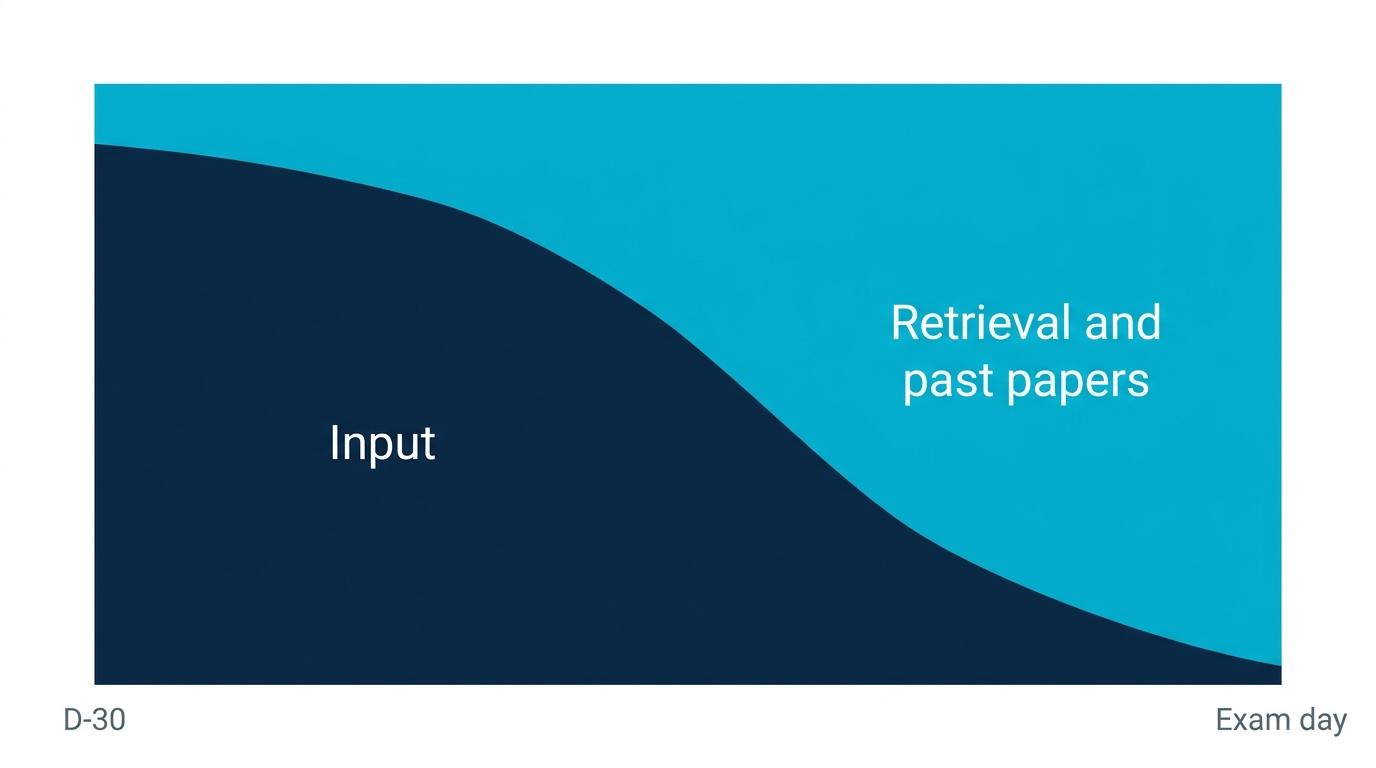
The whole month turns on one pivot: stop putting knowledge in, start getting it out. If your certification or licensing exam lands this fall, that pivot is due today.
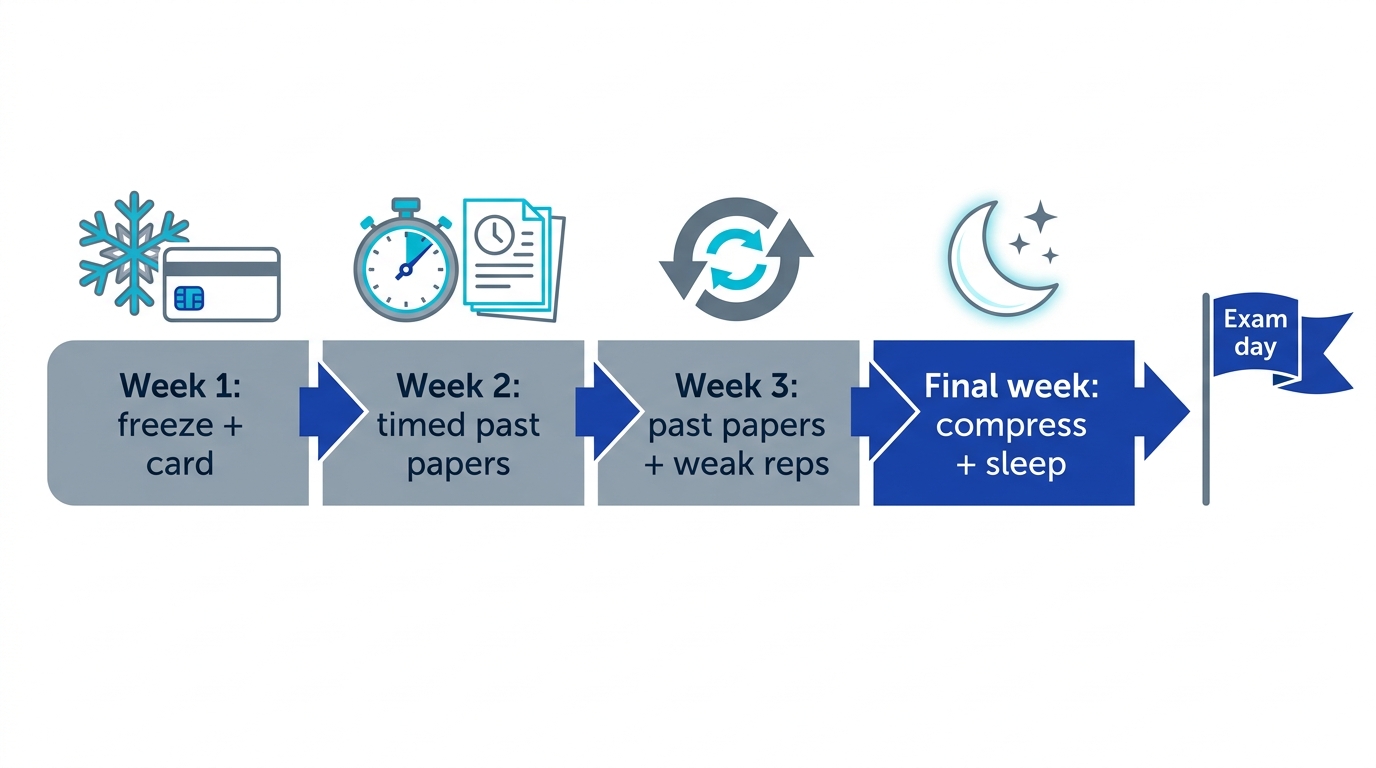
The short version: one month before the exam, (1) freeze new material in week 1 and finish converting what stays into cards, (2) spend weeks 2-3 on past papers under real conditions, carding only the misses, and (3) reserve the final week for compressing weak cards and protecting sleep. The last 30 days are not for cramming more in; they are for output practice and defending what you already own.
What should you do one month before an exam? Freeze the intake
The biggest decision at D-30 is the new-material freeze. A chapter started now will not be solid by exam day. The only exception: untouched material that is both heavily weighted and frequently tested. Everything else stays out of the queue, and the freed time goes to carrying what you already learned in retrievable condition all the way to exam day.
If you still have 90 days, the full-length version of this plan is in Three Months Before the Exam.
The 30-day reverse plan, week by week
| Week | Main job | Not this |
|---|---|---|
| Week 1 (D-30 to 24) | Decide the freeze. Finish carding what stays. Get the review queue in order | Reading new chapters |
| Week 2 (D-23 to 17) | Past papers under timed, exam conditions. Classify misses; card only knowledge gaps | Solve-and-forget |
| Week 3 (D-16 to 10) | Two or three more past papers plus weak-card repetition. Lock in time allocation | Re-grinding topics you already get right |
| Final week (D-9 to eve) | Compress only the cards you still miss. Shift your body clock to exam hours, guard sleep | All-nighters, new material |
Why are weeks 2-3 all about past papers?
Because past papers are retrieval practice shaped exactly like the exam. The skill of recalling under time pressure only grows in exam-format reps, never in rereading. The value is in what happens afterward: classify every miss as knowledge gap, application error, careless slip, or time-out, and convert only the knowledge gaps into cards. The full no-solve-and-forget protocol is in How to Use Practice Tests.
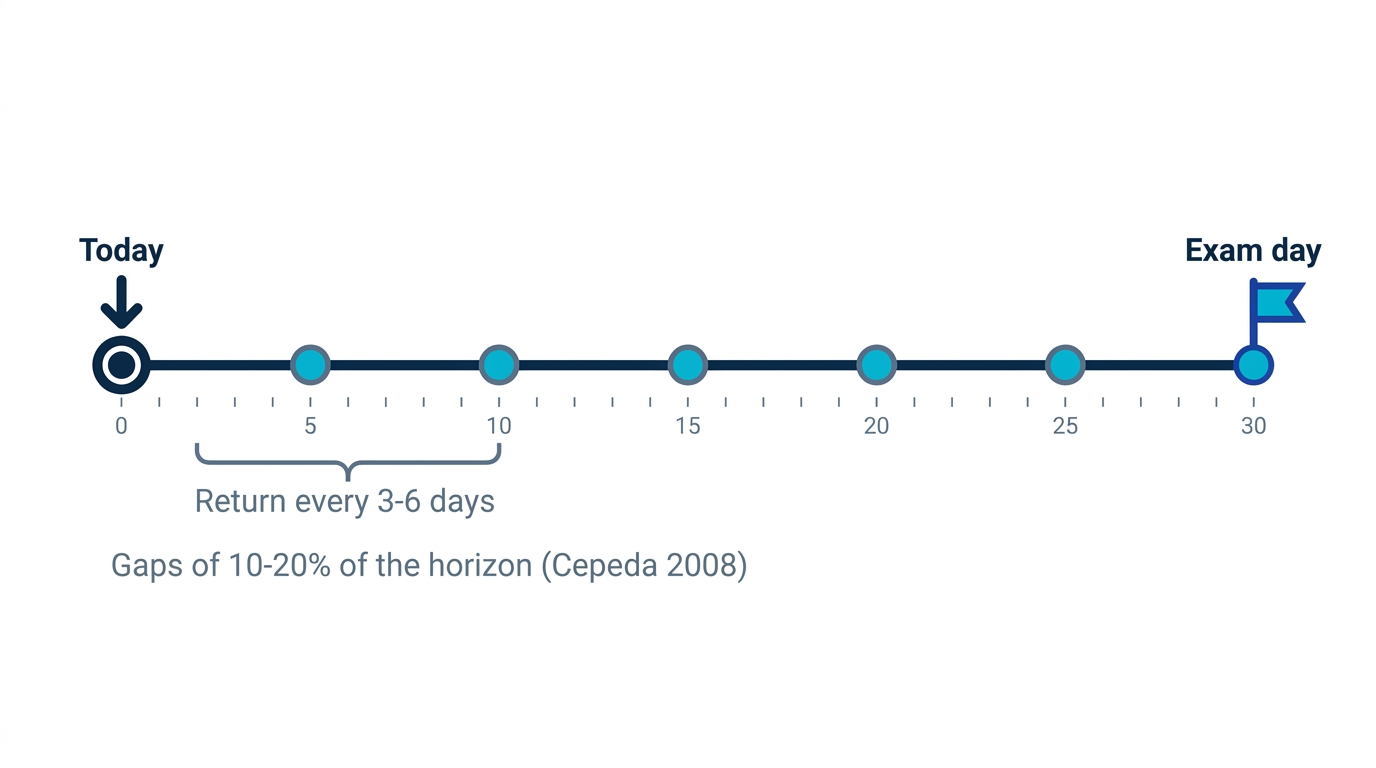
The revisit spacing has evidence behind it too. In Cepeda and colleagues' large 2008 experiment (n=1,354), review gaps of roughly 10-20% of the time you want to remember something for proved most efficient. With 30 days to go, that works out to returning to each weak spot every 3-6 days, rather than re-polishing the same topic daily. And you should not manage those gaps by hand; a spaced repetition algorithm does the bookkeeping per card.
The final week: cut, don't add, and sleep
The last week has one job: compressing the set of cards you still miss. Cards you recall reliably are already being pushed to longer intervals; leave them alone. The urge to reread everything the night before soothes anxiety but buys zero points. Sleep is the other half of the week's job: memories consolidate overnight, so the hour taken from bed costs more than the hour of rereading returns. If you find yourself inside the final 72 hours, the emergency version is Exam in 3 Days?
Running the 30-day plan on Memly
- Finish week 1 carding fast: photograph or upload the material that survives the freeze, and AI converts it into question-and-answer cards. In our internal study (n=648), card creation time dropped by 98%.
- The 3-6 day returns run themselves: FSRS computes each card's optimal gap and resurfaces weak cards on shorter cycles.
- Web, iOS, and Android: past papers at the desk, weak-card reps on the commute.
For the full picture of AI-assisted memorization, see the pillar guide AI-Assisted Memorization: How It Works and the Best Tools.
Draw the freeze line today
Most candidates will read this and still open a new chapter tomorrow, because "I haven't covered everything" feels unbearable. That feeling spreads the final 30 days thin. The people who pass are the ones who switch, right about now, from collecting material to producing answers.
One action today: draw the line in your materials that says nothing new gets memorized past here. Photograph what is inside the line, turn it into cards, and the 30-day queue starts moving tonight. Memly is free to try, no credit card required.
