


Your exam is in three days and some material is still uncovered. Start by choosing what matters most, not automatically rereading the textbook from page one. A short practice test can show which topics need factual review, a clearer explanation, or more problem-solving practice.
The good news: cognitive science has a lot to say about what sticks in a short window.
Three moves, then. Cut the material down to what is likely to be tested and you cannot do yet (triage), convert it into question-and-answer form and practice recalling it from memory instead of rereading (retrieval), and protect your sleep the night before so the memories actually consolidate.
Why cramming by rereading collapses on exam day
Rereading feels productive because the second and third pass feel smooth. That smoothness is a trap cognitive psychologists call the fluency illusion: text that is easy to re-read feels learned, but recognizing material when it is in front of you and producing it from a blank page are two different abilities. Exams only test the second one. We explain exactly why that gap forms in why you forget what you read.
In Dunlosky's large 2013 review of study techniques, rereading and highlighting were rated among the least effective methods, while practice testing (retrieval) and spaced review came out on top. In the classic Roediger and Karpicke (2006) experiment, students who practiced recalling a text remembered more a week later than students who reread it (roughly 56% versus 42%; the exact numbers vary by condition, but the direction is what matters).
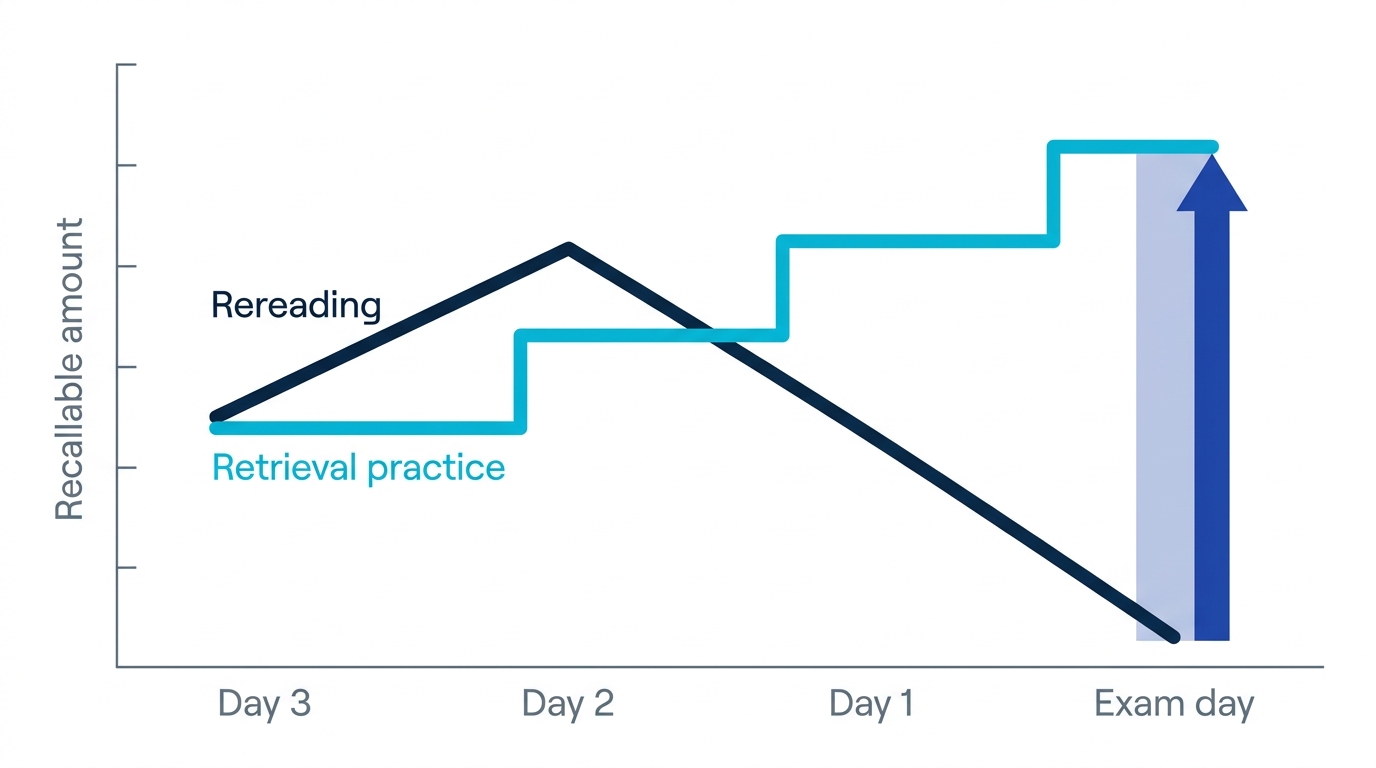
So the design principle for your three days is simple: minimize reading time, maximize recall time.
Day 3: triage the material and turn it into cards
First, decide what NOT to study
You cannot master everything in three days, so your first job is to cut. Sort the material into four buckets:
| Bucket | Likely on the exam? | Can you do it now? | What to do |
|---|---|---|---|
| A: Priority | Yes (past papers, emphasized in class) | No | Your battlefield. Turn into cards |
| B: Maintain | Yes | Yes | One quick pass the day before |
| C: Only if time allows | No | No | Do not touch until A is done |
| D: Drop | No | Yes | Nothing |
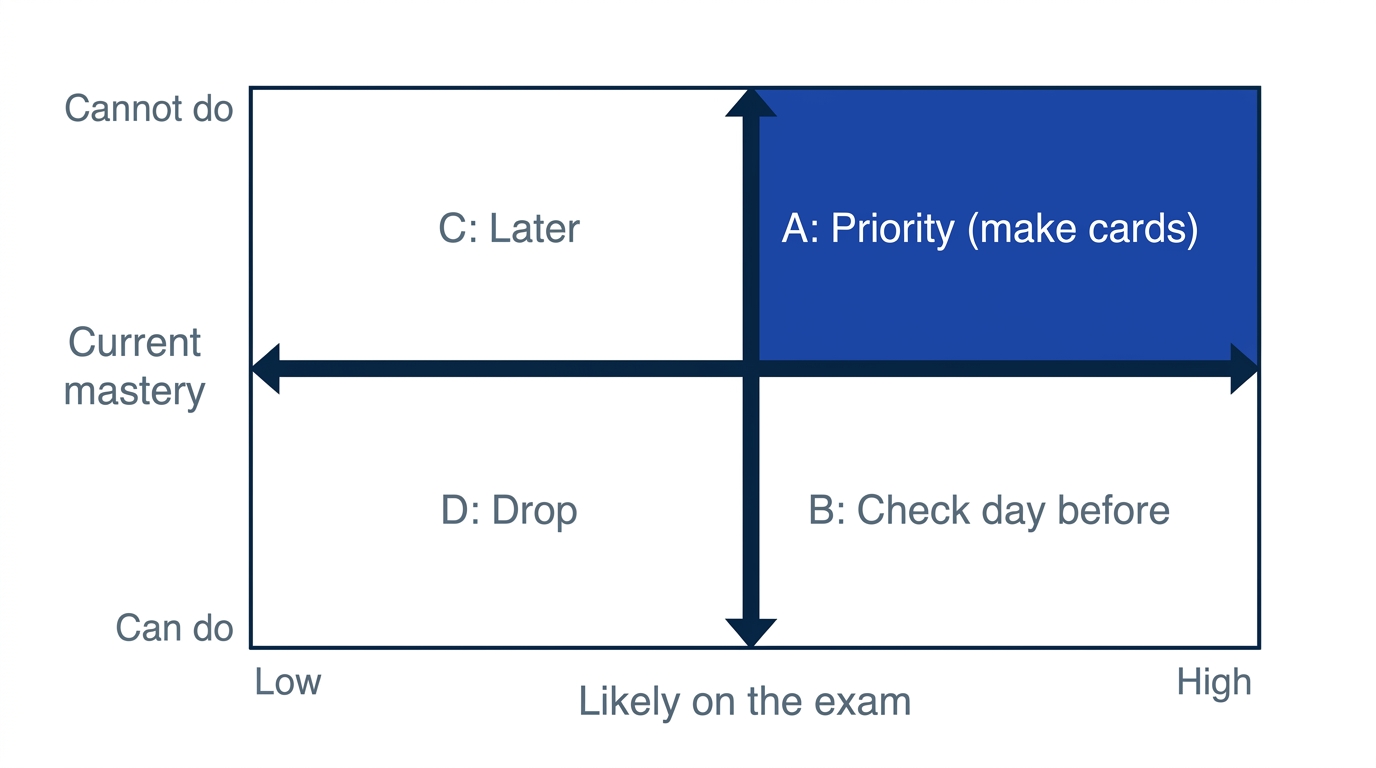
Use past exams, what the professor emphasized, and point values to decide. The bucket that hurts to fill in is D: material you already have cold that will not be tested. Every minute spent there is a minute taken from A. Spending a full hour on triage is fine; it sets the efficiency of everything that follows.
Then convert bucket A into question-and-answer cards
A textbook page only lets you read. A flashcard lets you practice retrieving. That conversion is the single most important move of the three days. Making cards by hand takes one to two minutes each, which you cannot afford right now, but with an AI flashcard tool you can photograph a textbook page or upload a PDF and get cards in seconds. The same move works for lecture notes and slides, not just textbooks — here is how to turn lecture notes into flashcards. By the end of Day 3, all of bucket A should exist as cards.
Day 2: nothing but retrieval practice
Do not chase new material today. Just work through your cards and sort them into "recalled" and "failed". The first pass will feel rough, and that is normal. Trying to recall, failing, and then checking the answer is precisely the loop that engraves memory far more deeply than another comfortable reread.
One key detail: space your passes out across the day. Review the cards you missed in the morning again at noon, and again at night. Spacing is not only a weeks-long strategy; meta-analytic work (Cepeda et al., 2006) shows that separating reviews in time improves retention even over short horizons. With three days, a gap of a few hours is the practical unit.
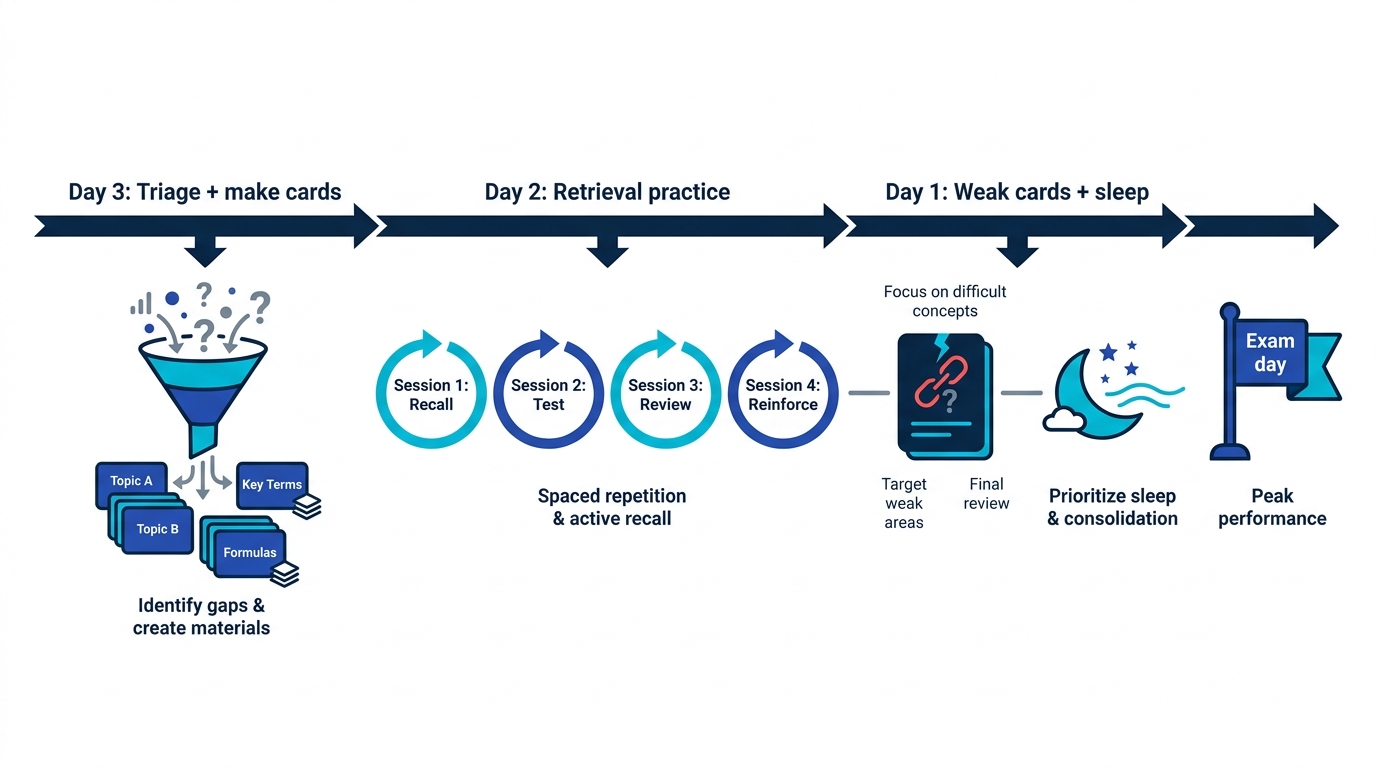
Day 1: weak cards only, then sleep
The day before the exam has exactly two jobs: repeat only the cards you still cannot recall, and go to bed. Cards you already know and bucket B get one quick confirmation pass, nothing more.
Pulling an all-nighter is the worst available move. A large body of research shows that memories are consolidated during sleep, so skipping sleep deletes the one step that makes the day's cramming stick. Sleep deprivation also degrades attention and reasoning during the exam itself. An extra hour of sleep the night before is worth more points than an extra hour of cramming at 2 a.m. The full case against the all-nighter, and what to do the night before instead, is in the science of pulling an all-nighter. For why the last session before sleep sticks best, see the best time to memorize.
The three-day plan at a glance
| Day | Do | Don't |
|---|---|---|
| Day 3 | Triage (1 hour), convert bucket A to AI cards, first retrieval pass | Read the textbook cover to cover |
| Day 2 | Retrieval passes every few hours, focused on missed cards | Start new material |
| Day 1 | Weak cards only, one pass over bucket B, early bedtime | All-nighters, full rereads |
Memly removes the bottleneck: card creation time
The choke point of this plan is Day 3, when material has to become cards. Memly is built for exactly that moment:
- Snap a photo, get cards: photograph textbook pages, handwritten notes, or handouts, or upload lecture PDFs, and AI turns them into question-and-answer cards in seconds.
- Your weakest cards come first: the FSRS spaced repetition algorithm automatically prioritizes what you are about to forget, so your remaining hours concentrate on weak points without you managing anything.
- Every gap becomes review time: Memly runs on Web, iOS, and Android, so the bus ride and the hallway before the exam count too.
For the full picture of how AI-assisted memorization works, see our pillar guide AI-Assisted Memorization: How It Works and the Best Tools.
Three days is still enough to change the outcome
With three days left, make the next decision small: choose one high-priority topic and answer a practice question without notes. Use the result to decide whether it needs a clearer explanation, factual review, or more practice applying it.
Keep rereading with a knot in your stomach, or spend one hour on triage and turn the first page of bucket A into cards. From the first card onward, your remaining three days stop being reading time and become recall time. Memly is free to try, no credit card required.
