


A teacher certification exam may combine subject knowledge, learning theories, legal requirements, written tasks, and interviews. Check your own exam's syllabus first, then separate facts to recall from skills to practise. That makes a large reading list easier to turn into specific sessions around work or classes.
Certification exams, whether it is the Praxis in the US or a state or national equivalent elsewhere, are not won by covering everything equally. They are won by concentrating memorization on high-frequency areas and keeping that knowledge alive until exam day.
The short version: use past papers to identify what your exam actually asks, convert laws, theorists, and frameworks into question-and-answer cards that include the "why," and let a spaced repetition algorithm decide what you review in your fragments of free time. Essays and interviews run on a separate weekly lane.
Why teacher exam prep burns people out
The raw volume of a certification exam is manageable; the killer is breadth multiplied by fragmented study time. Working candidates get one or two broken hours a day. Ebbinghaus's forgetting curve does the rest: leave a topic for a few days and the statutes and theorist names drain away. Trying to hold a syllabus this wide by rereading is a maintenance bill you cannot pay.
So the design starts not with "how do I memorize" but with "what do I refuse to memorize."
Step 1: triage the syllabus with past papers
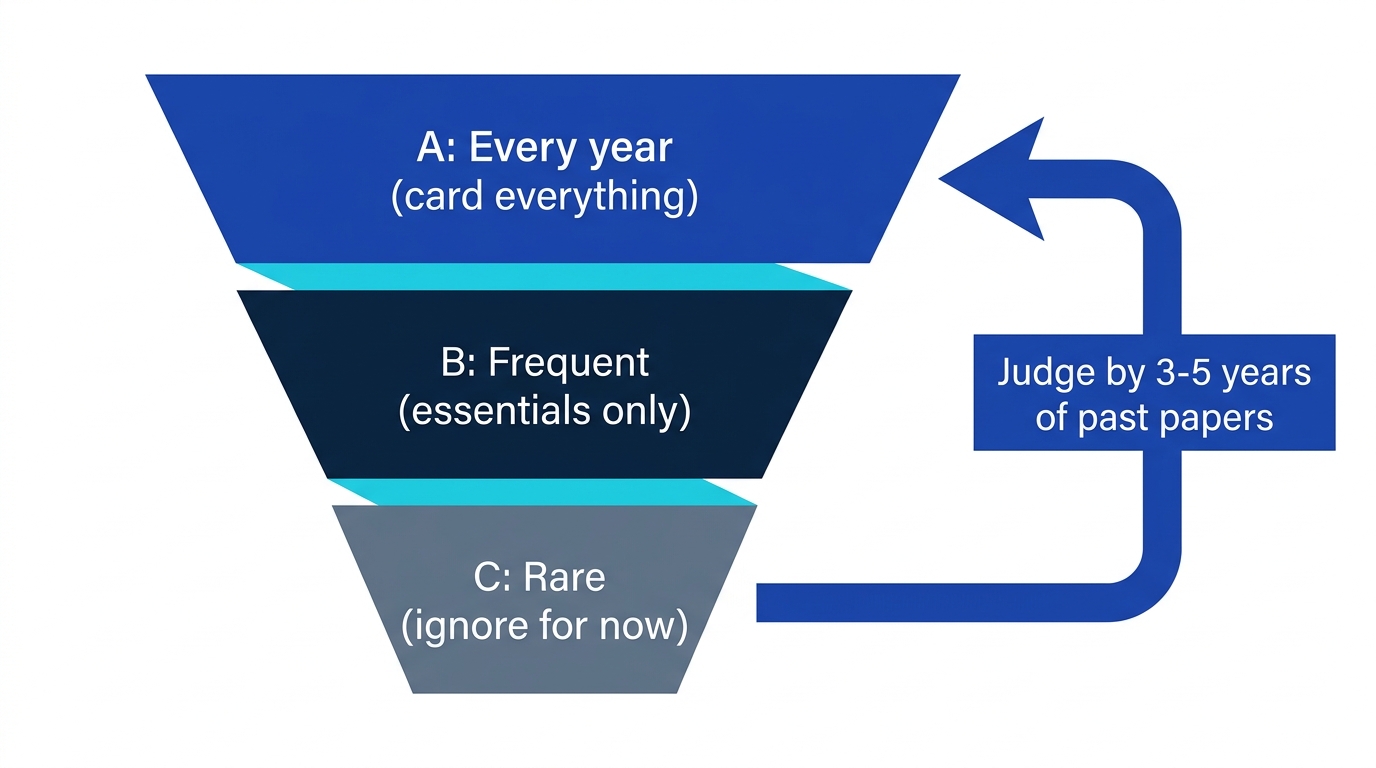
Every certification exam has a personality. Pull three to five years of past papers or official practice tests for your specific exam and score each domain by frequency:
| Priority | Typical domains | Treatment |
|---|---|---|
| A: appears every year | Core education law, classroom management, special education, major learning theories | Card everything, maintain to exam day |
| B: frequent | Developmental psychology, assessment concepts, key historical figures | Card the essentials only |
| C: rare | Peripheral topics your exam rarely touches | Ignore until A is stable |
Row C is the one candidates fight. Deliberately skipping material feels like negligence, right up until you notice the hours it eats are the hours the A domains need to stay alive.
Step 2: turn laws and theorists into "why" cards
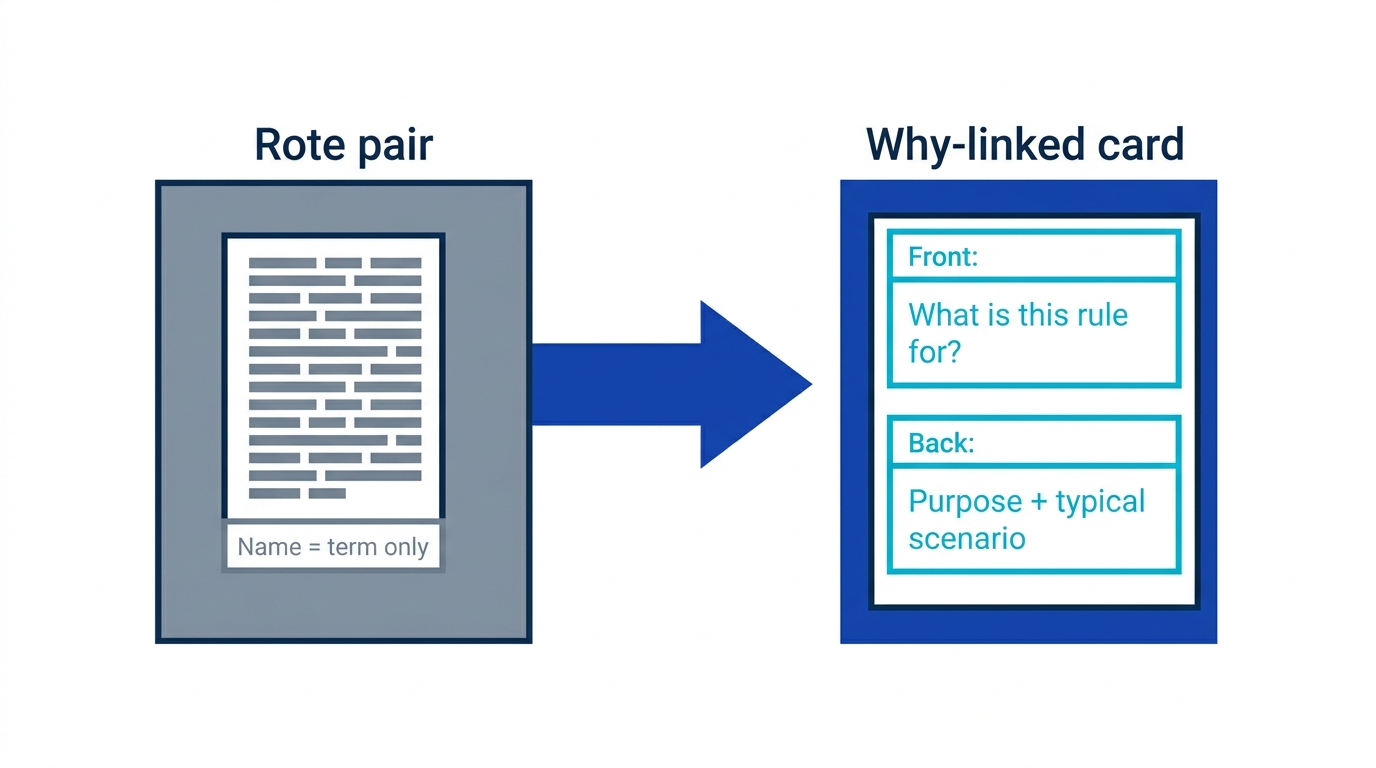
Rote pairs like "Piaget = stages" collapse on these exams because questions test application, not recognition: which theory explains this classroom scenario, which regulation governs this situation. So build cards that ask what a rule is for and in what scenario it shows up, not just the name and the term. One card per fact, plus a "why" or "which case" card behind it.
Making hundreds of those by hand is exactly the time a working candidate does not have. Photograph the prep book page or your notes, or upload the PDF, and let AI draft the question-and-answer cards; your job shrinks to a quick accuracy check. The workflow is the same one we describe in Turn Lecture Notes and Slides into Flashcards in 10 Minutes.
Step 3: let spaced repetition do the maintenance
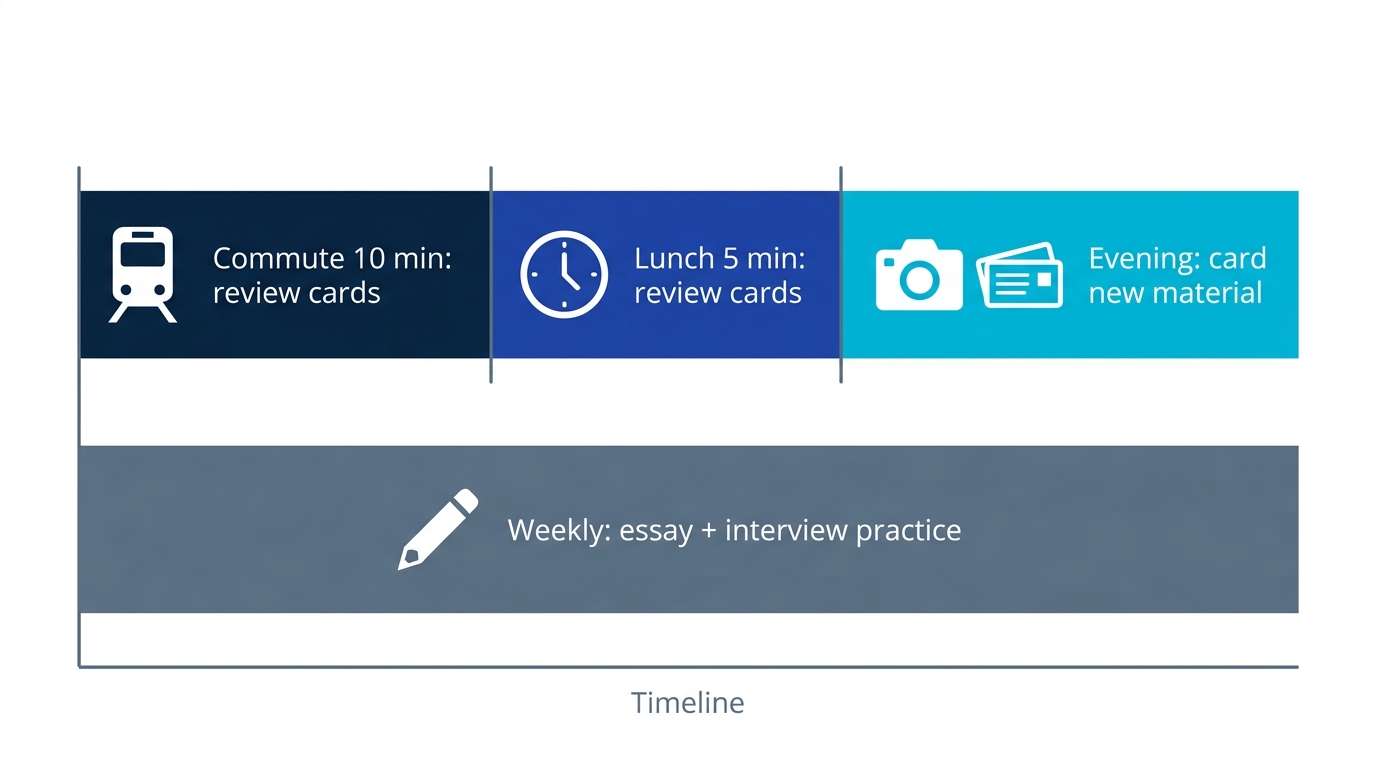
With a deck built, the obvious plan is to run through it whenever there is time. That holds for a week or two. Then the deck outgrows the gaps you have, and a full pass spends most of its minutes on cards you already know. Dunlosky's 2013 review rates practice testing and distributed review as the most effective techniques, and a months-long certification campaign is exactly where the scheduling of re-study decides the outcome. A spaced repetition algorithm like FSRS resurfaces each card just as you are about to forget it. The fragmented minutes go to the weakest material by default. Ten minutes commuting, five at lunch, ten before bed covers 30 to 50 cards a day. The timing logic is unpacked in The Forgetting Curve and the Best Time to Review.
Essays and interviews: a separate weekly lane
Do not mix constructed-response practice into the memorization pipeline. Fix one weekly slot for essay writing and mock interviews. The two lanes still feed each other: the frameworks and legal vocabulary you maintain in cards become the raw material that makes your essays specific. Memorization lives in fragments; writing and speaking live in blocks. That split is what makes the exam compatible with a job.
Memly automates the memorization lane
- Photograph prep books, notes, or official frameworks: AI converts them into Q&A cards, so building a several-hundred-card deck takes days, not months.
- FSRS handles maintenance: over a long campaign it keeps serving exactly the items you are about to lose.
- Web, iOS, and Android: capture at your desk, review on the commute.
For the full picture of AI-assisted memorization, see the pillar guide AI-Assisted Memorization: How It Works and the Best Tools.
Card one high-frequency domain today
Check one part of your exam syllabus this week. Separate facts to recall from tasks to practise, such as analysing a classroom scenario or answering an interview question. Use the official requirements to decide which needs attention first.
One action: pick your exam's single most frequent domain, photograph those pages, and turn them into cards. Ten minutes moves your prep from "read and forget" to "memorize and maintain." Memly is free to try, no credit card required.
