


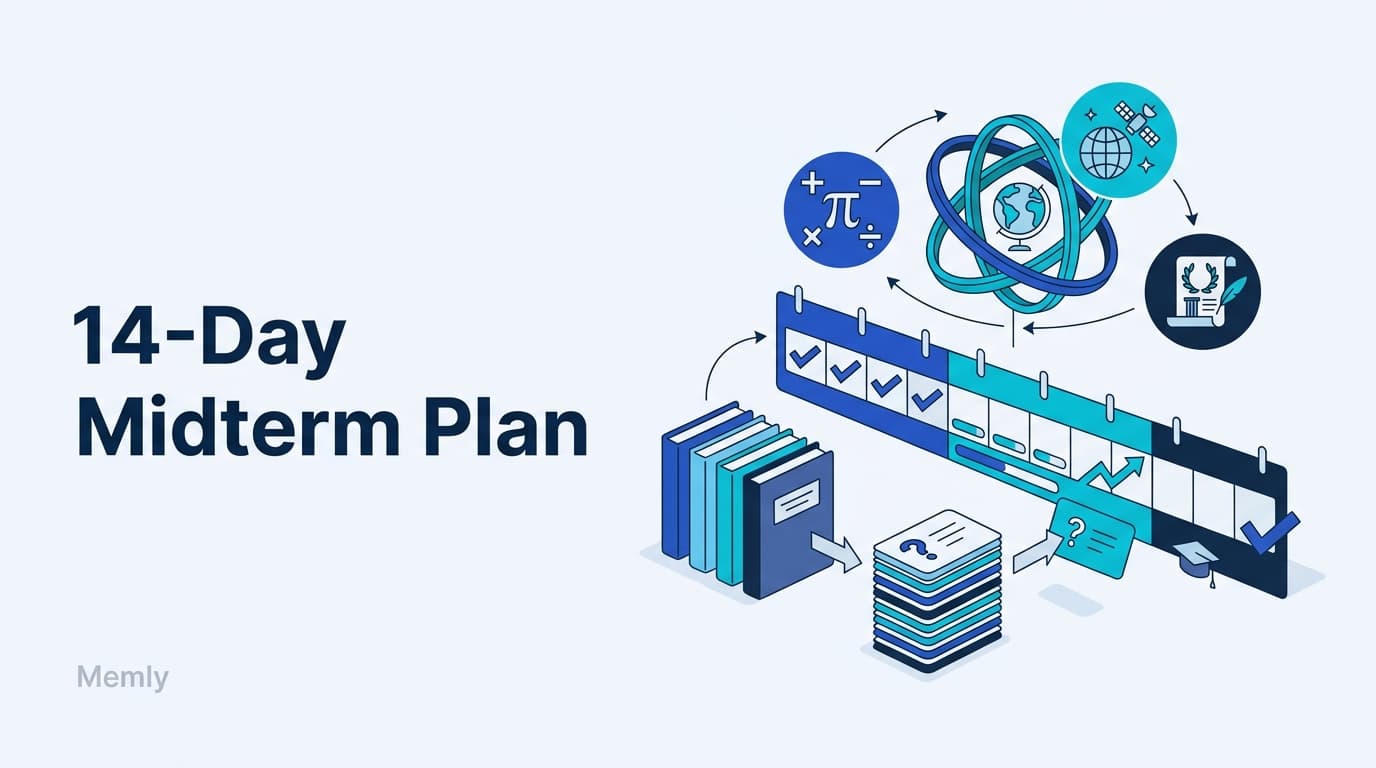
Midterms are two weeks away. Do you keep opening the workbook for your favorite class while a difficult, heavily weighted subject waits until the night before? Alongside finding study time, review how you allocate it across subjects.
What you can achieve in two weeks depends on the syllabus, your starting knowledge, and your available time. This is a planning example for finding gaps and returning to important material across classes.
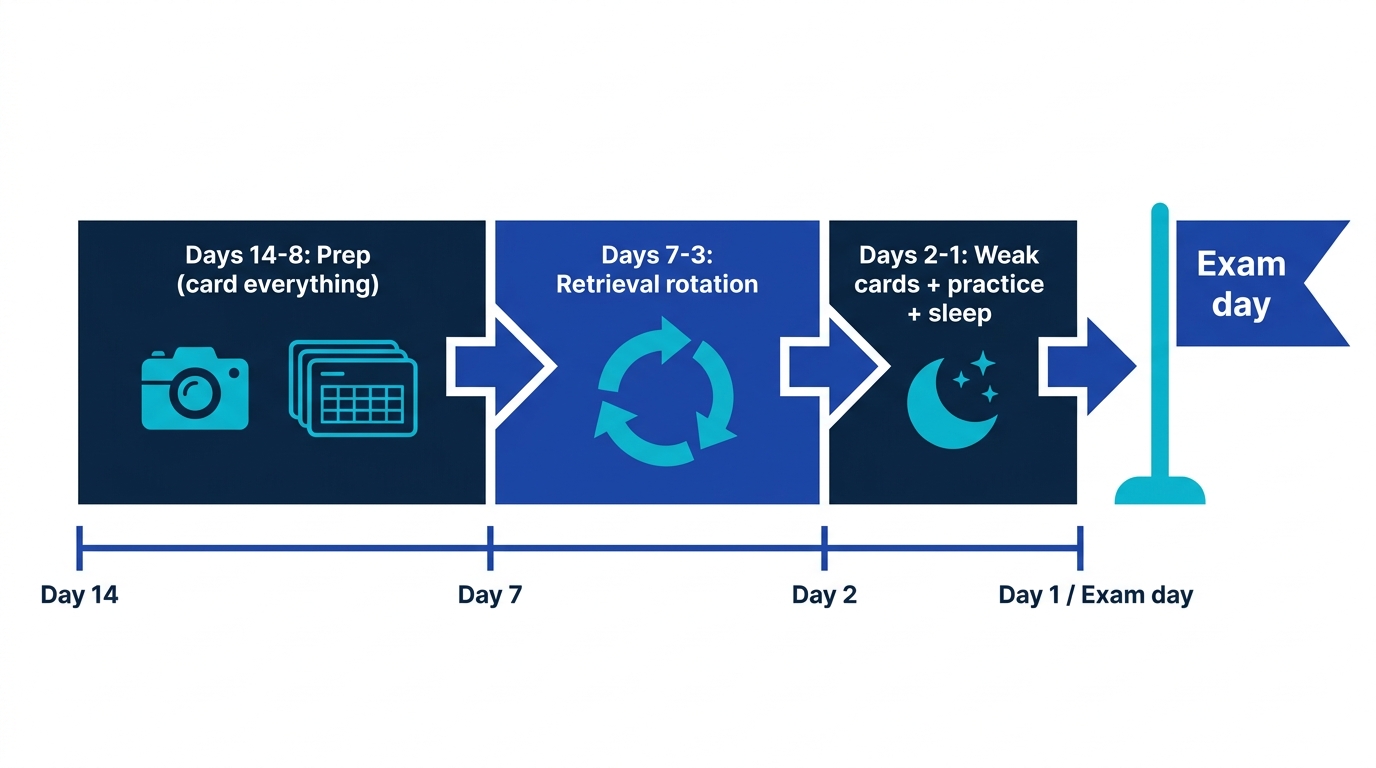
The short version: days 14–8: check every syllabus, make cards for key facts, and begin practice problems. Days 7–3: revisit several subjects and practice retrieval. Days 2–1: prioritize weak points and corrections, and protect sleep. Choose subject priorities using exam dates, weighting, and current understanding; use the app to help manage card review intervals.
Why study time can become uneven
Choosing priorities from scratch every day takes effort, and familiar work can be easier to start than a difficult chapter. Mark untouched topics and weak areas on your syllabus, then decide what needs attention before opening your materials.
A one-subject-per-day plan can still include later reviews. The risk is completing one block and never returning to it before the exam.
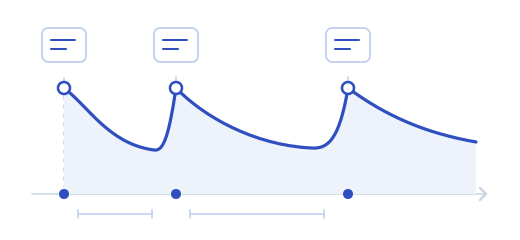
Plan repeated opportunities to recall important material. You do not need equal time for every class every day: revisit topics according to the exam schedule, your difficulties, and the work still left to do.
The 14-day midterm study plan
Days 14–8: check the scope and make cards for key material
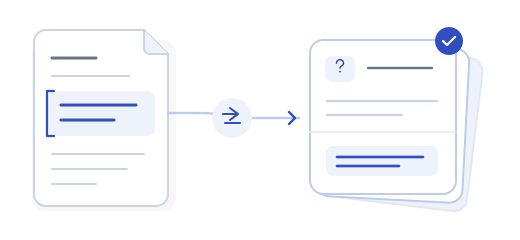
Start by checking every syllabus and turning important facts into questions you can answer. AI can draft cards from notes and handouts, but compare them with the source before using them. Do not spend the whole week converting everything: begin calculations, written answers, and other practice alongside card review. See How to Turn Lecture Notes and Slides into Flashcards for the workflow.
Days 7–3: revisit subjects and practice retrieval
Try recalling the answer before checking it. In experiments using prose passages, Roediger and Karpicke (2006) found that retrieval practice supported retention on delayed tests compared with restudying. That does not guarantee an identical effect in every subject. Combine cards with appropriate practice problems and give difficult topics more time.
Days 2-1: the finish (weak cards, practice sets, sleep)
Prioritize cards you still miss and problems you need to solve again. Fill essential remaining gaps selectively, and avoid sacrificing sleep to cover everything at the last moment. If little time remains and much of the syllabus is untouched, see Exam in 3 Days? The Science-Backed Way to Cram.
| Phase | Focus | Daily load |
|---|---|---|
| Days 14-8 | Check each syllabus, card key facts, and begin practice | 30 min carding + 20 min review |
| Days 7-3 | Revisit subjects and practice retrieval | 40-60 min review + problem sets |
| Days 2-1 | Weak cards + practice problems + early bedtime | 30 min review + 30 min problems |
The times in the table are illustrative, not a guarantee that an hour covers every class. Allow additional time for problem sets, and adjust the plan to your syllabus and other commitments.
Separate subject priorities from card review intervals
You set subject priorities using exam dates, weighting, and your current understanding. FSRS adjusts card review intervals based on answer history; it does not automatically balance study time across classes. Use the due reviews as a guide while reserving time for untouched topics and practice problems.
After the exam, sort your misses by cause and feed the knowledge gaps back into the decks, so finals prep then starts from where midterms left off. The sorting method is the same one from How to Review a Mock Exam.
Use Memly for card creation and review management
- Draft cards from your material: AI can generate questions and answers from textbook, note, and handout images. Check accuracy and relevance to the syllabus before studying them.
- Support review timing: FSRS adjusts review intervals using your answer history. You plan subject priorities and time for practice problems.
- Use short gaps in the day: with Web, iOS, and Android, you can review a manageable number of cards during a commute.
For the full picture of AI-assisted memorization, see the pillar guide AI-Assisted Memorization: How It Works and the Best Tools.
Choose a first step when the syllabus arrives
Starting early leaves more opportunities to ask questions and revisit mistakes. If the exam is already close, rebuild the plan around the time left and the most important gaps.
Today, check the syllabus for a difficult class and turn a few key questions into cards. Verify the answers, then begin your first review and practice problems. Memly is free to try, no credit card required.
