


1789. Within 14 days. 42.195 km. Section 25. Every time a number appears in your textbook, your heart sinks a little. The date you memorized last week is already fuzzy, and the deadline swapped places with a similar one. Here is the uncomfortable truth: time spent memorizing numbers evaporates faster than any other study time, because a naked number means nothing, and the brain discards what means nothing.
People who are "good with numbers" do not have special memory. They use techniques that attach meaning and structure to digits after the fact. Which technique works depends on what kind of number you are fighting: a date, a statistic, a deadline, a constant.
The short version: numbers cannot be memorized "as is". Use the four-part kit: chunking, reason-linking, story or mnemonic, and spaced retrieval. The first three get a number INTO memory; only the last one KEEPS it there. Most people do the encoding tricks and skip the keeping system, which is why numbers vanish.
Why numbers refuse to stick
The 1789 in "the French Revolution began in 1789" has no meaning of its own. Meaningless information has no hooks into your existing knowledge, so semantic encoding never happens. Rereading it produces familiarity, which is recognition, not the ability to produce it from a blank page. Numbers are the single biggest victims of the fluency illusion: they always look familiar and almost never come back on demand.
The fix, then, always runs in the same direction: give meaningless digits some meaning and structure of your own making.
Technique 1: chunk it
Split long numbers into meaningful groups, exactly the way phone numbers are written as 555-123-4567. A string of digits becomes a short list of chunks: 42.195 becomes "42" and "195"; a historical year splits into century (17) plus year (89), which even adds meaning for free.
Technique 2: link it to a reason
Most exam numbers secretly have a reason. Find out why it is 14 days, and what happens on day 15, and write that on the back of the card. A number tied to a consequence stops being an isolated fact and becomes the conclusion of a logic you can reconstruct even after partially forgetting it. This works especially well for legal deadlines, clinical reference values, and economic statistics.
Technique 3: turn it into a story or mnemonic
For numbers with no reason (pure dates, constants), force meaning onto them with a number-word mnemonic or a tiny story. Digits mapped to sounds, shapes, or a ridiculous scene give recall many more entry points than the digits alone. An image you invented yourself holds better than one from a textbook, because building it forced you to process the digits instead of just reading them.
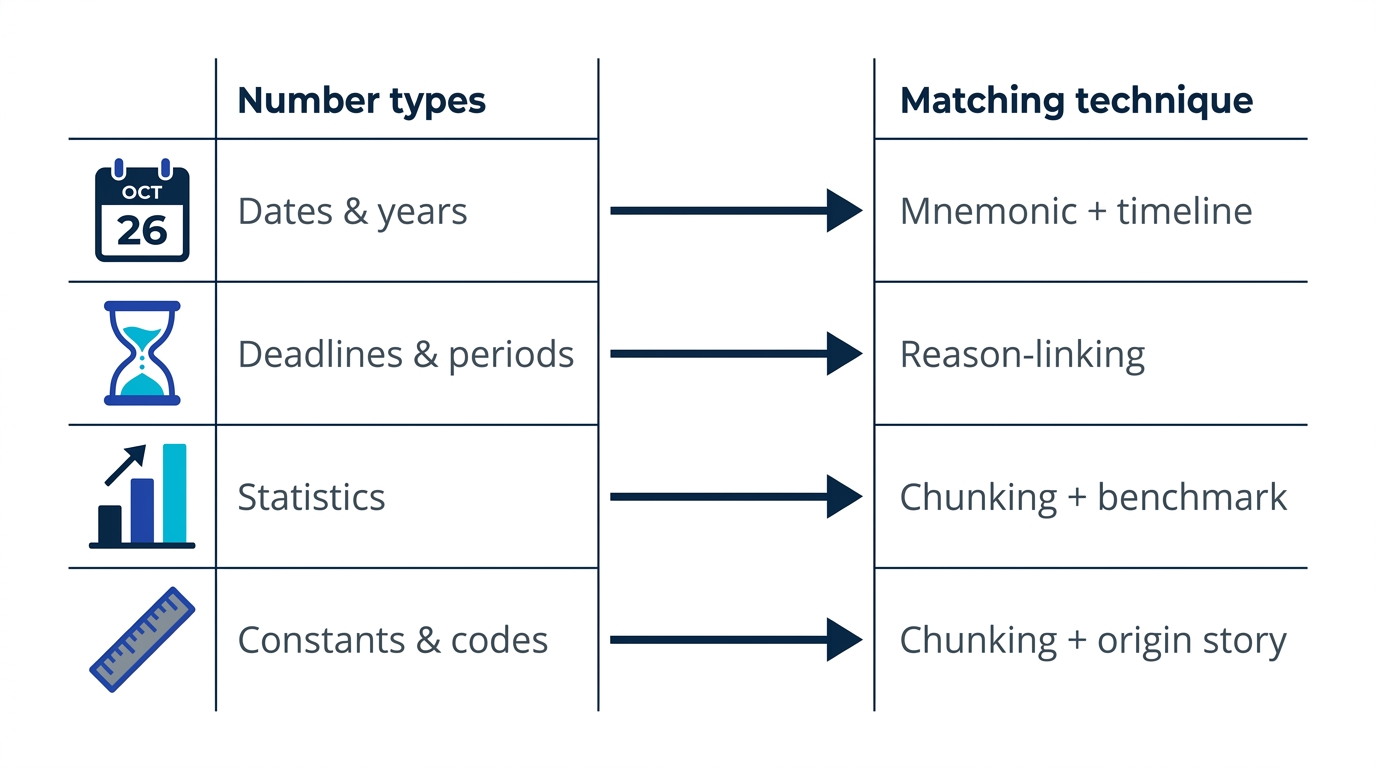
| Number type | Example | Best technique |
|---|---|---|
| Dates and years | 1789, a treaty year | Mnemonic + anchoring in the causal timeline |
| Deadlines and periods | Within 14 days, 30 days prior | Reason-linking (what happens if exceeded) |
| Statistics | Aging rate, share of GDP | Chunking + comparison to a benchmark |
| Constants and codes | 42.195 km, Section 25 | Chunking + origin story |
Only the first row calls for a mnemonic outright. Deadlines and statistics usually have a reason or a benchmark sitting right there in the material, and using one of those beats inventing an image for it.
Encoding gets it in. Only spaced retrieval keeps it
The three techniques above are encoding tools. But a number memorized with a clever mnemonic still fades, mnemonic and all, without review. As we argued in Memory Palace vs Spaced Repetition, mnemonics are the entry ramp and spaced repetition is the maintenance system.
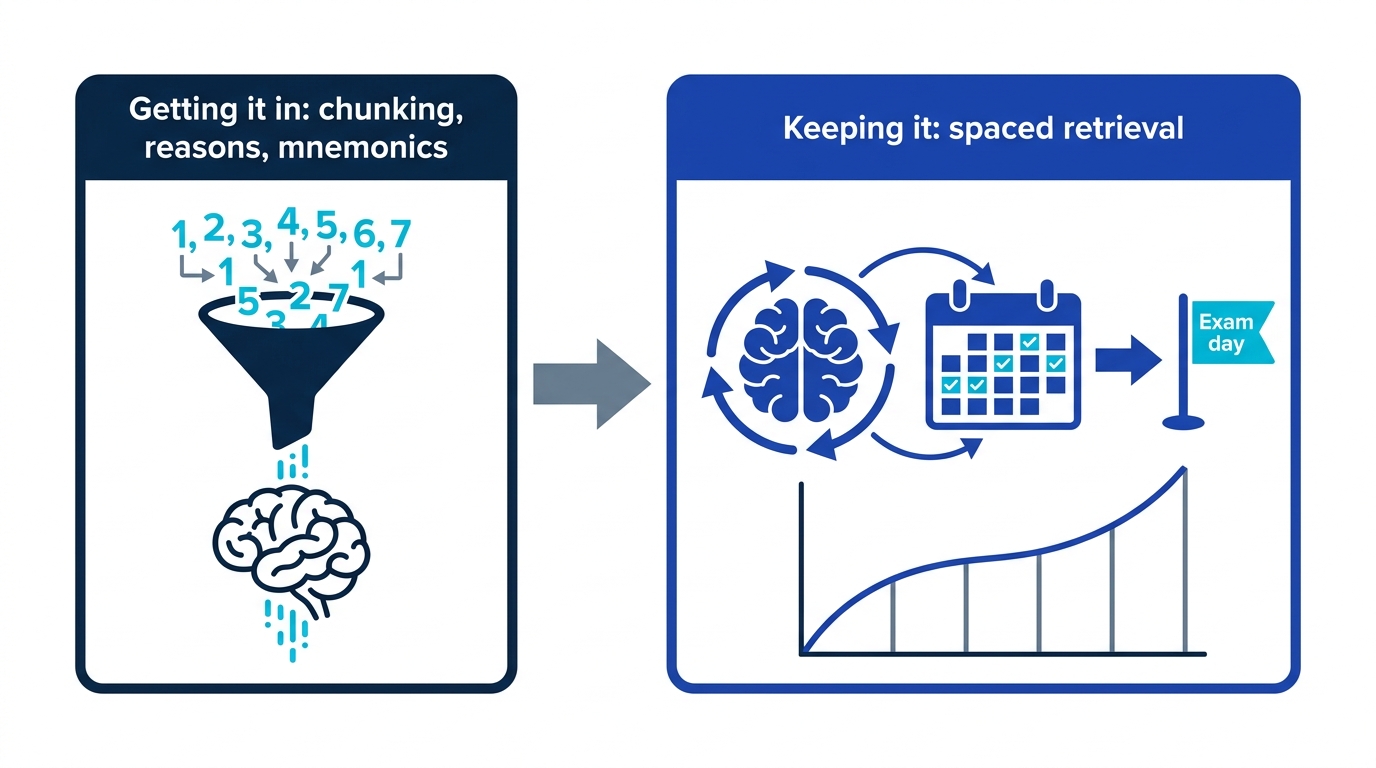
Apply the two top-rated techniques from Dunlosky's 2013 review, practice testing and spaced review, to numbers and the routine is simple: phrase the number as a question ("Cooling-off period: how many days?") and recall it just as it starts to slip. Cepeda et al.'s (2006) meta-analysis shows that spacing reviews out improves long-term retention, and low-meaning material like digits is exactly what fades fastest without it.
How to build number cards
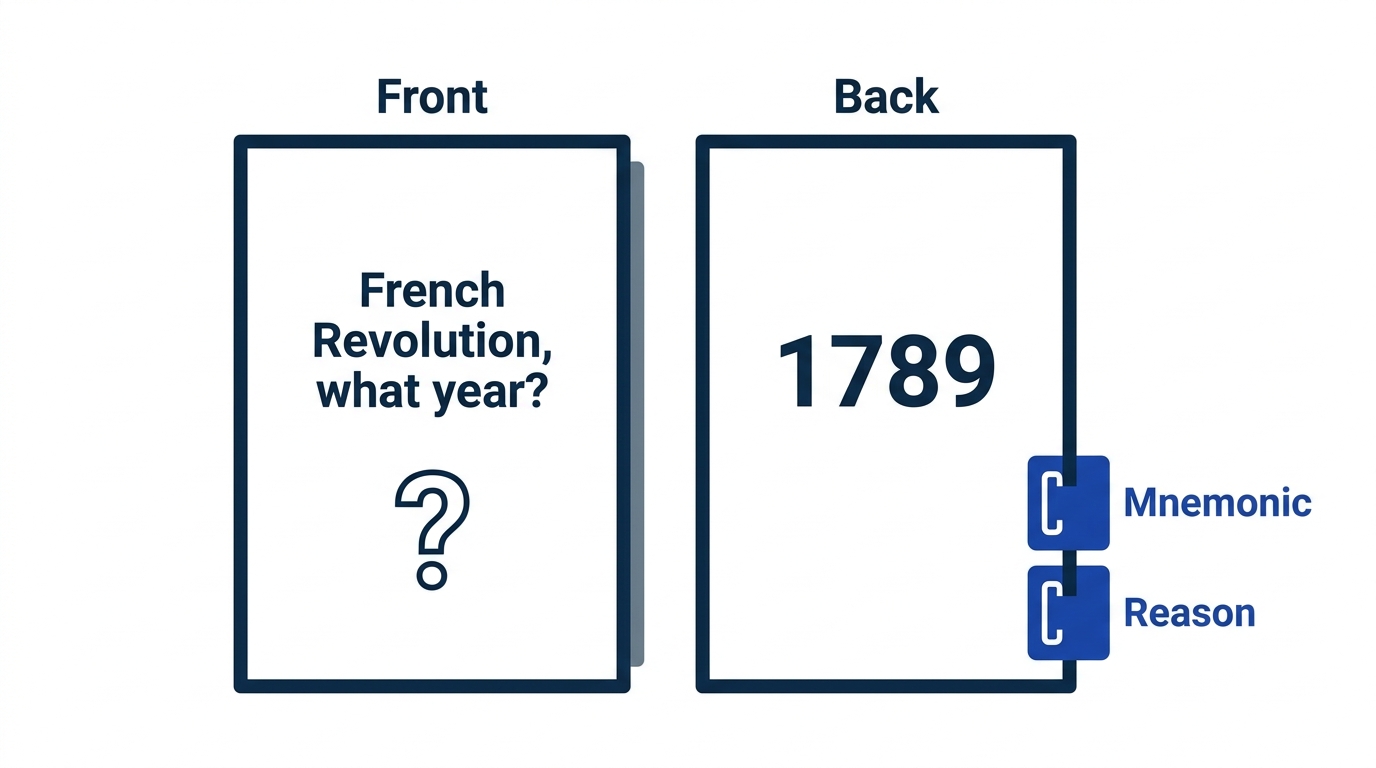
- Front asks for the number: "What year did the French Revolution begin?" A reverse card ("What happened in 1789?") doubles the strength.
- Back is the number plus its hooks: the mnemonic, the reason, or the benchmark comparison.
- Confusable numbers get contrast cards: "14 days versus 30 days: which applies to which?" asks the difference directly.
Memly mass-produces and maintains number cards for you
- Photograph a table or timeline, or upload the PDF: AI converts number-dense pages into question-form cards, which is exactly where AI generation shines.
- FSRS spaced repetition resurfaces the numbers you are about to forget: shaky numbers appear often, solid ones rarely.
- Web, iOS, and Android: thirty seconds at a red light is two dates recalled.
For the full picture of AI-assisted memorization, see the pillar guide AI-Assisted Memorization: How It Works and the Best Tools, and for the timing principle behind reviews, see The Best Time to Review: Right Before You Forget.
Try it on the next number you meet
Most readers will hit the next number in their notes and write it out five times again, and forget it again next week. The ones who change are the ones who run one experiment today.
Pick one number you need to know, look up why it is that number, and turn it into a question card. That one number will stick differently. Memly is free to try, no credit card required.
