


A mock-exam score tells you where you stand, but the missed questions can tell you what to practise next. Instead of reviewing every explanation in the same way, sort the mistakes by cause: a fact you did not know, an application error, a careless mistake, or a timing problem.
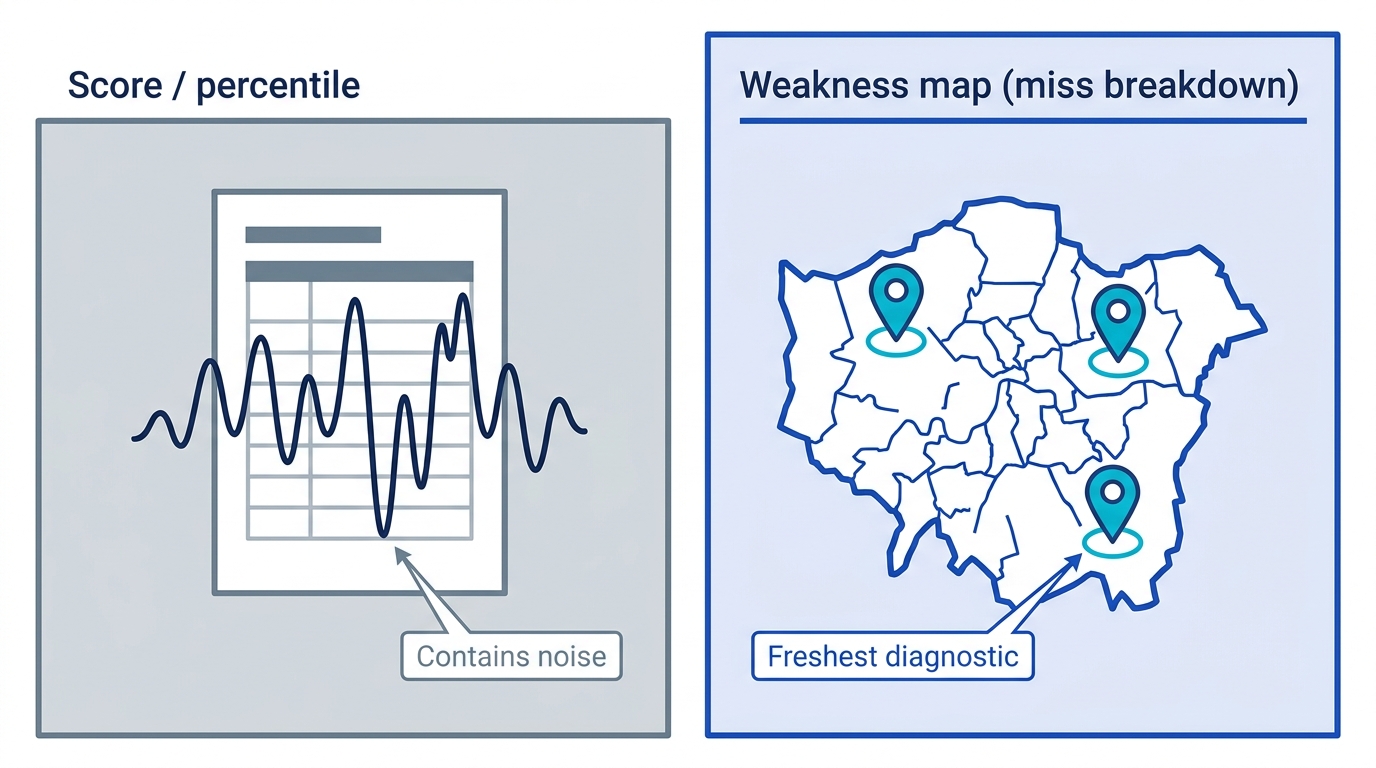
The result is a weakness map: a short list of errors paired with specific next actions. For example, "forgot the definition" needs a different response from "used the right formula but ran out of time."
The short version: while the exam is still fresh, classify the missed questions, turn useful factual gaps into flashcards, and schedule another attempt. About two weeks is one possible retest interval; shorten it if the real exam is nearer. Check your reasoning as well as whether the final answer is correct.
A mock exam's value is the diagnosis, not the score
Scores and percentile bands bounce around with luck and condition, so they are noisy. What is not noisy is which questions you missed and why: the freshest diagnostic of your current ability that exists. Past papers are practice material to be mined repeatedly; a mock exam is a one-shot health check of where you stand today. Different role, different review method. The protocol for past papers is in How to Use Practice Tests.
Review soon enough that you can still describe how you chose each answer. If you have already forgotten, reattempt the question before reading the explanation. Record what you observe now rather than guessing why you missed it originally.
Step 1: classify every miss into four categories
In the margin, every miss looks identical: a red mark. Four different problems are hiding behind it, and only one of them is fixed by studying harder.
| Category | How to spot it | Action |
|---|---|---|
| Knowledge gap | You did not know it, or could not recall it | Convert to cards, maintain with spaced repetition (top priority) |
| Application error | You knew the fact but misused it | Write out where the decision went wrong, then solve similar problems |
| Careless mistake | Misread, arithmetic slip, wrong bubble | Log the pattern, define a checking routine |
| Ran out of time | You could have solved it with more minutes | Change time allocation strategy (not a knowledge problem) |
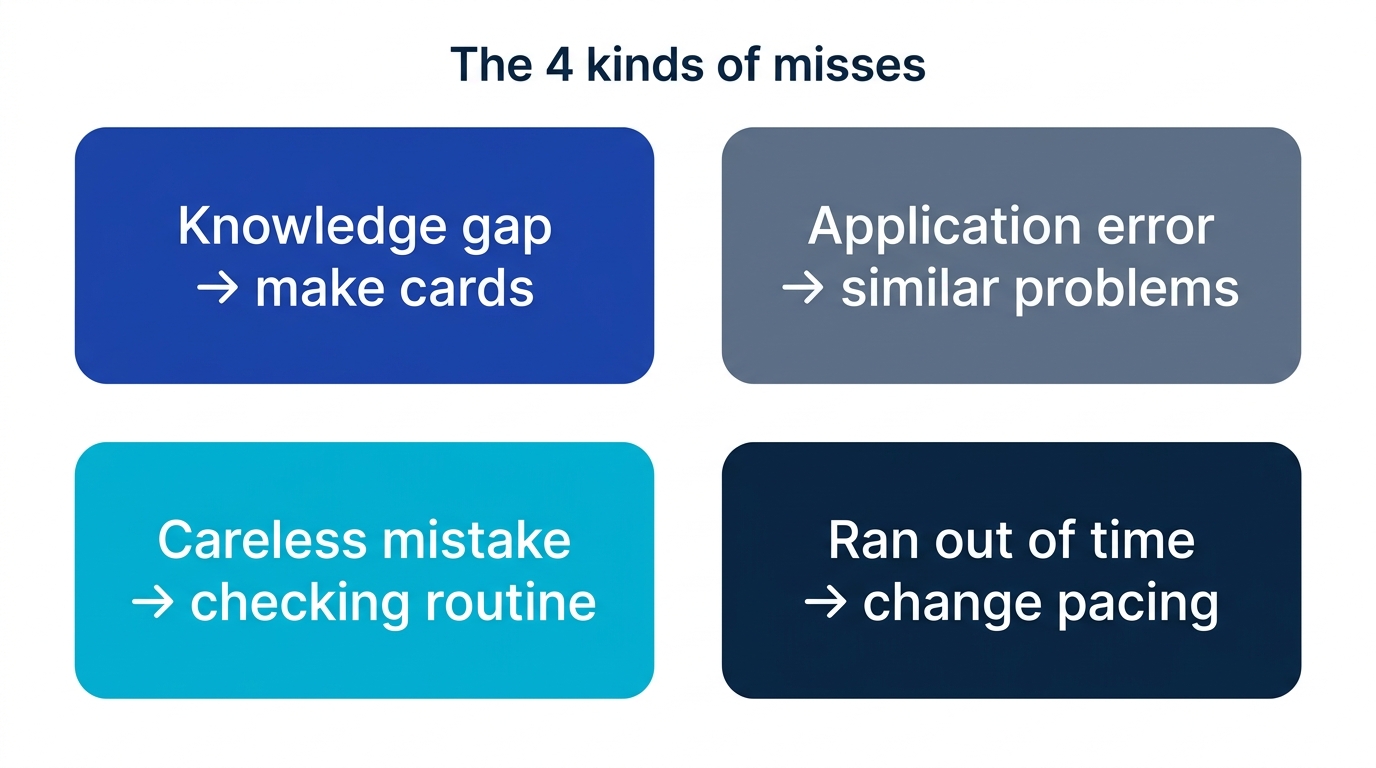
The classification alone converts the vague dread of "I need to redo everything" into a concrete task list: twelve knowledge gaps, one timing fix. That is your weakness map.
Step 2: card only the knowledge gaps
Of the four categories, only knowledge gaps belong in your flashcard app. The most dangerous moment of mock-exam review is reading the explanation and feeling "right, of course": that is recognition through rereading, and it guarantees nothing about recalling it next time. The gap between understanding-when-reading and producing-from-memory is the whole story of Why You Forget What You Read.
Write one clear question for each useful factual gap. You can also use AI to draft cards from permitted material, then check the answers against the explanation. Our flashcard-writing guide shows how to avoid cards that ask for too much at once.
Step 3: re-solve after two weeks to confirm the hole is closed
Review the factual gaps between attempts, then retry the missed questions without the solution beside them. Also try a similar question if one is available: remembering a familiar answer is not the same as being able to use the method in a new problem.
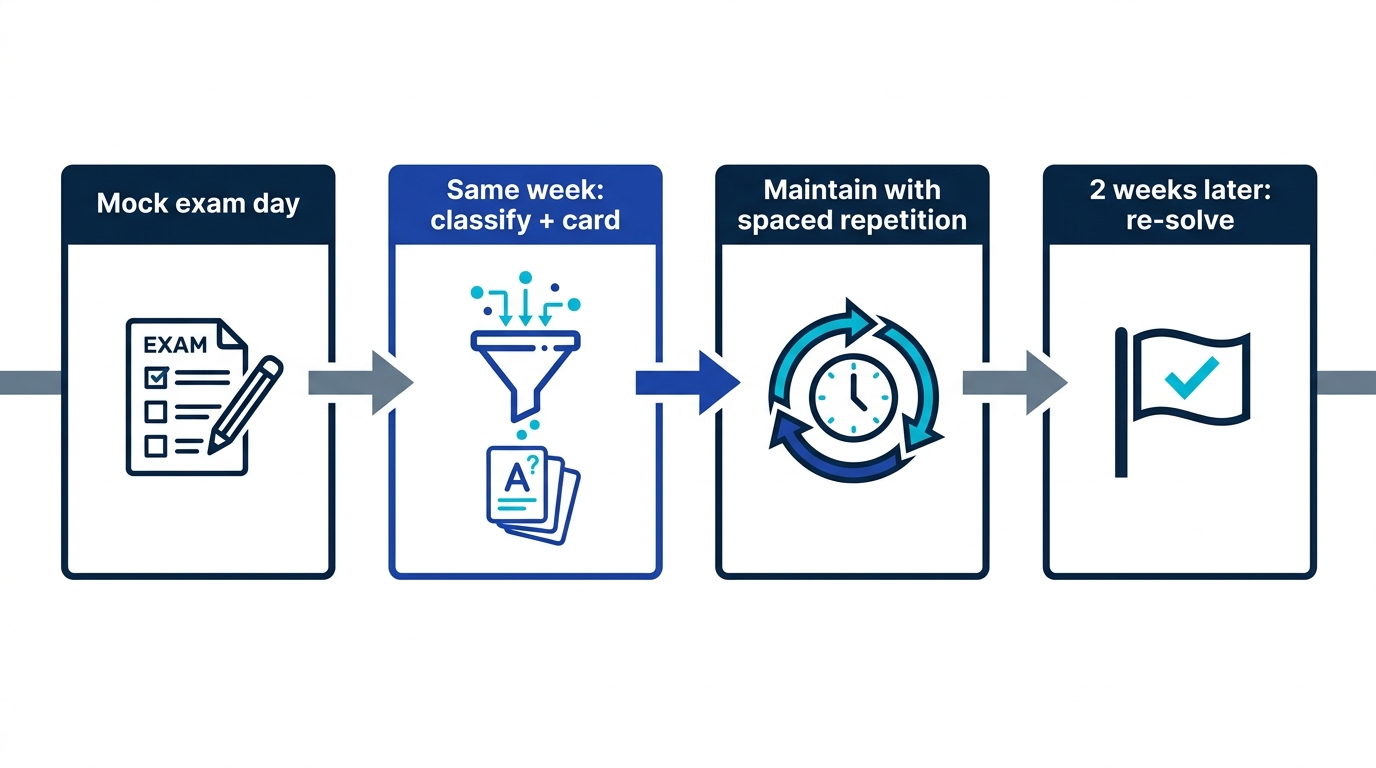
The re-test itself is doing the teaching. Spacing reviews out improves retention (Cepeda et al., 2006), because a recall attempt made after partial forgetting takes more effort and leaves a stronger trace, and for the same reason testing beats restudying (Roediger & Karpicke, 2006). For how to choose the interval, see The Best Time to Review: Right Before You Forget.
Use Memly for Card Drafts and Scheduled Reviews
- Photograph the missed questions: AI converts the knowledge gaps into question-and-answer cards; no card-writing session required.
- Review dates are suggested: FSRS uses your answers to schedule the cards. Keep separate time for retrying full exam questions and checking your reasoning.
- Web, iOS, and Android: classify and card at your desk; maintain the deck on the bus.
For the full picture of AI-assisted memorization, see the pillar guide AI-Assisted Memorization: How It Works and the Best Tools.
Your next mock exam's value is decided before you sit it
Before your next mock exam, revisit the most common error from the previous one. Try a similar question without the explanation beside it, then compare both your answer and your reasoning. That check is more useful than simply counting completed papers.
The best-value study material you own right now is the last mock sleeping in your drawer. Today, classify just one missed question, and if it is a knowledge gap, turn it into a card. Memly is free to try, no credit card required.
