



If a word still slips away after you write it repeatedly, changing the task may help more than adding another line. Check what the word means, connect it to an example, and try recalling it without looking. This article turns those steps into a repeatable study routine.
Cognitive science has a blunt answer here. What separates people who memorize fast from people who struggle is method, not raw memory.
The short version: memorization that works is built on three principles, which are meaningful encoding, retrieval practice, and spacing. Memorizing is not about increasing the number of times you see something; it is about increasing the number of times you recall it. Make that one switch and the same study hours produce different results.
It is not a memory gap. It is a method gap
In his large 2013 review of study techniques, cognitive psychologist John Dunlosky rated the effectiveness of the most common methods. The result was brutal: rereading and highlighting landed in the low-utility category, while practice testing (retrieval) and distributed practice (spaced review) earned the top ratings.
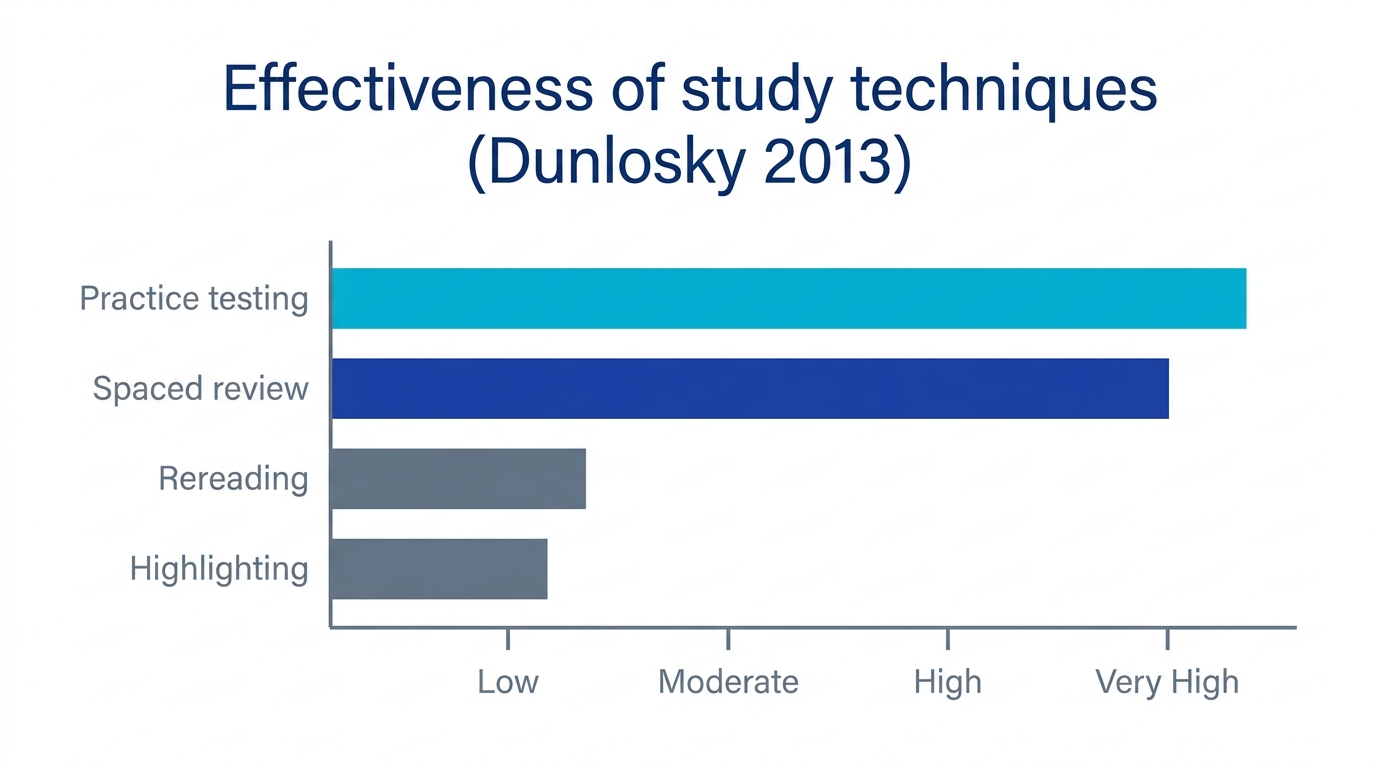
Most people who are "bad at memorizing" are not low on ability; they simply spend the most time on the least effective methods. And the people who look naturally gifted are usually running the effective ones without naming them.
| Habits that don't work | Habits that do |
|---|---|
| Rereading the same page again and again | Reading once, closing the book, recalling |
| Rote memorization with no meaning attached | Attaching a "why" and a connection |
| One massive session the night before | Short sessions spaced across days |
| Highlighting and feeling done | Turning highlights into questions |
Every habit in the right-hand column costs more effort in the moment than the one beside it. That is the difficulty: the methods that work feel worse while you are using them.
Principle 1: encode with meaning, not sound
An isolated fact gives your brain nothing to grab onto. A date alone, a term alone, memorized as noise, peels off within days. Effective memorizers attach each fact to a reason, a mechanism, or something they already know. Instead of "mitochondria: powerhouse," they store "mitochondria make energy, which is why muscle cells are full of them." A fact wired into a network has many doors you can enter to retrieve it, so failing to recall one route still leaves the others.
Principle 2: count recalls, not views
In Roediger and Karpicke's classic 2006 experiment, students who practiced recalling a text remembered more one week later than students who reread it (roughly 56% versus 42%; the exact numbers vary by condition, but the direction is what matters). Rereading builds recognition, the feeling of "I know this when I see it." Exams demand recall, producing it from a blank page, and recall only grows through recall practice.
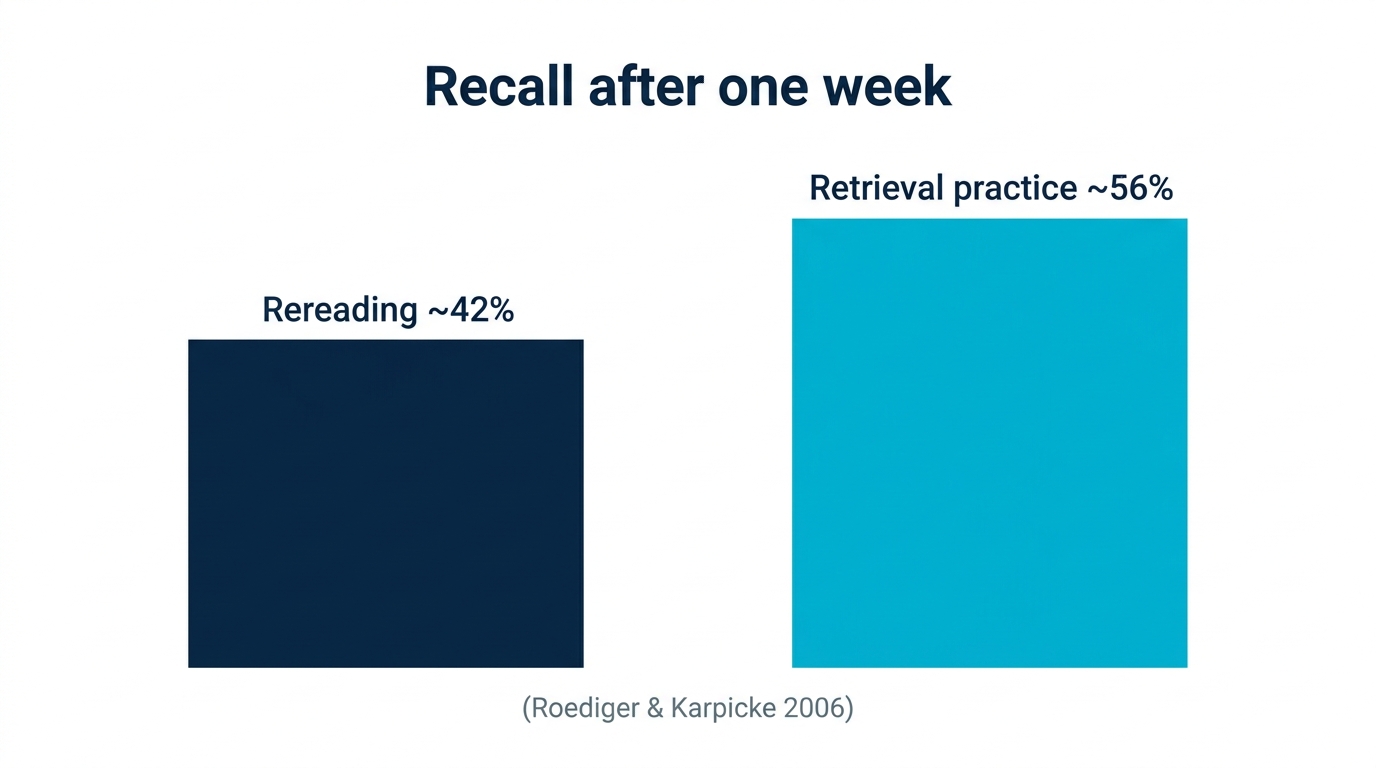
The smooth feeling of a familiar page is the fluency illusion at work, where ease of reading gets mistaken for strength of memory. That trap is the subject of Why You Forget What You Read.
Principle 3: space it. Return just before you forget
Ebbinghaus's forgetting curve shows memory decays fast when left alone. But the meta-analysis by Cepeda and colleagues (2006) shows that putting time between reviews itself strengthens memory. Three reviews spread over days beat three reviews crammed into one evening. The sweet spot is returning right as the memory starts to slip; we cover the timing logic in The Forgetting Curve and When to Review.
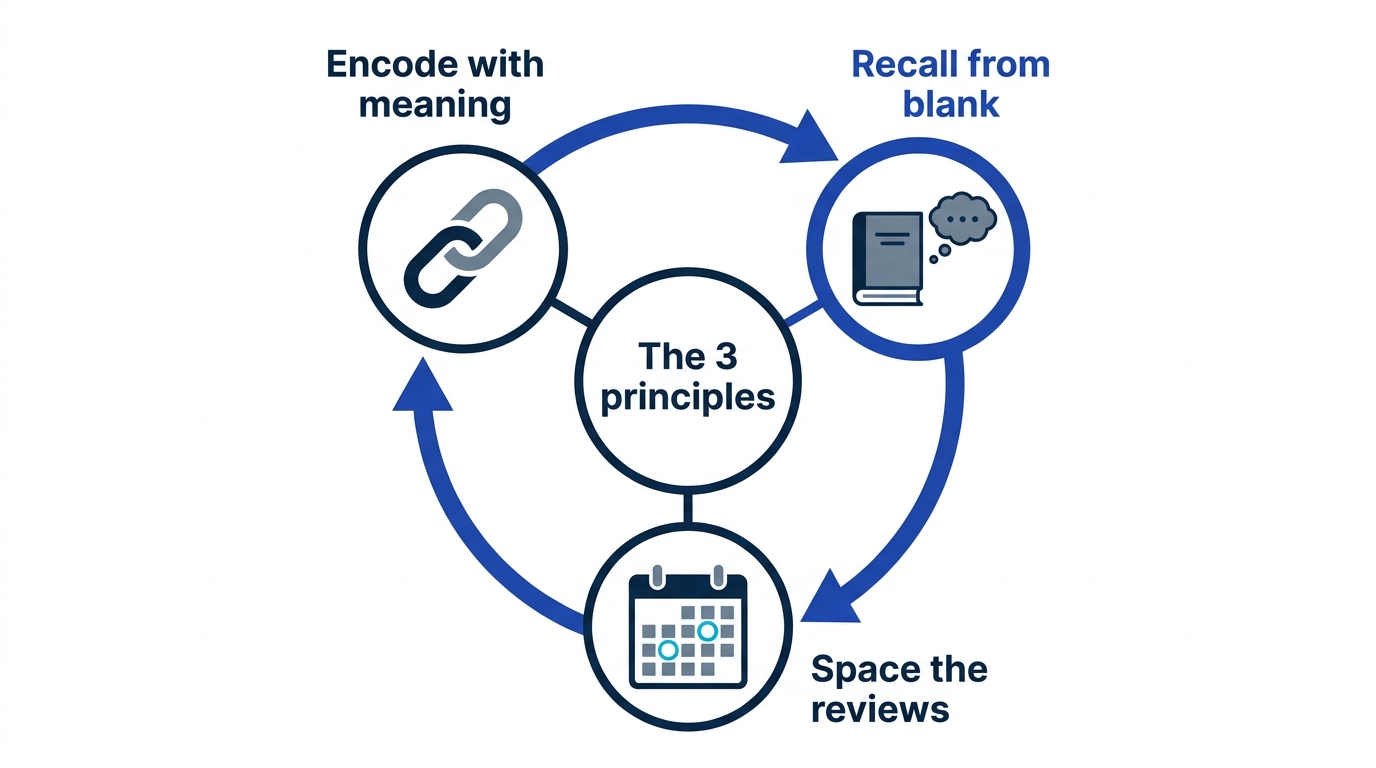
Running all three on willpower is where people fail
Writing why-questions, scheduling recall practice, and computing the right interval for every fact in every subject is a project management job. People who struggle with memorization usually do not fail at the method; they fail at the administration of the method.
So hand the administration to a tool. Memly turns the three principles into a system:
- Meaningful encoding: photograph a textbook page or upload a PDF, and AI generates question-and-answer cards, including "why" questions that break you out of rote mode.
- Retrieval practice: every card demands an answer from a blank slate. There is no way to slide back into passive review.
- Spacing: the FSRS spaced repetition algorithm computes each card's forgetting point and schedules it for you.
Memly runs on Web, iOS, and Android, so you can encode at your desk and recall on the train. For the full picture, see the pillar guide AI-Assisted Memorization: How It Works and the Best Tools and 5 Evidence-Based Study Methods That Actually Work.
Stop saying "I have a bad memory" today
Use one difficult item to test the method. Add enough context to understand it, answer without looking, then return after a gap. If it still does not stick, change the question or revisit the explanation instead of judging your memory from one attempt.
The test is cheap. Take one thing you need to learn today and switch it from "read again" to "close and recall." Photograph the page and hand it to Memly, and the recall practice starts by itself. Free to try, no credit card required.
