


Writing can serve different purposes: copying helps you record a word or check its spelling, while writing with the answer covered tests recall. If repeated copying is not helping you remember, change the task before adding more repetitions. The distinction is whether you are looking at the answer or producing it from memory.
"Write it down to remember it" is one of the most persistent pieces of study advice in the world. So is the advice simply right, or is writing a waste of a study hour? Neither. Depending on how you write, it is either one of the strongest techniques available or nearly worthless.
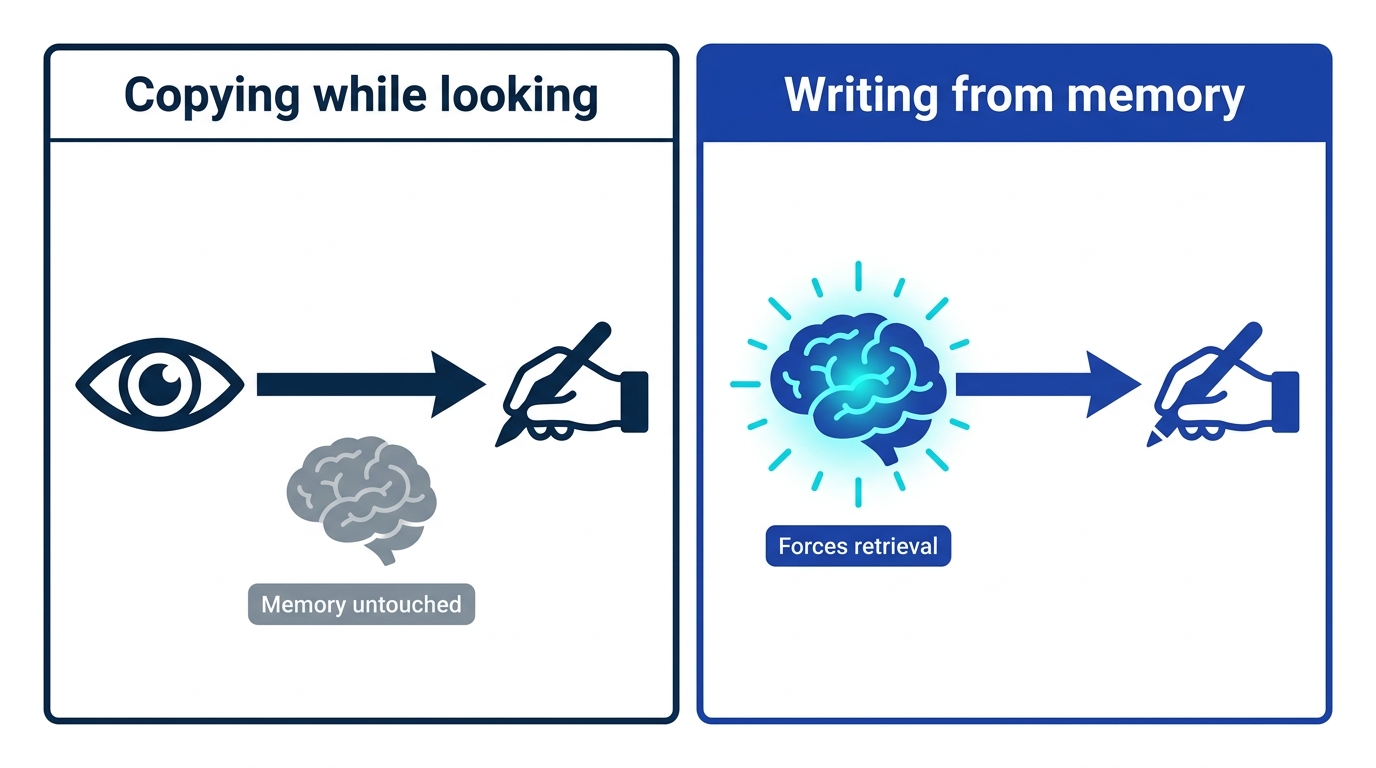
The short version: the line is between copying while looking and writing from memory. Copying with the source in view builds almost nothing. Writing with the source hidden turns every stroke into a test, and that is when writing works.
Why copying while looking does not stick
When you copy with the original in front of you, your brain's only job is transferring a visual shape to your hand. At no point does it retrieve anything from memory. In Dunlosky's 2013 review of study techniques, mechanical repetition and rereading landed in the low-utility category, while practice testing (retrieval) and spaced review rated highest. Copying while looking is just rereading with a pen.
Worse, copying has a treacherous property: the notebook fills up, so the sense of accomplishment grows regardless. It is the same trap as the fluency illusion, where smooth rereading feels like knowledge, except that here the evidence is physical. A full notebook proves effort, not memory.
Writing from memory is one of the best tests there is
The same pen changes everything when the source is hidden. The moment you try to write on a blank page, every gap in your memory is exposed without mercy. It is the difference between recognition (you know it when you see it) and recall (you can produce it) made physical.
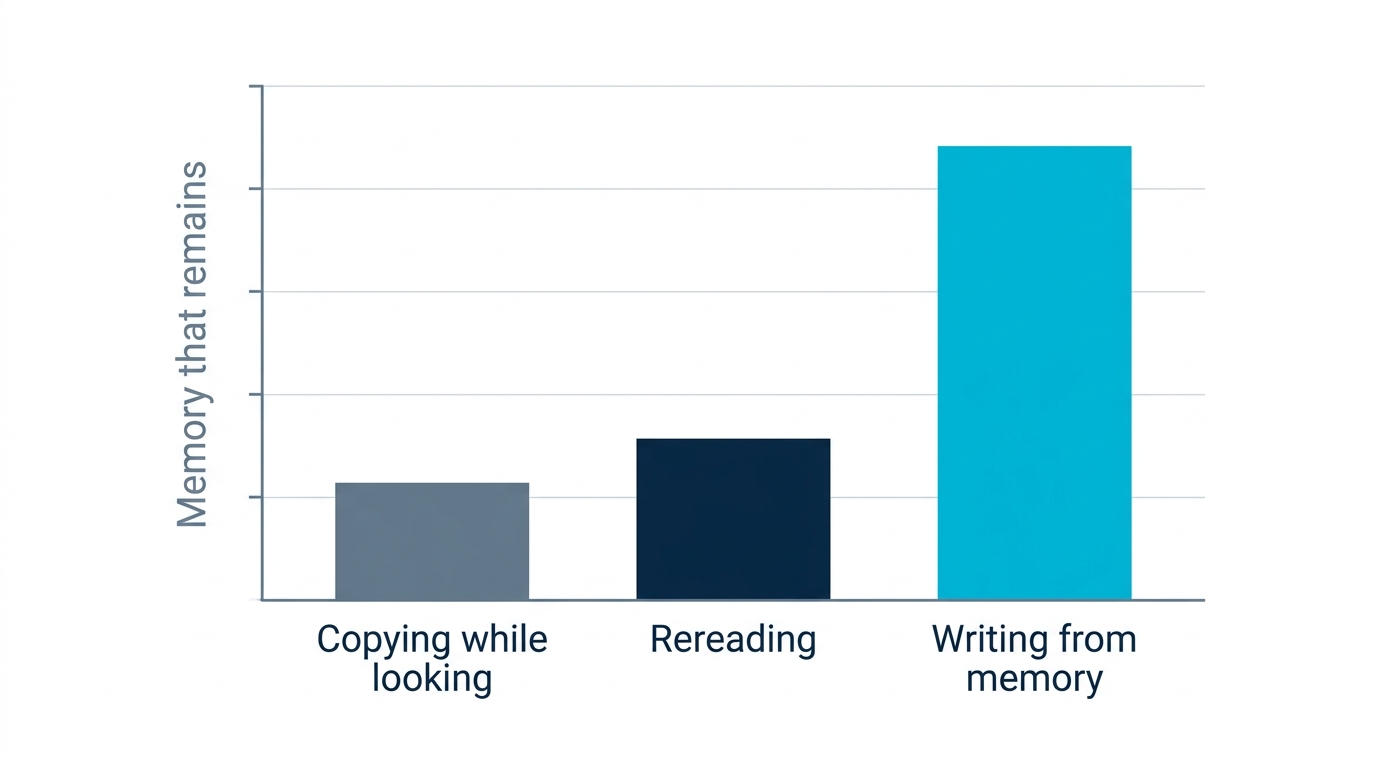
In Roediger and Karpicke's 2006 experiments, students who practiced recalling material outperformed rereaders a week later (roughly 56% versus 42%; the exact numbers vary by condition, the direction is the point). The value of writing lives in the retrieval, not the pen. Why passive exposure fails is explained in Why You Forget What You Read.
The same 30 minutes, three ways
| Method | What you are actually doing | What it trains |
|---|---|---|
| Copying while looking | Transferring shapes from eyes to hand | Mostly hand exercise; little memory |
| Rereading | Repeating input | Recognition only, plus a feeling of knowing |
| Writing from memory | A retrieval test with a pen | Recall, the ability exams actually demand |
The middle row is the uncomfortable one. Copying feels far more active than rereading, and it costs more time and an aching hand on top, yet the third column puts the two in almost the same place.
As for "I'm a writing learner" or "I'm a visual learner": preferences are real, but evidence that matching study methods to a preferred style improves results is weak. What works across the board is retrieval plus spacing. The broader toolkit is in 5 Evidence-Based Study Methods That Actually Work.
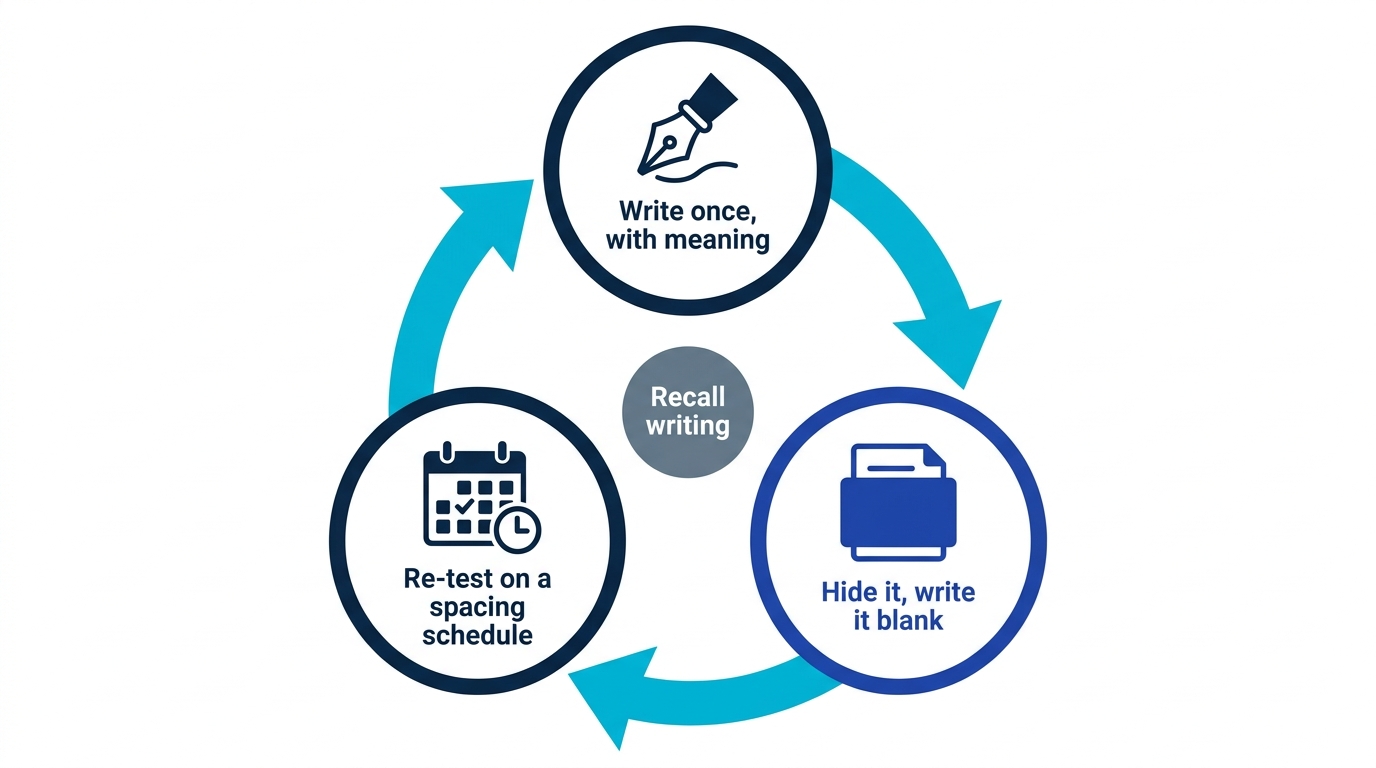
The recall-writing routine, starting today
- Write it once, with meaning: study the item, notice its structure (roots, parts, the reason behind it), and write it a single time. Not ten.
- Hide it, write it blank: cover the source and produce it from memory. If you fail, peek, then hide and write again.
- Re-test on a spacing schedule: blank-page test again the next day, three days later, a week later. Spacing reviews out is itself a proven booster, as Cepeda and colleagues' 2006 meta-analysis shows.
Memly automates the hide-and-test part
The weak point of recall-writing is logistics: making the tests and managing the schedule. That part is exactly what software should do.
- Photograph the wordlist or handout: AI converts your material into cards that ask you to produce the answer. The copying step disappears entirely.
- Re-test timing is automatic: the FSRS spaced repetition algorithm brings each card back just as it starts to slip. For spelling or characters, grab scratch paper, write your answer from memory, then flip the card.
- Web, iOS, and Android: write at your desk, recall mentally on the train.
If memorization has always felt like your weakness, the method swap pays off most; see How to Memorize Faster: 3 Principles That Beat a Good Memory and the pillar guide AI-Assisted Memorization: How It Works and the Best Tools.
Retire the notebook-blackening ritual today
Try both activities on a small vocabulary set: copy once to check spelling, then cover the words and write them from memory. Check errors against the original and retry later. This shows what writing is doing for you instead of assuming that more lines mean more learning.
Next time you memorize anything, change one thing. Write it once with attention, then hide it and see if you can produce it on a blank page. Whatever refuses to come out is what you actually need to study, and Memly will manage exactly that for you. Free to try, no credit card required.
