


You can fill a page with revision notes and still lose the condition that makes an answer correct. In the original five-point practice example below, a plausible-looking answer contains only three correct points. The useful part of blurting is finding that gap while you can still fix it.
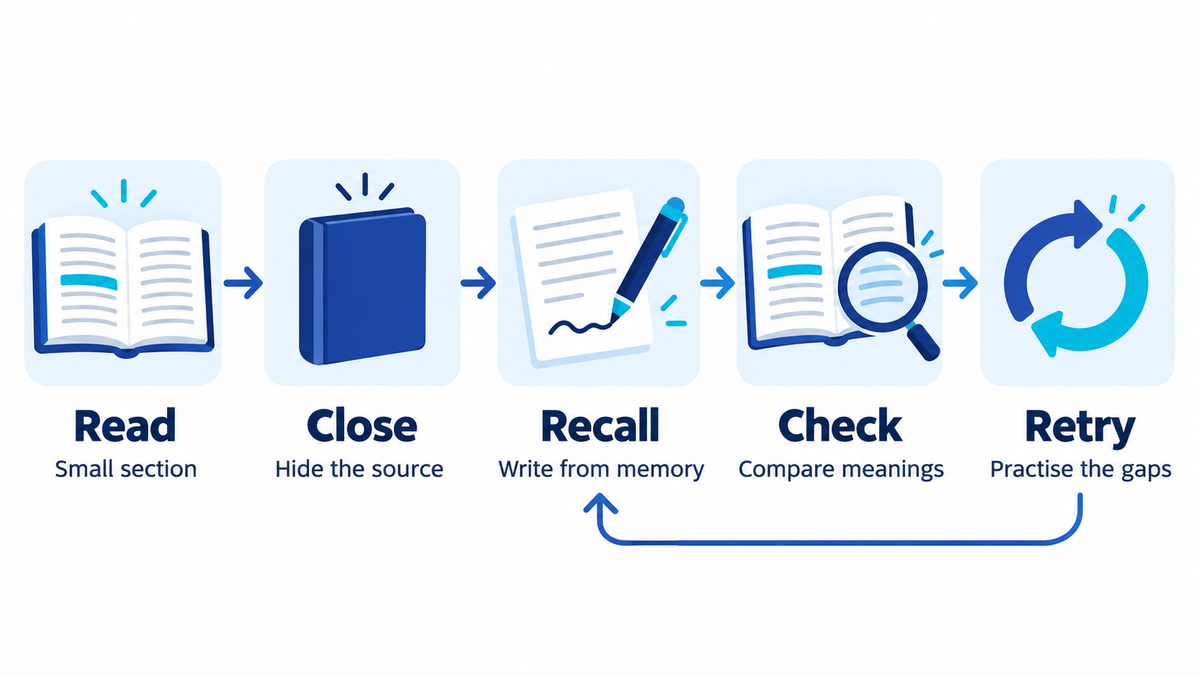
The blurting method means studying a small section, hiding the source, writing what you remember, and checking your response against the source. Keep correct points, missing points and incorrect claims separate. Then practise the gaps with the source closed again.
You can do this on paper or in a plain text document. You do not need a special notebook, a perfect mind map or an app to start.
What is the blurting method?
Blurting is a practical way to attempt recall without looking at the answer. Choose a bounded topic, such as how one process works or the conditions attached to one rule. After studying it, put the material away and reconstruct it in your own words.
The page can contain sentences, labels, a diagram or a rough explanation. What matters is that the information came from memory during the attempt. If you keep the source open and rearrange its wording, you are doing a different activity.
The result is useful evidence about that attempt. It is not automatically an exam mark, a prediction of tomorrow's memory or proof that you understand every application of the topic. A page can include the right keywords while leaving their relationships unclear.
For the wider distinction between recognising an answer and producing it, see active recall and effective study methods.
Does research support blurting?
Research supports retrieval practice, the broader activity behind a closed-source recall attempt. It does not establish that every routine called “blurting” has the same effect.
In experiments with educational science texts, Karpicke and Blunt found that practising retrieval improved later performance on questions about the material, including questions requiring inferences. Their study compared specific learning activities under controlled conditions; it was not a trial of this worksheet, Memly or a social-media routine. Karpicke and Blunt, 2011
A later study compared paragraph recall with concept mapping from memory. Both retrieval formats outperformed additional studying on a test one week later, without a difference between the two retrieval formats. That finding supports focusing on retrieval rather than treating a particular page layout as the essential ingredient. Blunt and Karpicke, 2014
Use the method as a way to practise and diagnose gaps. Do not use these findings to promise a fixed percentage improvement or a particular grade.
How to do blurting, step by step
Choose a question you can actually check
“Everything about this chapter” is difficult to mark. “What happens, in what order, and under what conditions?” gives you something concrete to reconstruct. Use your course specification, a teacher's question or a section heading to set the scope.
Keep the source reference beside the question: the page, slide or paragraph you will use to check the answer. If two sources disagree, resolve that disagreement before treating either as a marking key.
Read for meaning, then close the source
Work out what the passage is saying before trying to reproduce it. Identify any unfamiliar terms and notice words such as “only”, “unless” and “after”. Those words can change an answer even when the main nouns are correct.
Close the book, hide the notes and move any answer key out of view. If you need to peek, record that you used a cue. You can still learn from a prompted attempt; you just should not count it as unaided recall.
Write what you can retrieve
Use rough sentences or labelled arrows. Add a question mark where you are unsure instead of quietly inventing a connection. Leave space for a missing step rather than making the page look complete at any cost.
A timer can limit how long you spend stuck, but there is no universal number of minutes that makes blurting work. Pick a short, manageable attempt for the material you chose. Stop when you have made an honest effort, then check it.
Compare meanings, conditions and errors
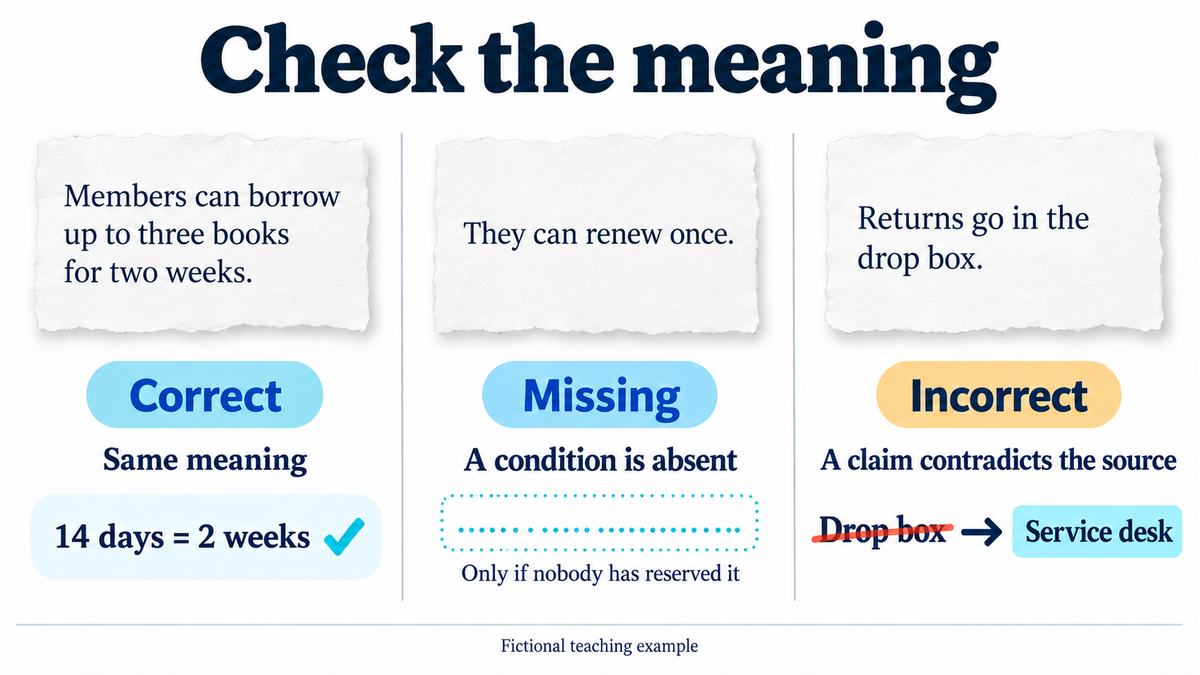
Open the source after the attempt. Mark each important point as correct, missing or incorrect. A wrong claim needs correction; an omitted claim needs a prompt that helps you retrieve it next time. Do not treat them as the same problem.
Accept equivalent wording when the meaning is intact. Keep exact terminology where your course or question requires it. Check relationships and conditions, not just whether a keyword appears somewhere on the page.
Repair a gap, then try again without the answer
Read the relevant source sentence, explain why your first answer missed it, and make a focused question. Close the source for the next attempt. Keep your original attempt visible in your records rather than overwriting it with the corrected version.
Plan another attempt after a gap as well as any immediate retry. Record the date and whether you used cues. A correct answer immediately after seeing the source is useful practice, but it is not the same observation as a later answer without help.
A worked blurting example with a marking key
The following passage and answer are fictional teaching materials written for this article. They are not a real library policy, a student record or a Memly learning result.
Read this passage, then hide it:
At the practice library, members may borrow up to three books for fourteen days. A book may be renewed once, only if nobody has reserved it. Books must be returned to the service desk.
The question is: “What are the borrowing, renewal and return rules?” Here is a deliberately imperfect response:
Members can borrow up to three books for two weeks. They can renew once. Returns go in the drop box.
The marking key separates the passage into five points:
- Borrowing limit: Correct. Source: Up to three books. Response: Up to three books.
- Loan period: Correct. Source: Fourteen days. Response: Two weeks.
- Renewal limit: Correct. Source: Once. Response: Once.
- Renewal condition: Missing. Source: Only if nobody has reserved it. Response: Not mentioned.
- Return place: Incorrect. Source: Service desk. Response: Drop box.
This response has three correct points out of five, one missing condition and one incorrect location. “Two weeks” expresses the same duration as “fourteen days”; requiring the exact original wording would hide what the learner actually retrieved.
The count is just a transparent check of this fictional response against this five-point key. It is not an exam percentage, a memory-retention measurement or evidence that blurting improved anything. In real coursework, a missing condition may matter more than a missing minor detail, so follow the actual marking criteria.
For the next attempt, the useful questions are specific:
- When is a renewal allowed at the practice library?
- Where must a borrowed book be returned?
Then reconnect the parts: “A member has already renewed a book once and nobody has reserved it. Can they renew it again?” Under the fictional rule, no: the renewal limit still applies. That final question checks how the limit and condition work together.
How to check your blurting without over-marking it
Write a small marking key before you judge the attempt. Otherwise, it is easy to change the standard to fit what you happened to write. Start with the expected ideas, then add any important relationships or exceptions.
For a definition, ask whether the meaning and distinguishing features are present. For a process, check the order and why each transition occurs. For an argument, check whether the conclusion follows from the evidence. A long list of relevant words is not enough for all three tasks.
If a point is partly right, write the missing qualification beside it instead of forcing a flattering score. The purpose is to choose the next practice task. You can use labels without calculating a percentage at all.
An AI tool can suggest a comparison, but compare that suggestion with the source too. Do not let an encouraging comment replace the marking key, and do not upload private or restricted course material without the relevant permission.
When blurting needs a different next step
If the page is nearly empty, reduce the scope. Revisit one short section and try a narrower question. Add a heading as a cue if needed, but record it so you can distinguish prompted recall from unaided recall later.
If the page is full but wrong, stop repeating it. Recheck the source and identify the specific misunderstanding. Ask a teacher or another appropriate person when the source itself is unclear.
If you recall the rule but cannot solve a problem, practise using the rule. For mathematics, that includes worked problems with the steps checked. For an essay, it includes building and supporting an argument. Blurting can reveal gaps in the material you draw on; it does not replace the assessed task.
If you keep reproducing the same page effortlessly, change the question or revisit it later. A familiar sequence of sentences can conceal a gap when the prompt changes. Keep enough variety to check the meaning you need, without turning every session into a new study system.
Use Memly's Blank page with a checked source
Memly's Blank page lets you write a response without viewing the cards, then compare the result with their answers. We tried the English web interface on October 23, 2026, using a dedicated demo deck containing one manually created card with the fictional passage above. This is a product walkthrough, not a learner outcome study.
Open the deck and choose Blank page. Select Type, hide your source material, and enter what you can recall. We deliberately entered the same imperfect response used in the marking key. The screen showed the answer box without exposing the card's model answer.
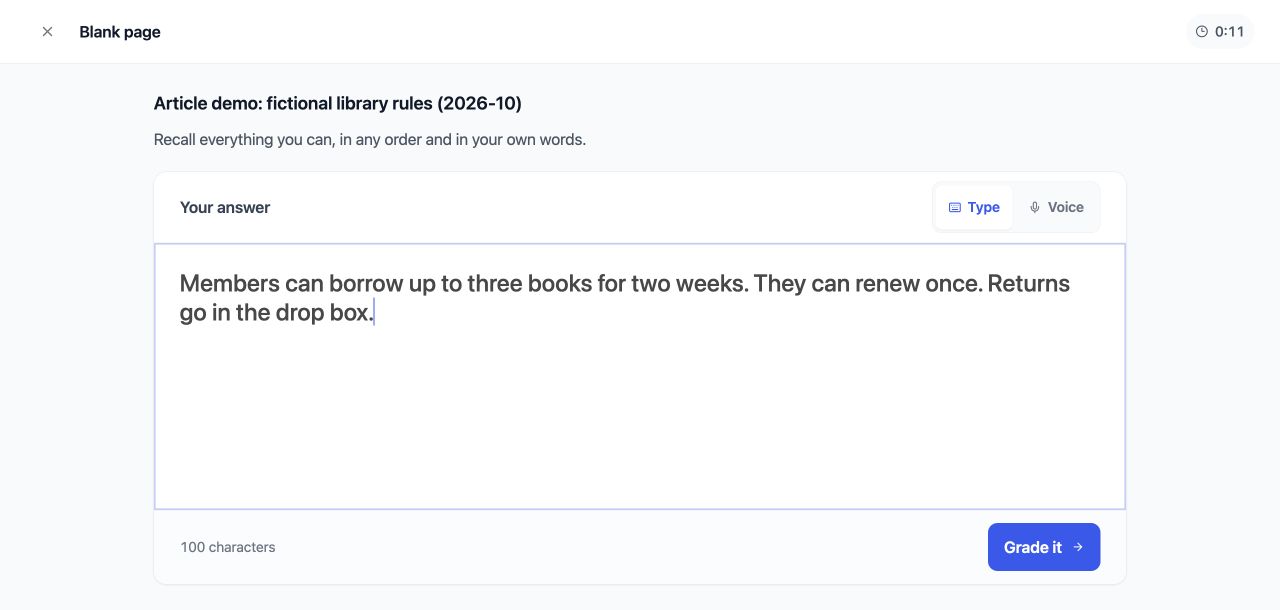
After Grade it, our result said “You recalled 1 of 1 card”, put the card under Written, and labelled it Close. It also reported that the review interval had been updated. The next interval shown in this demo was two days; it is an observed result for this card, not a recommended interval for everyone.
That card count is different from the five-point marking key. The response still has three correct points, a missing renewal condition and an incorrect return location. Do not read “1 of 1 card” as five correct points or a perfect answer.
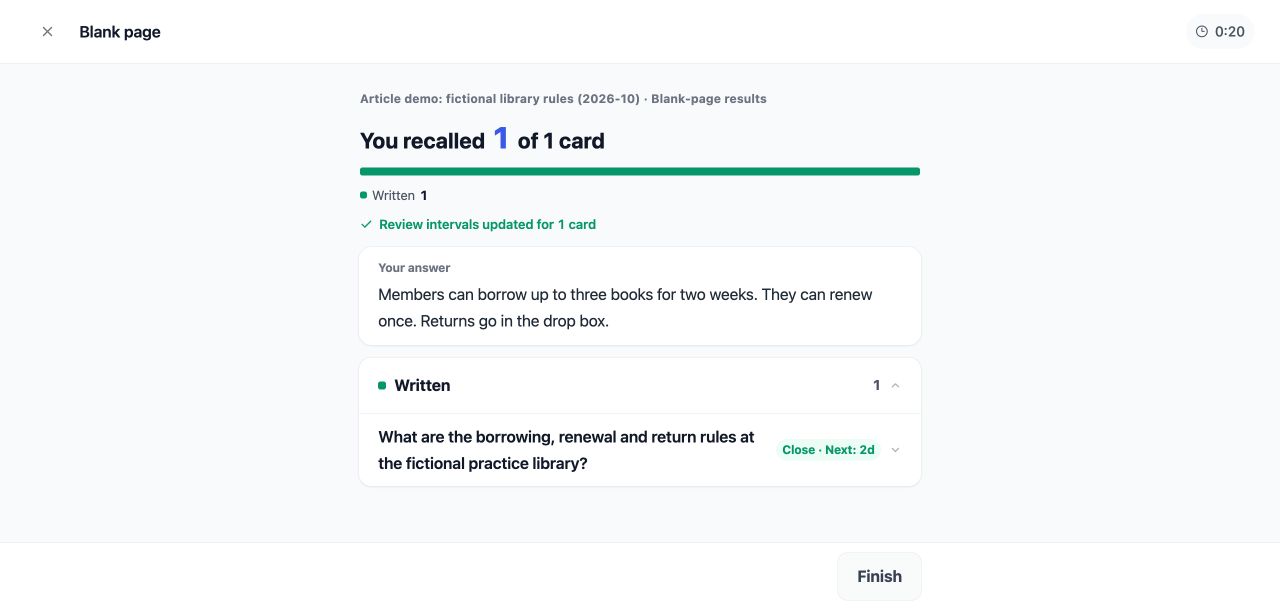
Expand the card to reveal Model answer. In this run, it showed our saved source text, including the reservation condition and the service-desk return rule. The displayed result did not separately list those two issues, so we compared the response with the source ourselves. This is where the correct/missing/incorrect checklist remains useful.
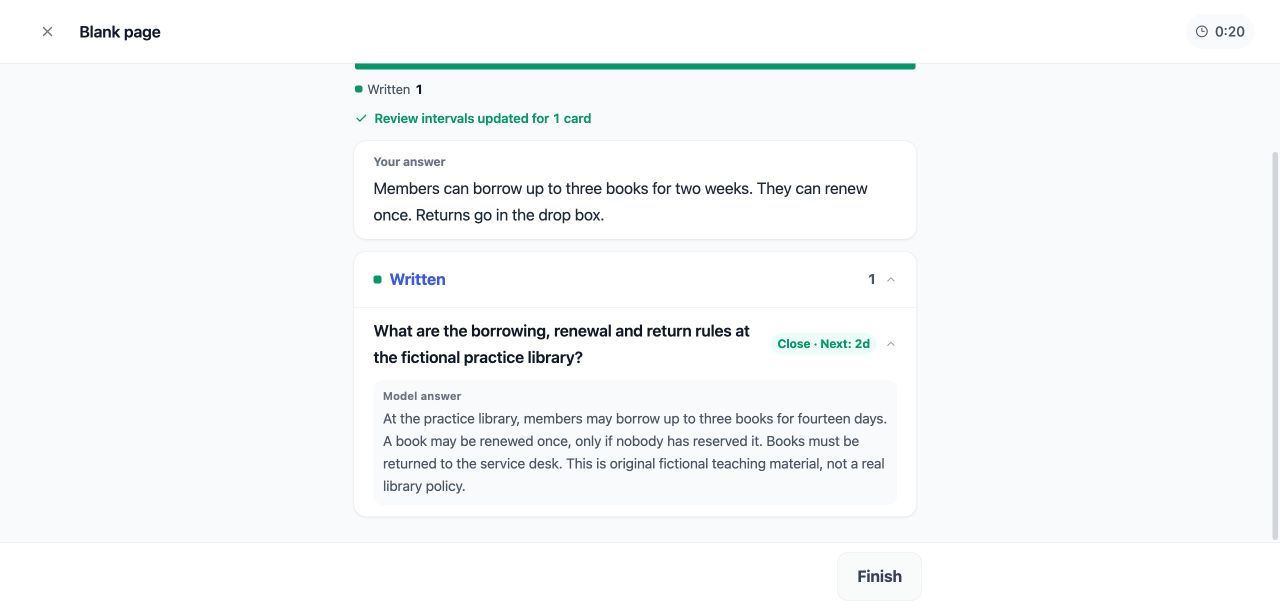
The benefit is having the broad recall attempt, the checked card answer and the next review in one workflow. The learner still needs to inspect the meaning. We finished the session and reloaded the deck; the card remained in its learned state. That verifies the saved demo state, not long-term retention or grading accuracy across other topics. Voice input and native-app behaviour were not tested in this walkthrough.
Turn repeated gaps into focused flashcard practice
Use blurting to see how ideas fit together, then use a short question to revisit a specific gap. In the fictional example, “Where are books returned?” is easier to check than “Explain all the library rules.” The broader question still has a place in a later full recall attempt.
Keep a checked answer with each question and answer from memory before looking. A generated card or suggested explanation should still be checked against the original material. For more context on choosing a way to answer a card, see Memly's study modes.
A worksheet for your next blurting session
Use the printable blurting worksheet with the original practice passage and marking key. The worksheet has separate space for your source reference, first attempt, corrections and a later attempt. Keep the source out of sight while you write.
Choose one question from material you are studying today. Make one honest attempt, find the most useful gap, and turn it into your next question. For the wider workflow, read AI-powered memorisation support. If you want to keep that question for later review, Memly is free to try with no credit card required.
