


An AI-generated explanation can sound clear while you read it and still be hard to explain later. It can also contain errors, so clarity alone is not proof of correctness. Check important points against a trusted source, then close the chat and try explaining the idea yourself.
Two well-documented mechanisms make an AI answer feel learned when it is not, and both yield to the same repair: the close-the-loop method that turns AI conversations into real ability.
The short version: an AI explanation gives you on-the-spot understanding, not memory. The fix is to capture what you learned as flashcards the moment you understand it, and schedule yourself to recall it later. That closes the loop, and knowledge you asked AI about becomes knowledge you own.
Why asking AI creates the illusion of knowing
Effortless understanding is not retention
An AI explanation is custom-built for you, with every stumbling block smoothed away. Your brain never struggles while reading it, and it misreads that lightness as mastery. This is the fluency illusion from cognitive psychology, the same trap as rereading a textbook, except AI triggers it harder: the better the explanation, the less friction there is to mistake for effort.
And what exams, interviews, and real work demand is not understanding an explanation in front of you (recognition) but producing it from a blank page (recall). We broke down that gap in Why You Forget What You Read. Left alone, AI conversations stack up recognition forever and recall never.
The knowledge lives in the chat log, not in you
The second mechanism is cognitive offloading: when your brain knows it can always ask again, it silently stops investing in remembering. The knowledge ends up residing in the chat log instead of your head. It is searchable, sure, but you cannot open the log in a meeting, in an exam hall, or in front of a patient.
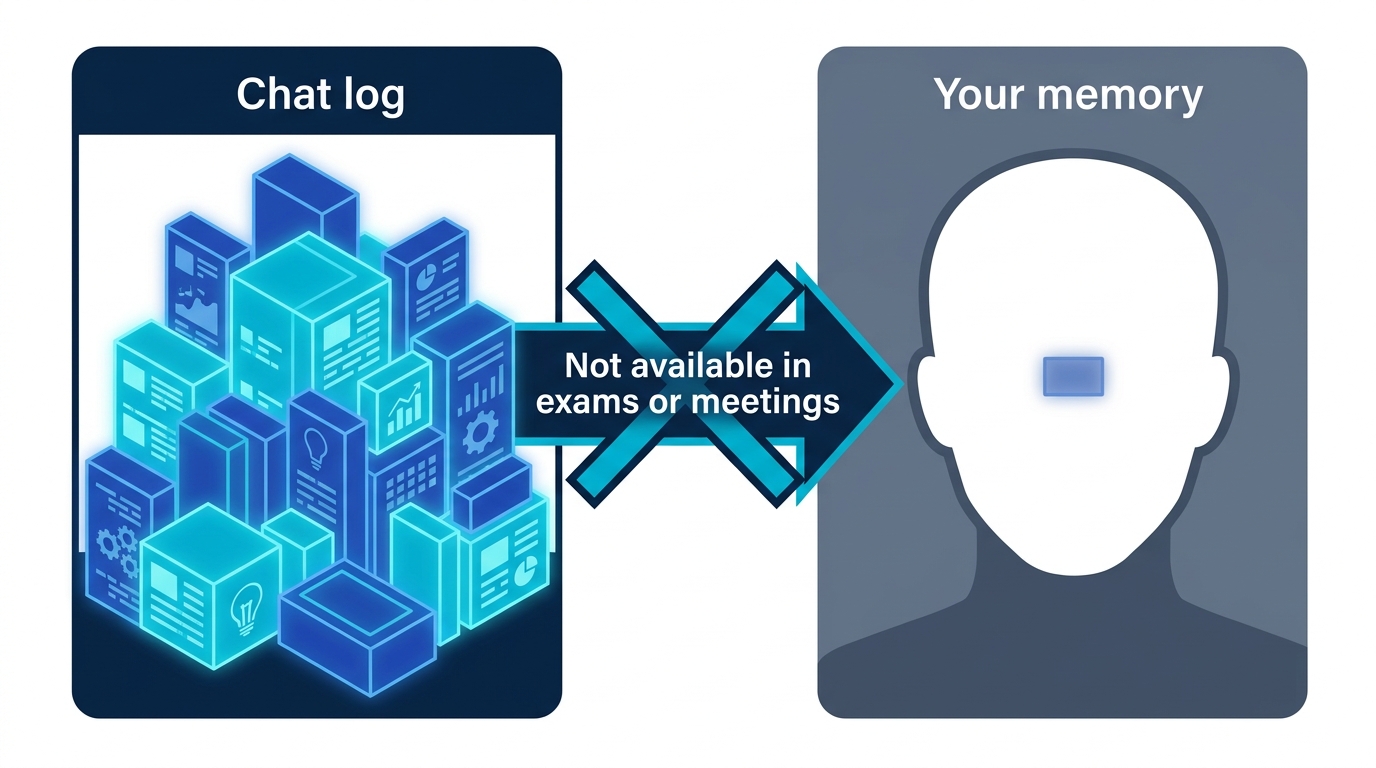
This is the structure we described in Learning in the Age of AI: the tools get smarter, your output gets faster, and your own capability quietly hollows out unless you learn deliberately.
Right after the "aha" versus one week later
| When | How it feels | What you can actually do |
|---|---|---|
| Right after reading the AI answer | Completely understood | Reproduce it while looking at the explanation |
| Next day | Pretty sure I remember it | Only fragments come back |
| One week later | "I looked this up before..." | Cannot explain it unaided. Ask AI again |
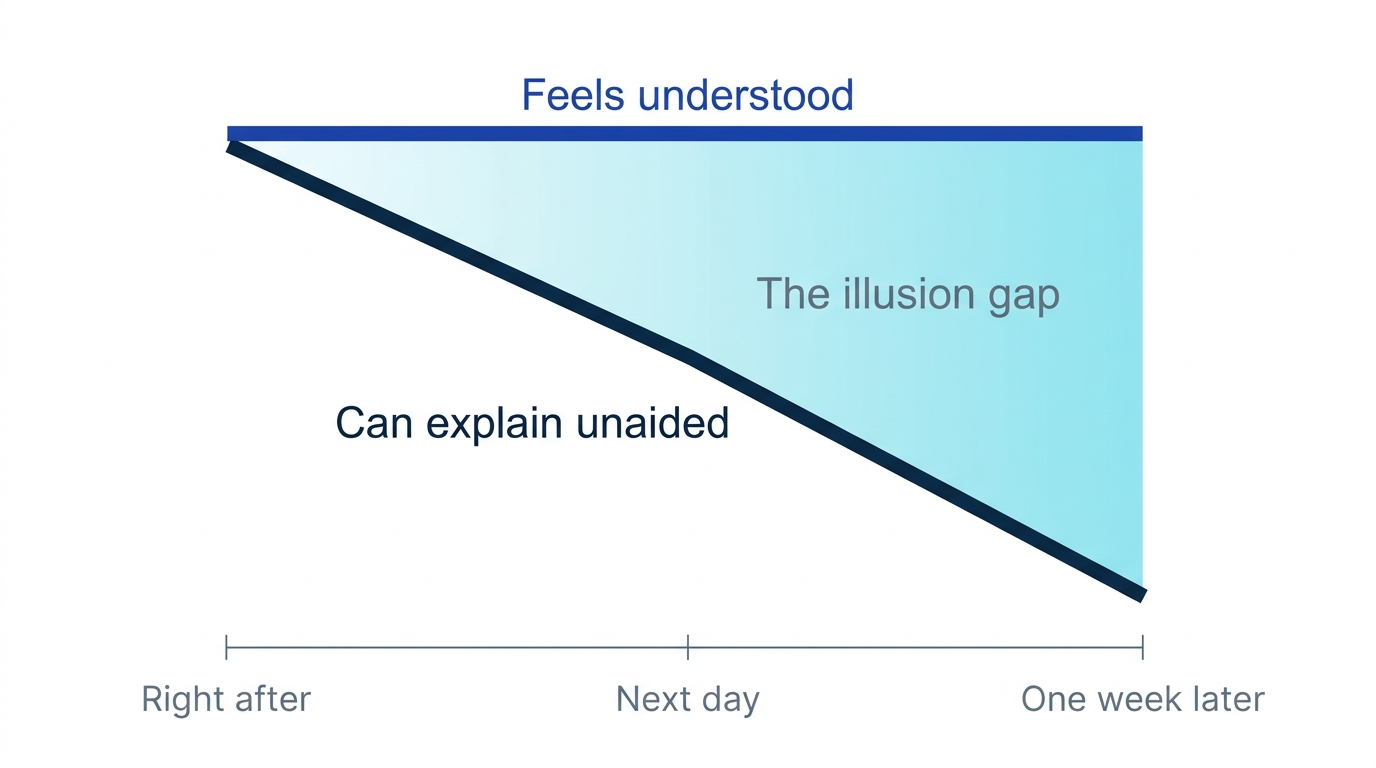
That last row is the problem. Re-asking AI the same questions is not just lost time; it keeps widening the gap between how much you feel you know and how much you can produce.
Close the loop: turn AI conversations into cards
The fix is simple in shape: do not stop at understanding; carry it through to retrieval. As Dunlosky's 2013 review shows, what drives retention is practice testing and spaced review, not reading beautiful explanations. Three steps:
- Detect the "I didn't know that": any point in an AI answer that makes you go "huh, interesting" is a card waiting to exist.
- Card it before you leave the conversation: cut out one to three question-and-answer pairs on the spot. Memly's MCP integration with ChatGPT and Claude lets you turn conversation takeaways directly into cards; see Memly's MCP Integration.
- Let FSRS do the rest: the spaced repetition algorithm quizzes you just as you start to forget, automatically testing whether you can still explain it unaided.
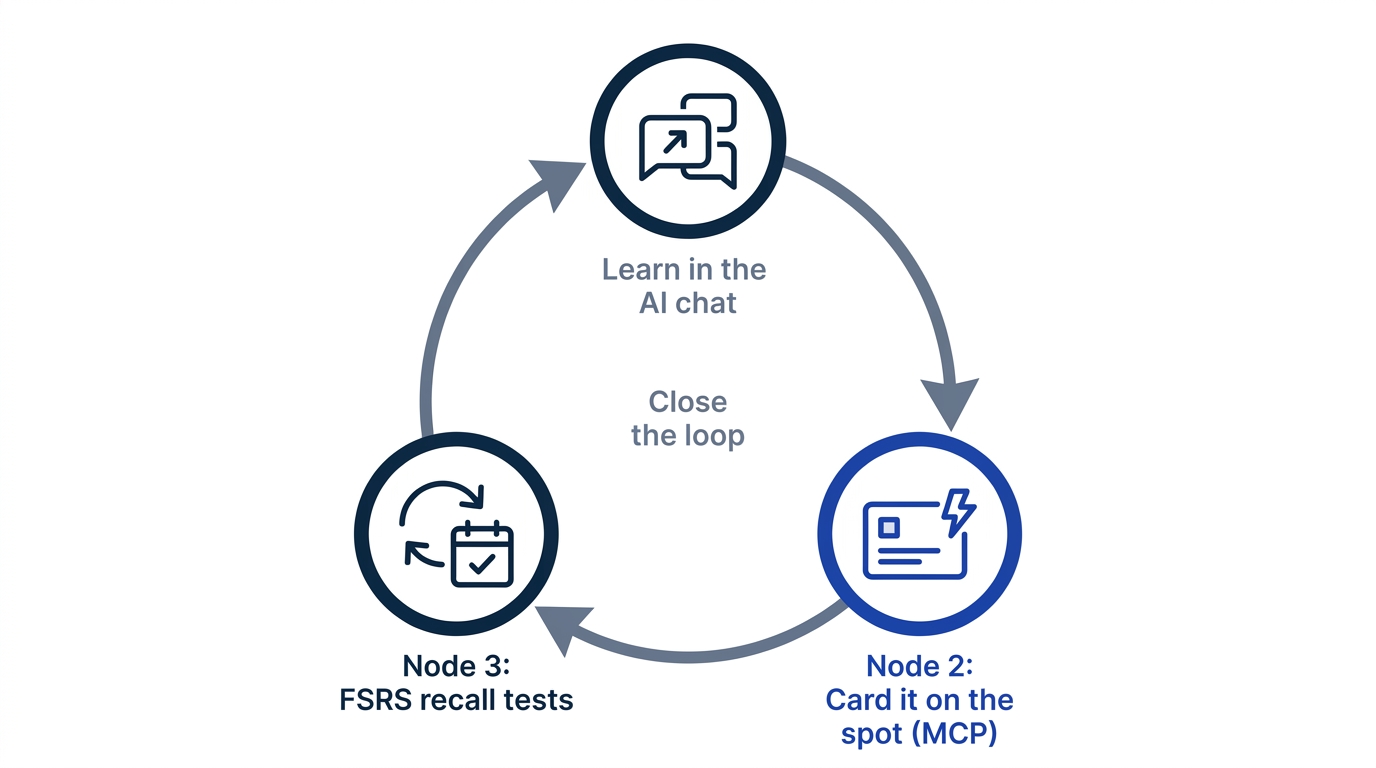
One practical rule: select cards by "did I not know this?" rather than "is this important?" Importance judgments stall you; novelty detection is mechanical, and it grows a deck of exactly your blind spots. For the hands-on workflow, see How to Make Flashcards with ChatGPT.
Turn AI from answer machine into course-material machine
Once this habit runs, your relationship with AI changes. It stops being a vending machine for disposable answers and becomes a daily generator of personalized study material. The more you converse, the more cards accumulate, FSRS keeps the reviews turning, and the stock of things you can explain unaided compounds. AI's progress becomes your memory's compound interest.
For the full picture of AI-assisted memorization, see the pillar guide AI-Assisted Memorization: How It Works and the Best Tools.
Keep exactly one of today's "aha" moments
For your next AI-assisted explanation, first check it against a trusted source. Then close the chat and explain the idea in your own words. Save one question you want to revisit; you do not need to retain every answer a chatbot produces.
One action: take one thing today's AI conversation taught you and turn it into a single card. That is the first turn of the loop that converts "got it" into something that comes out when someone asks. Memly is free to try, no credit card required.
