

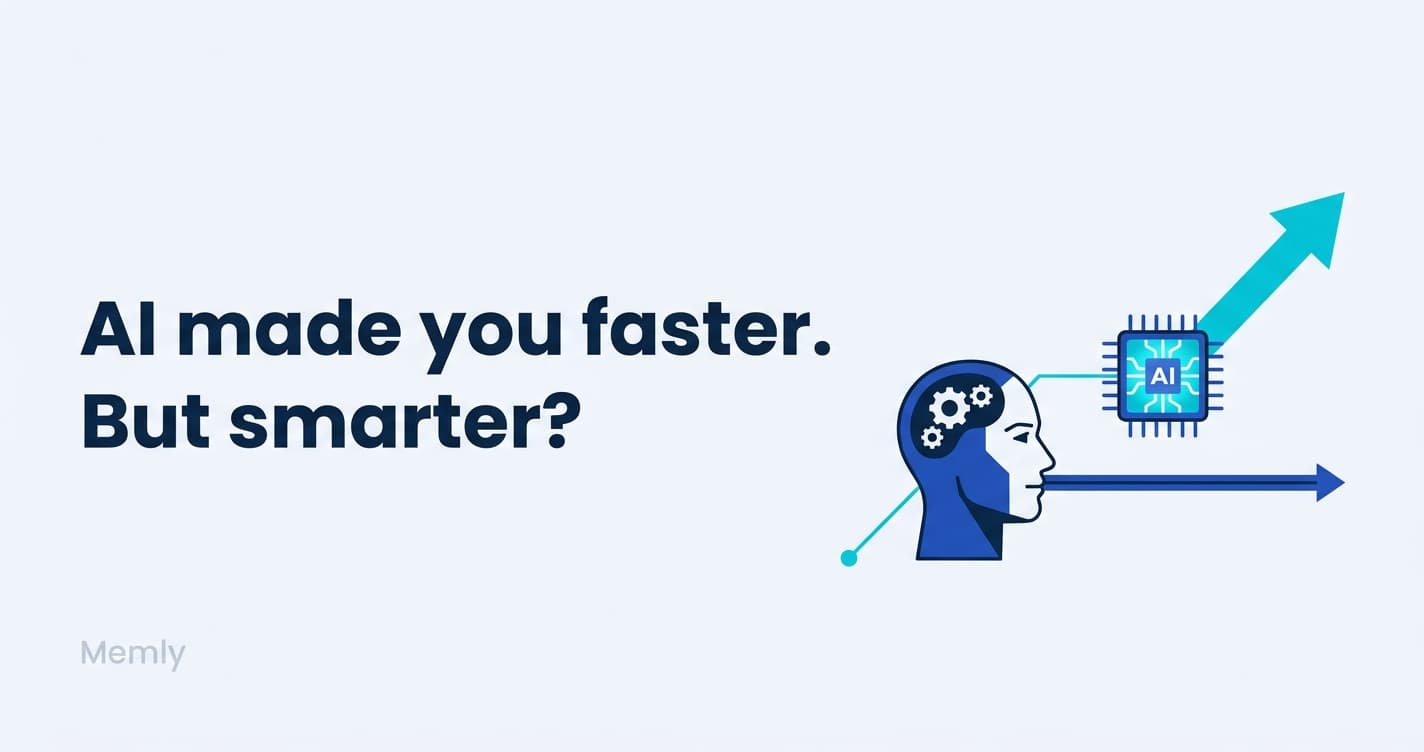
Be honest with yourself. Since you started using AI, your output has clearly gone up. Code, documents, emails, and research all ship several times faster than before. Now one more question. Over these past two years, have you actually become smarter?
This is where a lot of people pause. The output went up. But the version of you that exists the moment you close the AI, in a meeting, in an interview, in a split-second decision with no one to ask, is that version any sharper than before? The answer decides something fairly practical: whether the next two years leave you faster, or leave you dependent.
AI extends what you can do (your output), but it does not extend who you are (your underlying ability). So in the age of AI, more than ever, you can't hand everything off. You have to learn alongside AI and keep the knowledge in your own head. Capture what you learn in an AI conversation as a card on the spot, then review it at the right time so it sticks. That is exactly what Memly turns into a system.
AI extends your output. It does not extend you
Picture a forklift. With one, you can move a one-ton pallet effortlessly. But driving a forklift every day will not make your arms one gram stronger. AI is a forklift for the mind. The load you can move (your output) grows dramatically, while the muscle doing the directing, your own thinking and knowledge, stays exactly where it was.
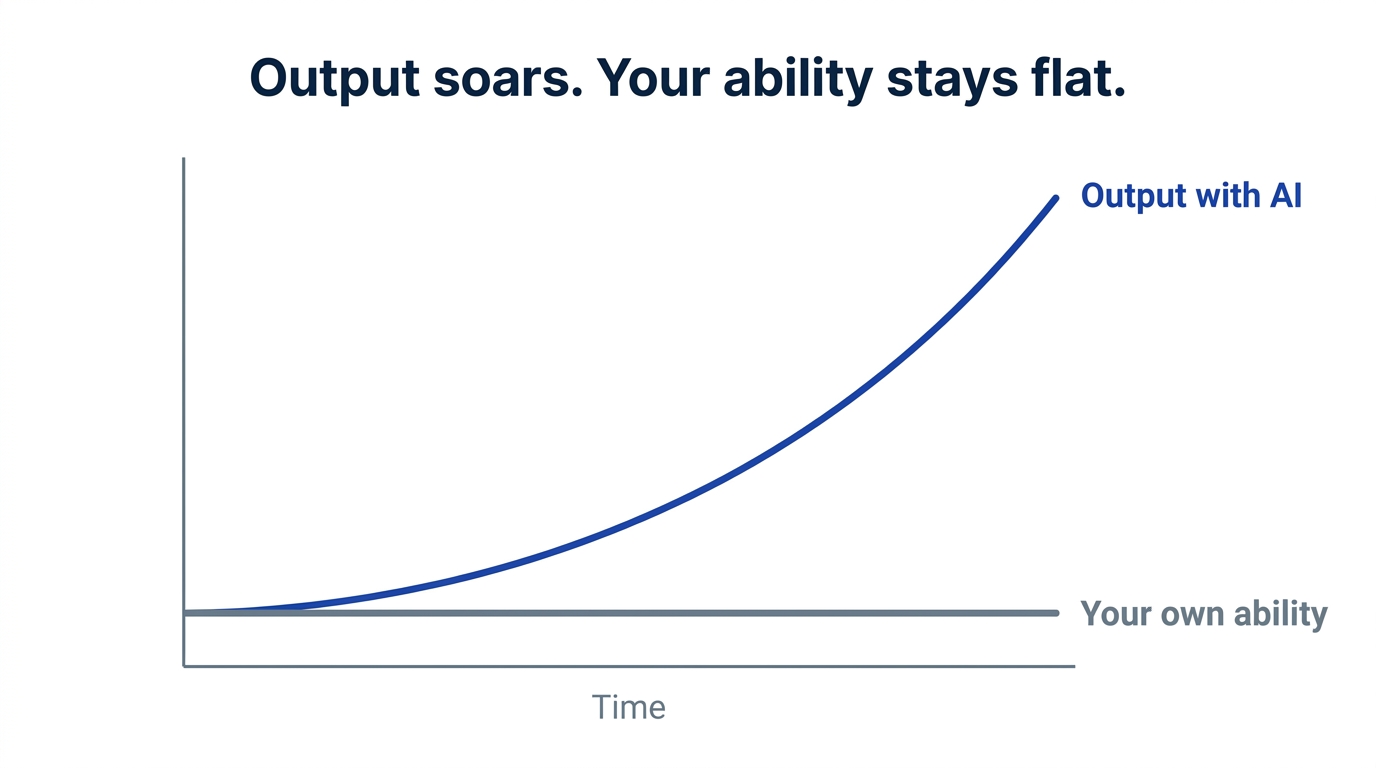
"Being able to reach the answer" and "actually knowing it" are two different things. Ask AI and the answer appears. That does not mean knowledge was added inside you. Your output curve can rocket upward while your own ability curve stays surprisingly flat.
The price of convenience is that unused skills rust
Worse than simply not growing: skills you stop using decay. A classic study by Sparrow and colleagues at Columbia (2011) showed that when people expect to be able to look something up later, they remember the information itself far less. The finding is known as the "Google effect," or digital amnesia. What calculators did to mental arithmetic is now starting to happen to thinking itself.
A 2025 study by researchers at Microsoft and Carnegie Mellon likewise found that the more people trusted AI, the less they engaged in critical thinking of their own (this is a correlation, not proof that AI is the cause). Still, the direction is clear: outsource your thinking long enough, and the ability to think itself dulls.
What makes this dangerous is that the decay hides behind the "illusion of fluency." Reading AI's smooth answer feels like understanding. But that is only "I recognize it when I see it," not "I can produce it myself." The feeling of having understood piles up, while real understanding slips right past.
Why your own ability matters more in the age of AI, not less
"If AI is always there, why do I need to know anything?" The reality is the opposite. The more powerful AI becomes, the more the human ability to wield it decides the outcome. There are four reasons.
| Situation | Why your own knowledge is required |
|---|---|
| Judgment & decisions | AI gives you options. Choosing among them takes your knowledge |
| Catching errors | AI is confidently wrong. Only someone who knows can catch it |
| Quality of prompts | Good questions come from knowledge. Your knowledge caps your prompts |
| Speed of conversation | Debate, interviews, negotiation move too fast to look things up |
Of those four, the second one is the one that bites soonest. An AI answer that is wrong reads exactly like an AI answer that is right, and the only thing standing between the two is what you already know.
There is a fifth reason too, less visible but decisive: knowledge compounds. The more you know, the faster you understand the next new thing, and the better you direct AI. Outsource your learning, and you step off the compounding curve. The gap may be tiny at first, but the more time passes, the wider it grows.
The answer isn't dropping AI. It's growing together with it
Don't misread this. This is not "stop using AI." AI is the best tool humanity has ever built. The question isn't whether you use it. It's whether you grow as you use it, or hollow out as you use it.
What changes the outcome is refusing to treat your AI conversations as disposable. Every day, you learn real things in those chats: new concepts, unfamiliar terms, clever approaches. And almost all of it is left behind in the chat history and forgotten by tomorrow. The forgetting curve does not care that your teacher was an AI. Change just this one thing, and the same AI turns from a tool for output into a partner for growth.
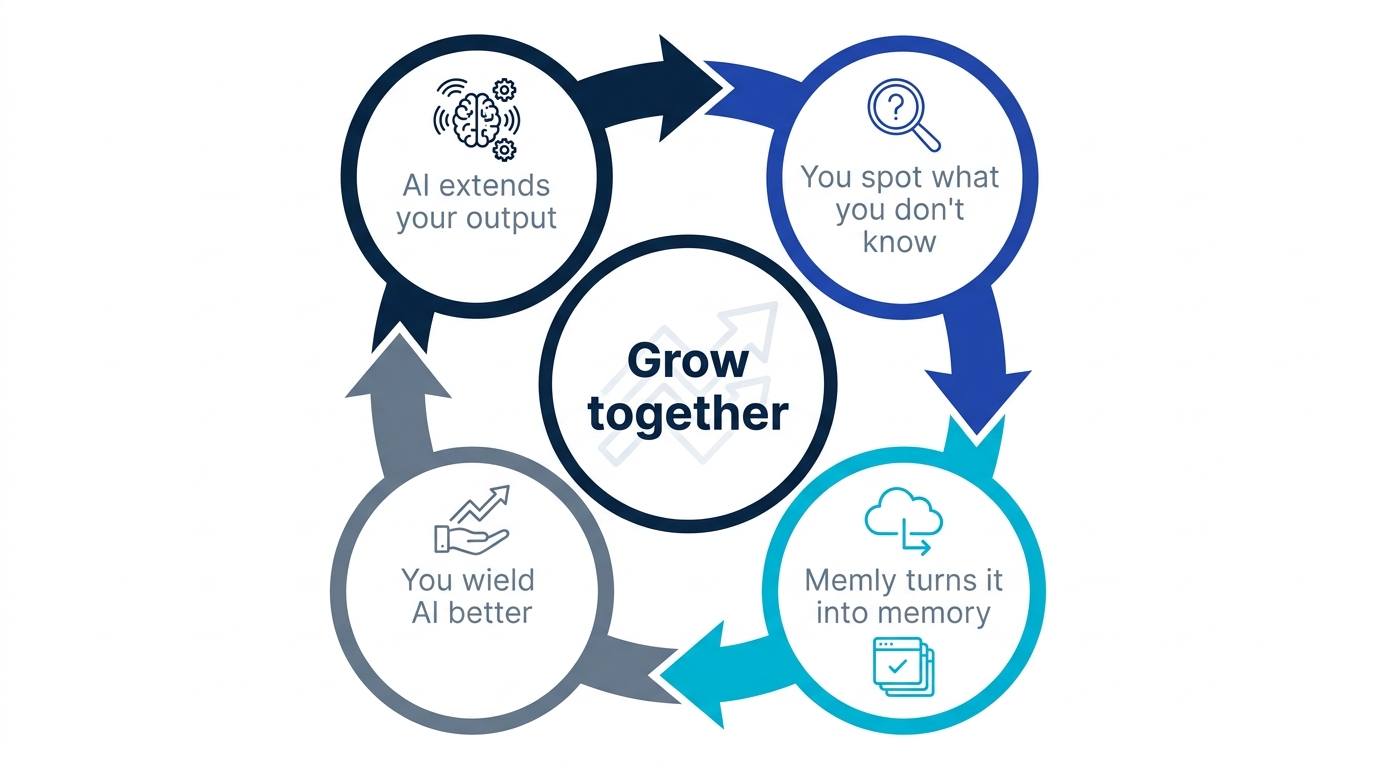
Once this loop turns, AI widens your output, that widening grows your own ability, and that ability lets you wield AI even better. Human and AI lift each other up. That is what learning in the age of AI should look like. It is the same idea behind Satya Nadella's learning loop, a habit of learning that keeps compounding no matter how much work you hand off to AI.
Memly turns learning-with-AI into a system
"Don't let it go to waste" is easy to say, but willpower alone won't sustain it. So you make it a system. Memly is an AI flashcard app built to turn learning-with-AI into your own memory automatically.
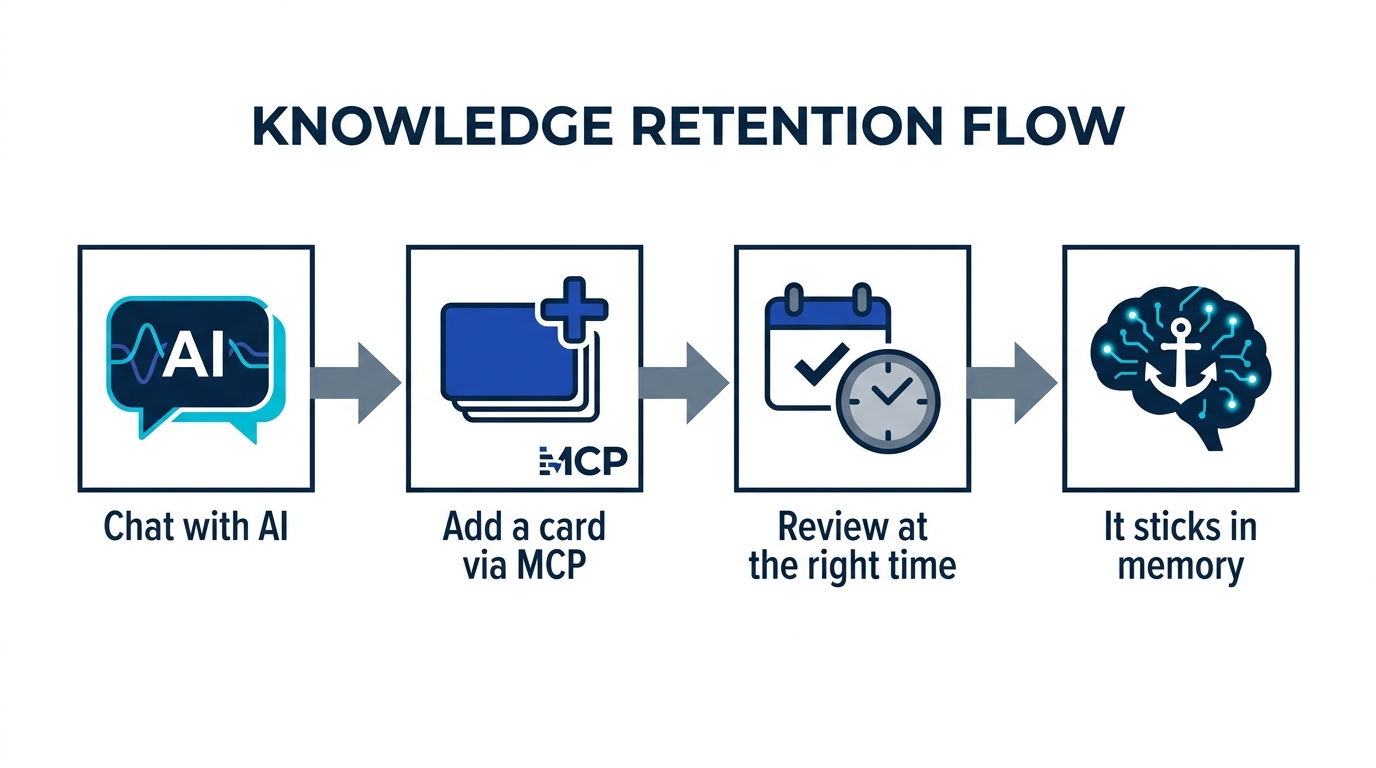
Add a card straight from your AI chat, via MCP
Memly supports MCP (Model Context Protocol). The moment you think "I didn't know that" in a conversation with ChatGPT or Claude, you can add it straight to Memly as a card without leaving the chat, capturing the insight while it's still hot. The mechanics are covered in Memly's MCP integration.
Any format becomes a card
AI takes the busywork of making cards off your hands. Chat text, PDF slides, a photo of your notes or textbook: whatever the format, AI shapes it into clean question-and-answer cards. You just hand it the material. See how to make flashcards with ChatGPT for a concrete example.
It gets etched into your memory at the right time
Memly resurfaces each card at the moment you're about to forget it, which is what spaced repetition means in practice. Instead of letting knowledge sleep in your chat history, you recall it again and again until it becomes part of you. The science of review timing is in the forgetting curve and review timing.
Learning in the age of AI means Memly
AI will keep doing enormous amounts of work for you. That's fine. But no matter how smart AI gets, it will never carry the contents of your own head into the meeting for you. When the question lands and there is no time to open a chat window, what answers is whatever you actually learned. The one who gets smarter is always you.
The person who only has AI "do it" and the person who "grows with" AI: the gap starts small, but after enough compounding time, it becomes decisive. Learning in the age of AI means continuously turning what AI helps you learn into your own memory, and Memly is the system for it.
Keep waiting for AI to make you smarter? Or take one thing you learned in today's AI conversation and start turning it into your own memory? Memly is free to try, with no credit card.
For the big picture of AI-powered memorization, see what AI-powered memorization support is, and for making cards with ChatGPT, see how to make flashcards with ChatGPT.
