

Microsoft CEO Satya Nadella recently published a long post about how companies survive in the age of AI. It sounds like a boardroom problem with nothing in it for you. But one idea inside it speaks directly to you as an individual: the learning loop.
In an era where you can hand more and more work to AI, what decides your value? His answer is written for companies, but it survives translation to one person without losing anything.
Nadella's argument is that companies shouldn't just use AI. They should build a "learning loop" that keeps spinning and compounds like a snowball. The same logic holds for one person. You can hand off the work, but you can never hand off the learning.Only the people who own a learning loop keep getting stronger as AI takes over more tasks.
Nadella's post in 3 minutes, with every hard word translated
His post is full of business jargon, so here is every term in plain words.
| Nadella's term | In plain words |
|---|---|
| Cognitive loop | Humans and AI teaching each other and getting smarter, together |
| Human capital | The power inside people's heads (knowledge, judgment, experience) |
| Token capital | The AI capability a company builds and owns |
| Learning loop | Learn, try, fix, spun in a circle so you get stronger |
| Compounding | Like interest on interest: learning feeds more learning and speeds up |
| Hill-climbing machine | A machine that keeps climbing higher, one step at a time, never sliding back |
The single most important line: "You can outsource work, not learning"
You can send tasks outside, to AI or to other people. Learning behaves differently, because the change it produces lands inside whoever does the work of figuring the thing out. Outsource that work and the knowledge forms somewhere other than in your own head. So the system that stores learning and keeps it spinning becomes a company's single biggest advantage. That is the learning loop.
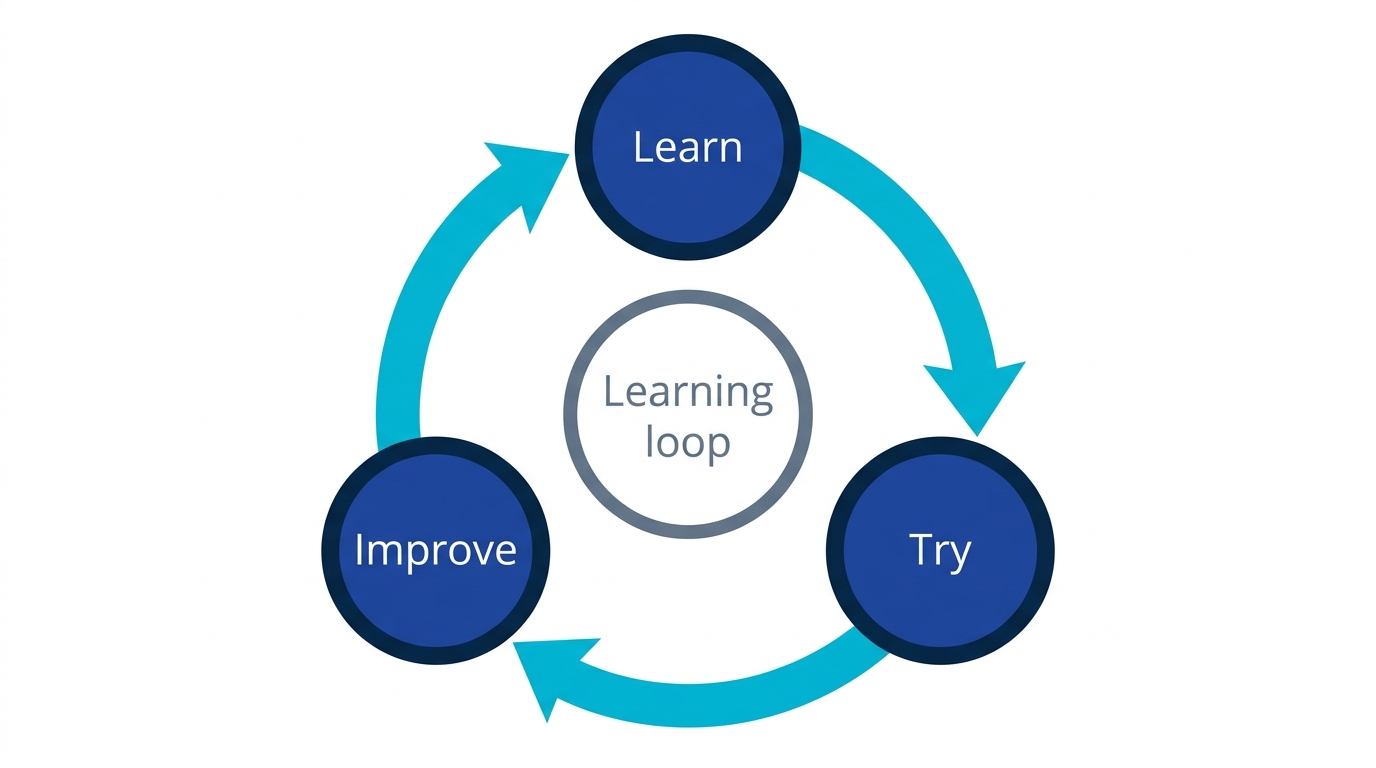
Learn, try, improve. Each turn starts from where the last one ended, so the gains stack instead of resetting, and a rival who starts later has to cover every turn already made. Nadella calls this a "hill-climbing machine" that keeps climbing and never slides back.
The goal isn't "winner takes all," it's "value spread widely"
Nadella worries about a future where a handful of powerful AI models soak up all the value, the way old-style globalization hollowed out whole industries. So instead of chasing one super-AI (a "frontier model"), he argues for building a level field where everyone can hold value (a "frontier ecosystem"). A world where value spreads widely is what he calls a "stable equilibrium."
The "company" story is your story, word for word
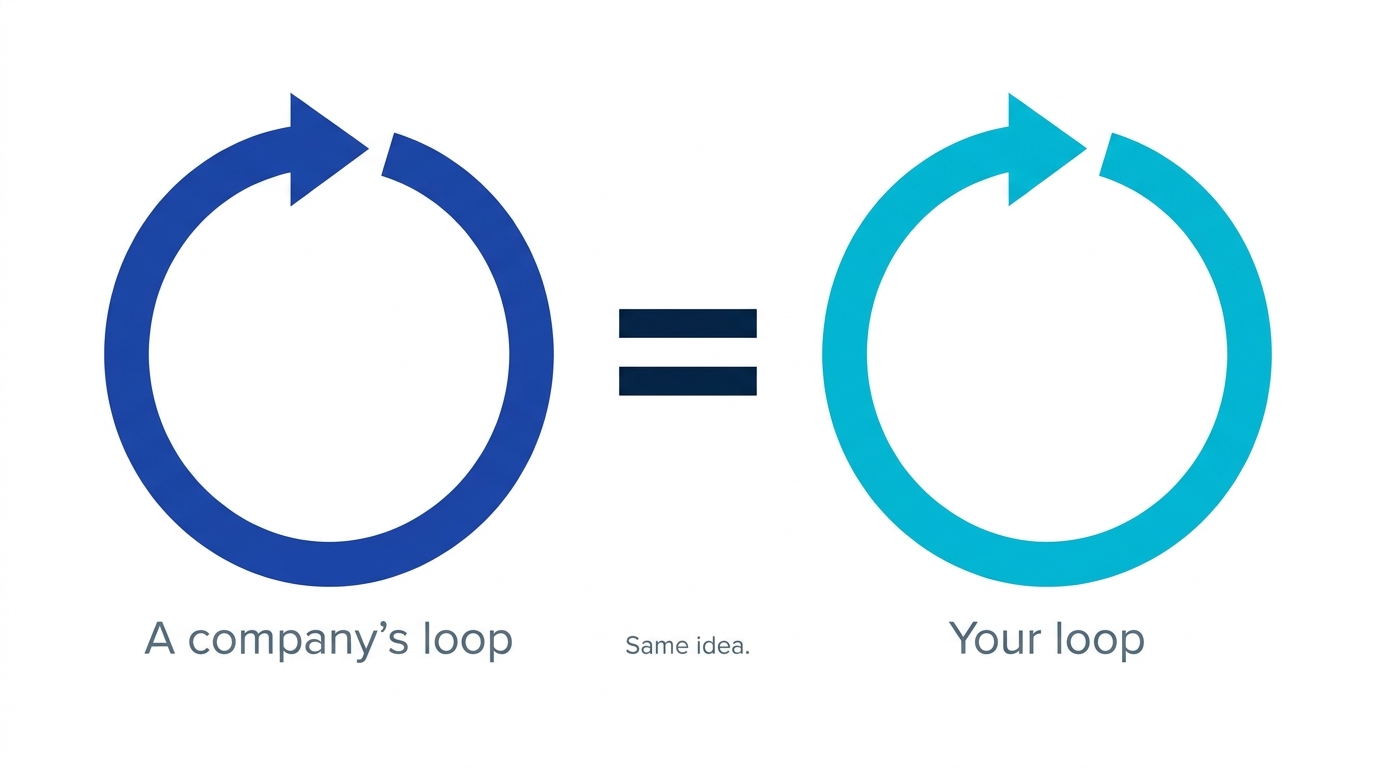
Nadella is talking about companies. Swap the company words for your words and nothing in the argument breaks.
| Nadella (company) | You (individual) |
|---|---|
| Human capital | Your own ability (knowledge, judgment, memory) |
| Token capital | The AI you can actually wield |
| Learning can't be outsourced | You can't hand off your learning either |
| A searchable knowledge base | A memory you can actually recall |
| Hill-climbing machine (compounding edge) | Your own edge, compounding over time |
The warning is easy to miss. If you hand everything to AI and stop learning, your own expertise turns into something "anyone can get from AI", because the answer you supply is then the answer anyone can fetch with a prompt. Why AI grows your output but not "you" is covered in Learning in the Age of AI.
How to spin "your learning loop" (3 steps)
Translate Nadella's company-sized loop into a personal one, and it becomes just three steps.
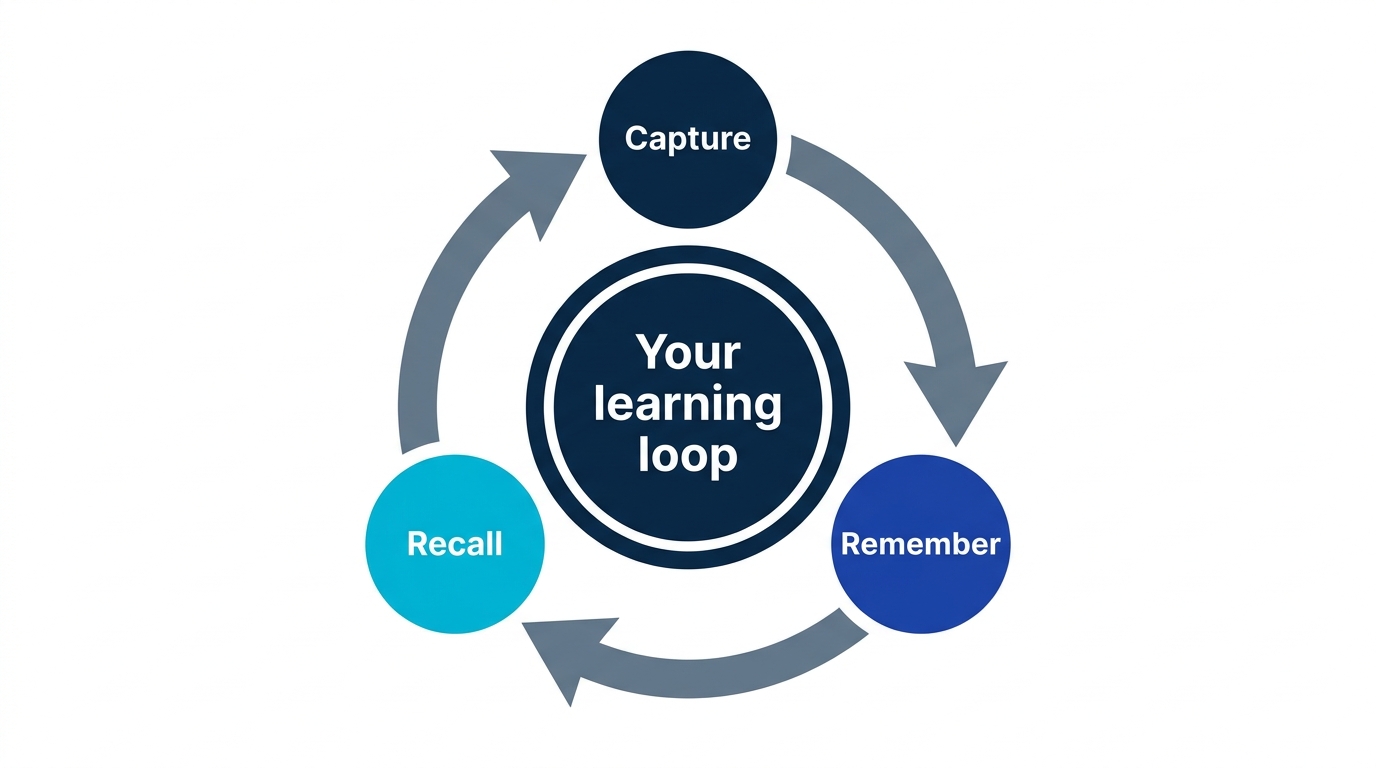
1. Capture
From your AI conversations and the material you read, pull out the things you didn't know before. This is the personal version of "storing your real work history." A lesson you don't record on the spot is gone by tomorrow.
2. Remember
Turn what you captured into something you can recall later. This is your version of a "searchable knowledge base." Left asleep in a chat log, it stays a record you could look up rather than knowledge you actually hold.
3. Recall (repeat)
Recall it before you forget, then use it again. Rereading the card and feeling like you know it doesn't count: pulling the answer out of memory yourself is the part that strengthens it, and spacing those attempts out is what makes the memory last. This is your hill-climbing machine. For when to recall, see the forgetting curve and review timing.
Memly becomes your learning loop
Memly is the tool that spins these three steps automatically, so it doesn't depend on willpower.
- Capture: the moment you think "I didn't know that" in a ChatGPT or Claude conversation, add it as a card via MCP. See Memly's MCP integration.
- Remember: chat, PDF, photo, any format, AI shapes it into a card.
- Recall: the app resurfaces each card right when you're about to forget it (spaced repetition).
The stack of cards you build stores tacit knowledge nobody else can copy, because it records what you personally got wrong and then fixed. In Nadella's words, it's your personal "IP." Tools and models may change, but this memory loop stays yours.
A learning loop starts with each individual
What Nadella wants is a world where value spreads to everyone (a stable equilibrium). That world starts with each person owning their own learning loop, since a company's loop is only the loops of the people inside it.
Don't wait for AI to make you smarter. Start spinning your own learning loop today, and one card is enough to start: take something you learned in today's AI conversation and turn it into your own memory.
Keep handing your value to AI? Or start spinning your own learning loop today? Memly is free to try, no credit card.
For the big picture of AI-powered memorization, see what AI-powered memorization support is, and for growing alongside AI, see Learning in the Age of AI.
Source: Satya Nadella's post on X (2026). This article summarizes and paraphrases it, explained from the angle of individual learning.
