


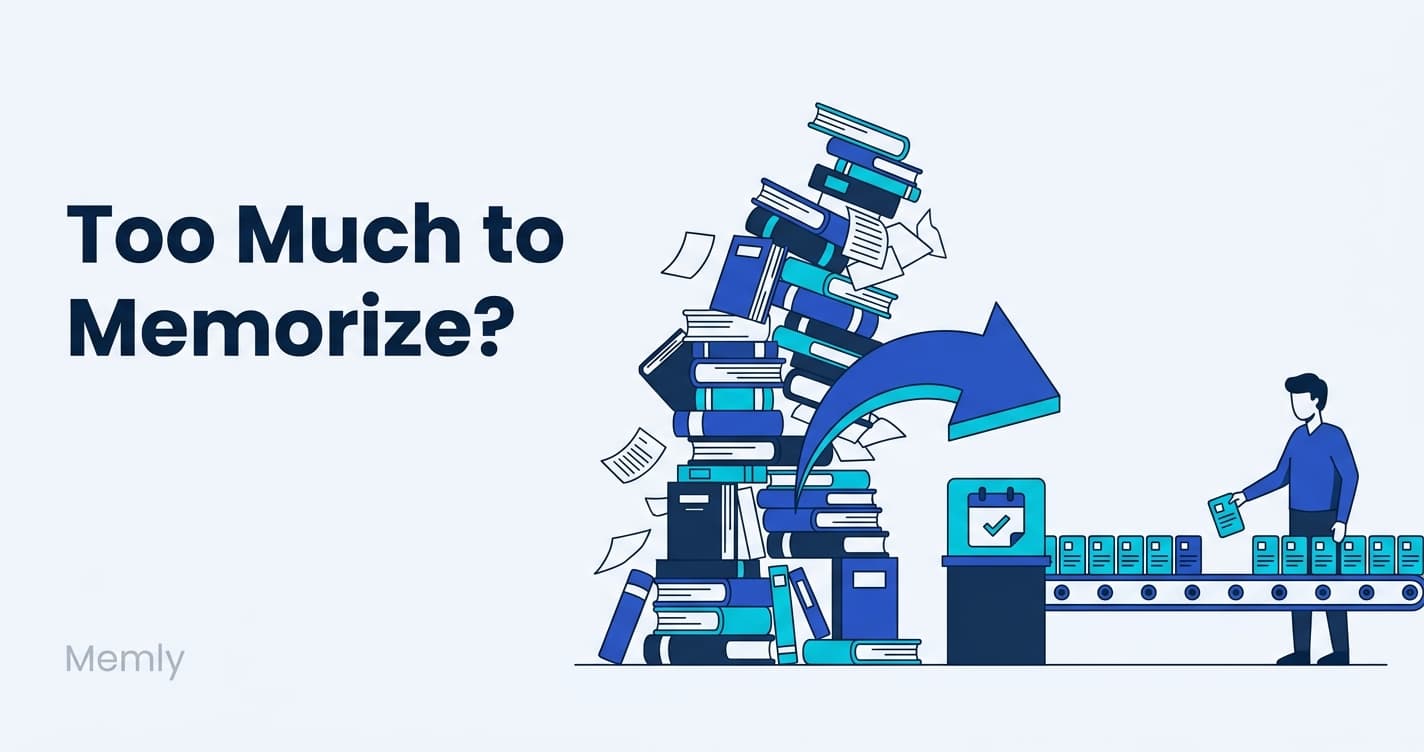
You open the textbook and sigh. Hundreds of pages, thousands of terms. You start reading anyway, and by page ten, page one is already gone. That sinking feeling makes it harder to sit down tomorrow, and every skipped day makes the mountain taller. This is the overwhelm spiral, and it costs you weeks.
Feeling like there is too much to memorize is not a capacity problem. It is a queue problem. Three design moves turn the mountain into a queue you can actually walk through.
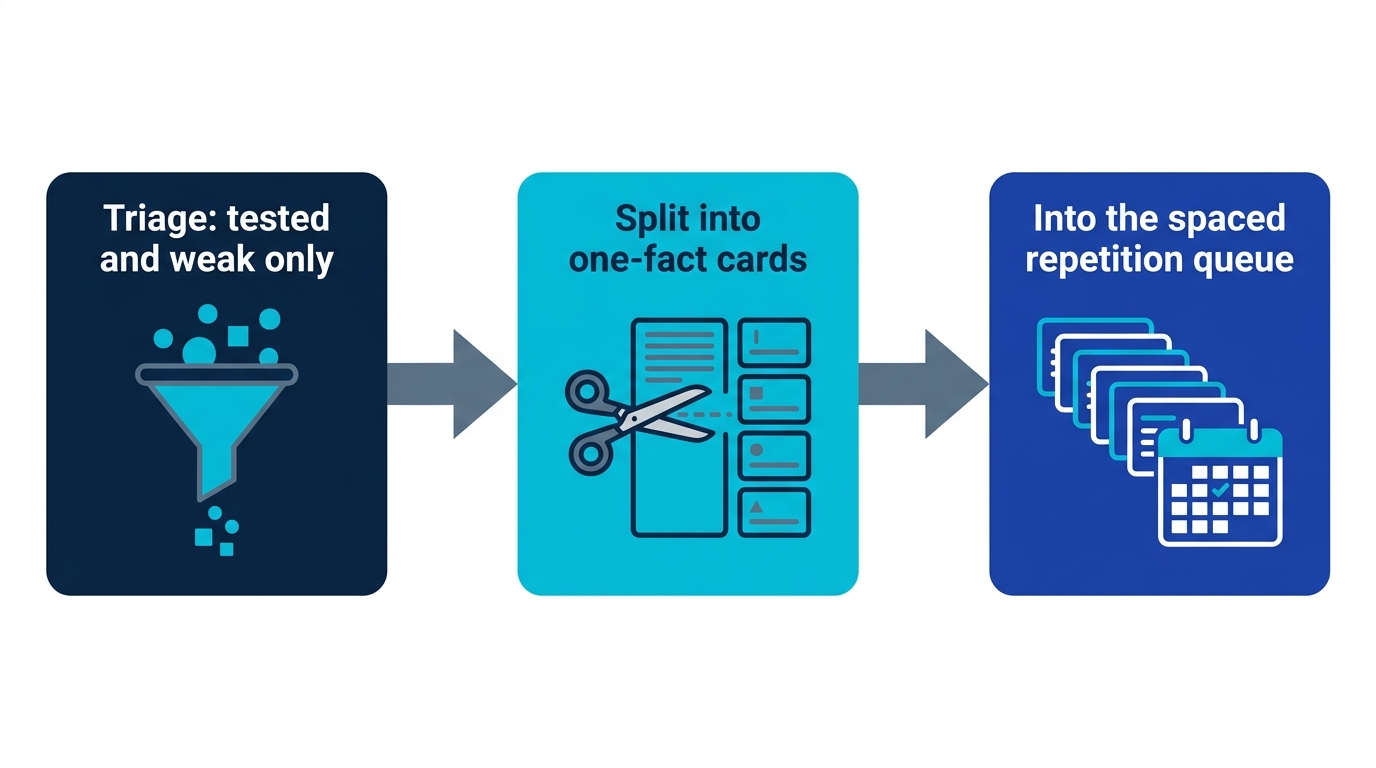
The short version: when the material feels endless, (1) shrink the unit to one fact per card, (2) triage what deserves to enter the queue at all, and (3) hand the "when do I revisit this?" bookkeeping to spaced repetition, so you only ever face today's due pile instead of the whole mountain.
Why does having too much to memorize make nothing stick?
Your brain's workbench, working memory, is astonishingly small: a handful of items at a time. The crushing feeling in front of a 400-page syllabus comes from trying to set the entire mountain on that tiny workbench at once. It cannot fit, so the reading slides off, and the sliding sets off panic, which takes up part of the same workbench and leaves even less room for the material.
Long-term memory plays by different rules, and its ceiling is not what limits you. What limits you is how fast new material arrives and whether it comes back at the right times. Med students memorize thousands of anatomy terms not because their brains are bigger, but because the intake is metered: a set number of new terms a day, each one scheduled to return before it fades (see How to Memorize Anatomy and Pharmacology).
Move 1: shrink the unit to one fact per card
"Learn chapter 3" does not fit on the workbench. "What neurotransmitter do preganglionic sympathetic fibers release?" fits. Cut the material into the smallest units you can recall in one go. The total volume has not changed, but the cognitive load per item collapses. Four hundred pages, decomposed, is just a pile of ten-second questions.
Move 2: triage before anything enters the queue
The more there is, the less you can afford to memorize all of it. Use past papers and frequency to let "likely tested AND I can't do it yet" material into the queue first. The four-bucket triage from Exam in 3 Days? works at any time scale. Shortening the queue is not giving up; it is investing where the points are.
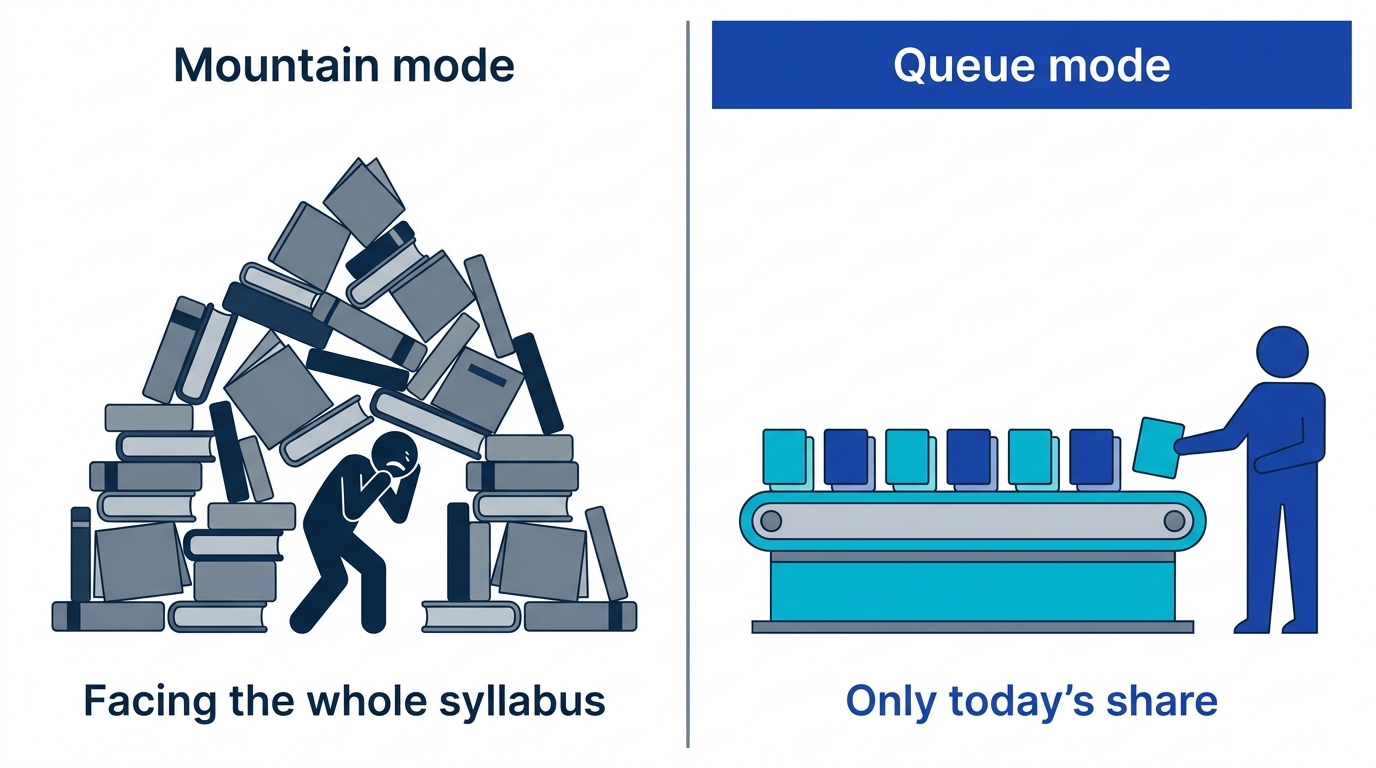
| Mountain mode (overwhelming) | Queue mode (steady) | |
|---|---|---|
| What you face | The entire syllabus, always | Only today's few dozen cards |
| Unit | Chapters and pages | One fact = one card |
| Priority | Front to back | Tested x can't-do first |
| Revisit bookkeeping | Gut feeling and anxiety | Spaced repetition, automatic |
| Sense of progress | Despair at an unshrinking pile | The queue moves every day |
The bottom row is the one that decides whether any of this survives a week. A pile that visibly empties is the only progress signal a long syllabus ever gives you, and mountain mode never produces one.
Move 3: stop managing "when to revisit" yourself
A huge syllabus wears you down less through the memorizing than through the background hum of "wait, am I forgetting the stuff from three weeks ago?" That question never resolves, so it runs all day alongside whatever you are actually studying.
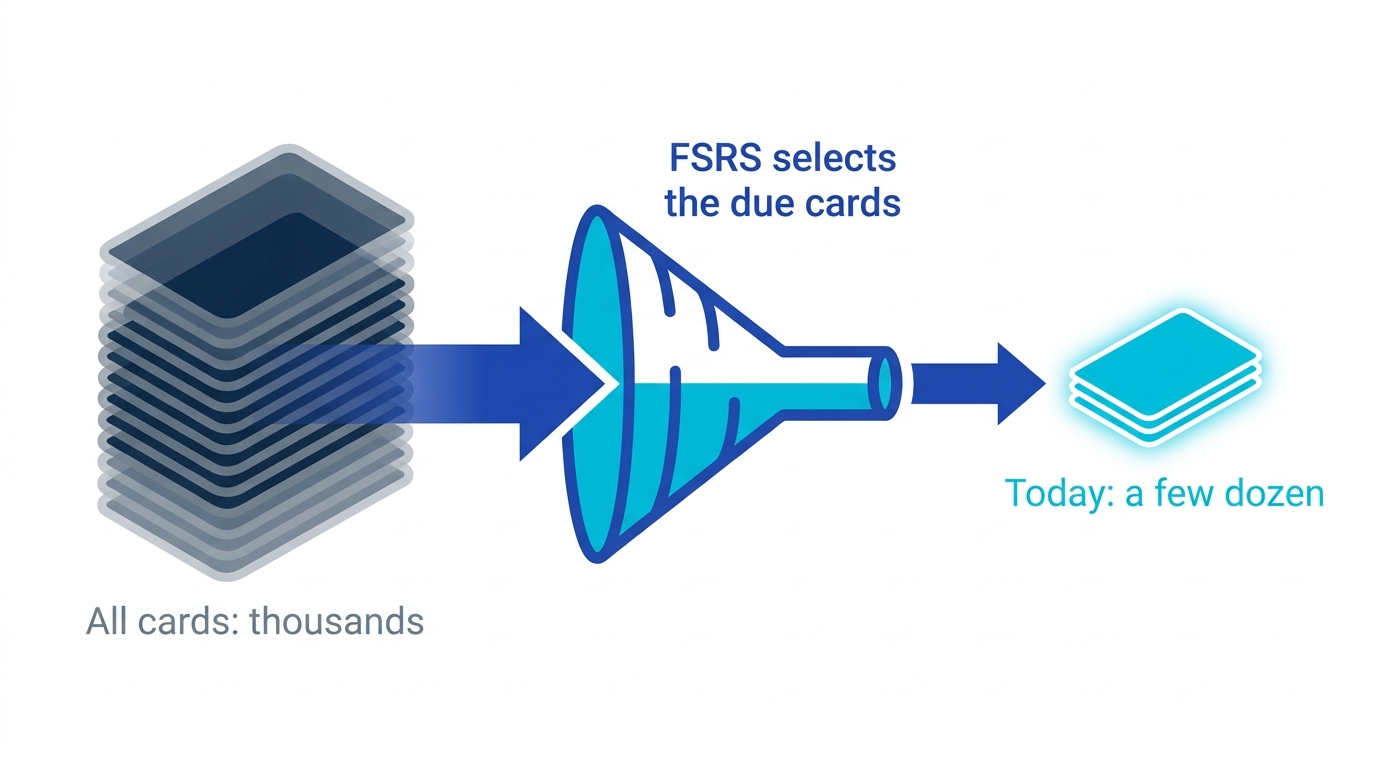
Tracking revisit timing for thousands of facts is not a human job anyway: the right moment for each card depends on when you last recalled it and how easily it came, and nobody holds that ledger for thousands of items. Hand it to a spaced repetition algorithm and the only thing that ever appears in front of you is today's due pile. You never have to look at the whole mountain again.
If the "too much to learn" feeling is about a new job rather than an exam, the constraints differ. We covered the workplace version in Too Much to Learn at Your New Job.
Memly turns the mountain into a queue in minutes
- AI does the decomposing: photograph textbook pages or upload PDFs and text, and AI splits them into one-fact question-and-answer cards. The "cutting" of hundreds of pages stops being manual labor.
- FSRS runs the queue: the spaced repetition algorithm computes per-card revisit timing across thousands of cards and serves only today's share.
- Web, iOS, and Android: ingest on your laptop, clear the daily queue from your phone.
For the full picture of AI-assisted memorization, see the pillar guide AI-Assisted Memorization: How It Works and the Best Tools.
Stop looking at the mountain today
Most people will finish this article and still spend tomorrow staring at the full syllabus, sighing. Staring never shrank a mountain. Only the card at the front of the queue does.
One action for today: photograph the single most "tested but can't do it" page and turn it into cards. The mountain only overwhelms you while it stays shaped like a mountain. Memly is free to try, no credit card required.
