


![Too Much to Learn at a New Job? Surviving the 3-Month Wall [Complete Guide]](/_next/image?url=%2Fblog%2Fen%2Ftoo-much-to-learn-new-job.png%3Fv%3D4&w=1920&q=75)
Here is the data that explains exactly what you are feeling: between months 2 and 4 of any new job, 91% of professionals report wanting to quit. They do not. The wave passes. But while it is happening, almost everyone privately concludes the same thing: "I made a mistake. I am in over my head. Everyone else is faster than me." Each of those conclusions is statistically wrong, and yet they feel devastatingly true.
This is what onboarding professionals call the 3-month wall. It is not a sign you picked the wrong job. It is a predictable, biological consequence of the human brain trying to absorb 6 months of context in 90 days. Hermann Ebbinghaus could have predicted exactly how it would feel back in 1885. The same roughly-70%-in-24-hours forgetting curve that fails students fails new hires too, only this time the volume is 10x higher.
Knowing the shape of the wall does not make month 3 painless. It changes what you conclude from the pain, and that turns out to be the part that decides who stays.
The 3-Month Wall: What It Actually Is
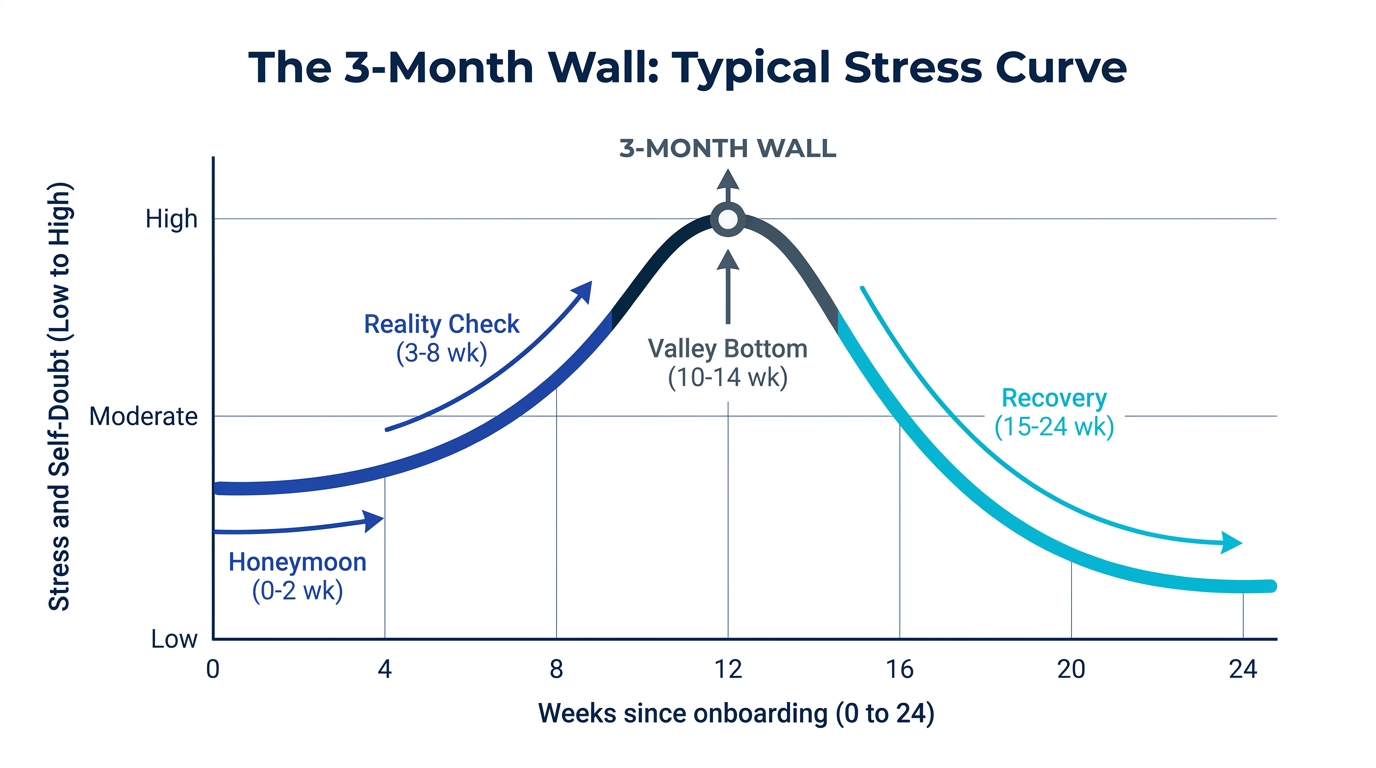
New-hire research consistently shows the same emotional pattern across industries.
| Phase | Duration | Internal experience |
|---|---|---|
| Honeymoon | Days 1–14 | Excited, optimistic, overwhelmed in a "good" way |
| Reality dawn | Weeks 3–6 | "Wait, there's a lot here" |
| The Wall | Weeks 8–14 | "I cannot do this. I should quit." |
| Re-emergence | Weeks 14–22 | Pieces start fitting; first wins land |
| Operating | Month 6+ | "Oh, I actually know this job" |
The Wall is the predictable consequence of three forces stacking simultaneously: the honeymoon ending, your manager's patience wearing thin, and your own self-comparison getting brutal. One number cuts against how permanent it feels: almost no one quits at month 6+. The desire to quit is concentrated in months 2–4 and almost always evaporates by month 6 if you stay. If the Wall has already drained your motivation to keep studying, our protocol for restarting after study burnout gets you moving again in two days.
Why Your Brain Specifically Breaks at Month 3
Why month 3, though? The firehose is at full blast in week 1, and week 1 feels fine. The crash arrives later, after the volume has stopped climbing. Three findings from cognitive science explain the delay.
1. Cognitive overload (Sweller, 1988)
Cognitive Load Theory describes three types of mental load. New hires get hit with all three at once: intrinsic (content is hard), extraneous (the system used to teach it is messy), and germane (the brain is also building schemas, the mental frameworks that organize new knowledge). Even brilliant people break under triple-stacked load.
2. Working memory limits (Cowan, 2001)
Your brain holds approximately 4 items at a time. New jobs throw 30+ at you per day. Most of what flowed past you never got encoded. You did not "forget" it. You never absorbed it in the first place.
3. Context absence (Bransford & Johnson, 1972)
Information without context encodes ~3x worse than information with context. At month 3 you have just enough context to realize how much you do not know, but not enough to anchor new information securely. This is the painful "knowing the size of your ignorance" stage.
Stack all three and the crash is close to schedulable. You are not failing. Your brain is doing exactly what every other brain does in this situation. The only difference between people who survive the wall and people who quit is whether they have a system.
The 30/60/90/180 Framework
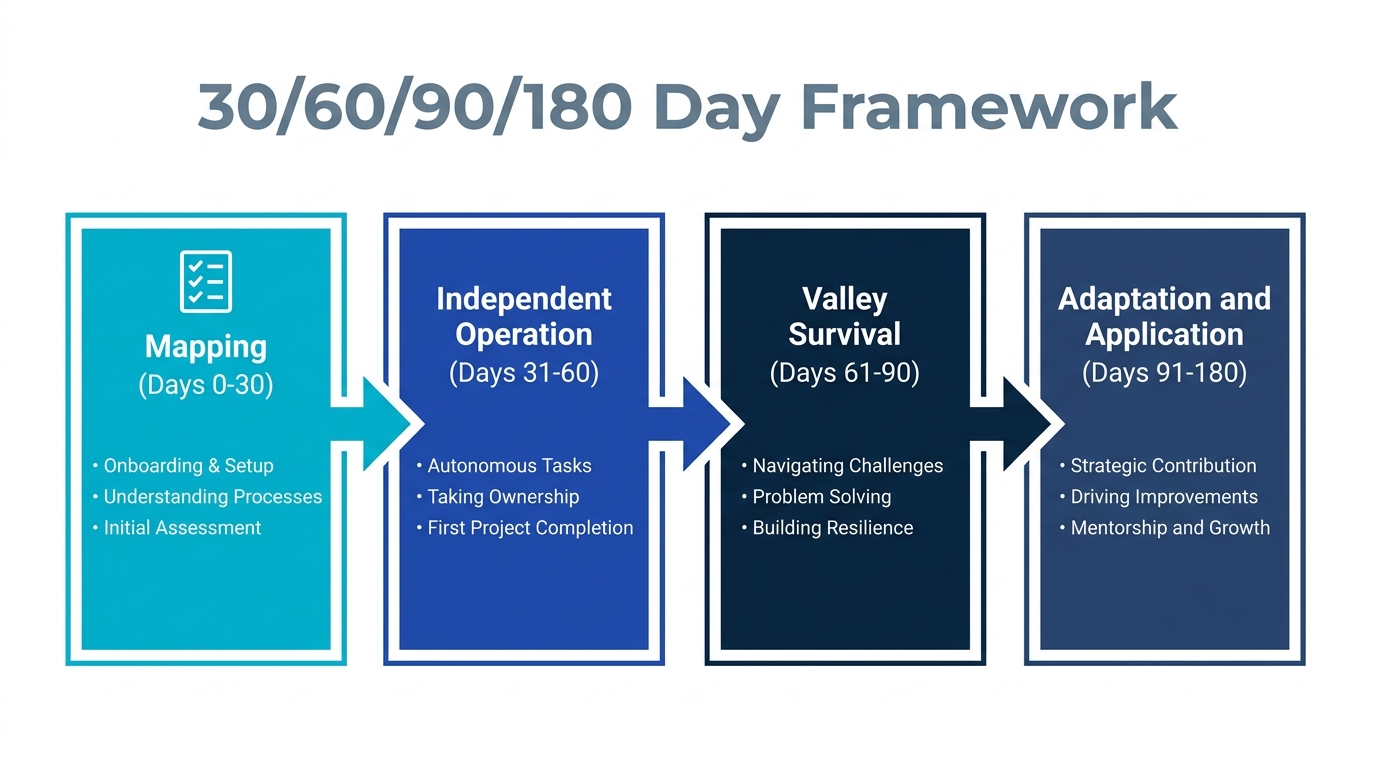
Days 1–30: Build the map, not the depth
Your only goal in month 1 is to sketch the territory. Do not try to memorize details yet, because your brain has no scaffolding to attach them to. Build the scaffolding first.
- Org chart on one page (yes, hand-drawn).
- Product map: what your company sells, in 4 sentences.
- Customer journey: who buys, why, what changes after.
- Tech stack overview: 5 main tools and what each does.
- Glossary of 30 most common acronyms — start a flashcard deck.
- Sleep 7+ hours, every night. Non-negotiable.
Days 31–60: Layer depth via active recall
Now the scaffolding holds. Time to fill it in, using real learning techniques rather than passive re-reading.
- End-of-day active recall (actively pulling information from memory rather than re-reading it): write the 5 most important things, no looking. Karpicke & Roediger (2008) showed +50% retention from this single habit.
- Push your flashcard deck to 100–150 cards.
- Run weekly Feynman explanations (explaining a concept in plain language as if teaching it) to a teammate or imagined audience.
- Identify the 3 highest-frequency processes in your role and chunk each into 3–4 phases.
Days 61–90: Engineering your way through the Wall
This is the hardest stretch. Expect: imposter syndrome, comparison spiral, the urge to quit. Plan for them.
- Compare to past you, not peers. Different teams, different ramp curves, different prior context. Peer comparison is mathematically meaningless.
- Schedule a 60-day check-in with your manager. Get honest signal. Most managers think you are doing fine and forgot to tell you.
- Stack small wins on visible items. For confidence, three small completed deliverables beat one large one that's still in progress.
- Maintain spaced repetition every commute. See our commute learning playbook.
- Defer the quit decision. If you are reading this in week 10 and want to quit, the data says you almost certainly do not actually want to. Defer all big decisions to month 6.
Of those five, the check-in is the one people skip, and it is the one that most often ends the spiral in a single conversation.
Days 91–180: Operate, then teach
The wall breaks around week 14–18. Pieces start clicking. By month 6, you are operational. The new task is consolidation.
- Take ownership of one end-to-end deliverable.
- Convert "things I had to ask twice" into permanent flashcards.
- Begin onboarding the next new hire, since explaining the job to someone else forces you to retrieve everything you learned.
- Build a personal playbook: 1 page summarizing how you do your most frequent task.
The Same-Industry Trap (And Why It Surprises People)
Even professionals switching to the same industry hit the wall hard. Why? Because internal terminology, internal processes, internal politics, and internal tools are company-specific, not industry-specific. You bring industry context, which helps with the broader scaffolding, but you still have to absorb the entire internal layer from scratch.
| Knowledge type | Cross-industry move | Same-industry move |
|---|---|---|
| Industry concepts | Learn from zero | Already have |
| Company terminology | Learn from zero | Learn from zero |
| Internal tools | Learn from zero | Mostly from zero |
| Org dynamics | Learn from zero | Learn from zero |
Three of those four rows barely change between the columns. That is why same-industry hires often suffer more from the 3-month wall: they expected it to be easier. The wall's timing is the same. Only the surprise is bigger.
Retroactive Interference: When Your Old Job Sabotages Your New One
You keep doing X the way the old company did it, even though the new company does Y. You know the new way. You have been told the new way. Your hands do the old way anyway. Cognitive psychology calls this retroactive interference: previously learned material disrupts the encoding of new material.
The fix is conscious, not natural. Explicitly tell yourself: "Old company did it that way. New company does it this way. Same problem, different solution." For the first 90 days that costs a beat of deliberate effort every single time, which is why it feels like it is not working. By month 4, the new pattern integrates and the interference fades.
The Mental Health Side of the Wall
At month 3 the hit is not only to what you know. It is to your sense of who you are at work. You went from competent at your last job to confused at your new one, and your self-image has not caught up.
- Imposter syndrome is the default emotion at month 3. It is not diagnostic of your actual ability.
- Comparison to peers is biased. You see their wins on Slack; you do not see their private 2 a.m. doubt.
- The brain confuses "novelty fatigue" with "wrong job." They feel identical. They are not the same.
- Talk to one peer in a similar role at a different company. Their story will sound exactly like yours.
The last one is the cheapest and the one nobody does. One conversation with someone three months into the same role somewhere else, and the private 2 a.m. doubt stops looking like evidence.
For the broader picture of memory failure at work (much of which intensifies during onboarding), see our hub guide and the new-job memorization deep dive.
Tools That Compress the Wall
You cannot eliminate the wall. You can shorten it. The category that pays off fastest here is AI-powered flashcards on a spaced repetition schedule.
- You generate cards from any document in seconds, not hours.
- The algorithm schedules every review for you, so no willpower is required.
- Mobile-first means your commute does the work.
- By month 3, your retention curve has already flipped, and you are operating on knowledge most peers will not have until month 5.
The last one is the actual payoff. That glossary of 30 acronyms from month 1 stops being a document you keep meaning to reread and becomes something you can produce from memory, mid-meeting, without stalling.
For tool comparisons, see the 2026 flashcard app comparison, best AI flashcard apps, and the underlying mechanics in AI memorization support.
Before vs After: Real Numbers
| Metric | No system | 30/60/90/180 framework | Difference |
|---|---|---|---|
| Self-rated confidence at month 3 | 3.2 / 10 | 6.8 / 10 | +113% |
| "Want to quit" intensity at month 3 | High | Mild | Material drop |
| Time to "operating" | ~7 months | ~4 months | -43% |
| Retention of acronyms at day 90 | ~22% | ~78% | +254% |
The row worth staring at is the last one. Same brain, same job, same 90 days. The only thing that differs is whether the acronyms sat on a review schedule or sat in a document.
Frequently Asked Questions
I'm 3 months in and want to quit. Is that normal?
Statistically, almost universal. 91% of new hires report wanting to quit between months 2 and 4. Almost none of them do. Defer the decision to month 6. If it survives that long, take it seriously.
Is it the age? I'm 40+ and learning slower than younger peers.
Mostly no. Older professionals have richer prior knowledge, which actually makes new information stickier once context exists. The "slower" feeling is usually about needing more setup time before the new info has somewhere to attach.
I switched within the same industry. Why is it still this hard?
Same-industry moves still require relearning the entire internal layer: terminology, processes, tools, org dynamics. The industry layer transferred. The internal layer did not. The wall is the same height. It just shows up when you don't expect it.
My company has zero formal training. What now?
OJT-only environments require you to build your own learning system. Read the wiki proactively, convert what you learn into flashcards, and review on commute. Most of the system in this article runs perfectly without formal training.
I have no peer cohort. How do I cope emotionally?
Find one peer in the same role at a different company through LinkedIn, Slack communities, or niche forums. Their story will sound identical to yours. You do not need a coworker; you need a peer.
I cannot see the big picture. Everything feels like fragments.
That is exactly the problem of the first 30 days, and exactly why the framework above starts with map-building. Sketch the org chart, product map, and customer journey on a single page. The fragments will start falling into place.
How do I stop my old job from interfering with my new one?
Explicit conscious switching. Whenever you catch yourself doing it the old way, say (silently): "Old company X. New company Y." For the first 90 days, this conscious effort is necessary. By month 4, the new pattern is automatic.
The Bottom Line
Most readers who are at the wall right now will close this article and continue suffering. They will mentally draft their resignation. They will silently conclude they made a mistake. Some will actually quit. Most will not, but they will spend month 3 in unnecessary pain.
Tonight, do the smallest possible version of "different." Open a notebook. Write down the 3 most important things you learned today, from memory, no looking. Tomorrow morning, before any meetings, write them down again. That single 60-second habit is the entry point to the entire framework. The rest builds itself once the first habit is automatic.
And if you want the algorithm to do the heavy lifting through your wall, Memly is built specifically for the new-hire onboarding case. Paste your onboarding doc, your meeting transcripts, or your wiki, and get a structured flashcard deck in seconds. The FSRS 6.0 engine, a spaced repetition algorithm that predicts when you are about to forget, schedules every review at the optimal moment. Five minutes a day on your commute can compress your wall by weeks. No payment method required. Start with Trial.
For the broader framework of work memory, read the hub: Can't Remember Things at Work?. For the day-1 starter pack, see how to memorize everything at a new job. For the daily implementation, see study during your commute and 5 scientifically proven study methods.
