


Anatomy and pharmacology involve many related facts: muscles and nerves, drug names and mechanisms, structures and functions. Studying each as an isolated item can make similar terms hard to distinguish. The three approaches below add a clear organising structure before you practise recall.
In subjects at this scale, ordinary memorization does not just get harder; it breaks. What breaks is not the amount of effort, which is unfortunate, because adding hours is what almost everyone tries first.
The survival design has three parts. Structure by system, encode by mechanism (the "why"), and hand the review schedule to an algorithm. You do not out-grind the ocean; you change the shape of the material so it cannot blur.
Why brute force collapses at thousands of items: interference
With 100 items, raw repetition works. At thousands, interference takes over: similar pieces of information overwrite and cross-wire each other at recall time. Ten beta blockers with near-identical names; muscles with near-identical origins. The more isolated each fact is, the worse the cross-wiring, because an isolated fact offers only one retrieval route and its near-identical neighbors all compete for it.
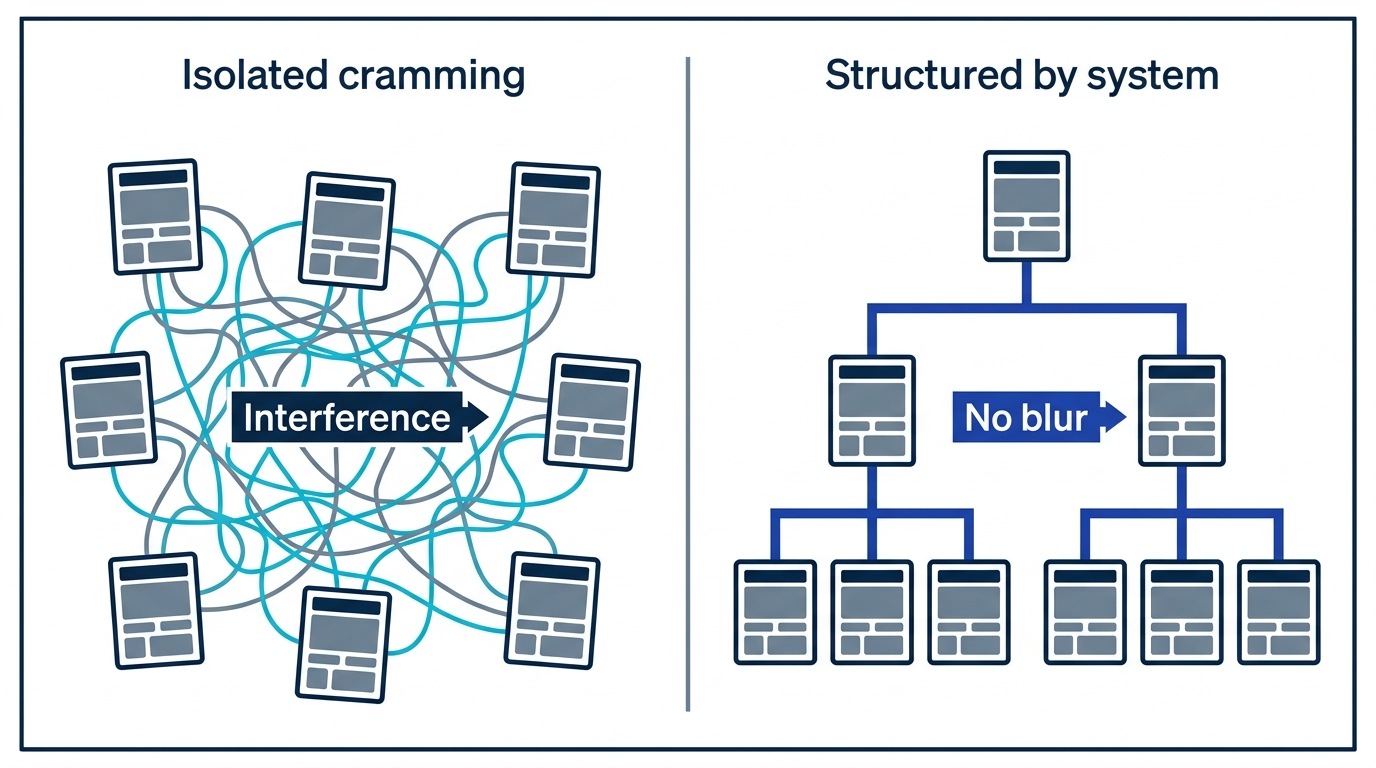
So in medical memorization you fight two enemies, not one. Forgetting can be fought with review, as the Ebbinghaus forgetting curve suggests. Review does little for confusion between similar items, though; that one is settled at encoding time, by how the material was organized when it went in.
Design 1: structure by system, not by page order
Making cards in index order or slide order scatters the knowledge in your head the same way. What works is memorizing along the classification tree: autonomic system, then sympathetic, then beta blockers, then individual drugs; upper limb, then flexors, then each muscle. Learn the frame first and every item becomes "one slot in a frame," with more retrieval routes and less interference.
If you want the anatomy frame already built, Human Anatomy Essentials 300 is a free deck organized the way this section argues for: 300 terms grouped by region and system — skeleton, joints, muscles, neuroanatomy, thorax, abdomen, pelvis, head and neck — rather than listed alphabetically, and cards that can carry a position say what the structure borders.
Design 2: encode the mechanism. "Why it works" is the strongest mnemonic
"This drug: watch for bradycardia" memorized alone is fragile. "It blocks beta receptors, so heart rate drops, so watch for bradycardia" lets one understood mechanism regenerate many facts on demand. Side effects and contraindications stop being list items and become inferences. In anatomy, derive actions from origin and insertion. Reducing what must be memorized raw is the biggest time-saver the ocean allows.
| Approach | Card shape | Strength at scale |
|---|---|---|
| Brute-force | Drug name to warning, one-to-one | Weak to interference, collapses under pressure |
| Mnemonics only | Sound-based lists | Good for order, weak when meaning is tested |
| Mechanism-based | "Why does it work? Why contraindicated?" | Regenerable by reasoning, transfers to applied questions |
The middle row is the one students defend hardest. Mnemonics do hold an order in place. Then the exam asks why the drug is contraindicated in asthma, and the acronym has nothing to say.
Design 3: never manage the review schedule yourself
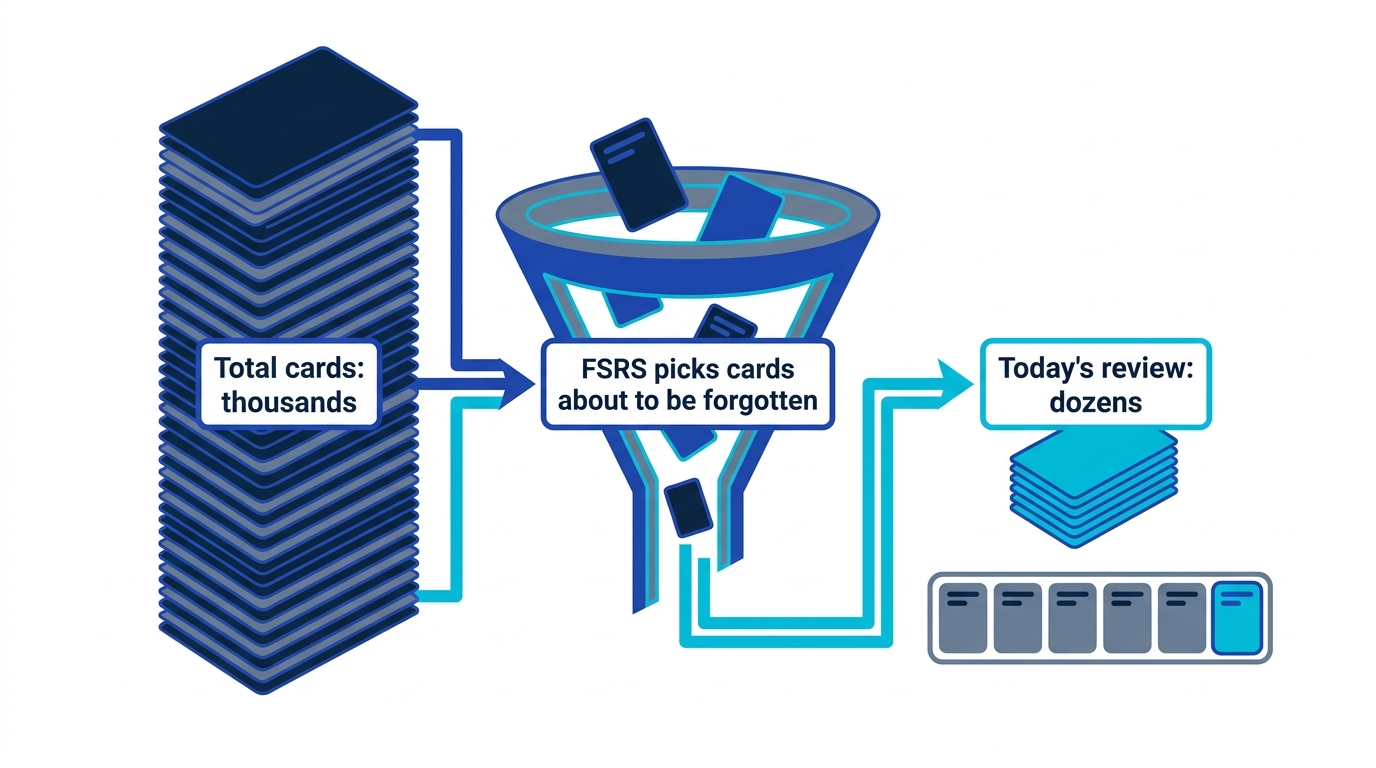
Deciding when to review each of several thousand cards is not a human-scale task. This is where most students quit and slide back to pre-exam cramming. The only realistic answer is to let a spaced repetition algorithm own the schedule: only the cards you are about to forget surface each day, so even a five-figure collection settles into a manageable daily load.
Slides and textbooks become cards the same day
The biggest obstacle to all of this is card-making time: one lecture's slides take well over half an hour by hand. With Memly, you hand over the slide PDF or a photo of the textbook or your notes, and AI generates the question-and-answer cards, including mechanism questions like "What is this drug's mechanism of action?", which is Design 2 made automatic.
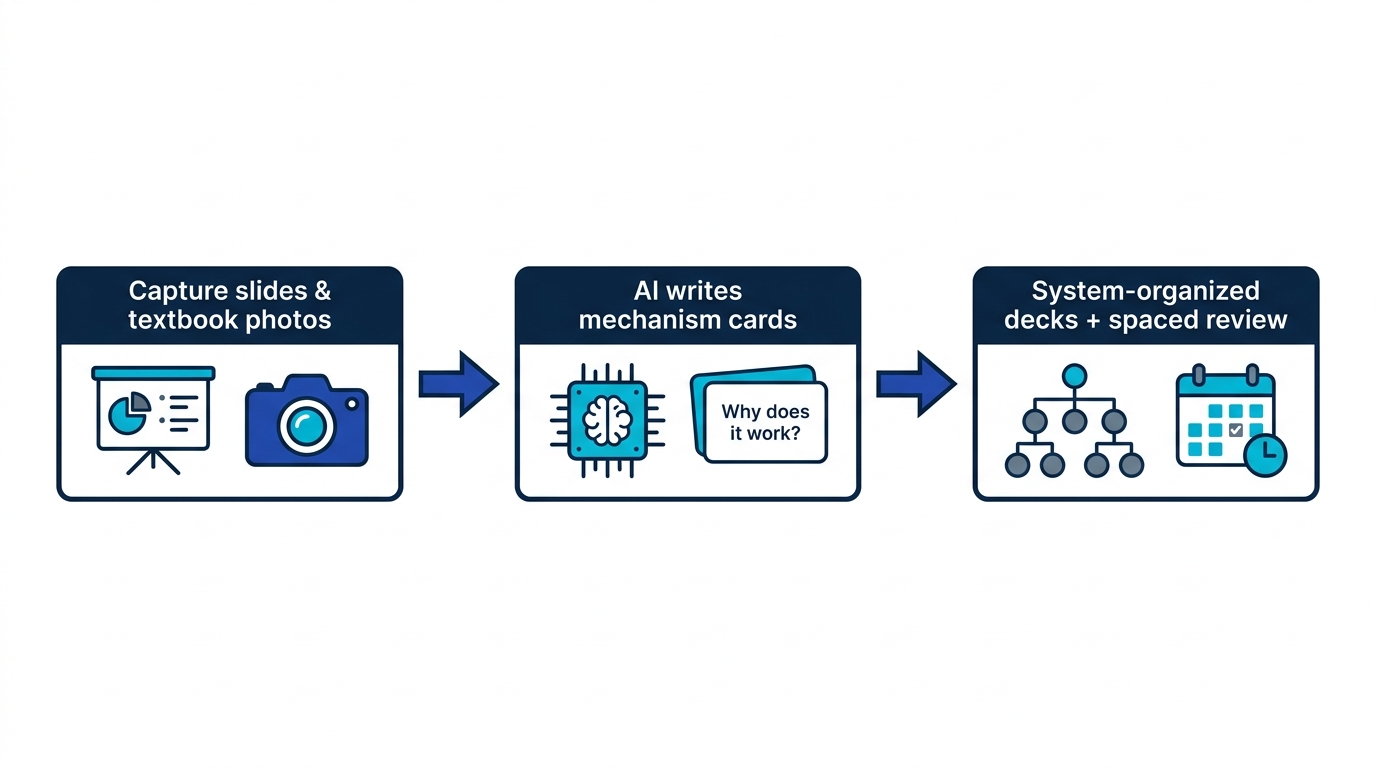
- Capture: slide PDFs, textbook photos, handwritten notes, pasted text. Ten minutes on lecture day; the full workflow is in Turn Lecture Notes and Slides into Flashcards.
- Review: the FSRS spaced repetition algorithm distributes thousands of cards automatically, and busy clinical days still fit a phone session on the commute (Web, iOS, Android).
- Across subjects: separate decks for anatomy, pharm, and physiology, one unified review flow.
None of this drains the ocean. It changes what happens at 11pm: answering the cards that came due tonight instead of deciding which part of the ocean to open.
For the full picture of AI-assisted memorization, see the pillar guide AI-Assisted Memorization: How It Works and the Best Tools. And if you are weighing which tool fits a health-sciences program, see our comparison of the best flashcard app for med school.
Start lowering the water level at your next lecture
Start with one relationship you keep confusing, such as a nerve and the muscle it supplies. Locate it in a diagram, explain the relationship, and make a precise question. Continue using your course materials and supervised practical work alongside flashcards.
Start small: take one slide deck from your next lecture and turn it into mechanism-question cards. Ten minutes, and this week's commute becomes review time. Memly is free to try, no credit card required.
