



If your MCAT is in January 2027, you have roughly 13 to 16 weeks from mid-October, depending on the date you book. That is enough time for a structured plan, but not enough to read every review book cover to cover and still leave room for full-length practice exams. The weeks you spend on passive rereading now are weeks you will not get back in December.
This schedule works backward from test day. It combines content review, flashcards for discrete facts, the AAMC's official practice materials, and full-length exams. It is a planning template, not a promise about scores: your starting point, available hours, and target schools should shape how you use it.
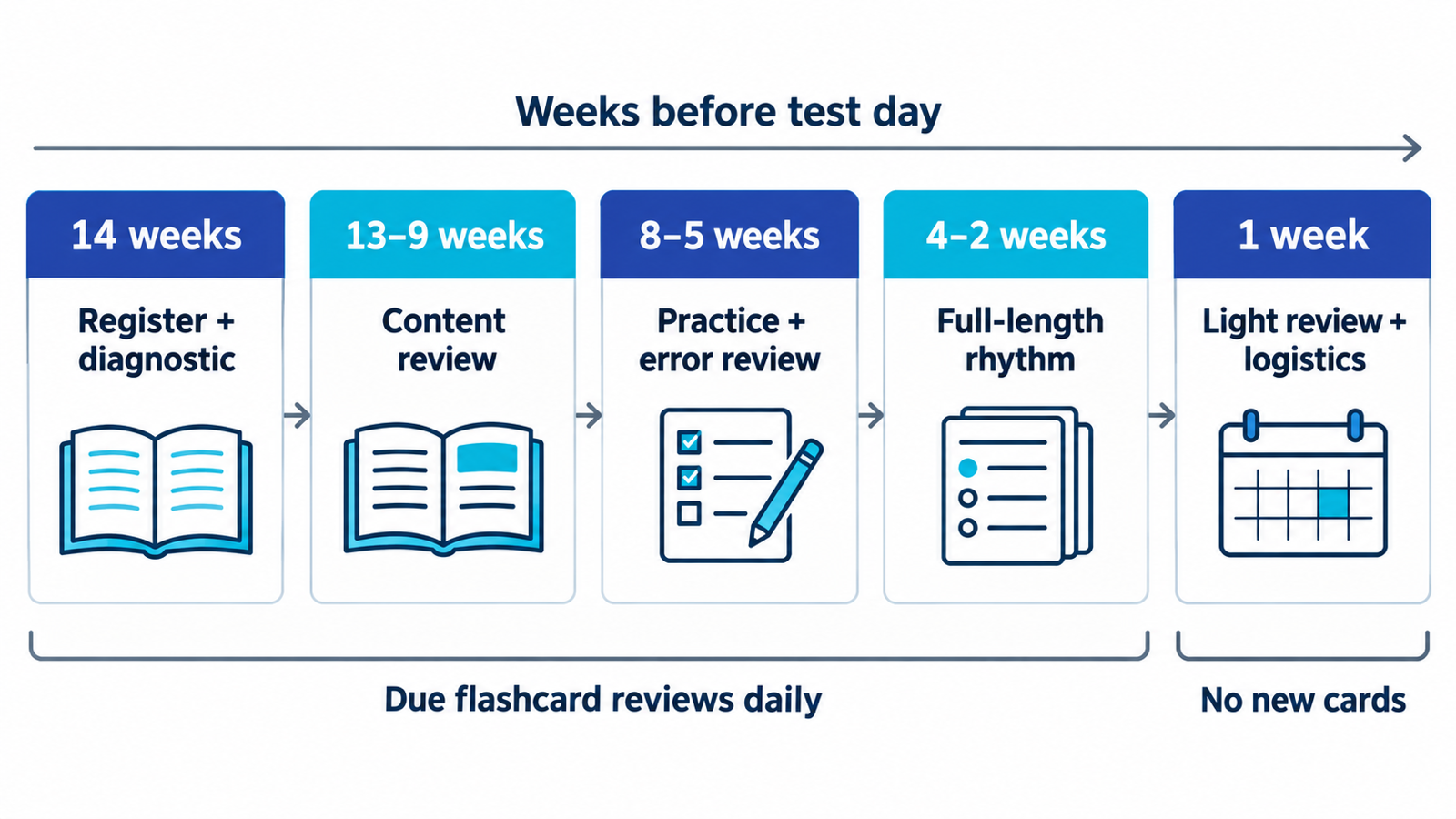
The short version: register when your testing center group opens (October 20–22, 2026), take a diagnostic in the first week, spend roughly weeks 14–9 on content review with daily flashcards, shift toward official practice questions and full-length exams from about week 8, and add few new cards in the last month (none in the final week) so reviews and practice tests take priority.
January 2027 MCAT test dates and registration
According to the AAMC, scheduling for 2027 test dates opens by testing center location: Group A on Tuesday, October 20; Group B on Wednesday, October 21; and Group C on Thursday, October 22, each at noon ET (AAMC, 2027 MCAT Registration Opening, checked October 11, 2026). Each group covers a set of U.S. states and other locations, with Canada in Group C, so check the page for the group your testing center belongs to. The same page asks examinees to complete the first five tabs of the registration system between October 5 and 19, and states that the 2027 testing year runs from January to September.
The AAMC's U.S. calendar lists five January 2027 test dates (AAMC, U.S. MCAT Calendar, Scheduling Deadlines, and Score Release Dates, checked October 11, 2026):
| Test date (U.S.) | 10-day deadline | Score release |
|---|---|---|
| Friday, January 15, 2027 | January 5 | February 16 |
| Saturday, January 16, 2027 | January 6 | February 16 |
| Thursday, January 21, 2027 | January 11 | February 23 |
| Friday, January 29, 2027 | January 19 | March 2 |
| Saturday, January 30, 2027 (select centers only) | January 20 | March 2 |
The AAMC defines the 10-day deadline as the last date to schedule, reschedule, or cancel a reservation, and says scores are released by 5:00 p.m. ET on the listed date. January 30 is offered only at select U.S. testing centers. The calendar also lists 60-day and 30-day deadlines; the calendar points to a separate AAMC scheduling fees page for what they mean, so read it before you book. If you are testing in Canada or internationally, use the Canadian calendar or the U.S. territories and international calendar instead; this article does not list their dates.
What the MCAT covers and how long test day is
The plan only makes sense against the exam's shape. The AAMC's MCAT Essentials for Testing Year 2027 (checked October 11, 2026) lists four sections:
| Section | Questions | Time |
|---|---|---|
| Chemical and Physical Foundations of Biological Systems | 59 | 95 min |
| Critical Analysis and Reasoning Skills (CARS) | 53 | 90 min |
| Biological and Biochemical Foundations of Living Systems | 59 | 95 min |
| Psychological, Social, and Biological Foundations of Behavior | 59 | 95 min |
Total content time is 6 hours and 15 minutes, and total seated time is about 7 hours and 30 minutes, not counting check-in. Optional breaks come after sections 1 (10 minutes), 2 (30 minutes), and 3 (10 minutes). That length is one reason full-length practice matters: knowing the content is a separate skill from staying accurate in the seventh hour.
Flashcards fit three of the four sections well and CARS hardly at all. CARS asks you to reason about passages from the humanities and social sciences; there is no list of facts to memorize for it. The science sections, by contrast, reward fast recall of terms, classifications, and relationships, so that your working time goes to reading the passage and the data rather than reconstructing basics.
A week-by-week MCAT study schedule for January 2027
Count your weeks backward from test day. From the week of October 12, a January 15 or 16 date leaves about 14 weeks; January 29 or 30 leaves about 16. If you have the longer runway, add the extra weeks to content review, not to the final stretch. Students in classes this fall should also mark finals weeks now and plan lighter MCAT loads around them.
| Weeks before test day | Main focus | Flashcards | Official AAMC practice |
|---|---|---|---|
| 14 | Register; read the AAMC content outline; take a diagnostic | Set a daily new-card cap you can keep | Unscored Sample Test (free) to see question style and timing |
| 13–9 | Content review, rotating bio/biochem, chem/phys, and psych/soc; CARS passages several times a week | Card new material the same day you review it; clear due reviews daily | Question packs and CARS practice by topic |
| 8–5 | Shift from reading to practice; review every missed question | Card knowledge gaps found in practice; fewer new cards | First scored full-length (Practice Exam 1); section banks; another full-length about every 1–2 weeks |
| 4–2 | Full-length rhythm; fix recurring weak areas | Mostly reviews; new cards only for real gaps | About one full-length per week, with a full review day after |
| 1 | Light review; test-day logistics; sleep | No new cards; due reviews only | Revisit missed questions rather than starting a new exam |
The AAMC says it offers two free full-length practice exams and five low-cost ones, alongside question packs, the CARS Question Bank, Section Bank volumes 1 and 2, and an Independent Question Bank (AAMC, Official Low-Cost Products, checked October 11, 2026). The table spaces them so each full-length gets a review day afterward. You do not have to take all of them; a full-length you never review teaches less than a section bank you go through question by question.
Week 14: diagnostic, outline, and registration
The first week is for measurement, not heavy studying. Download the AAMC's What's on the MCAT Exam? outline and mark each topic as known, rusty, or new. A timed diagnostic shows which sections need the most weeks; the free Unscored Sample Test gives no score, so judge it by the questions you missed in each section. Register on your group's opening day if you can. The AAMC notes that the registration system stays open afterward for dates that are still available, so waiting can cost you your preferred date or location.
Weeks 13–9: content review with daily cards
This block carries most of the new material. A workable rhythm is one content topic per study session, followed by a short set of practice questions on the same topic, then cards for the discrete facts that came up. Rotate subjects across the week rather than finishing all of biology before touching physics. Mixing subjects means earlier topics come back before you have forgotten them entirely, which a single block per subject does not allow.
Weeks 8–2: practice exams take the lead
From about week 8, the ratio flips: less reading, more questions. After each full-length, sort every miss by cause. A missed fact becomes a card. A misread passage or a calculation slip needs more practice questions, not a card. Our guide to reviewing practice tests walks through that sorting step in detail.
Week 1: protect what you already know
In the last week, new material has little time to settle. Keep due reviews going, revisit the questions you missed most often, confirm your testing center and start time, and protect sleep.
What to put on MCAT flashcards (and what not to)
Retrieval practice is the reason flashcards earn a place in this plan. In Roediger and Karpicke (2006), students who practiced recalling prose passages retained more on a test one week later than students who reread them (about 56% versus 42%). Recalling an answer strengthens the memory more than looking at it again. The same logic shapes what belongs on a card: something you can answer from memory in a few seconds.
Good candidates: discrete, checkable facts
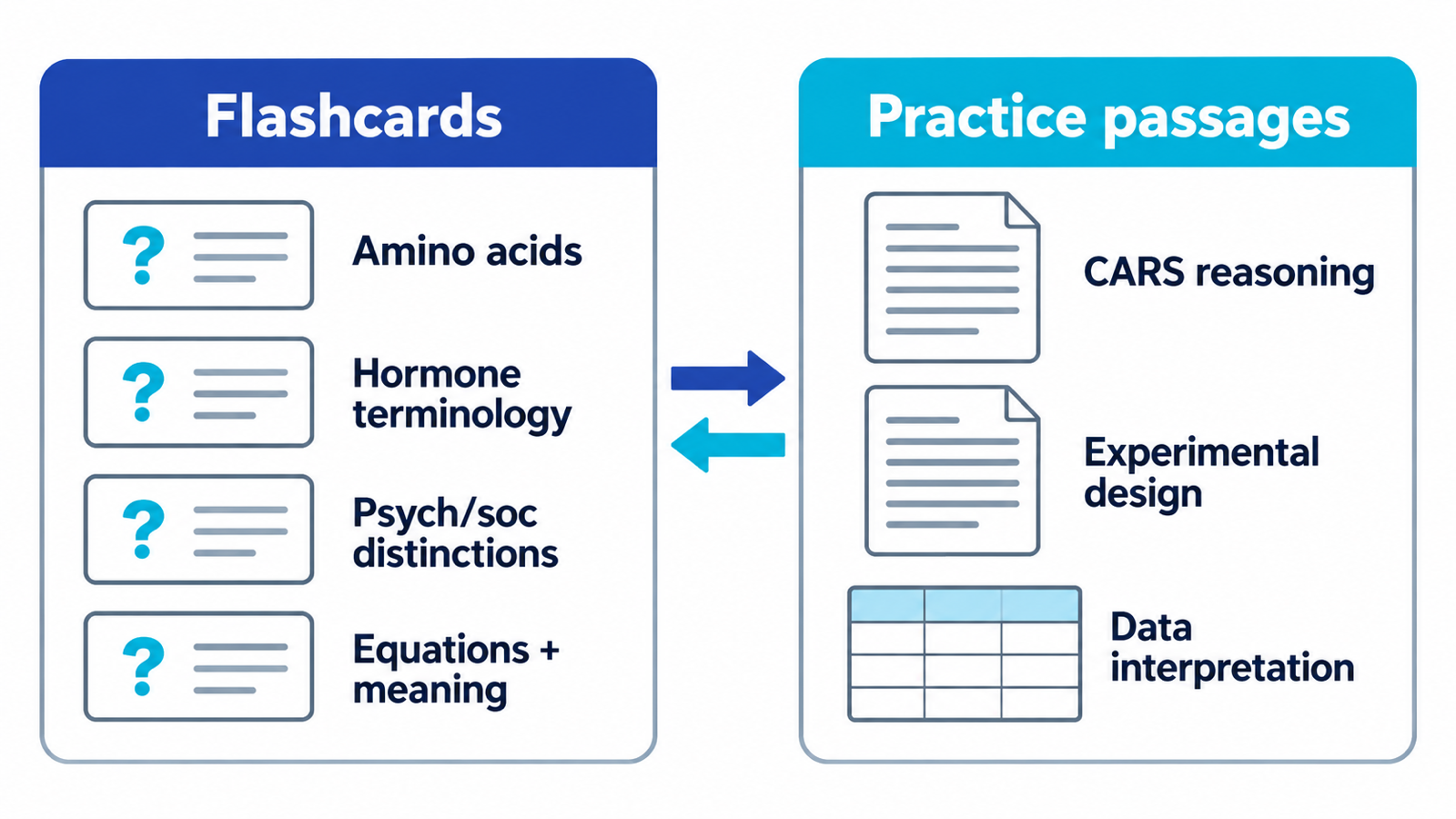
- Amino acids: one-letter codes, structures, and side chain classes. For example, "Which amino acids have acidic side chains?" with the answer "Aspartate (D) and glutamate (E)."
- Hormones as terminology: name, source gland, and chemical class. For example, "Cortisol: secreted by which gland, and peptide or steroid?" with "Adrenal cortex; steroid."
- Psych/soc terms: definitions and the distinctions between neighbors. For example, "Negative reinforcement" (removing an aversive stimulus to increase a behavior) versus "positive punishment" (adding an aversive stimulus to decrease one).
- Equations and their meaning: the formula plus one consequence. For example, the Henderson–Hasselbalch equation, pH = pKa + log([A-]/[HA]), with a second card asking what pH equals when [A-] = [HA] (the pKa).
Poor candidates: skills and long processes
CARS reasoning, experimental design, and data interpretation are skills; they improve with practice passages, not with cards. Long processes (a full metabolic pathway on one card, for instance) also work poorly, because a card you can only half answer is hard to grade honestly. Split them into single steps, or leave them for practice questions. And avoid carding material you have not understood yet: a card can help you keep an idea, but it cannot explain it to you.
For more on structuring large fact sets into cards, see How to Memorize Anatomy and Pharmacology; the same splitting and grouping ideas apply to biochemistry and psych/soc terms.
How many new MCAT flashcards a day?
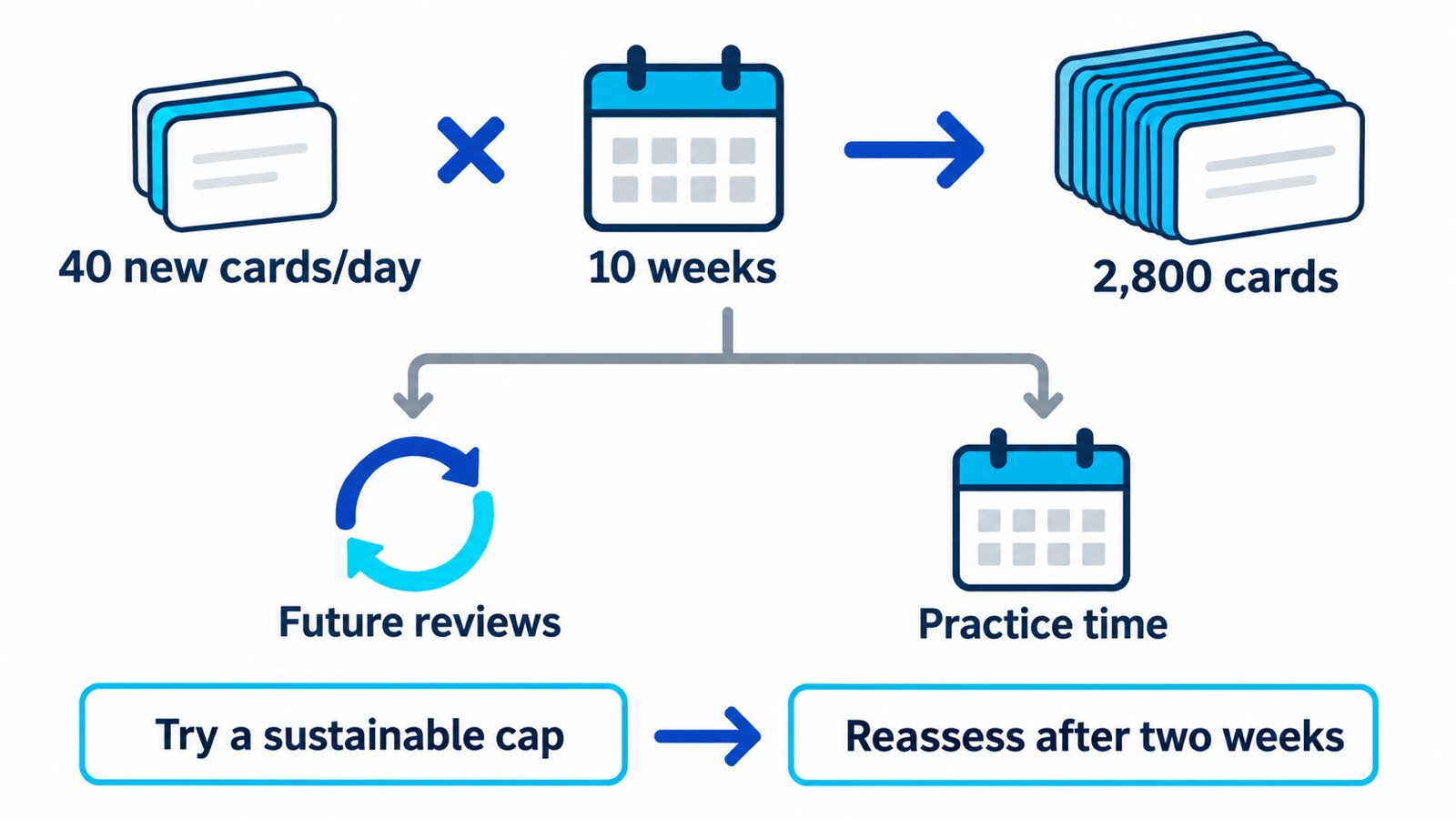
Every new card brings future reviews with it, so today's new cards decide next month's workload. The arithmetic adds up quickly: 40 new cards a day for ten weeks is 2,800 cards, all of which keep coming back for review while you are also taking full-length exams. A sustainable cap is one you could still clear during your busiest week, not your best one.
A practical way to set it: pick a modest number, keep it for two weeks, and watch your daily review count. If reviews fit comfortably alongside practice questions, raise the cap a little. If they start crowding out practice, lower it before the backlog grows. Spreading reviews out is worth the patience; in Cepeda et al. (2008), an experiment with more than 1,350 participants, the study gap that produced the best final-test performance grew with the length of time until the test, while shrinking as a share of it: roughly 20–40% of a one-week delay but only 5–10% of a one-year delay.
Desired retention: the trade-off in one paragraph
Apps that use the FSRS algorithm let you choose a desired retention: the probability of recall the scheduler aims for when a card comes due. A higher target schedules reviews sooner, so you remember more at any given moment, but you also review more each day, and the extra workload climbs steeply as the target approaches 100%. A lower target saves time and accepts more forgetting. One reasonable approach is a moderate setting during content review, with a heavier review load accepted only in the final weeks.
Using Anki or another app for MCAT flashcards
Many MCAT students use Anki, often with community-made decks shared online. Pre-made decks save writing time; the trade-off is that they may not match your resources or your gaps, and unsuspending thousands of cards can produce a review load that leaves little room for practice exams. If you use one, add cards in step with your content review rather than all at once. Anki has had FSRS built in since version 23.10; it is off by default, and you can turn it on and optimize its parameters using your own review history.
For a broader comparison of apps used in medical and premed study, see Best Flashcard App for Med School in 2026.
How Memly can help with an MCAT schedule
Memly is one option for the flashcard part of this plan. It does not replace the AAMC's practice exams or question banks, which are the closest thing to the real test.
- Cards from your own material: AI drafts flashcards from text, PDFs, images, and other sources, such as your content review notes. Check each card against the source before studying it.
- Exam-date mode: set your test date on a deck and Memly shows a daily target and whether you are on track. From two weeks out, reviews come earlier and the recall target rises toward 95% by default; the last three days offer a sweep that orders cards by lowest predicted recall on exam day. If the pace cannot cover everything, Memly proposes narrowing the deck, and set-aside cards can be restored. These retention figures are model predictions, not a forecast of your score.
- Learning intensity: each deck has four desired-retention levels (80%, 90%, 93%, 95%), with 90% as the default. Memly's FSRS uses one shared set of parameters for all users rather than optimizing per person.
- A starting deck: Memly's free MCAT Biology and Biochemistry key terms deck covers terminology such as isoelectric point and enzyme inhibition types, written by Memly rather than taken from official questions.
If you already have cards in Anki, Memly imports CSV files only. It does not import Anki .apkg files, and review history, images, audio, and cloze formatting do not carry over. The free plan includes a one-time AI allowance with no monthly refill. To see how many study days you have left, try the exam countdown tool. For the bigger picture of AI-assisted memorization, see the pillar guide AI-Assisted Memorization: How It Works and the Best Tools.
Start this week, before registration opens
Fourteen weeks feels long in October and short in January. The practice-heavy second half of the plan only works if the first weeks produce reviewed cards and a clear list of weak topics, and Dunlosky et al. (2013) rated practice testing and distributed practice as the two highest-utility techniques among the ten they reviewed.
This week, pick your test date, mark your registration day, and turn one chapter of notes into cards you can answer from memory. Then check your daily review count before adding more. Memly is free to try, no credit card required.
Sources and dates checked
All AAMC pages checked on October 11, 2026.
- AAMC, 2027 MCAT Registration Opening: registration groups and dates (October 20–22, 2026, noon ET); testing year runs January to September.
- AAMC, U.S. MCAT Calendar, Scheduling Deadlines, and Score Release Dates: January 2027 test dates, 10-day deadlines, score release dates.
- AAMC, MCAT Essentials for Testing Year 2027: What's on the MCAT Exam?: sections, question counts, timing, breaks.
- AAMC, Practice for the MCAT Exam with Official Low-Cost Products: official practice exams and question banks.
- AAMC, What's on the MCAT Exam? outline.
- Roediger, H. L., & Karpicke, J. D. (2006). doi.org/10.1111/j.1467-9280.2006.01693.x
- Cepeda, N. J., et al. (2008). doi.org/10.1111/j.1467-9280.2008.02209.x
- Dunlosky, J., et al. (2013). doi.org/10.1177/1529100612453266
This article was not reviewed by a medical professional or by the AAMC. Dates and policies can change; confirm them on the AAMC pages above before you register. MCAT is a registered trademark of the Association of American Medical Colleges (AAMC). Memly is not affiliated with the AAMC.
