


If a card is vague or asks for too many things at once, it is hard to tell whether you remembered it correctly. Better wording makes each review easier to judge: you know what the question asks and what a complete answer should include.
The short version: give each card one clear question, try to answer before looking, and keep enough context to make the question meaningful. Add a separate "why" question when understanding the explanation matters.
Why the card decides the outcome
A flashcard is a personal test item. In Dunlosky's 2013 review, the highest-rated study technique was practice testing, and cards are how you run that test daily. So if the card fails as a test, everything downstream fails: a card whose answer can be guessed from its shape, or whose question is ambiguous, is not a test at all.
The gap between recognition (knowing it when you see it) and recall (producing it from nothing) is the whole game, as we covered in Why You Forget What You Read. A good card is simply a card that forces recall.
The six rules of cards that stick
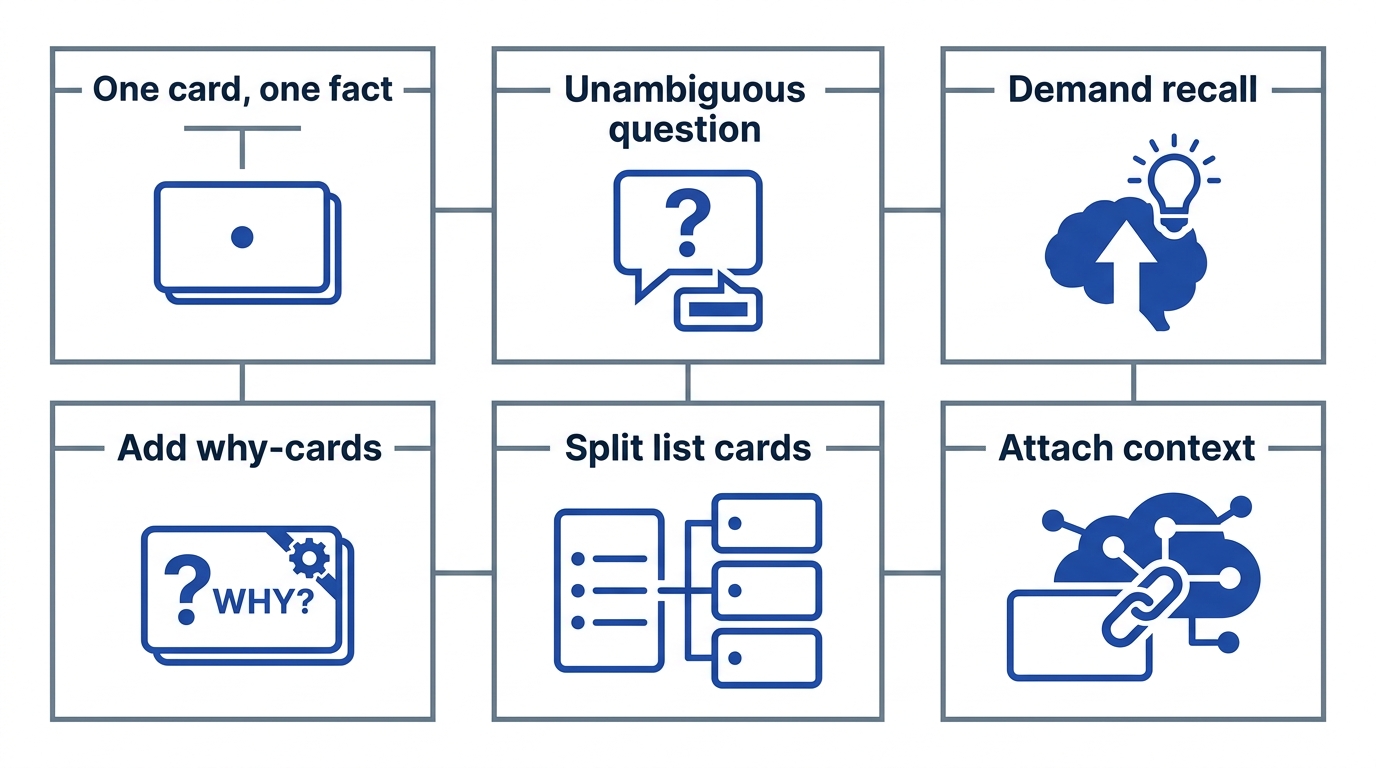
- One card, one fact (minimum information): split knowledge down to its smallest unit. Big cards create "partially recalled" states that wreck your grading and your schedule.
- Zero ambiguity in the question: reading the front should determine exactly one expected answer.
- Try answering before looking: use an open question when you want to test unaided recall. Multiple-choice practice can still be useful, especially if you explain why the other options are wrong.
- Add a "why" question where it helps: a definition and an explanation can test different things. Keep them on separate cards if one answer would become too long.
- Break up list cards: "name the five X" becomes five cards plus one overview card.
- Attach one context or example: concrete examples multiply the retrieval hooks.
Before and after: fixing bad cards
| Bad card (front) | Problem | Fixed card (front) |
|---|---|---|
| "About the sympathetic nervous system" | No defined answer | "When the sympathetic nervous system dominates, what happens to heart rate?" |
| "Key facts of the French Revolution (with timeline)" | Too many facts on one card | "In what year did the storming of the Bastille happen?" and one card per fact |
| "In this fictional policy, the deadline is 14 days: true or false" | Answerable by recognition | "Under this fictional policy, how many days are allowed?" plus a separate card for "What starts the deadline?" |
| "sustain: all meanings" | Partial recall, fuzzy grading | "sustain: what does it mean in 'sustain growth'?" |
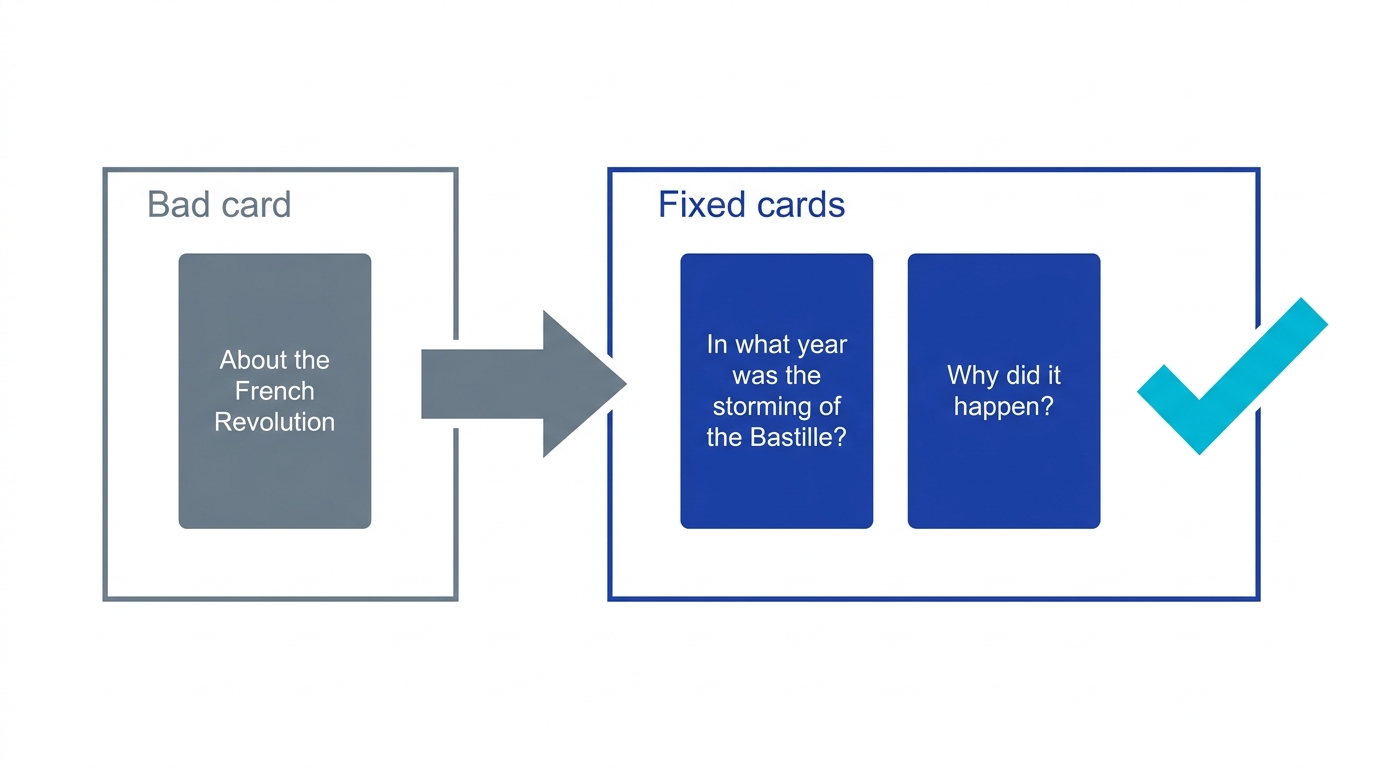
Notice the pattern: every fixed card has moved closer to the form an exam will use. Cards are not a storage box for knowledge; they are a rehearsal of the real performance.
The AI era: your job becomes the one-minute check
AI can save drafting work when you have many pages to cover. Upload a small section first, then check whether its cards meet the six rules. Do not assume that generated cards are clearer or more accurate than the source.
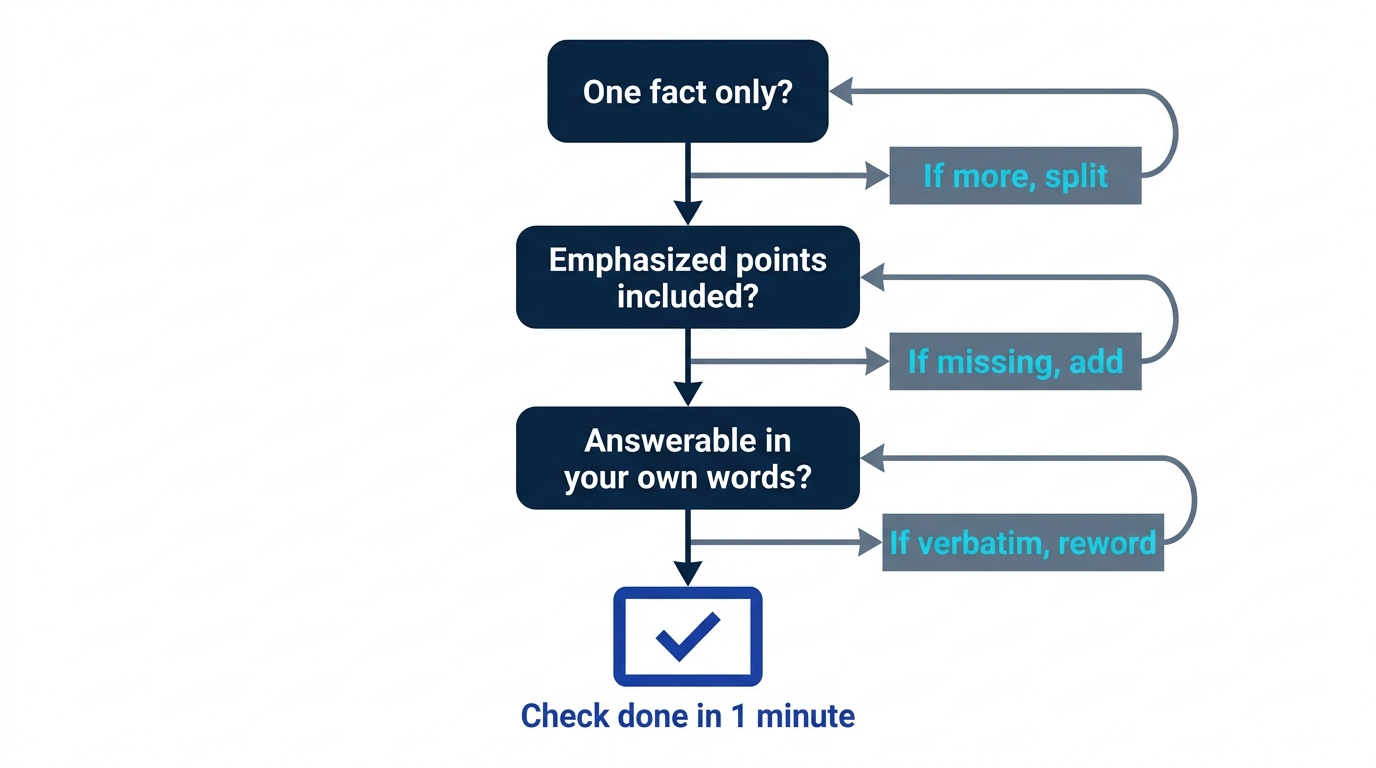
AI can draft cards, but you still need to check the answers against your source. Review a small batch at a time and ask:
- Does any card carry two or more facts? Split it.
- Is the answer accurate and complete? Compare it with the source, correct errors, and add any important point the draft missed.
- Can you answer the question in your own words? If the phrasing is a verbatim copy of the source, reword it.
Good cards plus spaced repetition completes the loop
Spacing reviews across days gives you another chance to retrieve material after a gap. Memly combines AI card drafts with the FSRS review scheduler, but the draft still needs your checks and the schedule is an estimate. For how to adjust reviews to what you remember, see when to review what you learned.
For the full picture of AI-assisted memorization, see the pillar guide AI-Assisted Memorization: How It Works and the Best Tools.
Fix exactly one card today
Start with a card you often mark as partly correct. Decide what one answer it should test, move the other facts to separate cards, and try answering the revised question without looking at the back.
One action: take the biggest card in your deck and split it into one-fact cards today, or photograph one textbook page and compare the AI's cards against your own. Memly is free to try, no credit card required.
