



A review scheduled one day after an exam may be sensible for long-term memory, but it contributes nothing to that exam result. When the date is fixed, every review that drifts past it represents effort allocated too late.
Memly 2.0 Exam Mode changes when cards return for review based on the date when you need to remember them. As the exam approaches, it can show important cards more often and keep reviews from falling after the deadline.
These features are available on the web, on iOS, and on Android. What you see may still vary by device and app version.
Why a schedule that spaces reviews over time needs an exam date
Memly normally uses spaced repetition, a method that schedules reviews across time. It balances how likely you want to be to remember the material against how much daily review you can manage. This works well for knowledge you want to maintain without a single hard deadline. An exam changes the goal in three ways:
- You need to remember the material on a specific date.
- A review after that date cannot help you remember on exam day.
- A weak card becomes more urgent when there are fewer chances to review it again.
Exam Mode adds that missing date to a group of cards (a deck) rather than asking you to manually shorten every gap between reviews.
What Memly 2.0 Exam Mode changes
| Stage | What Memly does for the exam |
|---|---|
| When the exam is distant | Keep reviews close to the deck’s usual frequency |
| As the exam approaches | Aim for a higher chance of remembering |
| When the next review would fall after the exam | Keep the next review from being scheduled after the exam |
| Near the deadline | Show first the cards you are less likely to remember |
| After the exam | Return the deck to its usual review frequency |
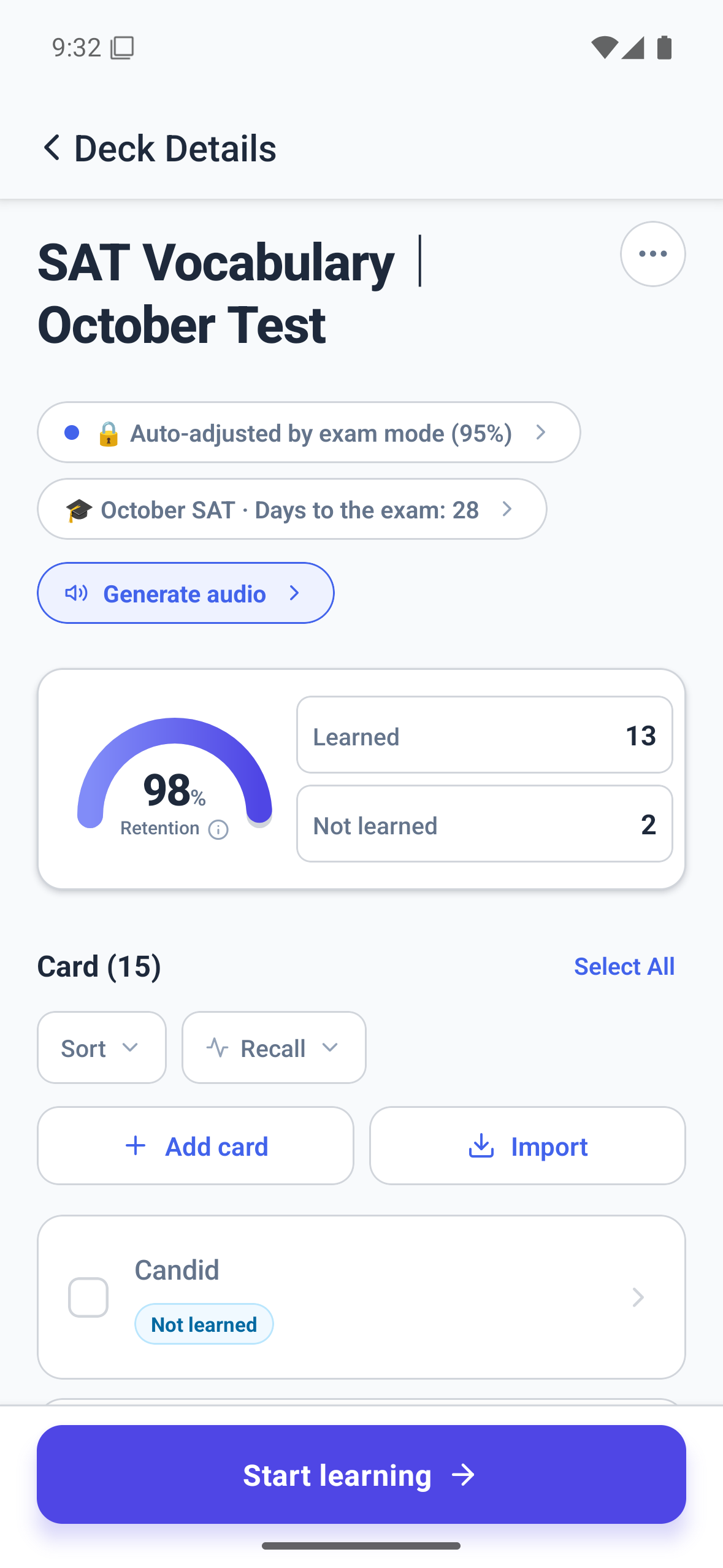
The deck displays the exam name and remaining days, so the deadline is visible before you start studying. The schedule supports preparation for the date; it does not predict or guarantee an exam result.
Choose your target chance of remembering for each deck
Not every deck needs the same amount of review. A certification deck may justify more frequent practice than notes you only want to recognize later. Memly 2.0 lets you choose the chance of remembering that it aims to maintain for each deck:
- 80%
- 90%
- 93%
- 95%
Before saving the change, the setting shows an approximate daily card count and study time. A higher percentage generally requires more frequent review, so the strongest setting is not automatically the best choice for every subject.
This setting is also a workload decision. Choose a percentage whose expected number of reviews matches the importance and timing of the deck.
Build an exam deck before the final week
Exam Mode can adjust a schedule, but it cannot make up for starting too late. Research consistently finds that studying in several shorter periods over time works better than doing the same amount all at once. A useful setup sequence is:
- Create a deck from the relevant pages, slides, notes, or images.
- Set the exam name and date.
- Choose a usual chance of remembering that fits the deck’s importance.
- Complete due reviews while there is still time before the exam.
- Use Memly’s estimate of how likely you are to remember each card to identify weak cards as the date gets closer.
The first step is easier when the deck only contains material you need to study. See creating flashcards with artificial intelligence (AI) for PDF page selection, PowerPoint slide selection, Word imports, and multiple-image sources.
Use the memory dashboard as an early-warning system
A deadline is more manageable when the workload is visible. The Memly 2.0 dashboard estimates the reviews due over the next 14 days, shows cards you are less than 90% or 80% likely to remember, lists reviews due by today, and identifies repeatedly forgotten cards. This information can reveal a growing problem before it becomes a final-day backlog.
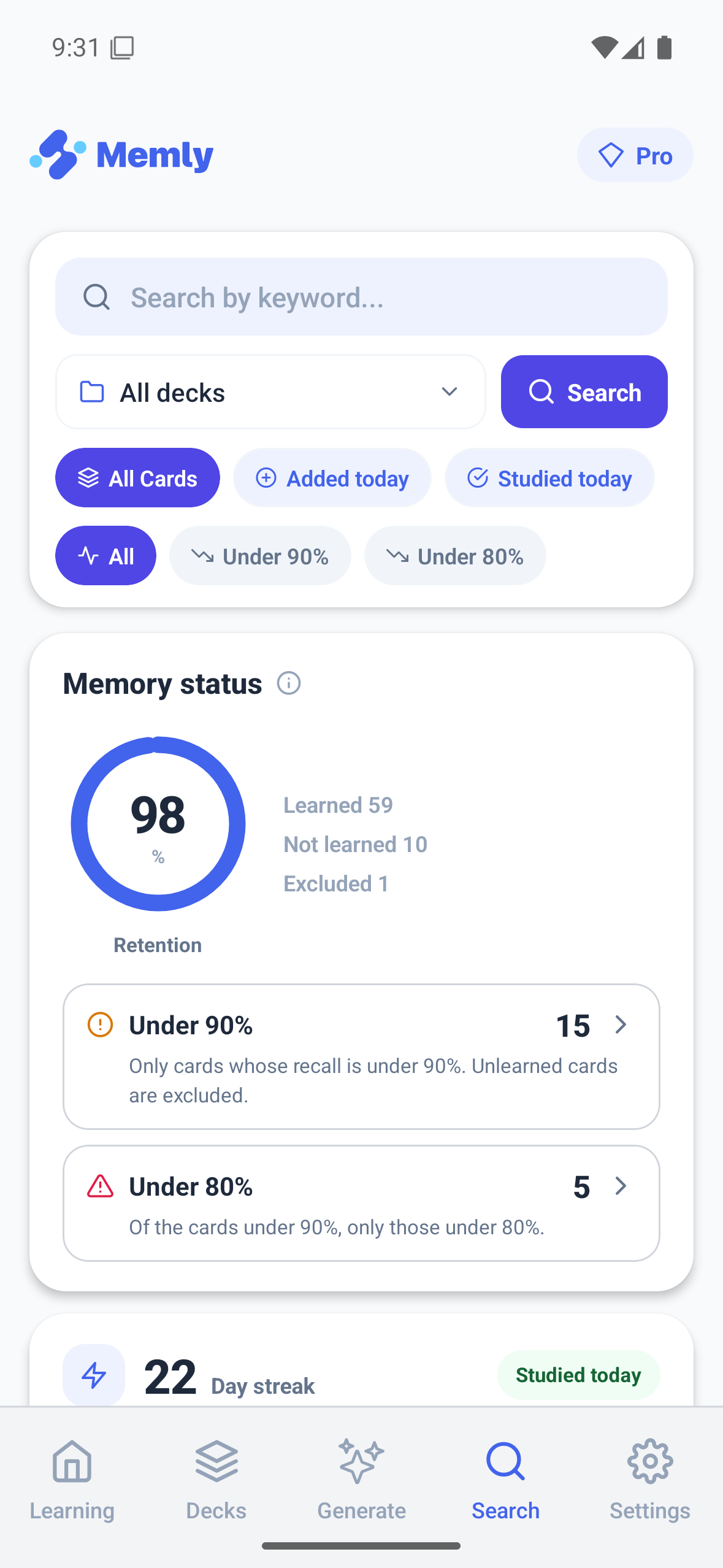
For a short review focused on weak cards, filter already-studied cards below 90% or below 80%. Results start with the cards you are least likely to remember, which puts the most fragile memories first. The full explanation is in Memly 2.0 Memory Review.
Choose the right mode for each phase of preparation
Early preparation should include trying to remember an answer before looking at it. Question-and-answer (Q&A), multiple choice, and true or false all require an answer before feedback. Quick Review is different: it shows both sides, advances automatically, and does not rate your answer or change when Memly will show the card again.
That makes Quick Review useful for a first look at a deck, returning to a neglected deck, or a brief overview near the exam. It should support, not replace, reviews where you first try to answer from memory. See the Memly 2.0 study-mode guide for a practical comparison.
Keep the final days specific
More activity is not always better near an exam. Use the remaining days to narrow uncertainty:
- Finish reviews already due.
- Inspect the weak-card groups instead of restarting every deck.
- Edit unclear cards that make you answer incorrectly for reasons unrelated to what you know.
- Use practice questions to expose gaps that flashcards do not cover.
- Protect sleep rather than adding an all-night rereading block.
Start with one real date
It is easy to read about a planning tool and postpone using it. Choose one deck you are studying now, add its real exam date, and inspect the estimated daily work today. You can then compare the full Memly 2.0 study process or add audio review options when part of your preparation needs to happen away from the screen.
For the research and scheduling principles behind Memly, read our guide to AI-assisted memorization.
