


"Don't memorize, understand it" can sound like a choice between two opposing methods. In practice, you often need both: facts you can recall and an explanation of how to use them. If you can repeat a definition but cannot apply it, or follow an explanation but cannot recall it, practise the missing part.
The dichotomy is fake. Understanding is the entrance to memory; memorization, meaning retrieval practice plus spacing, is what makes it stay. They form one loop: understand, encode with meaning, recall, use. The answer is not "which first" but "run both."
The trap in "if you understand it, you'll remember it"
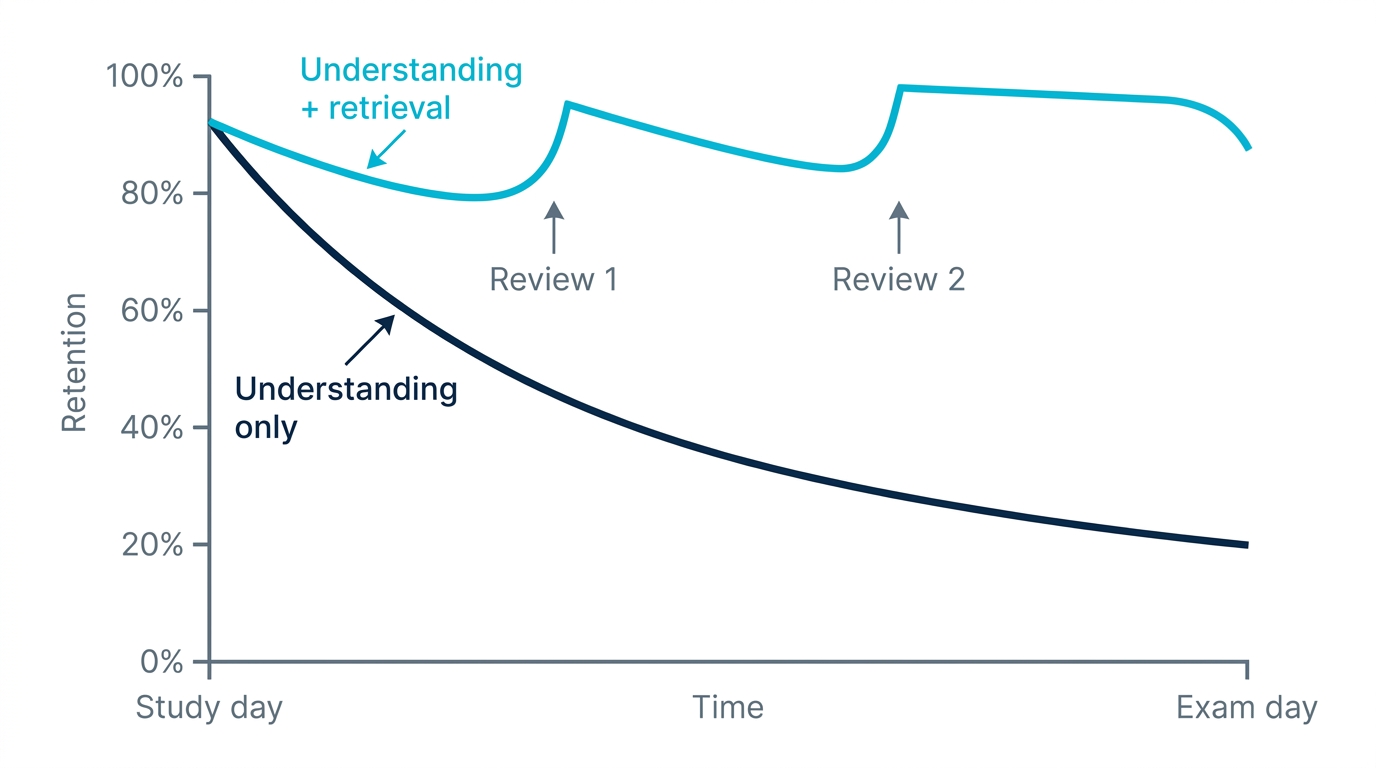
Start with the understanding camp's miscalculation. Content that felt completely clear in class still follows Ebbinghaus's forgetting curve: understood material fades fast without review. Understanding slows forgetting; it does not exempt you from it.
Worse, the feeling of "I get it" is prime territory for the fluency illusion: reading a smooth explanation and reproducing the idea on a blank answer sheet are different abilities. Getting it is recognition; solving is recall, and exams only pay for recall. Why You Forget What You Read traces how that illusion forms while you read.
Why rote memorization collapses in the exam room
The rote camp's miscalculation is the cost of throwing meaning away. Disconnected facts interfere with each other: memorize a hundred bare dates and the events blur together; memorize formulas without context and you cannot tell which situation calls for which formula.
Dunlosky's 2013 review rated practice testing and spaced review as the highest-utility techniques, and retrieval works better the more meaning is attached. A fact learned together with its "why" has more retrieval hooks, and it comes back even when the question is twisted.
The verdict: not a sequence, a loop
Both camps drop a step out of the same cycle, so neither ends up with knowledge that survives a twisted question. The full cycle has four steps:
- Understand: grasp the mechanism, the reason, the connections. Pure input.
- Encode with meaning: turn the "what" and the "why" into question-and-answer form together.
- Recall: close the book, reproduce it from memory, and repeat with expanding gaps.
- Use: solve problems, explain it to someone. Whatever fails here feeds back into step 1.
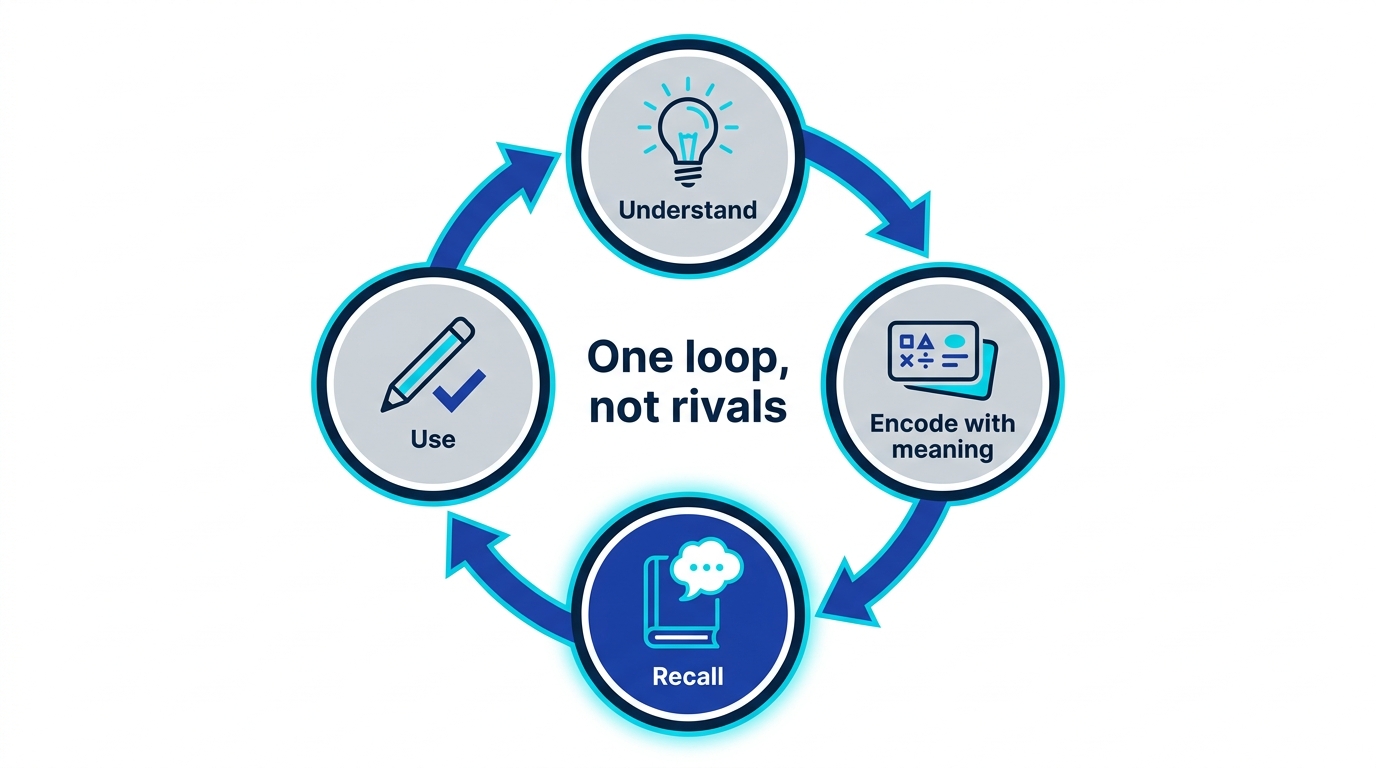
Rote memorization skips steps 1 and 2; understanding-only study skips step 3. Skip any part of the loop and the hours stop converting. The three principles behind effective memorization are covered in How to Memorize Faster: 3 Principles That Beat a Good Memory.
The right balance by subject type
So how much of each? It depends less on the subject's name than on whether its facts come with a "why" attached at all.
| Subject type | Examples | Balance |
|---|---|---|
| Paired-association subjects | Vocabulary, spelling, dates | Memorization-leaning, but adding etymology, context, and causes reduces interference |
| Mechanism subjects | Physics, physiology, economics | Understanding-leaning, but definitions and formulas still need retrieval practice |
| Hybrid subjects | Law, history, pharmacology | Structure by "why" first, then maintain requirements and numbers with spaced repetition |
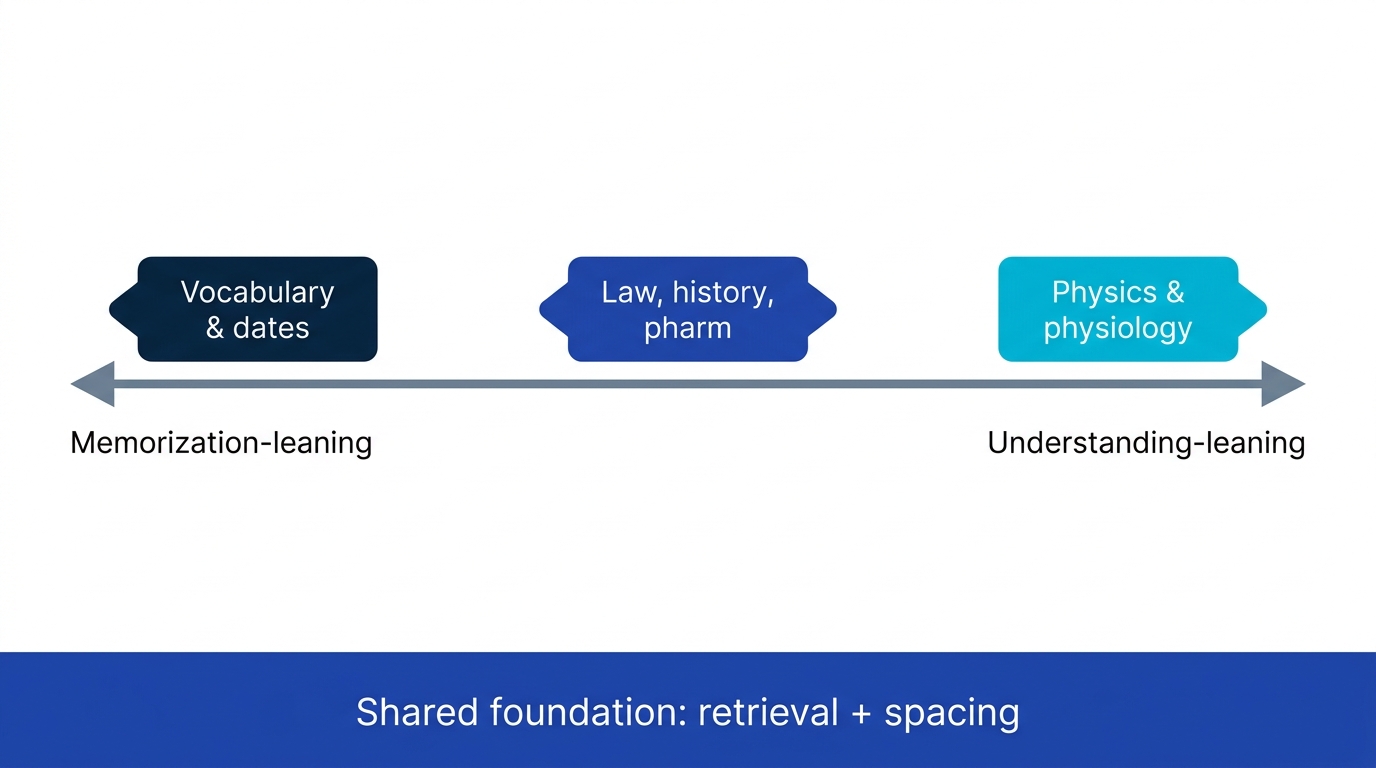
Across every subject, the foundation is the same: retrieval practice and spacing. Only the entrance changes; the mechanism of retention does not.
Memly automates the tedious half of the loop
Steps 1 and 4 are yours. Steps 2 and 3, writing the cards and deciding when each one comes back, are the ones that quietly fall off around week three.
- Cards that carry meaning: photograph a textbook page or upload a PDF, and AI generates cards that ask not just "what" but "why."
- Recall timing handled for you: the FSRS spaced repetition algorithm resurfaces each card just before you would forget it.
- Web, iOS, and Android: understand at your desk, recall on the move.
For the full picture of AI-assisted memorization, see the pillar guide AI-Assisted Memorization: How It Works and the Best Tools.
The people who quit the debate learn fastest
Use two checks for your next topic: can you explain why it works, and can you recall the key facts without notes? If only one is possible, practise the missing part. Then try a differently worded problem to check whether you can apply it.
The ones who improve do one thing: take one thing you understood today, turn it into a question that includes the "why," and try to recall it tomorrow. That is lap one of the loop. Memly is free to try, no credit card required.
