


If you study regularly but your grades stay flat, adding hours is not the only option. Look at a recent test: did you struggle to remember a fact, understand the question, apply a method, or finish in time? Each problem calls for a different kind of practice.
This article focuses on one common gap: spending plenty of time reading or watching explanations, but little time recalling, solving, or explaining without help. These are the "input" and "output" activities we compare below.
The short version: keep track of your study time, but also check what you can do with it. If you understand an explanation while reading but cannot answer later, add a short self-test before moving on. For a broader check of mistakes, use the four-category mock-exam review.
What "studying hard but not improving" actually is
Hours at the desk measure effort, not learning
Reading the textbook, listening to lectures, making beautiful notes, highlighting: all input, and all of it feels like studying while you do it. Yet in Dunlosky's large 2013 review of study techniques, rereading and highlighting were rated among the least effective methods, while practice testing and spaced review took the top spots.
If most of a session is rereading, try replacing part of it with a question you answer without notes. Keep enough reading time to understand new material. The aim is to balance explanation and practice, not to treat one activity as always useful and the other as wasted.
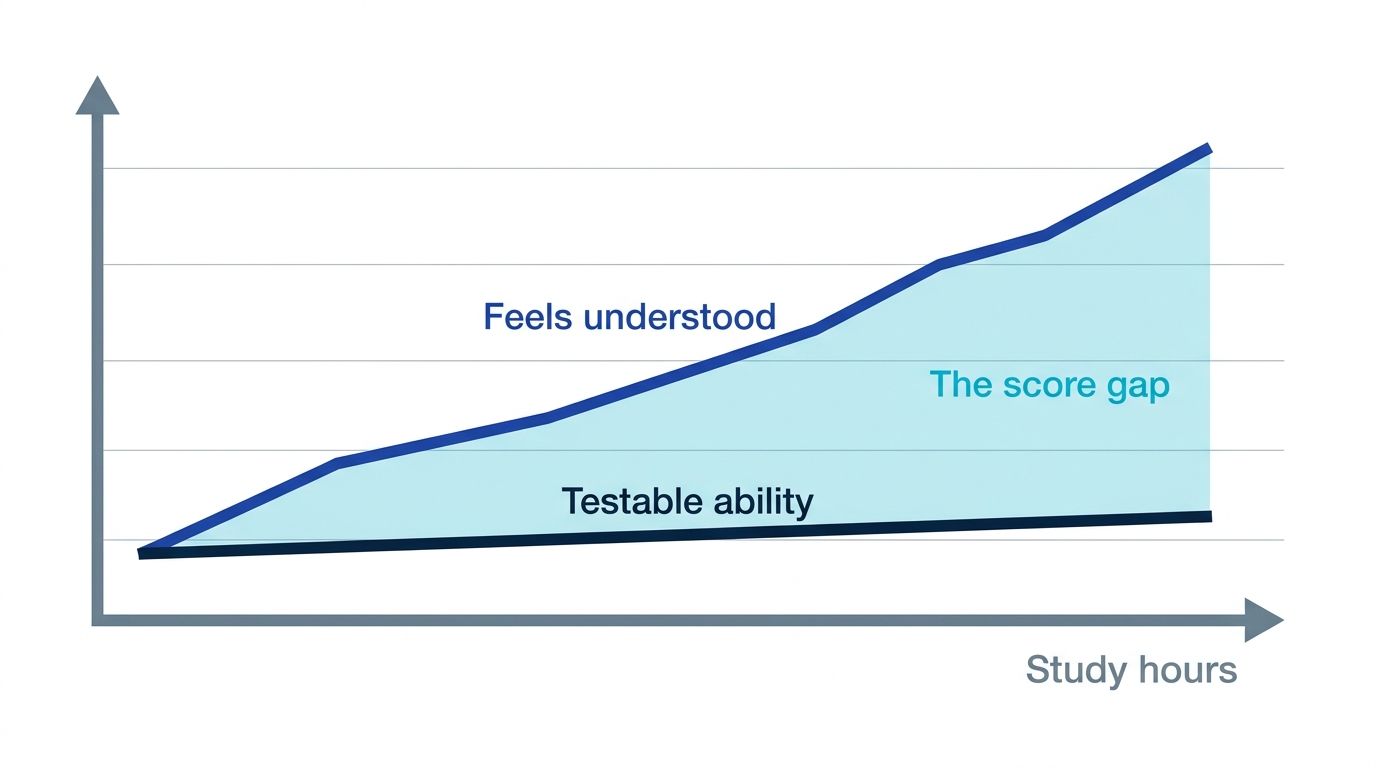
"I understand it" and "I can produce it" are different things
An explanation can make sense while you read it without being available from memory later. That familiar feeling is sometimes called the fluency illusion. A short closed-book question gives you a more direct check. See why familiar passages can still be hard to recall.
Self-diagnosis: which type is your studying?
- After reading a section, do you close the book and recall the key points?
- Have you ever tested whether you can explain a topic with nothing in front of you?
- When you miss a problem, do you re-attempt that problem days later?
- Do you review facts by hiding the answer and recalling, rather than reading to confirm?
- Did anything you studied last week get recalled again today?
Treat these questions as prompts, not a diagnostic score. A "no" answer identifies something to try: explain one concept without notes, retry one missed problem, or revisit one topic from last week.
Same two hours, different outcome: the restructure
In Roediger and Karpicke's 2006 experiments, students who practiced recalling a text outperformed rereaders a week later (roughly 56% versus 42% recall; exact figures vary by condition, the direction is the point). Here is that finding, translated into a daily two-hour block:
| Block | Input-type (before) | Output-type (after) |
|---|---|---|
| First 40 min | Read the textbook, make notes | Read new material, closing the book after each section to recall it |
| Second 40 min | Keep reading ahead | Convert what you read into flashcards, first retrieval pass |
| Last 40 min | Re-highlight, reread | Practice problems + spaced review of previous days' cards |
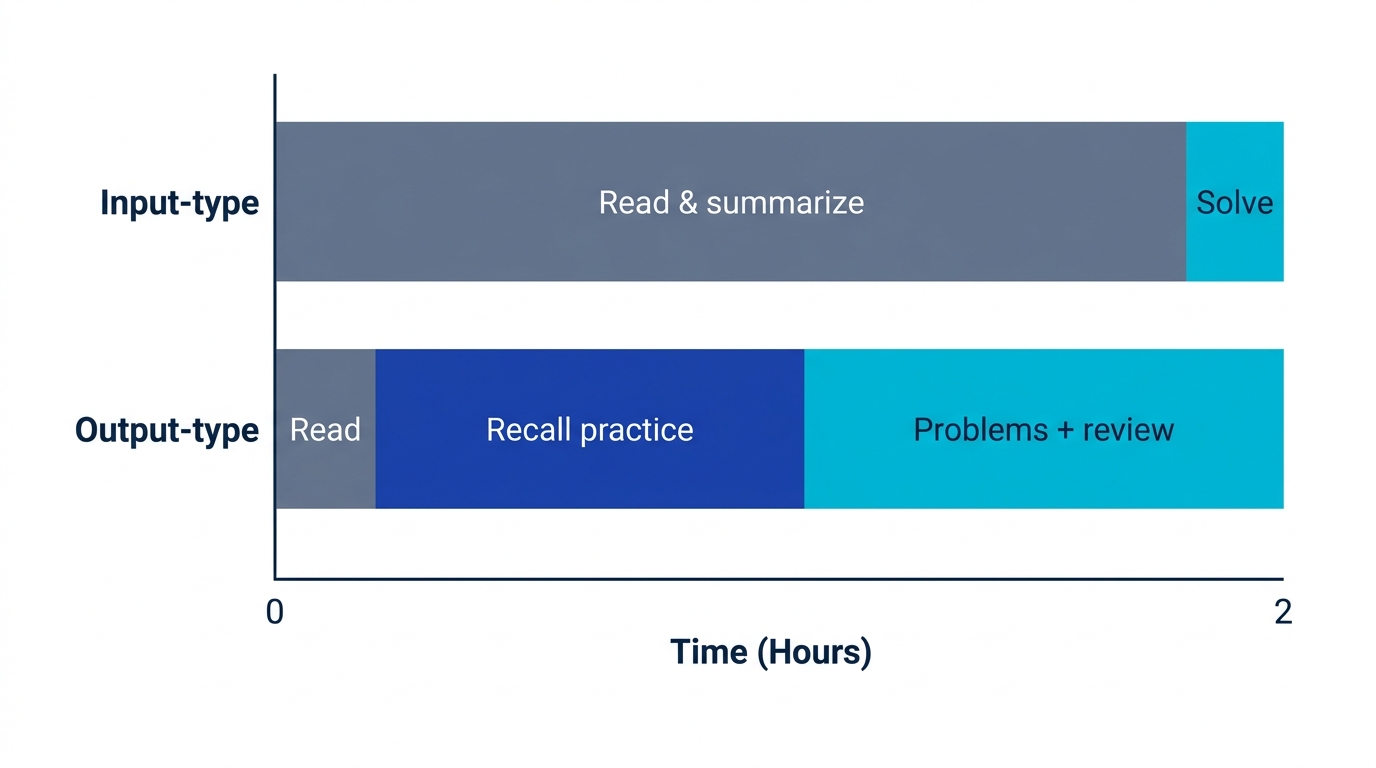
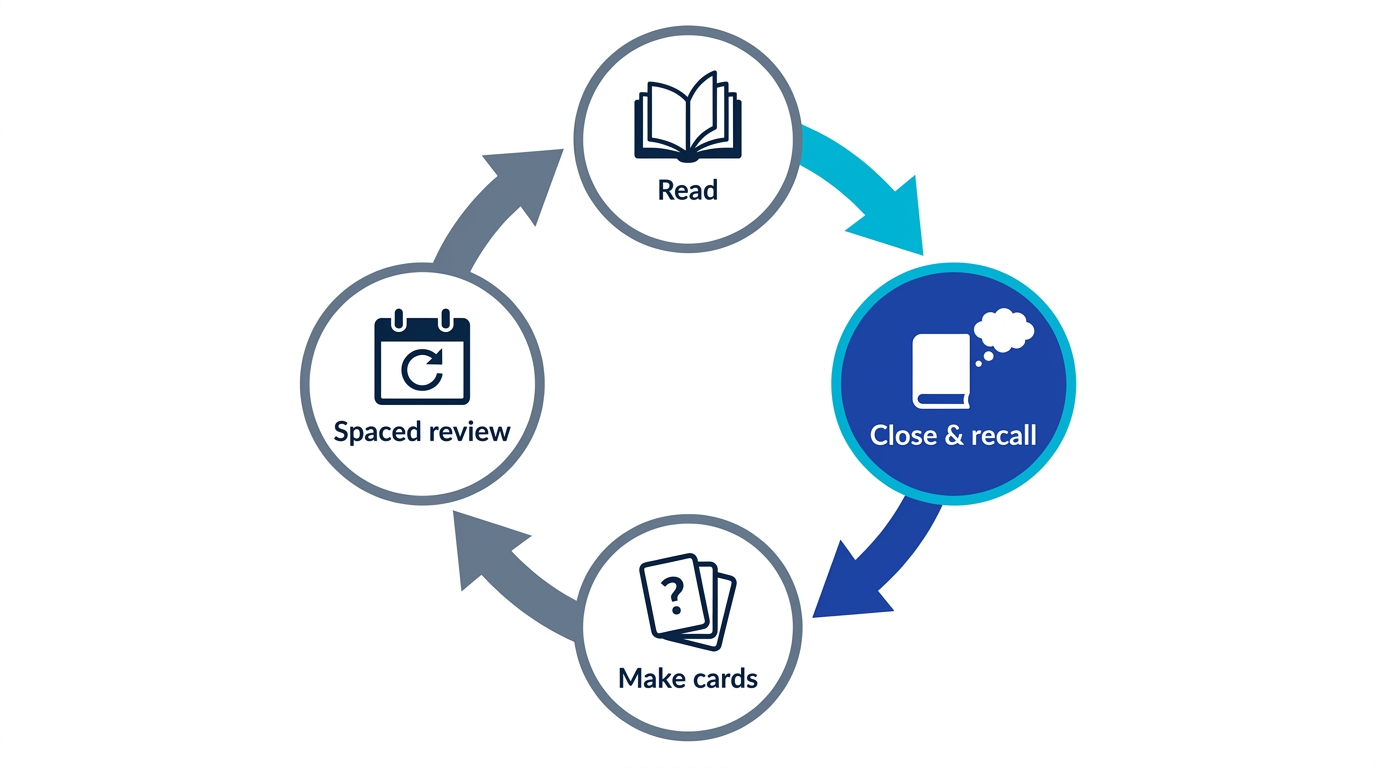
Reading has not disappeared from the right-hand column. What changed is that no block ends on input: read, then recall; learn, then card it and recall it again tomorrow. Studying that never closes this loop is the studying that never shows up on the scoreboard.
Make output the default, not a daily decision
Make the next review easy to find. You can use a paper checklist, a calendar, or an app; the useful part is deciding in advance what you will practise:
- Automate card creation: photograph textbook pages, handouts, or notes and AI converts them into question-and-answer cards. If making output material is the friction, delete the friction.
- Use a review schedule: FSRS suggests dates from your review history so you can revisit earlier material without tracking every date yourself.
- Assign idle minutes to output: with Web, iOS, and Android apps, the bus ride becomes retrieval practice.
For the evidence behind what actually works, see 5 Evidence-Based Study Methods That Actually Work, and for how AI-assisted memorization fits in, the pillar guide AI-Assisted Memorization: How It Works and the Best Tools.
Change only the last ten minutes of today's session
Try the revised routine on one topic this week, then use a similar practice question to check the result. If recall improves but the score does not, look next at application errors and time management.
You do not have to change everything. For the last ten minutes today, close everything and write down what you learned from a blank page. Whatever refuses to come out is your real weak point. When you want that loop to run itself, Memly is free to try, no credit card required.
