


Returning to study as an adult can feel different from studying at school. Work, interruptions, sleep, and less frequent practice all change the conditions. Before concluding that you cannot learn the material, look at how the task and your routine could better use the knowledge you already have.
Age plays a small role. The far bigger levers are circumstances and method, not brain hardware.
The short version: four things changed. Your study time became fragmented, your life floods new memories with interference, you have not practiced retrieval in years, and you are comparing yourself to a student who studied every day. All four are fixable by method. And adults hold one genuine advantage: a rich network of existing knowledge to hook new facts onto.
The four real reasons memory feels worse
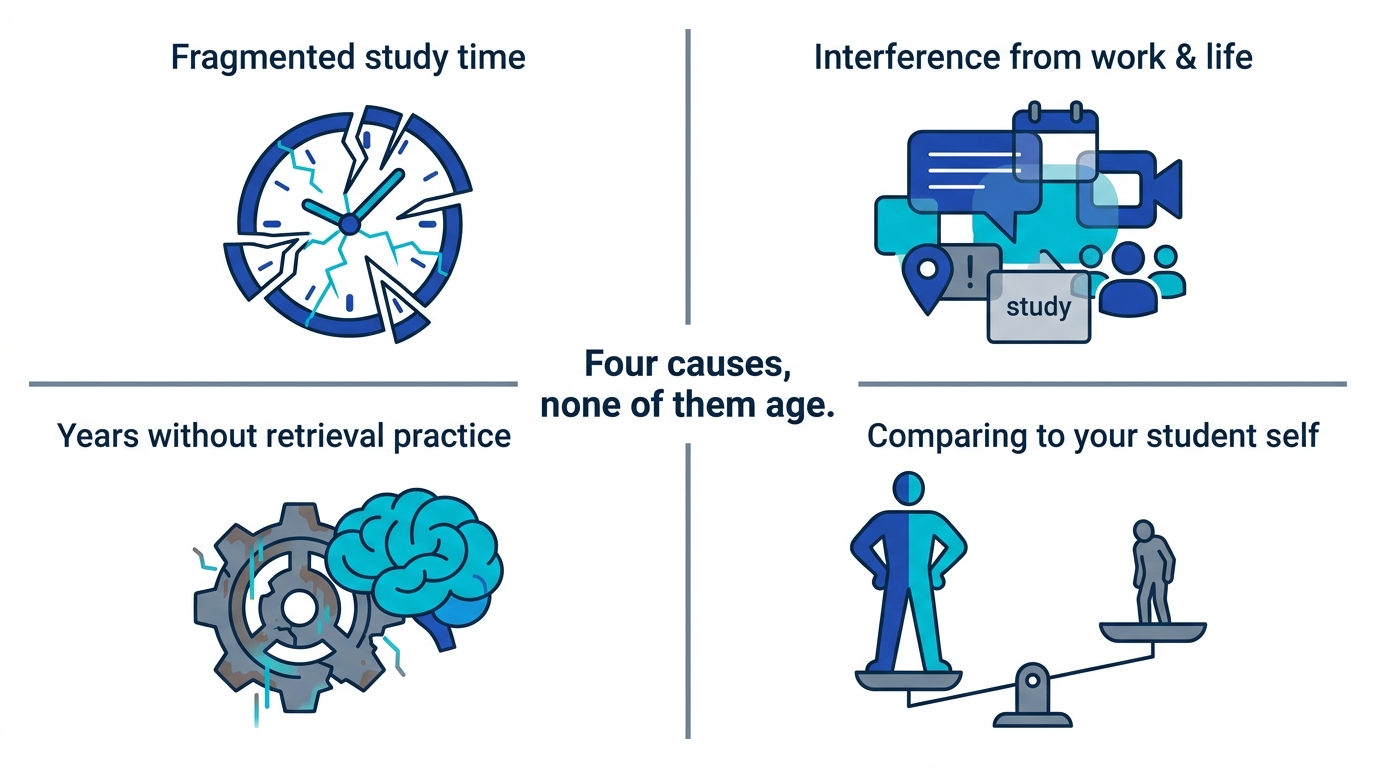
1. Your study time is fragmented, with no review design
As a student, classes, homework, and tests automatically spaced your exposures. As an adult, study happens in a two-hour weekend block, with gaps so irregular you restart from near zero each time. Measured against Ebbinghaus's forgetting curve, that pattern is relearning, not reviewing.
2. New memories get buried under the rest of your day
Whatever you memorize at 7 a.m. has forty emails, three meetings, and a family schedule stacked on top of it by 9 p.m. Memory suffers from interference: similar and voluminous information overwrites fragile new traces. Your recall did not weaken as much as your life got louder.
3. You have not practiced retrieval in years
Years without tests means years of recognition (it looks familiar) and no recall (produce it from nothing). Retrieval is a skill, and it rusts. It also returns with practice: in Dunlosky's (2013) review, practice testing ranked at the top of effective techniques, and nothing about that finding is student-only.
4. You are comparing against a full-time student
The high schooler who studied six hours a day and today's thirty-minutes-a-night version of you are not running the same race. You are misreading a difference in invested hours and structure as decay.
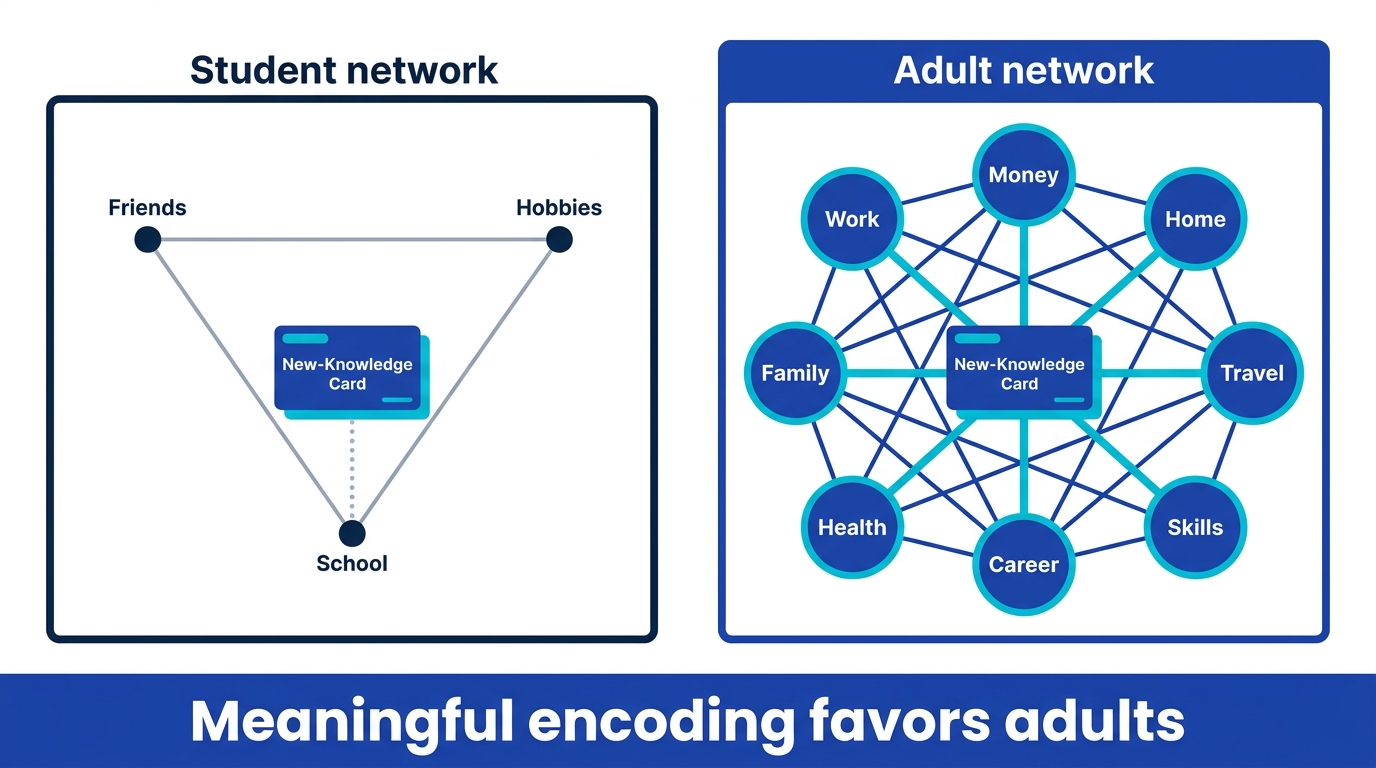
The adult advantage: your meaning network is bigger
Adults carry far more hooks for new knowledge than any student. Studying accounting? You have processed real expense reports. Studying law? You have watched contracts go wrong. Meaningful encoding, connecting new facts to what you already know, is exactly where adults outperform, and it is the first of the three principles in How to Memorize Faster.
Redesigning study for adult conditions
Each of the four causes has a matching move, and not one of them asks for more hours.
| Adult constraint | What fails | What works |
|---|---|---|
| Fragmented time | Weekend cramming blocks | 5-10 minute retrieval sessions spread across every day |
| Heavy interference | Reading more volume | Recall once right after learning; review again before sleep |
| Rusty recall | Rereading and highlighting | Convert material to Q&A and practice producing answers |
| No bandwidth for planning | Reviewing "when you feel like it" | Let a spaced repetition algorithm schedule everything |
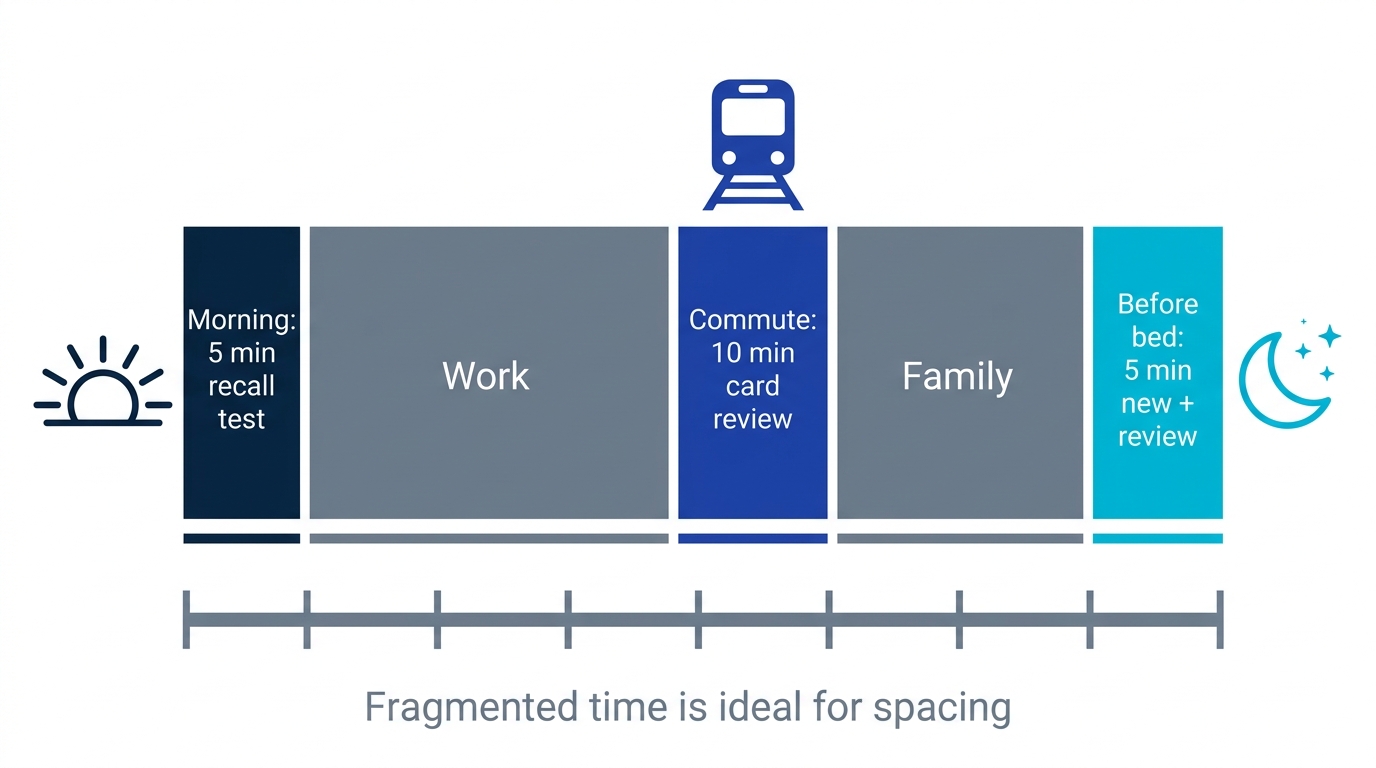
The fragmented-time constraint is the one that flips. Scattered minutes are the ideal structure for distributed practice, which Cepeda et al. (2006) showed beats massed study for long-term retention. Five minutes at breakfast, ten on the train, five before bed: designed well, an adult's scattered day beats a student's all-nighter. If work knowledge specifically keeps slipping, see Why You Can't Remember Things at Work.
Memly is built for exactly these conditions
- Zero-effort capture: photograph a textbook page, upload a training PDF, or paste notes, and AI generates the Q&A cards. No card-making sessions you do not have time for.
- Zero planning cost: the FSRS spaced repetition algorithm surfaces only what is due today, so the thinking part of review management disappears.
- Web, iOS, and Android: the commute and the lunch break become the review schedule.
For the full picture of AI-assisted memorization, see the pillar guide AI-Assisted Memorization: How It Works and the Best Tools.
"I'm too old for this" is where growth stops
Try one small change before increasing your workload: revisit a familiar topic, connect the new idea to that knowledge, and check it again after a gap. A difficult session is information about the task and conditions, not a verdict on your ability to learn.
The actual fork in the road is a method change, and a small one: make one card from today's studying and recall it once before you sleep. The difference is noticeable within days. Memly is free to try, no credit card required.
