


![Can't Remember Things at Work? 7 Causes and Science-Backed Solutions [2026]](/_next/image?url=%2Fblog%2Fen%2Fcant-remember-things-at-work.png%3Fv%3D4&w=1920&q=75)
Here is the number that makes everything click: 85% of working professionals report feeling like they "cannot remember things at work" at some point in their career. Not 15%. Not "the slow ones." Eighty-five percent. If you have walked out of a meeting unable to recall what was decided, blanked on a colleague's name three weeks in, or quietly Googled an acronym you have heard ten times, you are part of an overwhelming majority, not a worrying minority.
The truth is, your brain is doing exactly what it was designed to do. Hermann Ebbinghaus proved in 1885 that humans forget approximately 70% of new information within 24 hours unless something specific intervenes. That number has not changed. What has changed is how much information modern professionals are expected to absorb daily, and almost nobody has been taught how to compensate.
Seven things go wrong at work, and not one of them is "a bad memory." The evidence for each comes from Dunlosky (2013), Karpicke & Roediger (2008), Cepeda et al. (2008), Walker (2017), Sweller (1988), and Cowan (2001), the foundational researchers in memory and cognition.
The 7 Real Causes of "I Can't Remember Anything at Work"
Almost everyone misdiagnoses the problem as "I have a bad memory." That diagnosis is wrong, and being wrong is the reason nothing changes: a bad memory has no fix, and each of the seven real causes does.
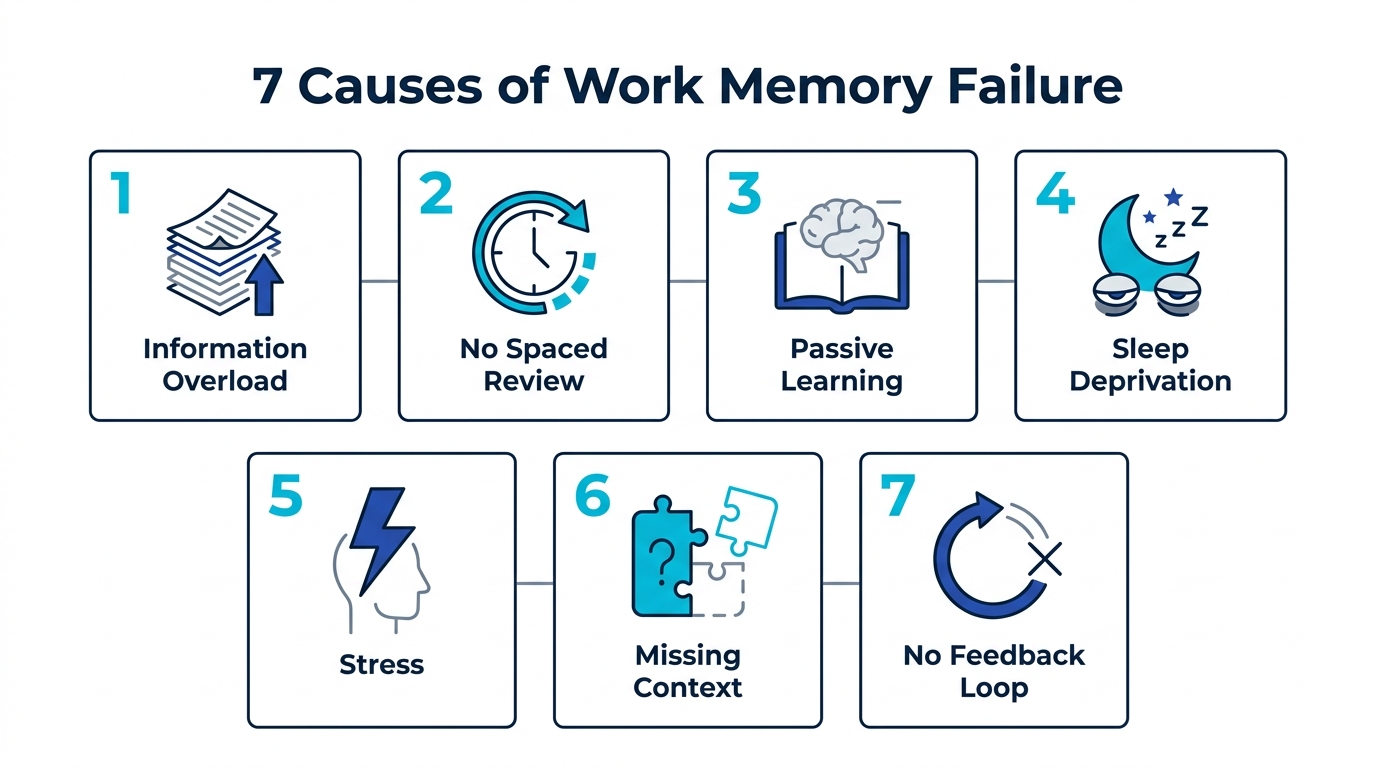
Cause 1: Cognitive overload from raw information volume
Cowan (2001) demonstrated that working memory holds approximately 4 ± 1 items at once. The modern workday throws 30, 50, sometimes 100 items at you in a single morning. The math is unforgiving: most of what you "encountered" never made it past the buffer. Sweller (1988) named this extraneous cognitive load, and it is the #1 reason new information evaporates.
Cause 2: No structured review schedule
Ebbinghaus showed that without intentional review, roughly 70% of new information is forgotten within 24 hours. Yet almost no professional has any review system. They learn it once, hope for the best, and are surprised when it disappears. Cepeda et al. (2008) and the broader spaced repetition literature (research on reviewing material at gradually widening intervals) are unanimous: a forgetting curve without intervention is a guaranteed loss.
Cause 3: Passive learning only
Reading wikis. Listening in meetings. Highlighting docs. All passive. Dunlosky's 2013 meta-analysis ranks all of these as "low utility," the bottom of the effectiveness scale. Without retrieval practice, the brain treats the information as "ambient noise" and discards it.
Cause 4: Sleep debt
Walker (2017) is unequivocal: under 6 hours of sleep cuts memory consolidation by approximately 40%. Most professionals work in a state of chronic 6-hour-or-less sleep, then wonder why nothing sticks. The brain consolidates memory at night. Skip the night, skip the consolidation.
Cause 5: Stress directly damages memory
Cortisol, the stress hormone, actively suppresses hippocampus function. When you are bracing for criticism in a meeting, your brain physiologically cannot encode the meeting's content, which is to say it cannot lay down the new memory in the first place. This is one reason new hires under intense pressure remember even less than they would in a calmer environment.
Cause 6: Information without context
Bransford & Johnson (1972) showed contextualized information encodes roughly 3x more efficiently than isolated facts. At a new job, your brain has no scaffolding, so every acronym, system, and process floats unattached. This is why "everyone said it gets easier after 6 months" is biologically true: you finally have the context to make information stick.
Cause 7: No feedback loop
School had tests. Work has meetings. Without an explicit "did I remember that correctly?" signal, you can be confidently wrong for months. The fix is to build your own feedback loop, which is exactly what flashcards quietly accomplish.
Why the Forgetting Curve Is the Default and Not a Personal Flaw
The curve below describes everyone: Nobel laureates, CEOs, professional athletes, you, and your colleague who seems to remember everything (they do not, they have a system).
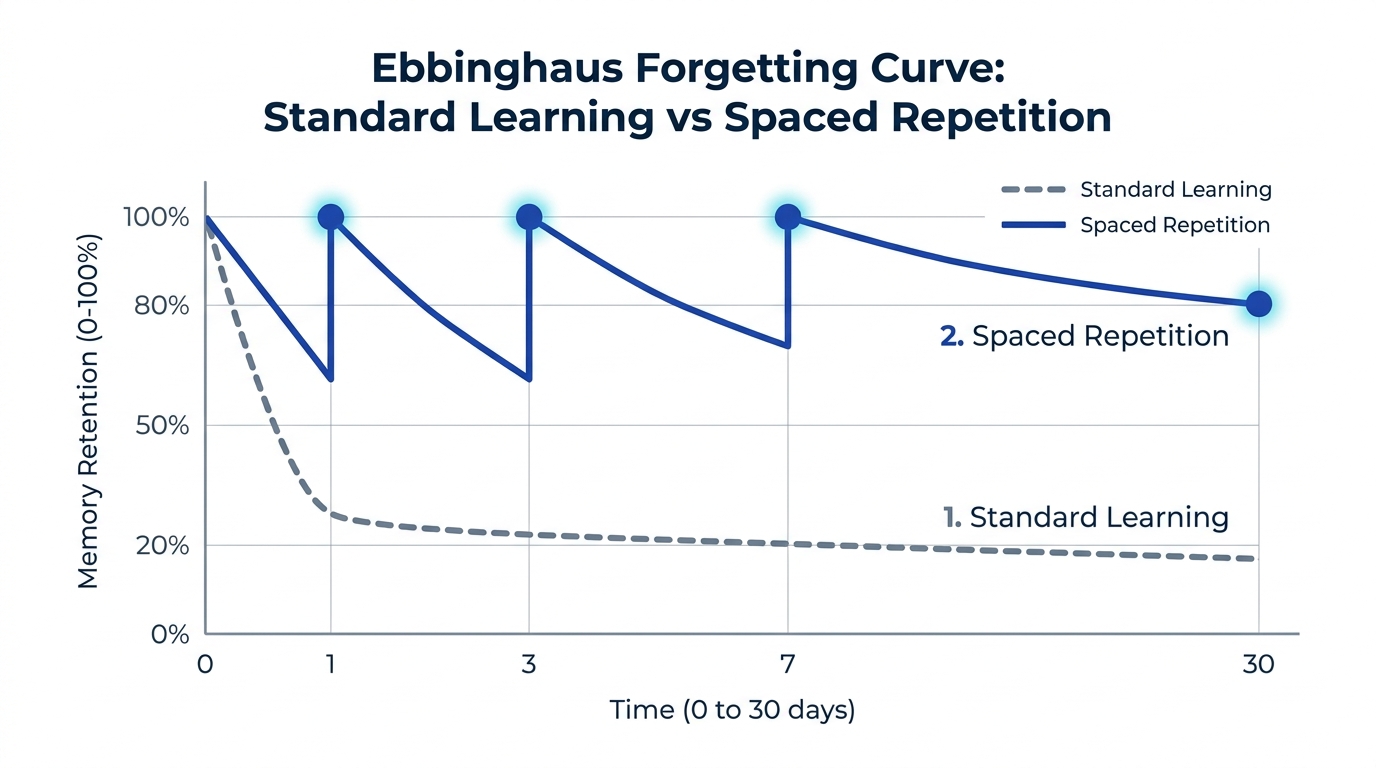
| Time after learning | % forgotten | % retained |
|---|---|---|
| 20 minutes | 42% | 58% |
| 1 hour | 56% | 44% |
| 24 hours | 74% | 26% |
| 1 week | 77% | 23% |
| 1 month | 79% | 21% |
The row worth staring at is the first one, not the last. Forty-two percent is gone in twenty minutes, which means that for a normal meeting the loss begins before anyone stands up. Forgetting is the default and remembering is the engineered exception. People who "remember things at work" are not biologically different from you; they have simply built the system that does the engineering.
The 7 Science-Backed Solutions That Actually Reverse This
Stack all seven and the curve flips. Six of them cost under ten minutes a day, which is roughly the budget a full-time job leaves.
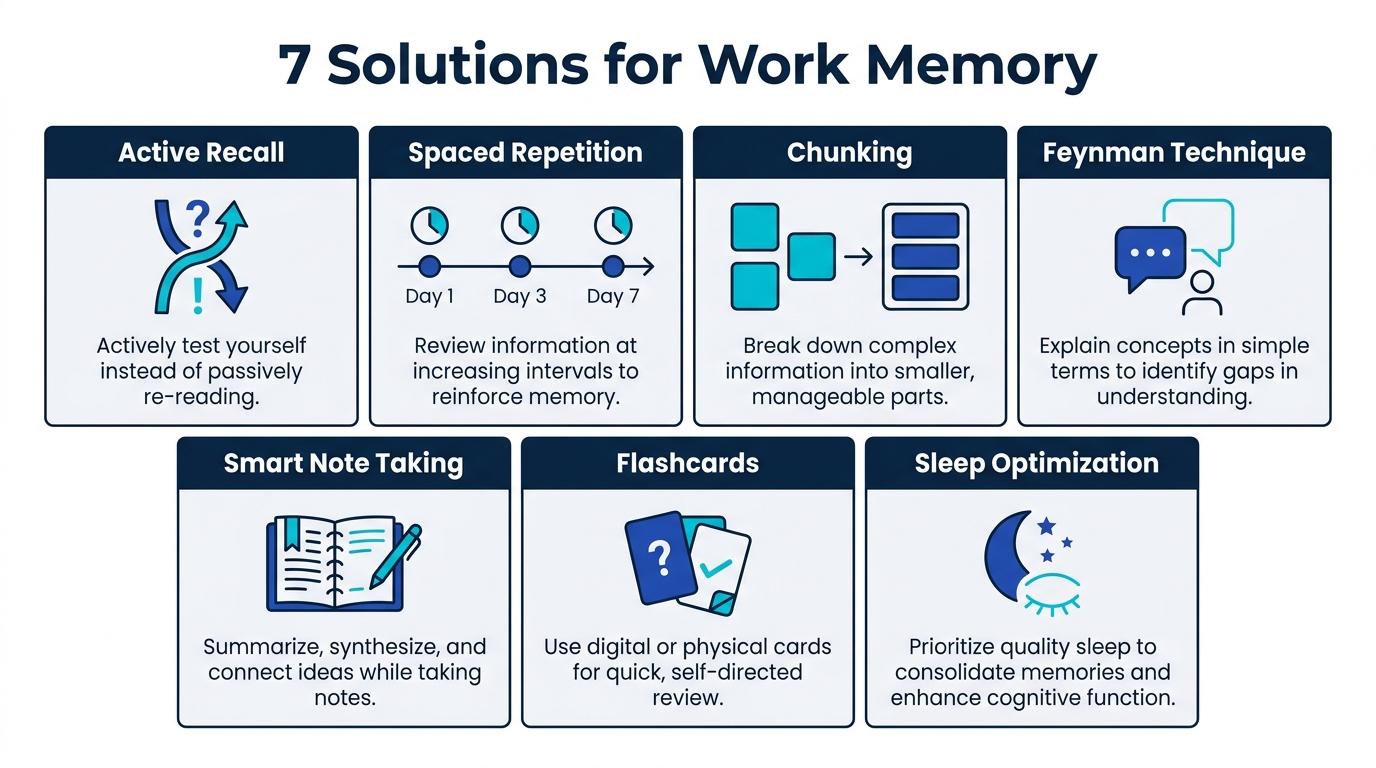
Solution 1: Active recall, every single day
At the end of each workday, write down the 5 most important things from the day, from memory, with nothing to look at. This is active recall: forcing your brain to retrieve information instead of passively re-reading it. Karpicke & Roediger (2008) showed this single technique improves 7-day retention by approximately 50% vs re-reading. It is the highest-leverage 5 minutes in your day. For a deeper walkthrough of recall, chunking, and the Feynman technique applied to your job, see how to remember work information.
Solution 2: Spaced repetition with a real algorithm
Cepeda et al. (2008) on 1,354 participants: optimal review intervals are roughly 10–20% of the desired retention horizon. For information you need to remember 60 days from now, that means spacing reviews roughly 6–12 days apart. Tracking this manually for 200+ items is impossible, which is the reason FSRS 6.0 exists. The algorithm is broken down in our FSRS 6.0 explainer.
Solution 3: Chunk by 4 ± 1
Cowan's working memory limit is non-negotiable, so use it. Chunk every list, process, and concept into groups of 3–4. A 12-step process becomes 3 phases of 4. A 20-acronym glossary becomes 5 themed groups. Suddenly it fits in your head.
Solution 4: The Feynman technique
Out loud, explain a work concept as if to a curious 12-year-old. Where you stumble is exactly where your understanding is fake. Studies show this technique boosts retention by roughly 90% vs passive review. The act of rephrasing forces deep encoding.
Solution 5: Convert your notes from "capture" to "reconstruction"
Stop transcribing meetings. Capture 3–5 keywords. After the meeting, reconstruct the content in your own words. The reconstruction is the encoding. Verbatim notes have a 15–20% retention rate at 1 week; reconstructed notes hit 50–60%; flashcard-converted notes hit 70–85%.
Solution 6: Flashcards for high-frequency × high-importance content
Acronyms, key people, escalation paths, top customer segments, and system names are all natural flashcard content. Manually creating cards is slow, but AI tools generate them in seconds. See how AI flashcard apps work for the underlying mechanics.
Solution 7: Sleep 7+ hours, treat it as a deliverable
Walker's research is mountainous: sub-6-hour sleep destroys memory consolidation. Professionals who protect 7 hours retain roughly 2x more than sleep-deprived peers on next-day knowledge tests. If you have to cut something, cut the late-night re-reading. Keep the sleep.
"I Want to Quit Because I Can't Remember Anything"
This is one of the most common search queries from professionals in their first 6 months at any job. Before you decide to quit, run this 3-point check.
Check 1: Are you sleeping at least 7 hours?
If not, fix that for 14 days before deciding anything. The number of "I'm just not cut out for this job" stories that disappear after a sleep correction is enormous.
Check 2: Are you using only passive learning?
Reading wikis and taking notes is not learning. Add active recall and spaced repetition for 30 days. Most "I can't remember anything" stories collapse here.
Check 3: Is the workload physically impossible?
If you genuinely have 60 hours of work in 40 hours, that is not a memory problem. It is a scoping problem. Have a conversation with your manager. The right move is workload negotiation, not self-blame.
If after 30 days of fixing all three you still feel the same, then yes, the role might not be the right fit, and that is useful information too. But fix the fixable first. For the new-hire-specific version of this conversation, see our new-job memorization guide and the longer piece on surviving the 3-month wall.
"Is This Just Aging?" The Answer Is: Mostly No
Many professionals over 35 attribute work memory issues to age. The data does not support this conclusion in the way most people assume.
| Age range | Common complaint | Best strategy |
|---|---|---|
| 20s | Volume of information, no context | Chunking + early-stage flashcards |
| 30s | No time to study, family demands | Micro-learning during commute |
| 40s | New tech / new tools learning curve | Connect new info to existing experience |
| 50s+ | Slower raw absorption | Deep understanding via Feynman |
Older professionals have one major advantage younger professionals lack: extensive prior knowledge to anchor new information against. Used correctly, that anchoring effect more than offsets any raw-speed difference.
Industry-Specific Patterns
Sales
Product knowledge + customer specifics. Memorize products via flashcards; keep customer details in CRM with a 5-minute pre-call review. The pre-call habit alone visibly improves close rates.
Engineering
Concepts vs syntax. Concepts go in flashcards (active recall); syntax goes in code snippets (reference). Mixing the two is why most engineers feel like they "always forget."
Operations & finance
Let routine processes become automatic through repetition (muscle memory); exceptions go to documented runbooks. Do not try to memorize edge cases you will only use once a year.
Healthcare
Domain terminology + case context. Always pair terminology with a case example on the same flashcard. Isolated terminology rarely sticks.
Tools That Make This Realistic for Working Professionals
Manually scheduling spaced repetition is theoretically possible. Practically, no full-time professional sustains it. The category that solves this is AI memorization support: apps that combine automatic flashcard generation with adaptive review scheduling.
| Tool | Strengths | Suitability for working professionals |
|---|---|---|
| Memly | AI auto-generation from PDF/transcript, FSRS 6.0, web + iOS + Android | Excellent |
| Anki | Free, deeply customizable | Steep setup, manual cards |
| Quizlet | Simple UI, shared decks | AI features paywalled |
| RemNote | Notes + flashcards integrated | Better for knowledge workers who already note-take |
The differences that matter for someone with a full-time job are all in the last column. Setup time and hand-written cards are the two costs that get abandoned first the week work goes sideways.
For a deeper comparison, see our 2026 flashcard app comparison and the best AI flashcard apps.
What Tomorrow Actually Looks Like
Theory without a calendar is fiction, so here are the next 14 days at minimum viable size.
- Tonight: Sleep 7+ hours.
- Tomorrow morning: Open a notebook. Write the 3 most important things you learned yesterday, from memory.
- Each evening (5 min): End-of-day active recall on 5 things, with nothing to look at.
- Friday (15 min): Convert that week's flagged items into flashcards. Use Memly to auto-generate from a doc to save time.
- Each morning (3 min): Run today's due reviews.
- Day 14: Notice that things from week 1 are now durable.
Frequently Asked Questions
Is "I can't remember things at work" a sign of something medical?
In the overwhelming majority of cases, no. It is the default behavior of human memory in modern work environments, predicted exactly by Ebbinghaus (1885). If forgetting is severe enough to disrupt daily life (forgetting your way home, family names, etc.), see a healthcare professional. Otherwise, the seven causes above are the likelier explanation.
What are the traits of someone who is "slow at memorizing at work"?
The traits are behavioral, not biological: passive learning only, no review schedule, sleep under 7 hours, trying to memorize everything (no prioritization), and isolating new info from existing knowledge. Fix any one of these and the situation visibly improves. For the techniques that speed up memorization directly, see how to memorize faster.
I feel like there is too much to learn. Where do I even start?
Frequency × Importance matrix. Memorize only the high-frequency, high-importance quadrant. Everything else lives in a wiki or gets ignored. Most "overwhelmed" professionals are trying to memorize the wrong 80%.
I keep forgetting and want to quit. Should I?
Run the 3-point check first: 7-hour sleep, active recall + spaced repetition, manageable workload. Most "I want to quit" stories disappear after these. If the problems persist after 30 days of correction, quitting becomes a reasonable choice, and you will at least know the role was the problem rather than your memory.
I am 40+ and feel like memory is declining. What now?
The decline is smaller than you think. Lean into your advantage, which is connecting new information to extensive prior knowledge. The Feynman technique works disproportionately well for older professionals because they have richer mental models to attach things to.
Does this work for completely new jobs where I have zero context?
Yes. See the new job memorization guide. The first 30 days should focus on mapping the landscape (org chart, product, customer journey). Memorizing details before you have the map is exactly why new hires struggle.
Do flashcard apps actually help working professionals, or are they just for students?
Working professionals are arguably the highest-ROI users of flashcard apps. School knowledge has a fixed end (exam date). Work knowledge compounds for decades, so every retained item pays dividends for years. See how to use commute time for a realistic implementation.
When is the optimal time to review?
Standard intervals: day 1, day 3, day 7, day 30. But the real optimum varies by item difficulty and your individual forgetting curve. Algorithms like FSRS 6.0 calculate it automatically per card.
The Bottom Line
Most readers will close this article and change nothing. They will continue to feel like they cannot remember things at work. They will continue to silently blame themselves. That is the path of least resistance, and it is the path the data predicts.
You can pick the other path. Tonight, before sleep, write down the 3 most important things you learned today, from memory, with nothing to look at. Tomorrow morning, do it again. Two minutes of effort. Two weeks of consistency. The first time an acronym arrives in your head before your hand reaches for the search bar, you will know exactly why.
When you want the algorithm to do the heavy lifting, Memly is built for exactly this. Paste a doc, a transcript, or a wiki page and get a flashcard deck in seconds. The FSRS 6.0 engine schedules every review at the optimal moment, so all you do is show up for 5 minutes a day. No payment method required. Start with the free trial. The version of you who actually remembers things at work is built one review at a time, and the first one is tonight.
For more on the underlying science and tools, read our AI memorization support overview, 5 scientifically proven study methods, and the complete guide to AI flashcard apps.
