


You have read the statute a dozen times. Then a practice question asks which rule applies, and you cannot remember whether it was 8 days or 14, notice or approval. For law students, bar candidates, and licensing exam takers, most of the hours spent rereading provisions and highlighting outlines quietly evaporate before exam day.
Legal memorization feels brutal not just because of volume, but because most people memorize statutes in a form the exam never asks for. The provision goes in as prose. The question comes back as a fact pattern, and prose does not answer fact patterns.
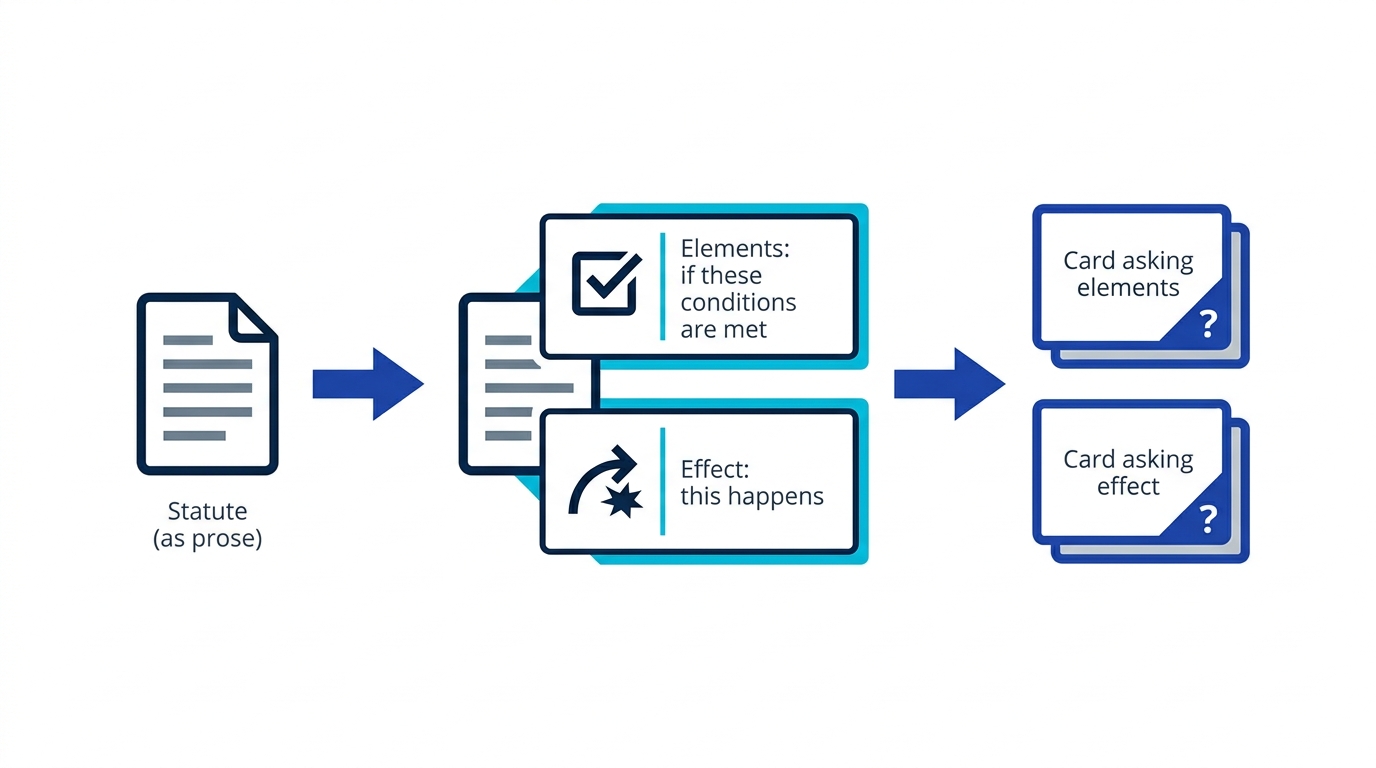
The short version: never memorize a statute as prose. Break it into element-and-effect pairs (if these conditions are met, this happens), give every number a reason, turn confusable provisions into contrast cards that ask "what differs?", and let spaced repetition handle maintenance until exam day.
Why rereading statutes never works
Statutory language is far from everyday speech: long subjects, nested exceptions, near-identical phrases. By the tenth pass the sentence finally reads like plain English, which feels like the hard part is over. It is not. Rereading produces smoothness, and smoothness masquerades as knowledge. That is the fluency illusion: in Dunlosky's 2013 review of study techniques, rereading and highlighting rated low, while practice testing and spaced review rated high. Exams do not ask you to recite a provision; they ask you to match facts to elements, which is a retrieval skill.
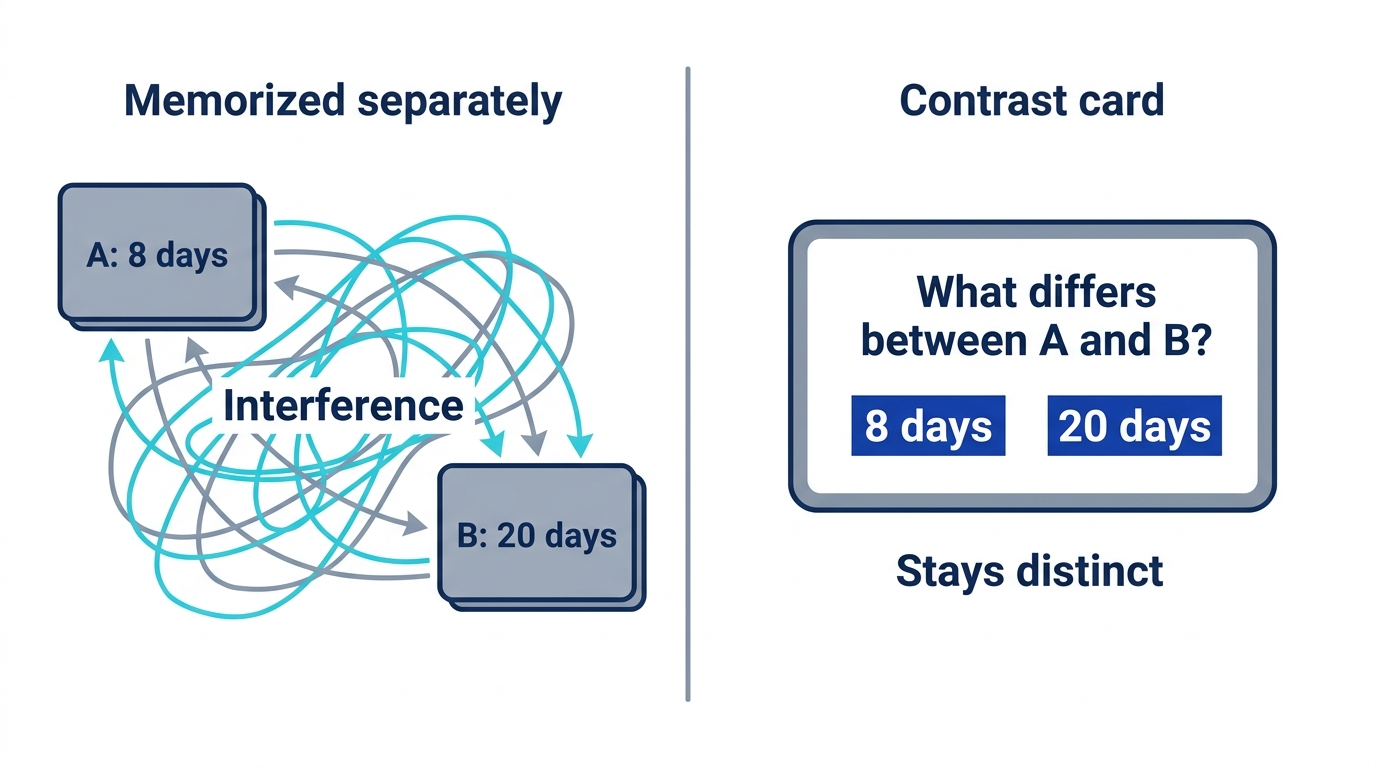
Law adds a second, heavier problem: interference between similar rules. Cooling-off periods versus notice periods, thresholds for one permit versus another. The more similar items you memorize in isolation, the more they cross wires under exam pressure.
Design 1: element-and-effect cards
Statutes are secretly card-friendly: nearly every provision is built as "if these elements are satisfied, this effect follows."
| Approach | Card looks like | On the exam |
|---|---|---|
| Memorize as prose | "Recite section 37-2" | Cannot match facts to rules in time |
| Elements and effects | "Offer made away from the office: until when can it be withdrawn?" | Matches the fact pattern instantly |
Only one of those cards is triggered by what the exam actually hands you.
Give every number a reason
Periods, thresholds, and amounts will not stay in memory as naked digits. On the back of the card, add why the number is what it is, and what happens once it is exceeded. Fourteen days is far easier to hold once you know what expires on day fifteen.
Design 2: contrast cards for confusable provisions
The fix for interference is not keeping similar rules apart; it is putting them side by side and testing only the difference:
- "How do the notice periods differ between A and B?": one card, direct comparison.
- "Which element exists in rule A but not rule B?": the difference itself becomes the retrieval target.
- Principle and exception on separate faces: "What is the rule?" and "What is the exception?" are different questions.
The pairs that blur under pressure, notice against approval, are the pairs a contrast card forces apart. The difference is what you practiced, so the difference is what comes back.
For the broader strategy of certification-exam memorization, see AI-Assisted Memorization for Certification Exams.
Design 3: plan backwards from exam day, let FSRS maintain
Autumn exam season means you must hold hundreds of rules at peak retention on one specific day. Cepeda et al.'s (2006) meta-analysis shows spaced reviews beat massed ones over every horizon, but manually scheduling reviews for hundreds of cards is not realistic. That bookkeeping is exactly what an algorithm should do.
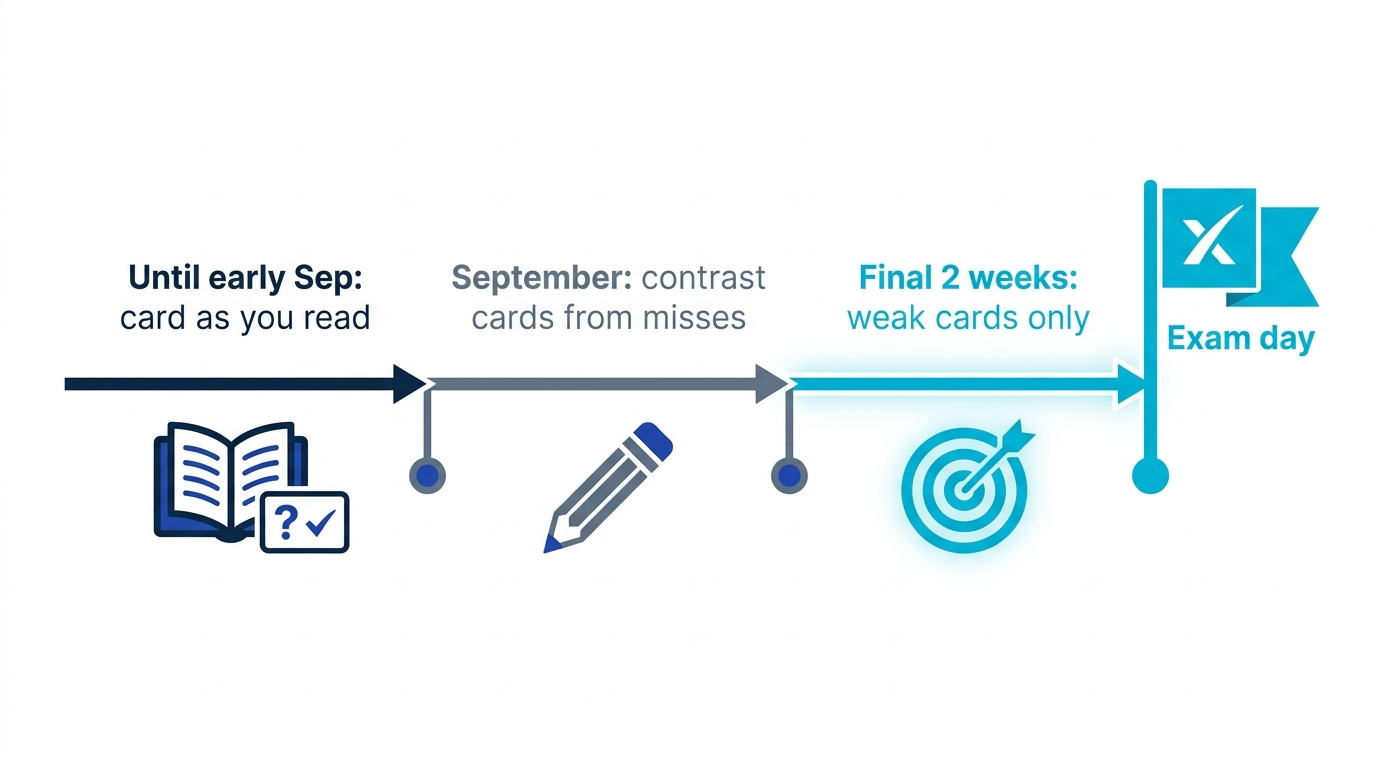
- Now to early September: as you read, convert each provision into element-effect cards the same day.
- September: add contrast cards for every mix-up practice questions reveal. Daily review is whatever the app schedules.
- Final two weeks: stop new cards; hammer only the ones you still miss.
Memly automates both the card-making and the maintenance
- Photograph outline pages or upload PDFs: AI converts them into question-and-answer cards, so drafting element-effect pairs stops being the bottleneck.
- FSRS spaced repetition resurfaces the provisions you are about to forget and manages hundreds of cards until exam day.
- Web, iOS, and Android: the commute becomes statute review time.
For the full picture of AI-assisted memorization, see the pillar guide AI-Assisted Memorization: How It Works and the Best Tools.
Build the version of you that can match rules to facts
Most candidates will finish this article and go back to rereading their outline, because reading feels like progress. On exam day, what counts is not how many passes you made but whether the fact pattern in front of you snaps onto a set of elements. Eight days or fourteen stops being a coin flip once you know what turns on it.
One action today: take the provision that confuses you most and split it into two cards, one asking the elements, one asking the effect. Memly is free to try, no credit card required.
