


Advice such as "read the textbook three times" or "see every word seven times" is easy to follow, but a fixed count cannot tell you what you retained. A familiar idea may need little review; a confusing one may need more. Start by checking what you can recall without looking.
So, how many times do you actually need to review something to memorize it? The answer is not a magic count but a change in what you count: not how many times you read it, but how many times you successfully recalled it.
The short version: there is no universal review count. You can use three to five spaced self-tests as a starting experiment, but do not stop simply because you reached that number. Check whether you can answer after a gap and apply the idea in the form your course requires.
Why "I did three passes" means almost nothing
The same "pass" can be completely different work:
| What a "pass" can be | What you are actually doing | Effect on memory |
|---|---|---|
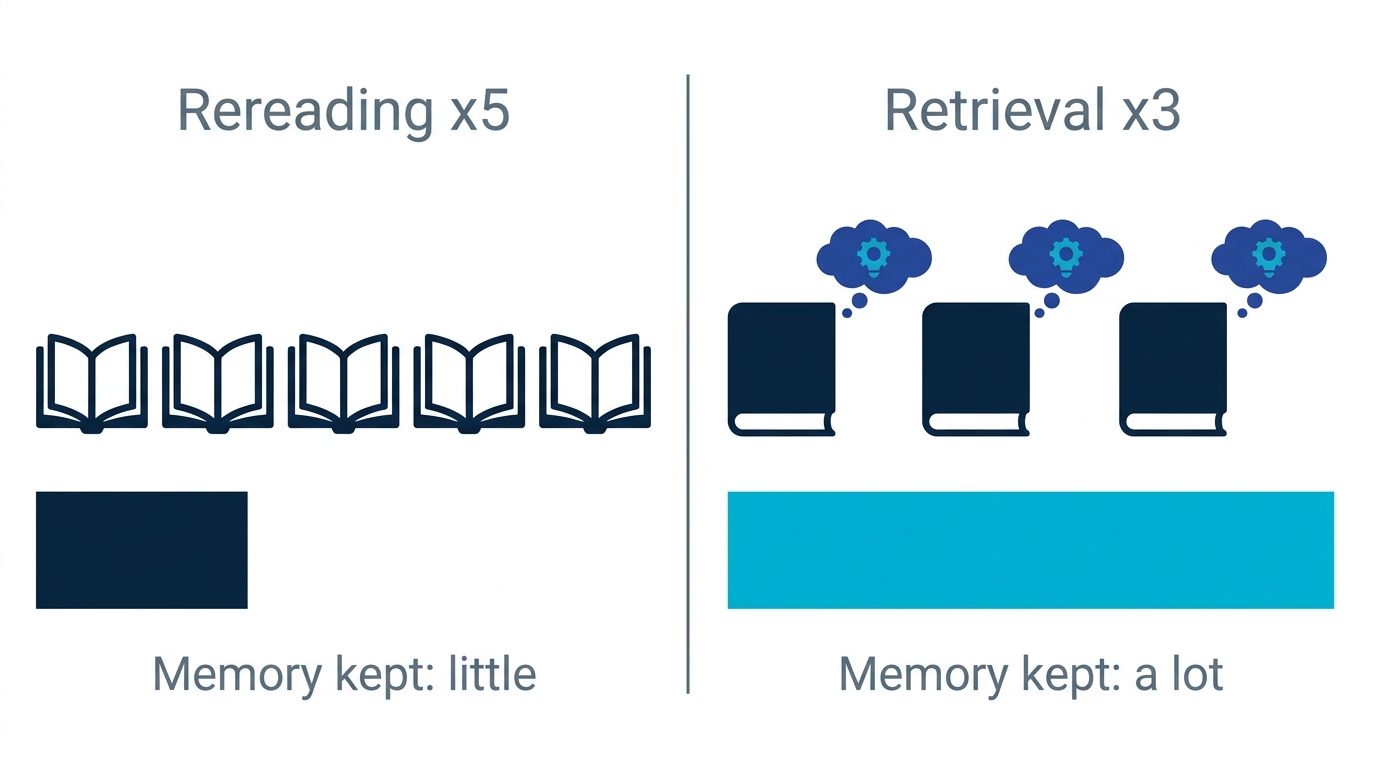
| Turning pages and reading | Rereading (repeated input) | Low; builds familiarity only |
| Skimming with answers covered, peeking | Recognition check (know it when you see it) | Limited; practice with hints |
| Book closed, producing it yourself | Recall (retrieval practice) | High; the same act the exam demands |
Dunlosky's 2013 review rated practice testing more highly than rereading for broad usefulness. Roediger and Karpicke's 2006 experiment also found better recall after a week in a retrieval-practice condition than in a rereading condition. The useful distinction is what a review asks you to do, not a fixed exchange rate between rereads and self-tests.
What to count instead: successful recalls at a gap
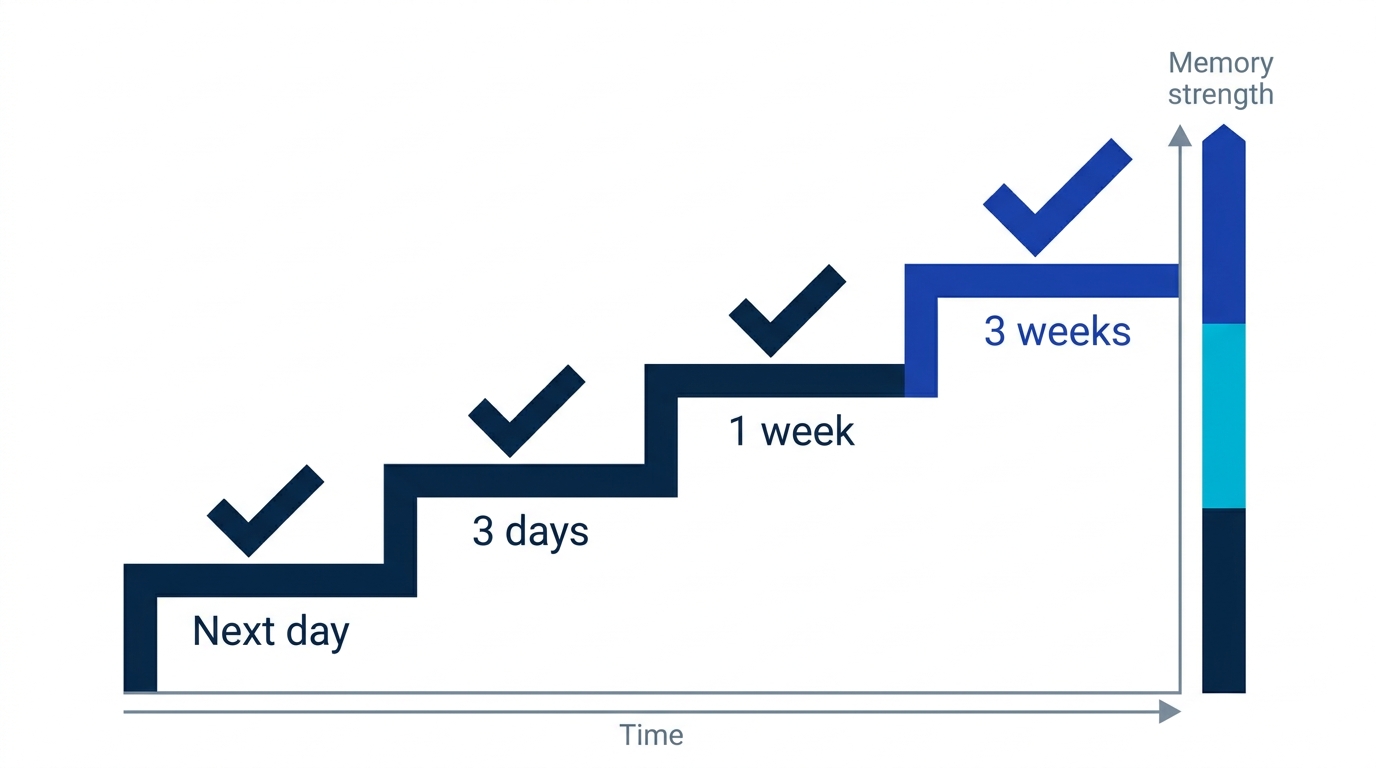
The unit to count is a successful, unaided recall after enough time has passed for forgetting to begin. Saying it ten times in a row right after learning is short-term rehearsal. It is not evidence of storage. One success the next day, another three days later, another a week later: those successes reflect long-term strength. Cepeda et al.'s (2006) meta-analysis shows the same number of reviews lasts far longer when spaced apart.
For a first trial, revisit the material the next day, a few days later, and again after a longer gap. These are example intervals, not an exam-proof formula. If you repeatedly miss an item, review it sooner or improve the explanation and question.
The honest answer: it differs card by card
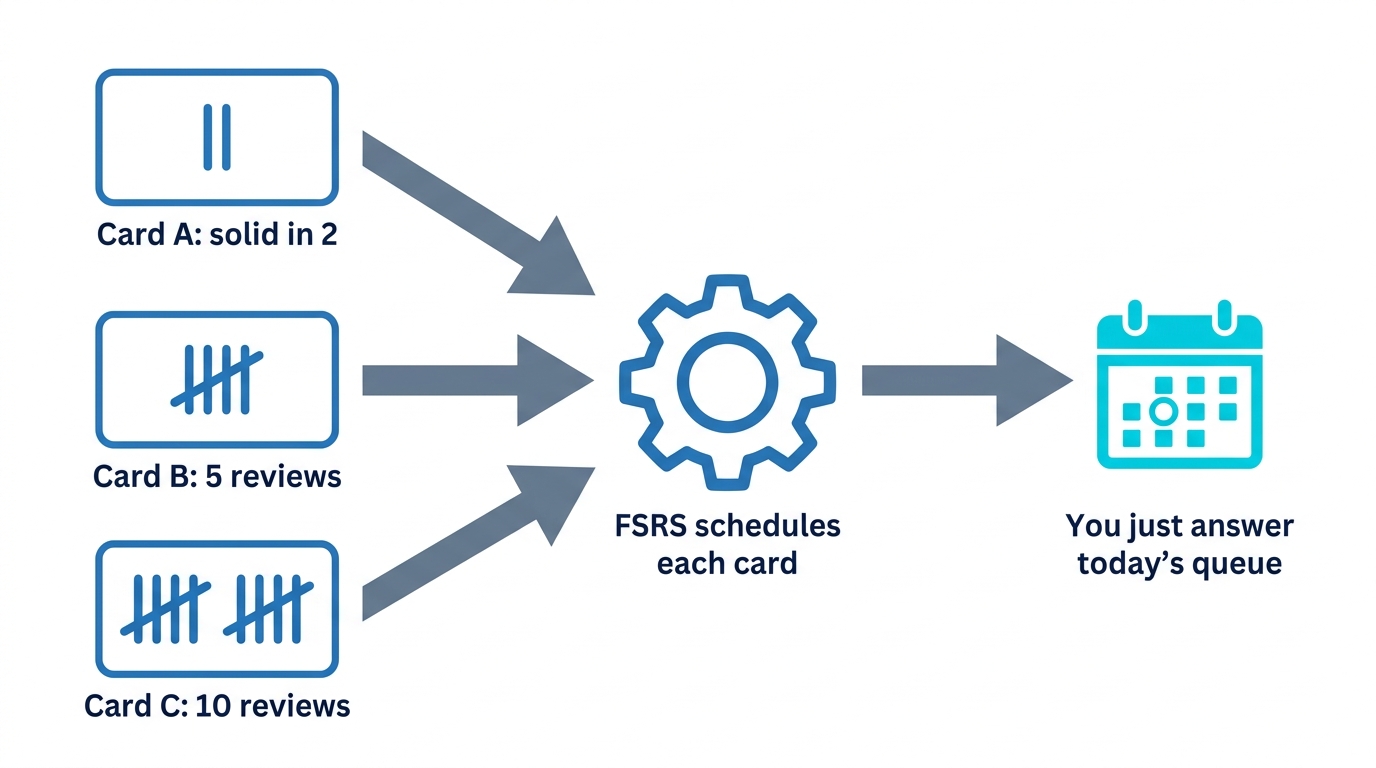
The inconvenient part is that the required number of recalls is different for every item. A fact that hooks into your experience settles in 2; a fact easily confused with its neighbors takes 10. Applying one pass count to everything therefore loses twice over: time goes to cards you already know, while the confusable ones come up too rarely to ever stabilize.
A spaced-repetition app can keep this record for you. FSRS, the Free Spaced Repetition Scheduler, uses each card's review history to estimate its next review date. It adjusts a schedule; it does not determine an exact number of repetitions that guarantees a permanent memory.
Why "just before forgetting" is the right moment is covered in The Best Time to Review: Right Before You Forget, and the wider evidence base in 5 Evidence-Based Study Methods That Actually Work.
Putting it into practice today
- Turn key points into questions: after reading a section, close it and explain the main point. A card is one way to save that question for later, not the only way to practise recall. See practical ways to build a recall routine.
- Grade yourself honestly: if it was fuzzy, count it as forgotten. Soft grading destroys the meaning of the count.
- Leave the intervals to the algorithm: with Memly, photograph or upload your material, AI generates the cards, and FSRS manages each card's count and gap. On Web, iOS, and Android, your only job is answering today's queue.
For the full picture of AI-assisted memorization, see the pillar guide AI-Assisted Memorization: How It Works and the Best Tools.
Today can be the last day you plan "one more pass"
For one topic, record whether you can answer without a hint after a gap. Use missed answers to decide what needs another explanation or an earlier review. The count is a useful record, not a pass mark you must reach.
One action: turn one page of material into cards today, and tomorrow, see what you can recall with the book closed. That is success number one. Memly is free to try, no credit card required.
