


Three months after passing, you try to recall the material and almost nothing comes back. The statutes, the formulas, the mechanisms you drilled for hundreds of hours have quietly drained away, and the certificate feels easier to show than the knowledge is to use. If your career needs that knowledge again, you may need to spend time learning it again.
This is not a memory problem; it is a design problem. Almost nobody plans the week after the exam, so the default runs unopposed, and the default is to stop reviewing. The alternative turns studying from a disposable expense into an appreciating asset, by keeping useful knowledge in your review routine.
The short version: crammed knowledge peaks on exam day and decays fast once reviews stop. The workload can change as cards become familiar: with spaced repetition, intervals stretch from weeks to months, and you can focus review time on knowledge you still need. Decide deliberately what to archive and what to maintain, then maintain only what compounds.
Why you forget everything after the exam
When you stop reviewing or using material, it can become harder to recall. Ebbinghaus studied relearning savings using mostly nonsense syllables; his curve is not a fixed percentage of exam knowledge that everyone loses. See Murre and Dros's 2015 replication for the experimental context.
Seen that way, a crammed pass never bought the knowledge; it rented it until the exam date. The exam ends the lease, and the knowledge starts moving out. The harder you crammed at the end, the faster it leaves, because material packed in over a few final nights never received the spaced recalls that turn it into durable memory.
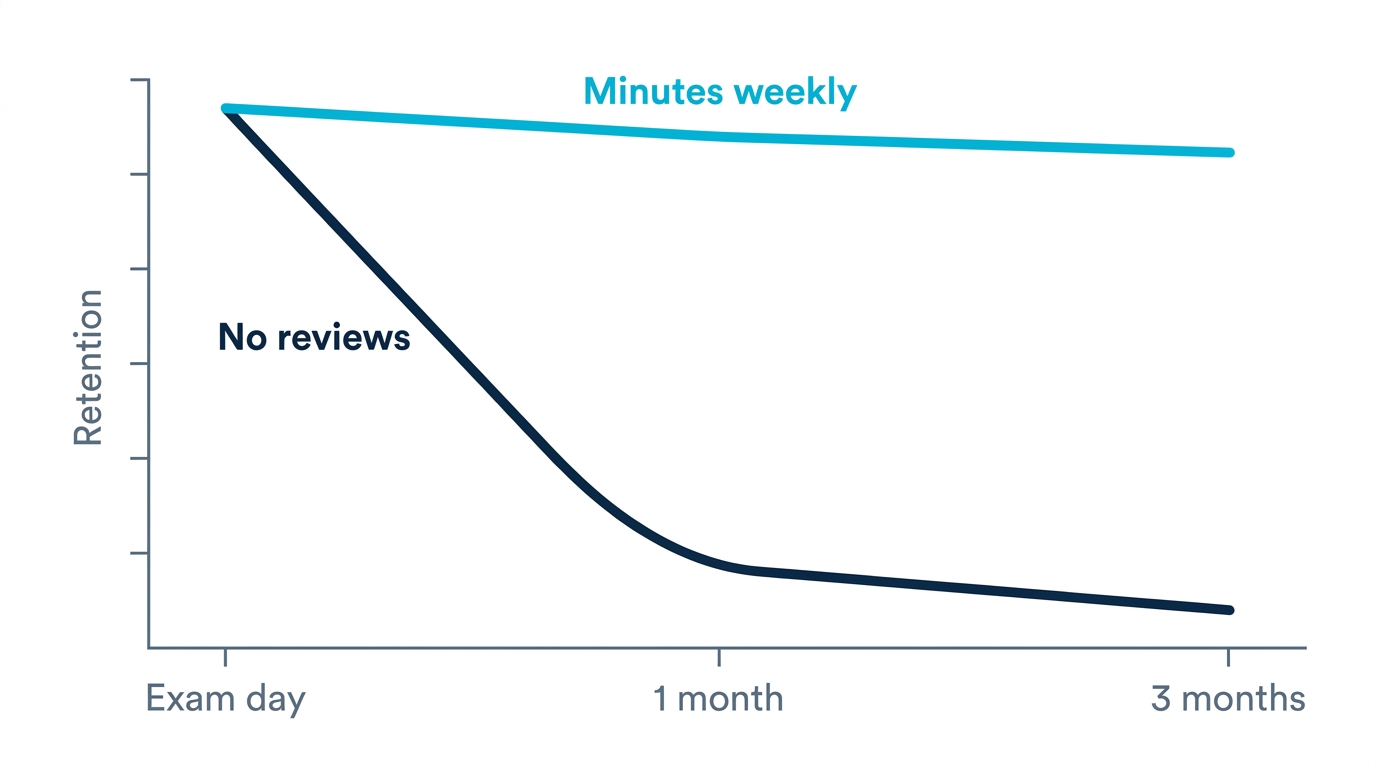
These diagrams illustrate an approach, not measured results. Review time and retention depend on deck size, difficulty, and recall accuracy. Minutes per week is an example for a small, familiar set, not an estimate for an entire qualification.
Well-learned material can allow longer review intervals
Here is the misconception: "keeping it all fresh sounds exhausting." The reality is the opposite. Once a memory is well consolidated, spaced repetition makes its upkeep cheaper and cheaper: intervals stretch to weeks, then months. Cepeda and colleagues' 2008 experiment points the same way: the longer you want to remember something, the longer the optimal gaps between reviews become.
In practice, the time you need depends on deck size, difficulty, and recall accuracy. Aim for manageable sessions focused on knowledge you expect to use. You spent hundreds of hours building a house of knowledge; choose a maintenance workload you can sustain. For the timing principle behind this, see The Best Time to Review: Just Before You Forget.
You do not have to keep everything: archive vs. maintain
Maintaining everything would cost more than it returns. Not all exam knowledge deserves maintenance. Trivia for a one-off internal test can be allowed to fade, guilt-free. The single question that decides: will this knowledge compound in my future work or my next qualification?
| Disposable studying | Studying for lasting use |
|---|---|
| Exam day is the finish line; reviews stop after passing | Exam day is a checkpoint; switch to maintenance mode |
| Knowledge exists only inside a workbook | Knowledge lives on as a card collection you own |
| The next certification restarts from the same basics | The next certification builds on maintained basics |
| At work: "I studied this..." then Google | At work: recalled on the spot |
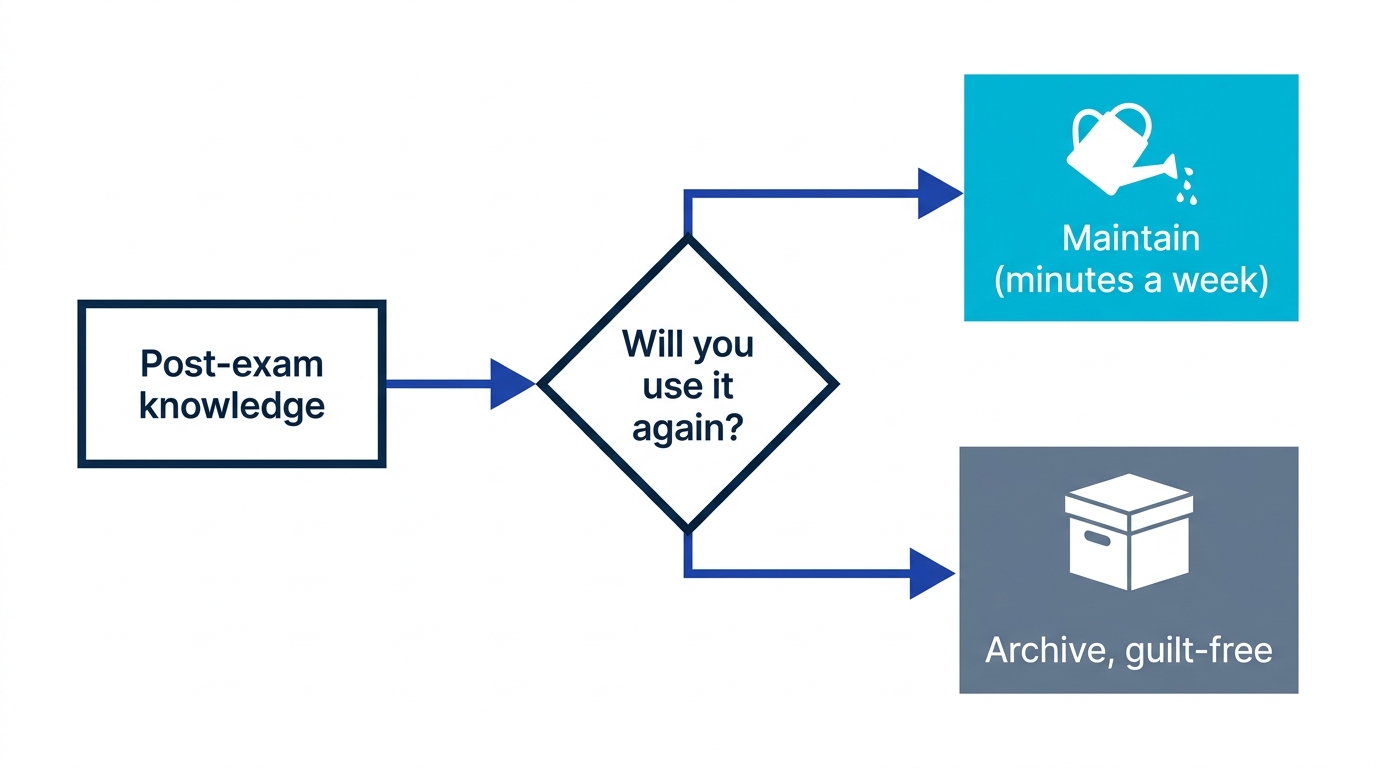
These diagrams illustrate an approach, not measured results. Review time and retention depend on deck size, difficulty, and recall accuracy. Minutes per week is an example for a small, familiar set, not an estimate for an entire qualification.
The row that stings is the last one. Everyone has said "I studied this" in a meeting and then quietly searched for it under the table. A nurse's physiology, a lawyer's statutes, an engineer's certification stack, a salesperson's product knowledge: these sit on the compounding side. We cover connecting exam knowledge to real work in Certification Exams and AI-Assisted Memorization.
Switching to maintenance mode: three moves the week after the exam
That week is when you least want to look at the deck, which is also when the sorting is cheapest: you still remember which cards were pointless.
- Sort the decks: keep cards for knowledge you will reuse; delete or archive exam-technique cards (question-format quirks and the like).
- Drop to maintenance pace: stop adding new cards and just answer what the algorithm schedules. It is a little busy right after the exam, and may become lighter as cards become more familiar. There is no fixed number of cards or weeks that applies to everyone.
- Merge in what work teaches you: add new on-the-job facts to the same decks, and exam knowledge grows into living professional knowledge.
Knowledge as an asset: the learning-loop view
Memorize-and-discard studying is building a house for every exam and demolishing it after the inspection. Maintained knowledge becomes scaffolding for the next thing you learn, so each qualification starts higher up than the last. This is the personal learning loop we described in Nadella's Learning Loop, Explained: the certificate is proof for other people; the maintained memory is capital that belongs to you.
How Memly supports review after an exam
- Adaptive review timing: FSRS adjusts the next review date using your answers. Well-recalled cards can receive longer intervals, while forgotten cards need more practice.
- Easy sorting: group useful knowledge into decks so you can choose what to review next.
- Upkeep fits in dead time: Web, iOS, and Android; fit a manageable review session into a commute.
For the full picture of AI-assisted memorization, see the pillar guide AI-Assisted Memorization: How It Works and the Best Tools.
Keep the certificate, or keep the knowledge too
Most people ride the post-exam relief straight out the door and never open the deck again. Years later, at the next career step, they open the same textbook at page one.
The week after your next exam, do one thing: spend 10 minutes sorting your deck, keeping only the cards your future self will use. That is the moment hundreds of hours of studying turn from disposable into an asset. Memly is free to try, no credit card required.
