


A recording preserves what was said. A flashcard asks you to retrieve one thing you need to know. The useful bridge between them is a checked transcript: record material you have permission to use, inspect what the transcription captured, and save only questions whose answers you can trace back to the source.
Start with a short, clear section rather than an entire lecture. In the worked example below, we uploaded an editorial audio file lasting about fifty-eight seconds to Memly, generated three English cards, reopened all three after saving, and checked a question and answer in the learning screen. The source was an original Japanese synthetic-voice demonstration, not a live class or a microphone recording test.
Before recording: choose the source and the question
Check the lecturer's and institution's recording and upload rules before capturing or sending course material to a service. Permission to listen to a class does not by itself establish permission to distribute its recording. If permission is unclear, use your own explanation of a concept and material you are allowed to share. Avoid capturing classmates' personal information in a test file.
Choose a section with a defined purpose: a short explanation of one mechanism, a worked example, or the conditions under which a rule applies. Write down the topic and source location while it is still easy to find. A file called "lecture-three.mp3" is less useful during correction than a note that identifies the example and where its explanation begins.
If you are making a new recording, make a brief test and listen to it before relying on the setup. Can you distinguish the speaker from background noise? Are names, symbols and numbers understandable? A transcript cannot recover a diagram that was never described aloud. Keep the relevant written source alongside the recording when you have permission to use it.
This article tests the upload of an existing MP3. It does not verify a particular phone recorder, browser microphone, classroom microphone, recording duration limit or supported format beyond the file used here. A successful short-file test is not evidence that every long or noisy lecture will work.
Transcribe first, then check the details that change meaning
Read the transcript while listening to the relevant passage. Concentrate on numbers, units, names, negation and conditions: "can" and "cannot" can produce opposite answers. If a passage is unclear, locate a clearer source or leave that card out until you can resolve it.
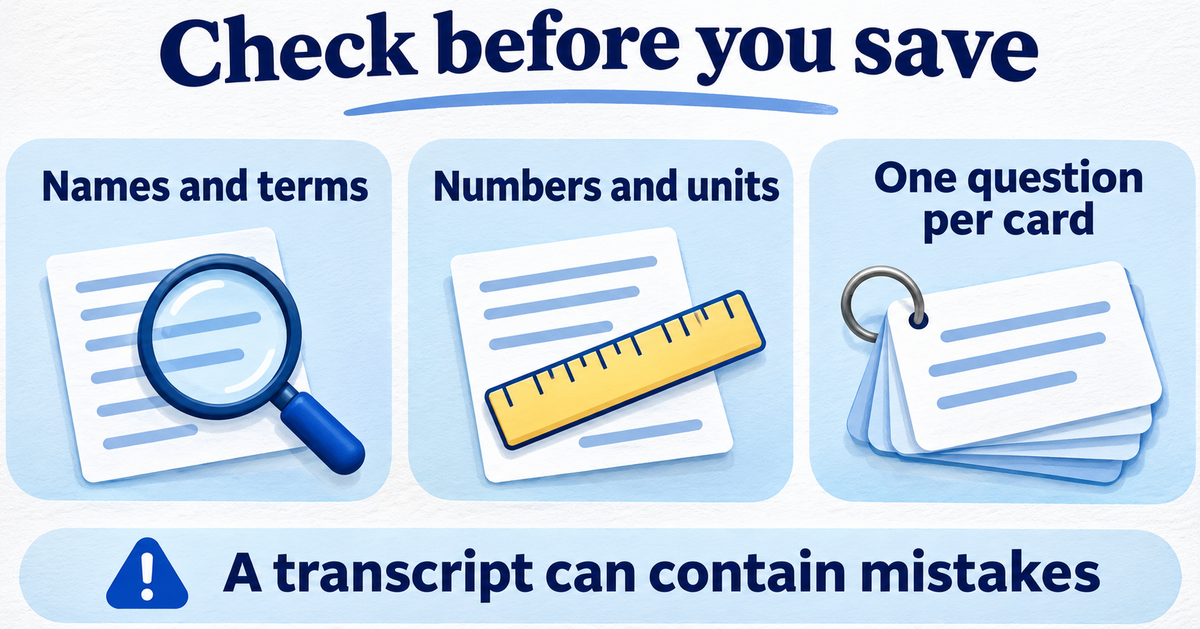
Do not treat grammatical text as evidence of correctness. An inaccurate term can still sit inside a fluent sentence. When your interface does not let you correct the transcript directly, keep a correction note and check the generated question and answer against the original. Do not silently promote a doubtful transcription into a fact you will later memorize.
For video captions and a separately tested direct YouTube URL workflow, see YouTube to flashcards. If you already have written notes, the lecture-notes workflow starts at the text-checking stage.
Our audio-to-card test: an original example of about fifty-eight seconds
On November 4, 2026, we used an editorially created Japanese MP3 about the difference between a mean and a median. Its fictional dataset was 10, 11, 12, 13 and 54. The total is 100, so the mean is 20; the middle value is 12, so the median is 12. The explanation also says that the median is not automatically the best representative value for every purpose.
The original MP3, original Japanese script and editorial English source notes are available for inspection. The script is the intended source, not an unedited export of the product's transcript. This is a simple arithmetic demonstration, not a dataset from students or a claim about learning outcomes.
- We opened Memly's audio-file generation flow and uploaded the existing MP3. The interface displayed a duration of fifty-eight seconds and produced a Japanese transcript.
- We compared the transcript with the original script. The numbers matched. One word did not: the source's Japanese word for "fictional" (架空) appeared as 下空. We retained this mismatch in our verification record rather than describing transcription as perfect.
- We requested three medium-difficulty cards in English, with an instruction to stay faithful to the source and cover the mean, median and difference between them.
- We inspected all three generated questions and answers against the original. The arithmetic and the qualification about choosing a representative value were preserved.
- We saved the three cards into a new editorial demo deck, returned through the deck list, reopened the deck and checked all three fronts and backs again.
- We opened the learning screen and revealed the answer to the question about why the mean and median differ. The saved explanation appeared correctly. We did not submit a self-rating as part of this verification.
The generated cards in this particular run needed no factual edits after comparison with the source. That does not mean future outputs should bypass review. The transcription error and the clean card answers are two separate observations; one does not cancel the other.
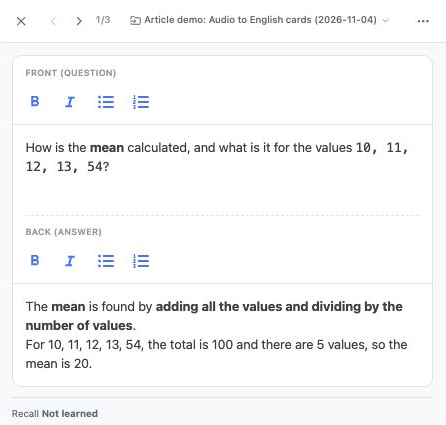
What made these three cards checkable?
The questions carried enough context to judge their answers. "What is the mean?" on its own could ask for a definition or the result of an unspecified dataset. The saved card asked how the mean is calculated and gave the exact five values. Its answer included both the operation and the result.
| Card focus | Source check | What to preserve |
|---|---|---|
| Mean | (10 + 11 + 12 + 13 + 54) ÷ 5 = 20 | The full dataset, total and number of values |
| Median | The third value of the five sorted values is 12 | The requirement to order the values and identify the middle |
| Difference | The value 54 pulls the mean upward | The qualification that the median is not universally the best summary |
For more complex material, a definition and worked calculation might deserve separate cards. The goal is a prompt you can diagnose: if the answer is wrong, you should be able to identify whether you forgot the definition, lost a condition or made a calculation error. See how to write good flashcards for revising broad questions.
A translated card needs the same comparison. In this test, Japanese input and English output preserved the arithmetic and qualification. That is a verified result for these three cards, not evidence of reliable translation across every subject or language. Check specialist terminology against an appropriate source before studying it.
Save a small set and try retrieval
After saving, reopen the cards from the deck list. This checks that you are looking at stored content rather than a generation preview. Read each front without exposing the answer and decide what a correct response must contain. Then reveal the back and compare your response with that standard.

If you could answer only because the wording hinted at the result, rewrite the front. If you can recite the answer but cannot explain the example, return to the source explanation. The purpose of a small first batch is to expose those problems before you generate a large deck with the same weakness.
Common questions
Can I turn an entire lecture into flashcards at once?
Our test covered a short MP3 only. For a longer recording, check the current product limits and start with a representative section. A larger generated set also creates more answers to verify and more material to review. Keep sections you can trace to their source instead of assuming a long upload produces a complete study plan.
What if the transcript misses a formula or diagram?
Do not guess from the surrounding sentence. Use the permitted written source, add the missing context yourself and check the resulting card. If the explanation depends on a visual that the audio does not contain, audio alone is an incomplete source.
Did this test include recording inside Memly or generating spoken review audio?
No. It used an existing editorial MP3, transcription, English card generation, saving, reopening and a question-and-answer display check. Microphone recording and generated spoken review audio are separate features and were not tested for this article.
Should I keep every generated card?
Keep the ones that match what you need to learn and have answers you can verify. Repair or set aside duplicates, unsupported details and ambiguous prompts. A smaller set with a clear source is easier to check than a large set whose errors are hidden by fluent wording.
To try the same bounded workflow, use Memly's card generator with the supplied original audio or a short recording you are permitted to upload. Check the transcript and each answer before saving your first small batch.
