


You play an audio course on every commute, and a month later you can barely recall a thing. That isn't a memory defect. It is the method: "just listening" is misaligned with how memory actually works. You can run an hour of audio every day and keep only a few percent of it by the next morning. That hour wasn't spent learning. It was spent watching yourself forget.
Used correctly, though, audio can transform retention. What makes the difference is not getting the material in through your ears. It is recalling while you listen. Three conditions decide which of those two commutes you get, and Memly's Review Radio was built around all three.
Short answer: passive listening on its own barely sticks, but audio learning works when it combines three things: recalling the answer as you listen (active recall), reviewing only what you're about to forget (spacing on the forgetting curve), and using your own material instead of a generic course. Get all three and review through your ears becomes powerful.
Why ordinary "passive listening" barely sticks
The weakness has nothing to do with sound. Listening receptively makes the brain feel like it has "processed" the information, but processing is not recalling. Memory is strengthened not when you put information in, but when you pull it back out. A pure listen-through skips the single most important step in retention: retrieval.
There is also a trap called the fluency illusion. When audio flows smoothly and you follow it easily, you feel like you "know" it. But that feeling tracks how easy the input was, not how much of it you could reproduce with the audio off. You feel confident the moment the track ends, and the next day nothing comes back. That is the classic failure mode of listening-only study.
"I'm an auditory learner" is not supported by science
People often say, "I'm an auditory learner, so audio works for me." But learning-styles theory, the idea that matching the input channel to your "type" improves results, has no solid supporting evidence. Pashler et al. (2008) reviewed the literature and found that the studies needed to validate the claim were essentially missing. Whether information arrives through your ears or your eyes is not the deciding factor for retention. What decides it is whether you recalled afterward.
Why retrieval, not the input channel, decides memory
What memory research confirms again and again is the power of retrieval practice (active recall). In Karpicke & Roediger (2008), groups that spent the same amount of time testing themselves retained far more on a delayed test than groups that simply reread the material. Rereading is easy but weak; recalling is effortful but strong.
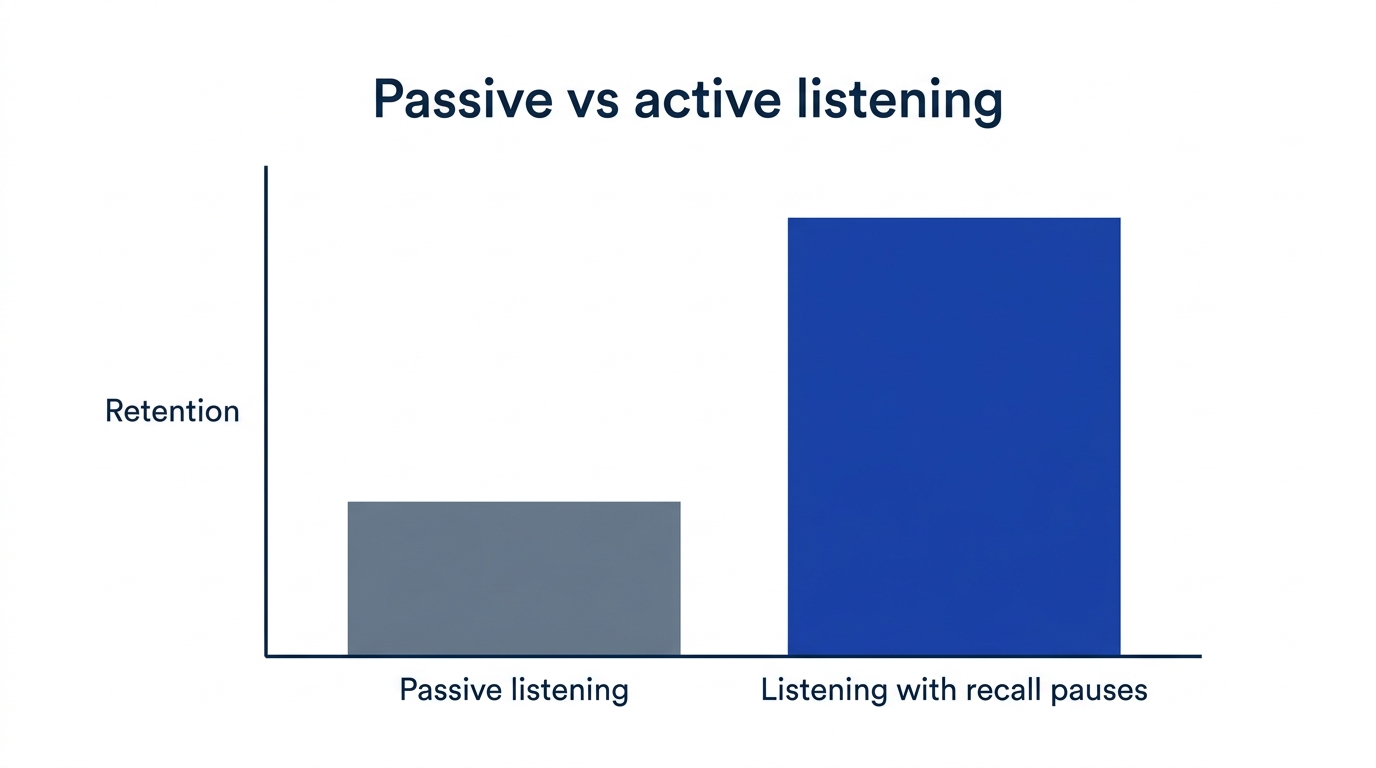
Dunlosky et al. (2013) went further, ranking common study techniques by usefulness and placing practice testing (retrieval) and distributed practice in the highest-utility group. The techniques most learners lean on, such as rereading, highlighting, and summarizing, were rated low. Mapped onto audio, passive listening behaves like rereading, while recalling as you listen behaves like practice testing.
Saying it out loud makes it even stronger
Pulling the answer out of your head is good; saying it aloud is better. MacLeod et al. (2010) described the production effect: words read aloud were remembered better than words read silently. Their account is distinctiveness. A word you produced carries an extra trace that a silently read word does not, which gives recall another route back in. That is why a "say the answer before you hear it" habit pays off in audio review.
The forgetting curve: when you review changes the result
The other axis is timing. As Ebbinghaus (1885) showed with the forgetting curve, memory decays rapidly when it is not reviewed. But if you recall something just as it begins to fade, the decay flattens and retention lasts much longer.
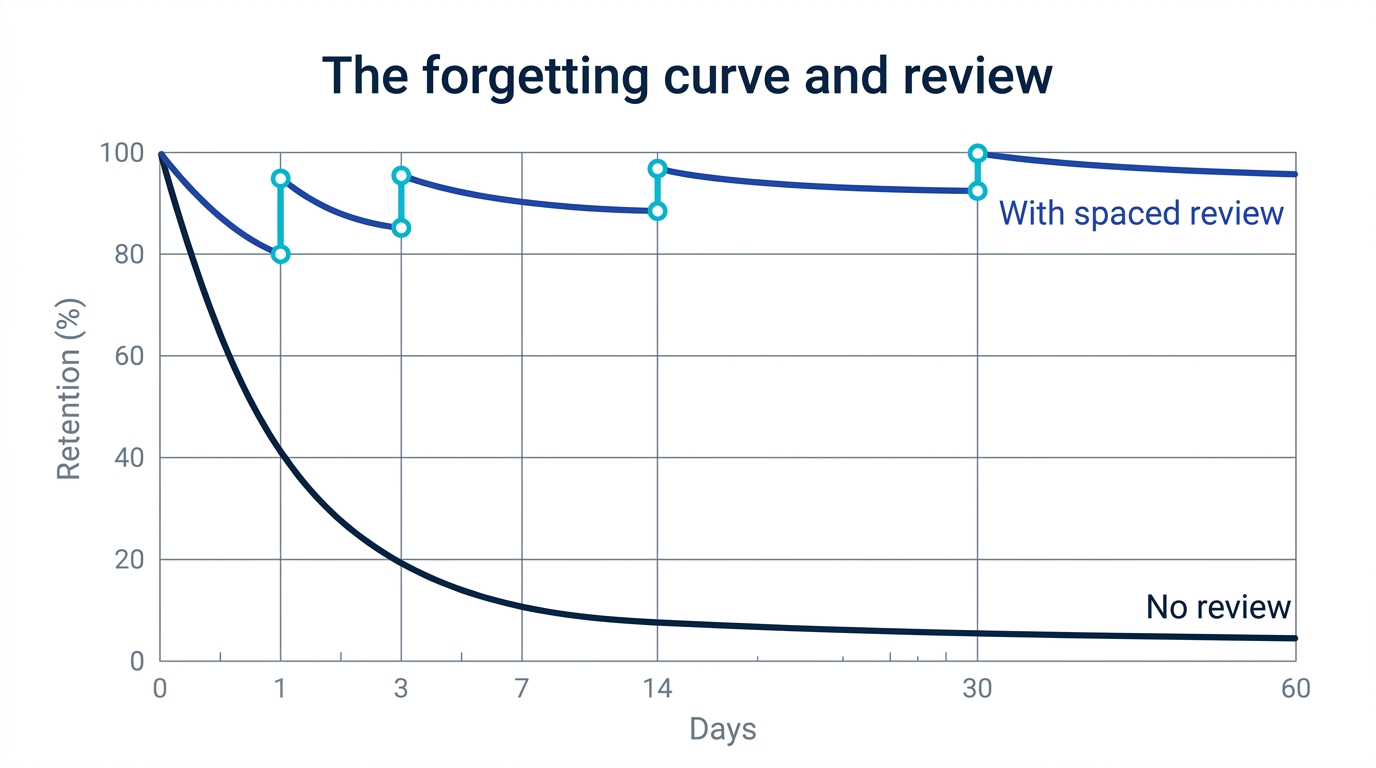
And as Cepeda et al. (2008) demonstrated, for the same total study time, spacing the sessions out produces substantially better long-term retention than massing them. The gap comes from where each review lands. A spaced review arrives once the answer has started to fade, so retrieving it takes effort; a massed review arrives while the answer is still sitting in mind, so there is nothing to retrieve. With audio too, replaying the same material every time is far less efficient than listening only to what's due today, at the right interval.
The three conditions that make audio learning work
Three conditions separate the audio hour that pays from the one that only feels productive.
| Condition | Why it matters | Without it… |
|---|---|---|
| Retrieval (active recall) is built in | Memory strengthens when you recall (Karpicke & Roediger 2008) | Passive listening leaves almost nothing behind |
| Spacing: you review what you're about to forget | Recalling on the steep part of the forgetting curve extends retention (Cepeda 2008) | You replay what you already know, and the session earns nothing |
| It's your own material | Targets your specific weak spots, unlike generic courses | Time drained on information you don't need |
The inverse is just as telling. Audio learning that lacks all three (generic material, played on a loop, without recalling, including the parts you already know) is the lowest-yield study you can do per minute. That is exactly where most "study while you do something else" attempts break down. For where these techniques rank among study methods overall, see 5 scientifically proven study methods.
How Review Radio meets these 3 conditions
Memly's Review Radio is an audio-review feature designed to satisfy exactly these three conditions.
- Retrieval is built in: before a host reveals the answer, the episode leaves a short pause for you to recall it. That makes it active recall, not passive listening.
- It handles only what you're about to forget: episodes prioritize cards with falling retrievability, overdue cards, and cards you've missed repeatedly. The logic of spaced repetition rides along automatically.
- It's made from your own material: episodes are built from the facts on the cards you created (or that the AI generated for you), not from a generic course.
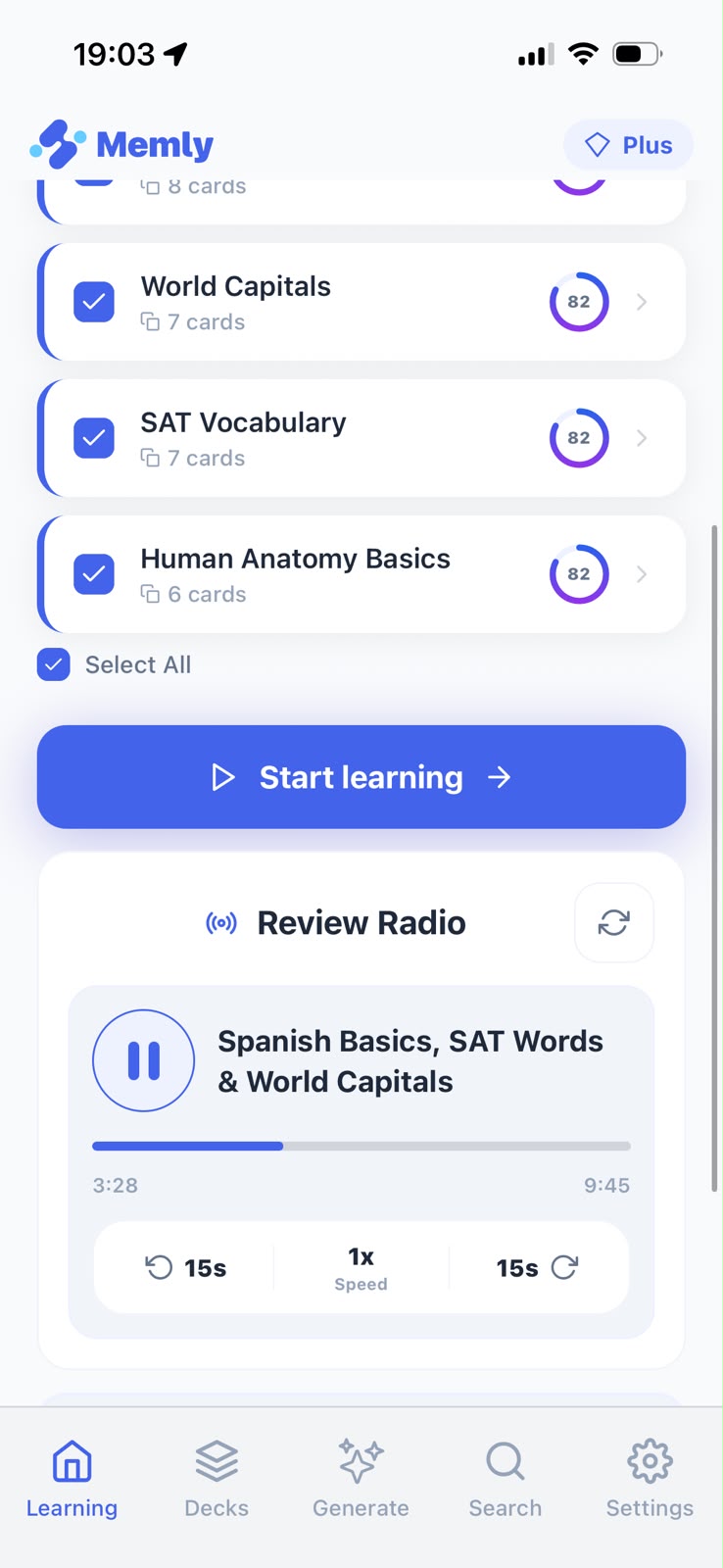
Review Radio therefore breaks the "audio equals weak learning" assumption by building retrieval and spaced repetition directly into the audio. For how the feature works in detail, see what Review Radio is; for the bigger picture of AI-powered memorization, see what AI-powered memorization is.
Frequently asked questions
So does audio learning actually work?
It depends on the conditions. Passive listening is weak. But when three conditions hold, audio becomes an effective way to review: (1) you recall while you listen, (2) you space your reviews and target what you're about to forget, and (3) you use your own material.
Is it true that "auditory learners" do better with audio?
The learning-styles claim, that matching input to your "type" improves results, has no solid scientific support (Pashler et al. 2008). Whether audio works for you isn't about a "type"; it's about whether a recall step is part of the listening.
Does listening at higher speed improve efficiency?
Within the range you can still understand, yes, it saves time. But if it's so fast you can't process the content, there's no room left to recall and the effect drops. The optimal speed is one where you can both follow along and pull up the answer.
Should I review with audio or on screen?
You don't have to pick one. When you can sit at a desk, do focused on-screen review; when your hands are busy, use audio. What matters isn't the channel. It is how many times you recall.
Does saying the answer out loud make a difference?
Yes. The production effect (MacLeod et al. 2010) shows that material you produce aloud is remembered better than material read silently. With audio review, saying the answer in the recall pause before the host reveals it adds an extra layer of strengthening.
The bottom line: audio's weakness was "not recalling"
Audio learning doesn't fail because it's audio. It fails because passive listening drops the act of recalling. Retention is decided by retrieval rather than by input channel, and once you add spaced repetition and your own material on top, review through your ears becomes a powerful tool.
Most people who read this will go right back to "just playing" a generic course tomorrow. The ones who change will try a single thing today: recall the answer before they hear it. That alone transforms how much the same commute is worth. Memly's Review Radio builds that recall pause into the episode from the start. No credit card required, and it's free to start. To see it in action, read how Review Radio turns your due cards into a hands-free episode, or, if you already use NotebookLM, see turning your review into a personal study podcast.
References
- Dunlosky et al. (2013). Improving Students' Learning With Effective Learning Techniques. Psychological Science in the Public Interest.
- Karpicke & Roediger (2008). The Critical Importance of Retrieval for Learning. Science.
- Cepeda et al. (2008). Spacing Effects in Learning: A Temporal Ridgeline of Optimal Retention. Psychological Science.
- Pashler et al. (2008). Learning Styles: Concepts and Evidence. Psychological Science in the Public Interest.
- MacLeod et al. (2010). The Production Effect: Delineation of a Phenomenon. Journal of Experimental Psychology: Learning, Memory, and Cognition.
- Ebbinghaus (1885). Memory: A Contribution to Experimental Psychology.
