


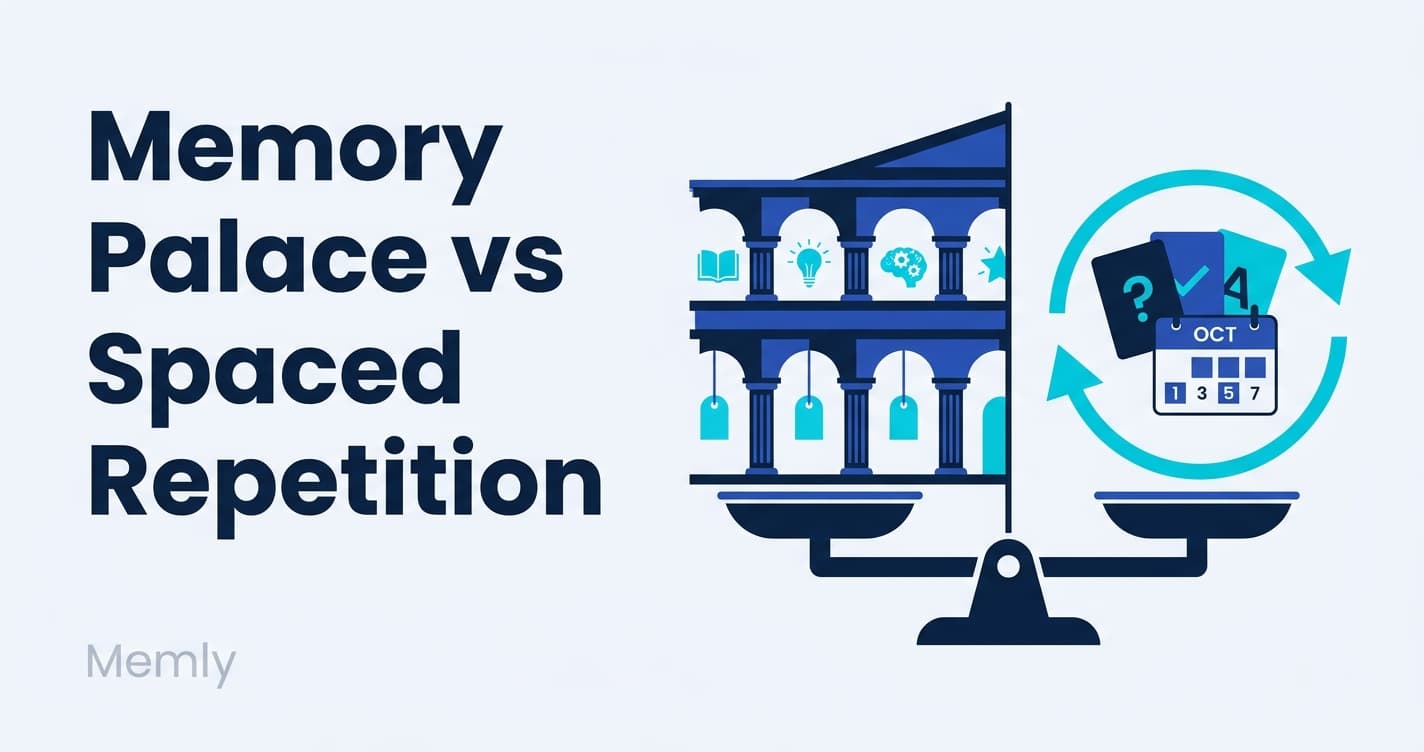
A memory palace and spaced repetition solve different problems. A palace links items to imagined locations, which can help organise recall; spaced repetition helps you revisit material over time. Start with what you need to remember and for how long, then decide whether to use either method or combine them.
The question worth asking is not which one is better. It is which knowledge you assign to which tool.
The short version: ordered, low-volume information, like the structure of a speech or the steps of a procedure, is memory palace territory. The mass of question-and-answer knowledge that makes up most exams belongs to spaced repetition. And the part almost nobody mentions: things you store in a memory palace still fade without review. The strongest setup is mnemonics to make things memorable, spaced repetition to keep them.
What a memory palace is, in three steps
- Pick a place you know deeply: your home, your commute, anywhere you can walk through with your eyes closed.
- Turn each item into an image: vivid, moving, slightly ridiculous images stick best.
- Place the images along a route: first item at the front door, second in the hallway. To recall, you mentally walk the route.
This is how memory athletes memorize shuffled card decks in minutes. The technique is real. The problem is that exam knowledge is mostly not shaped like a deck of cards.
What the palace is good at, and what it is not
| Type of knowledge | Examples | Right tool |
|---|---|---|
| Ordered, low-volume information | Speech outlines, procedures, lists | Memory palace |
| High-volume paired knowledge | Terms and definitions, dates and events, drugs and mechanisms | Spaced repetition |
| Stubborn trouble spots | Confusable numbers, similar-sounding terms | Mnemonic + spaced repetition |
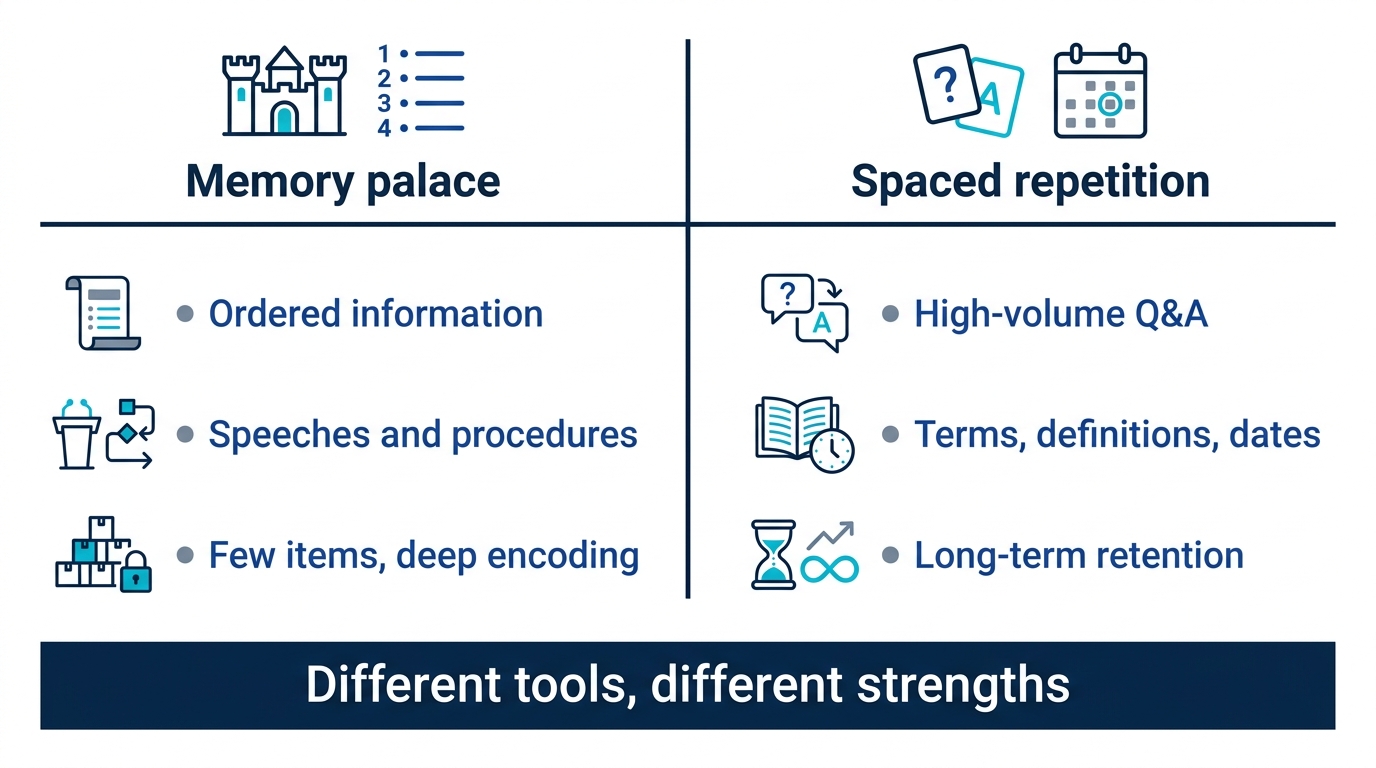
Most exam knowledge is question-and-answer shaped: you are shown a cue and must produce an answer. Turning hundreds or thousands of such facts into individual images placed in imaginary rooms is not realistic to build or to maintain. The memory palace is powerful, but it does not scale with volume.
Why spaced repetition is the workhorse of exam prep
The thousands of items a palace cannot hold still have to live somewhere.
In Dunlosky's large 2013 review of study techniques, the two winners were practice testing (retrieval practice) and distributed practice (spacing): recalling things from memory, at spaced intervals. Spaced repetition flashcards are simply those two findings turned into software.
For high-volume Q&A knowledge, the cost per item is far lower than image-crafting. No scene design, no route maintenance; make the card, and it comes back to you right around the time you would forget it. If you want the deeper reason why passively reviewing material fails, see Why You Forget What You Read.
The part nobody tells you: palace memories fade too
Images in a memory palace decay along Ebbinghaus's forgetting curve like everything else. Memory athletes do not retain competition digits a week later, and they do not try to. What a mnemonic strengthens is the moment of encoding. Extending how long a memory lasts still requires repeated retrieval.
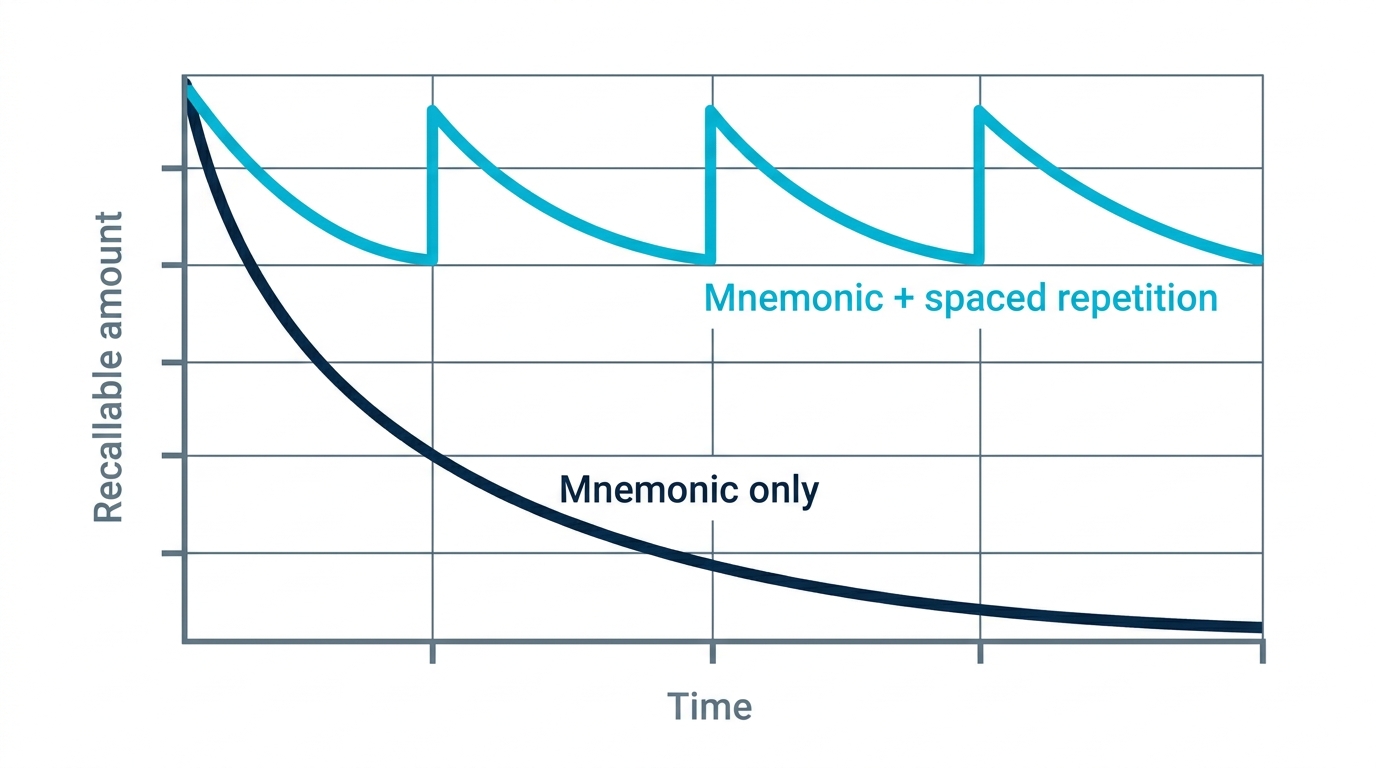
So "memory palace or spaced repetition" is a false choice. They do different jobs. Mnemonics are an encoding tool (make it memorable); spaced repetition is a retention tool (keep it from fading). For when to schedule those reviews, see The Best Review Timing, Based on the Forgetting Curve.
The combined workflow: mnemonics only where they earn their keep
- Turn everything into cards first: spaced repetition is your main force and handles 90% of the material.
- Craft images only for cards you keep failing: confusable numbers, look-alike terms, the spots you cannot get past. Write the image or mnemonic on the answer side of the card.
- Let the algorithm run: mnemonic cards and plain cards alike get resurfaced just before you would forget them.
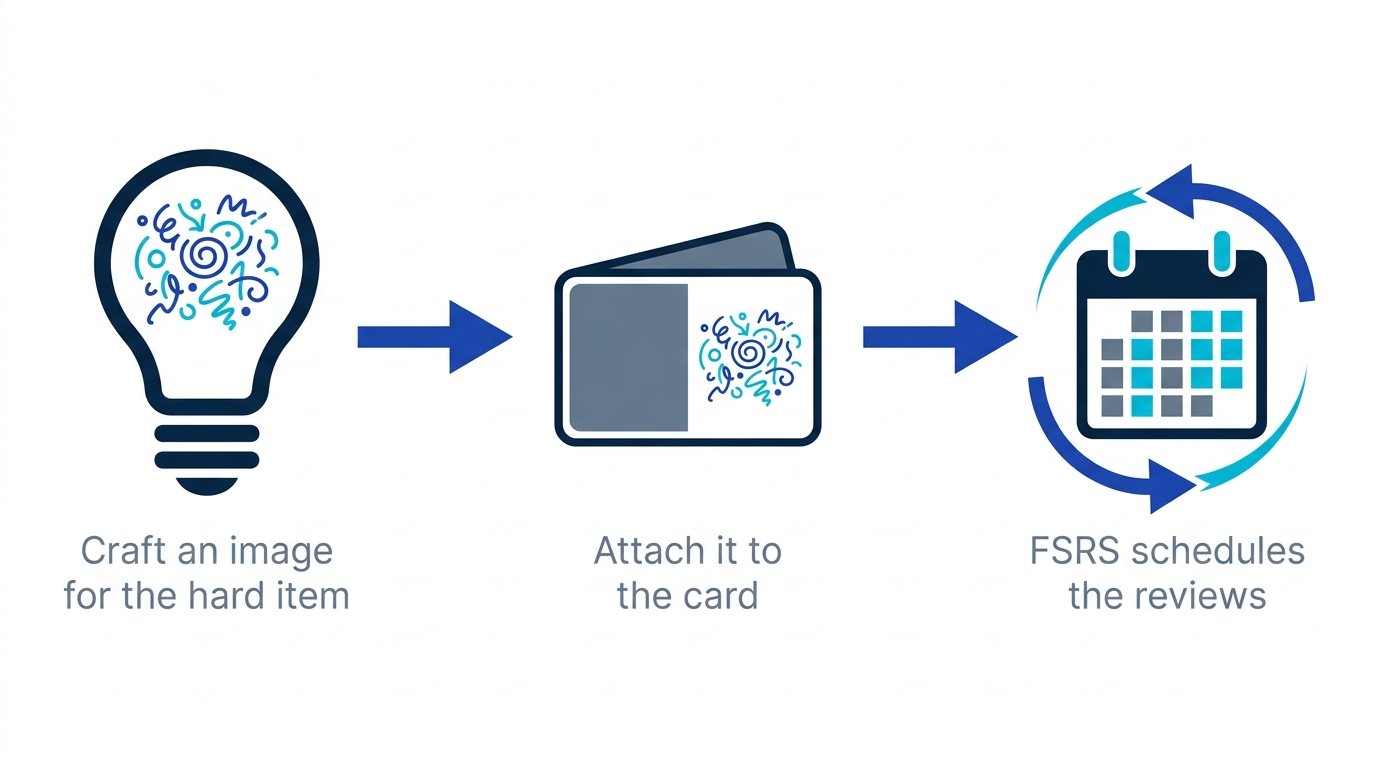
This gets you the encoding power of mnemonics and the staying power of spaced repetition, without the impossible project of imagining your entire textbook into a mansion.
Memly handles the retention half for you
- AI makes the cards: photograph textbook pages or notes, or upload PDFs and text, and AI generates question-and-answer cards. Add your mnemonic to the answer side where needed.
- FSRS schedules the reviews: cards you keep missing come back sooner, cards you know stretch out. Your stubborn cards surface themselves, which tells you exactly where a mnemonic is worth crafting.
- Web, iOS, and Android: the palace lives in your head, but your reviews can happen anywhere.
For the full picture of AI-assisted memorization, see the pillar guide AI-Assisted Memorization: How It Works and the Best Tools.
Give the palace the short list, give the cards the rest
Choose a small set of material and match the method to the job. An ordered list can be a useful memory-palace experiment; a collection of facts you need over time can become a spaced-review deck. Check recall later before expanding either system.
Do one thing today: turn one page of whatever you are studying into cards, then craft one ridiculous image for the single hardest card. You will feel encoding and retention click together on that one card. Memly is free to try, no credit card required.
