


You wrote out your interview answers word for word and memorized the script. Then, in the real interview, the first phrase slipped, and everything after it went blank. The same thing happens with speeches and presentations: the more perfectly you memorize a script, the more completely it collapses when a single word goes missing, taking all those rehearsal hours with it.
The cause is not nerves. It is the memorization format. Word-for-word memorization builds one long chain, and when any link breaks, nothing beyond it is reachable.
The short version: memorize the skeleton, 3 to 5 keywords that carry the argument, not the script. Order is what matters in a skeleton, and this is the one arena where the memory palace genuinely shines. Then rehearse by delivering from the skeleton (eventually from nothing), spaced over several days, not by reading the script twenty times the night before.
Why word-for-word scripts fail on stage
The natural response to a collapse is to rehearse the script harder. That makes both of its failure modes worse.
- They are serial chains: each sentence is connected only to "the next sentence". Forget one link under pressure and there is no other route forward; the chain snaps.
- They make you robotic: recall becomes a playback button. You stop reacting to the interviewer or the audience, and the moment a question is phrased slightly differently, the memorized answer no longer fits.
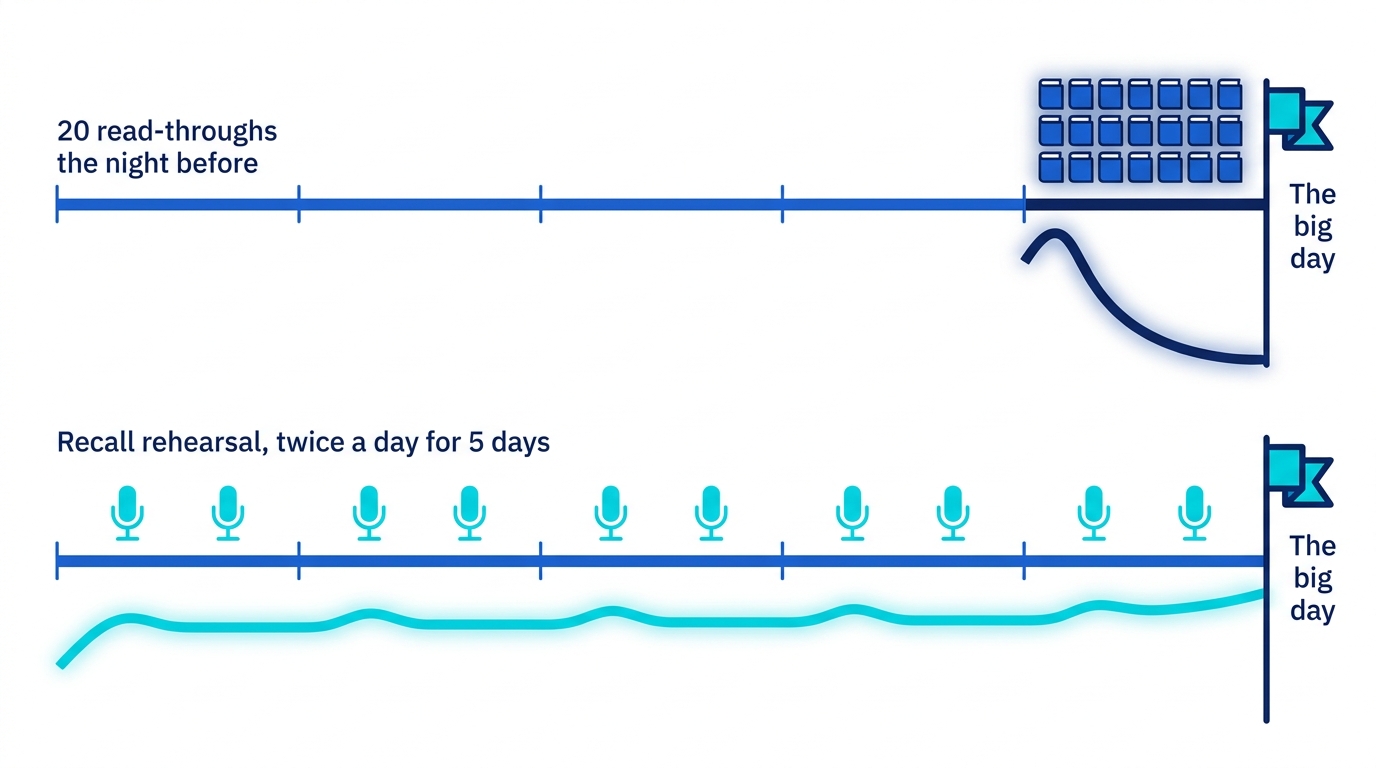
Worse, reading the script twenty times the night before is rereading, the exact technique Dunlosky's 2013 review rated among the least effective. Each pass makes the script feel smoother (the fluency illusion), but the ability to speak without notes is only built by practicing speaking without notes.
Memorize the skeleton: compress to 3-5 keywords
First change what you memorize. For an interview answer, extract the keywords that carry the structure: conclusion, supporting episode, lesson, connection to the job. For a talk, the keywords are your section headlines.
| Method | Amount to memorize | If one piece slips | Delivery |
|---|---|---|---|
| Word-for-word script | Hundreds to thousands of words | Everything after it is gone | Robotic; brittle to reworded questions |
| Skeleton (3-5 keywords) | A few words per topic | Recover from the next keyword | Your own words; adapts on the fly |
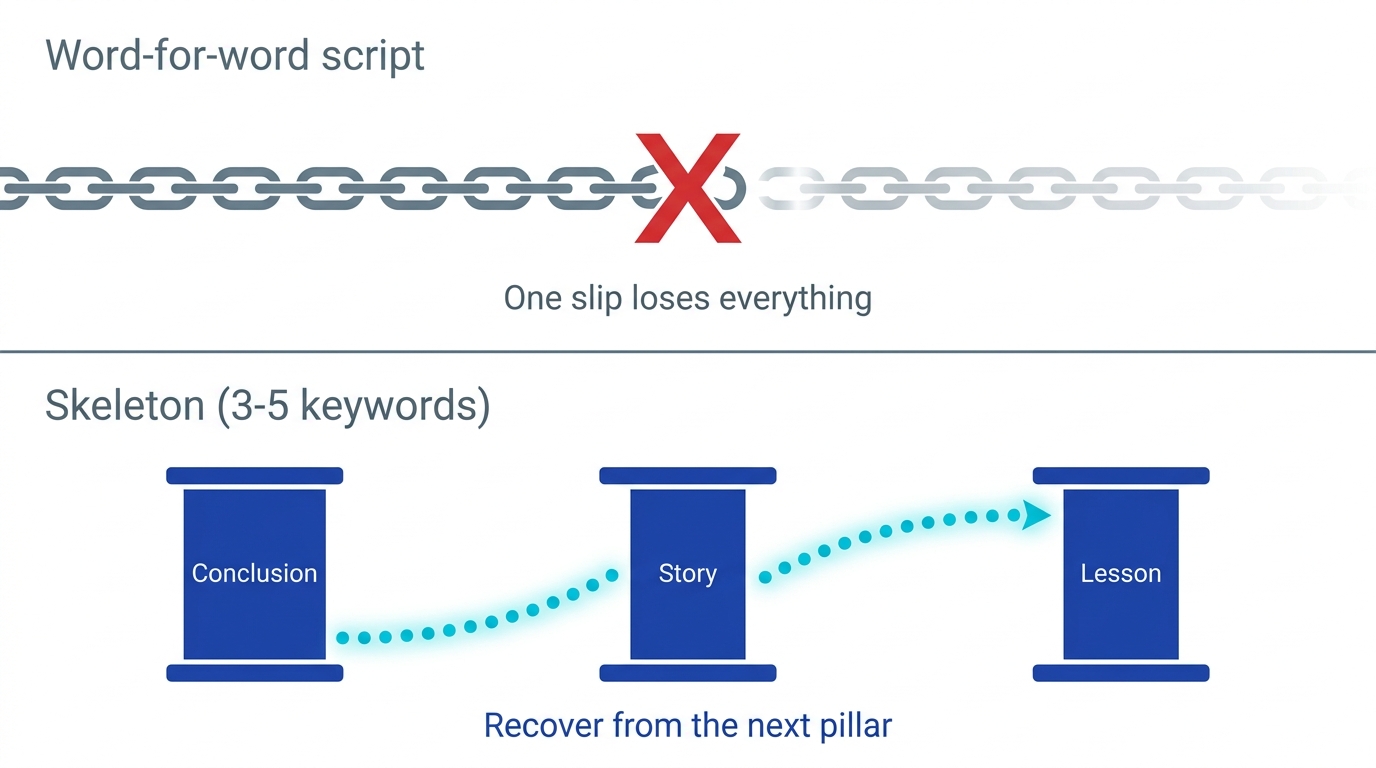
The sentences themselves get built on the spot, flesh on the skeleton. The slight variation each time is not a defect; it is what makes you sound like a person talking rather than a recording playing.
Store the order in a memory palace
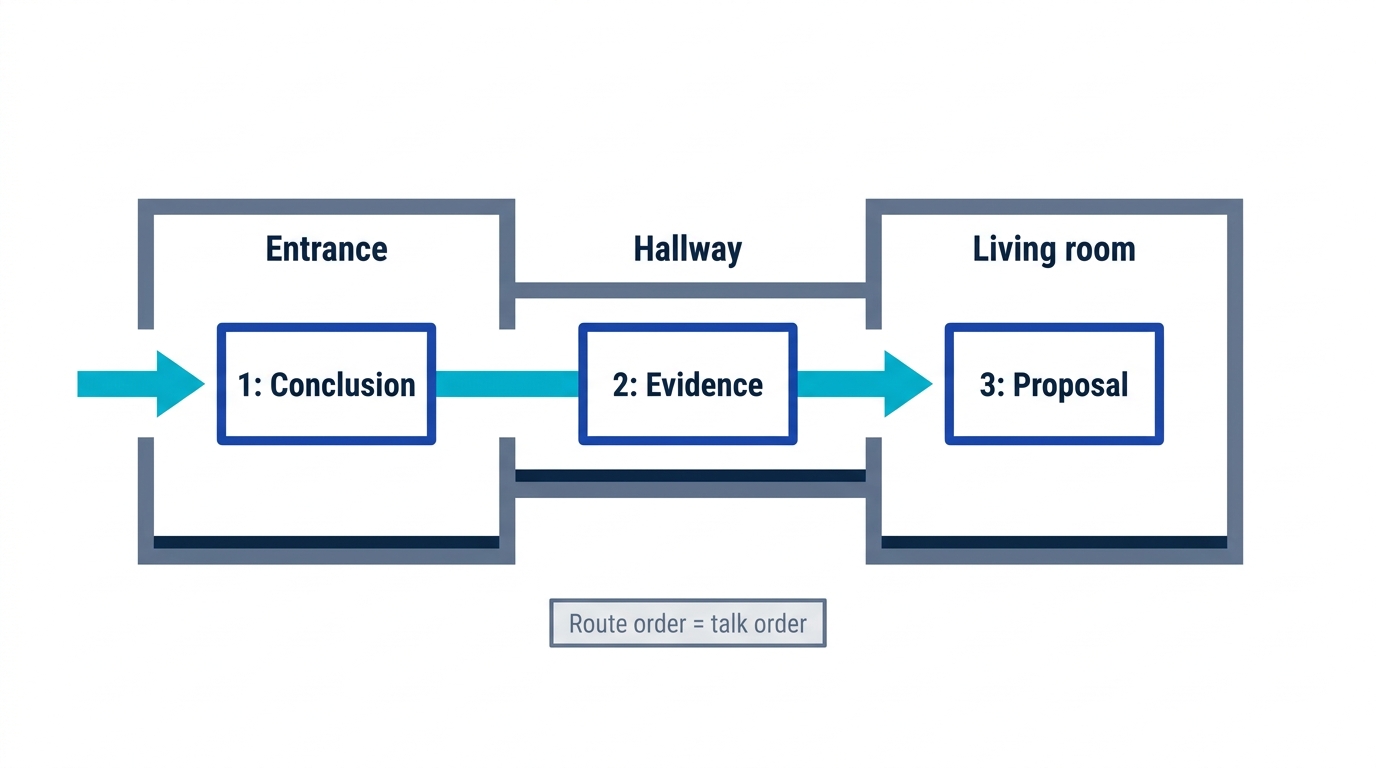
The one real risk with skeletons is forgetting the order of the beats. This is where the memory palace (method of loci) earns its reputation. Place one vivid image per keyword along a route you know cold: front door, hallway, living room. The route holds the order for you, so "what comes next?" becomes "what did I put in the next room?" A short, ordered list is exactly the material the palace handles best, as we covered in Memory Palace vs Spaced Repetition.
Rehearse as recall, spaced over days
Changing what you memorize buys nothing if rehearsal is still twenty read-throughs.
- Pass 1: deliver while looking at the skeleton: get the feel of building sentences on the beats. Recording yourself helps.
- Pass 2 onward: deliver with the skeleton hidden: check only the keywords you failed to recall. That retrieval effort is what actually installs the talk.
- Spread passes across days: not twenty times the night before but twice a day for five days. Cepeda et al.'s (2006) meta-analysis shows the same number of repetitions lasts far longer when spaced.
For interviews: question-to-skeleton cards
Interviews differ from speeches in one way: there are dozens of possible questions. That is flashcard territory. Front: the expected question. Back: the skeleton keywords, not the script. Reviewing them is a miniature of the real thing: see the question, recall the beats, flesh them out aloud.
- Paste your prepared Q&A document or upload the PDF to Memly, and AI converts it into question-and-skeleton cards.
- FSRS spaced repetition resurfaces the answers you are shakiest on, keeping every question recallable through interview day.
- Web, iOS, and Android: rehearse question-to-skeleton in your head on the train.
For the full picture of AI-assisted memorization, see the pillar guide AI-Assisted Memorization: How It Works and the Best Tools.
Throw away the script, build the skeleton
Most readers will still go back to the full script, because a script feels safe: it is all written down. That safety evaporates the moment the first phrase slips and the room is waiting for the second. A skeleton has no link to break: lose a beat and the next one is still there.
One action today: take your most important expected question, compress the answer to three keywords, and deliver it once without looking at anything. Memly is free to try, no credit card required.
