



You can finish today's new cards and still be creating a workload you cannot finish next week. To decide how many new flashcards to study a day, budget for the cards already due, then test a small new-card allowance against the work that comes back.
There is no universal daily number. A useful starting limit is the amount that fits after existing reviews, answer checking and a buffer—not the largest deck you can generate. The calculations below are original planning examples. They use invented timings and follow-up dates, not learner data, a memory forecast or an Anki/FSRS simulation.
Count introductions, attempts and minutes separately
A new card is a question you encounter for the first time. A review attempt is another encounter with a question you have seen before. One card can produce several attempts, especially while you are learning it or correcting an error. Card creation is a fourth quantity: writing or checking a question can take time before you ever study it.
This distinction matters when comparing two days. Introducing ten new vocabulary cards and reviewing forty familiar ones is different from introducing ten long clinical explanations. The card count may match while the reading, reasoning and checking time differs. Count the work you actually do, including the time spent looking up an answer you could not explain.
| Record | What it tells you |
|---|---|
| New cards first seen | How much new material entered your study routine |
| Later attempts | How often earlier material returned |
| Elapsed study minutes | Whether the work fitted your available time |
| Creation and repair minutes | Work that a simple review counter may miss |
If your app reports a count, check its definition before using it as a productivity score. Our retention-rate guide explains why counting all attempts and counting the first attempt per card can answer different questions.
Start with the time that remains today
Imagine a fictional thirty-minute session. Existing reviews need twenty minutes, and you reserve five minutes for corrections or interruption. Five minutes remain for new material. Those numbers are assumptions to illustrate a budget; they are not recommended timings for every learner.
New-material minutes = max(0, available minutes − existing-review minutes − buffer)
Example: max(0, 30 − 20 − 5) = 5 minutes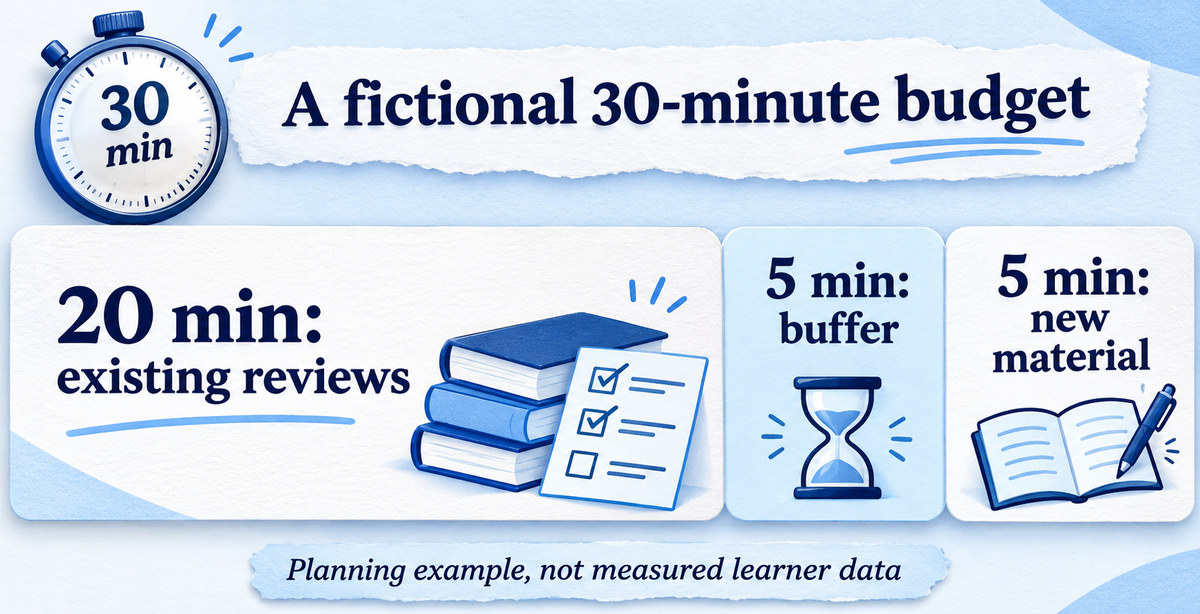
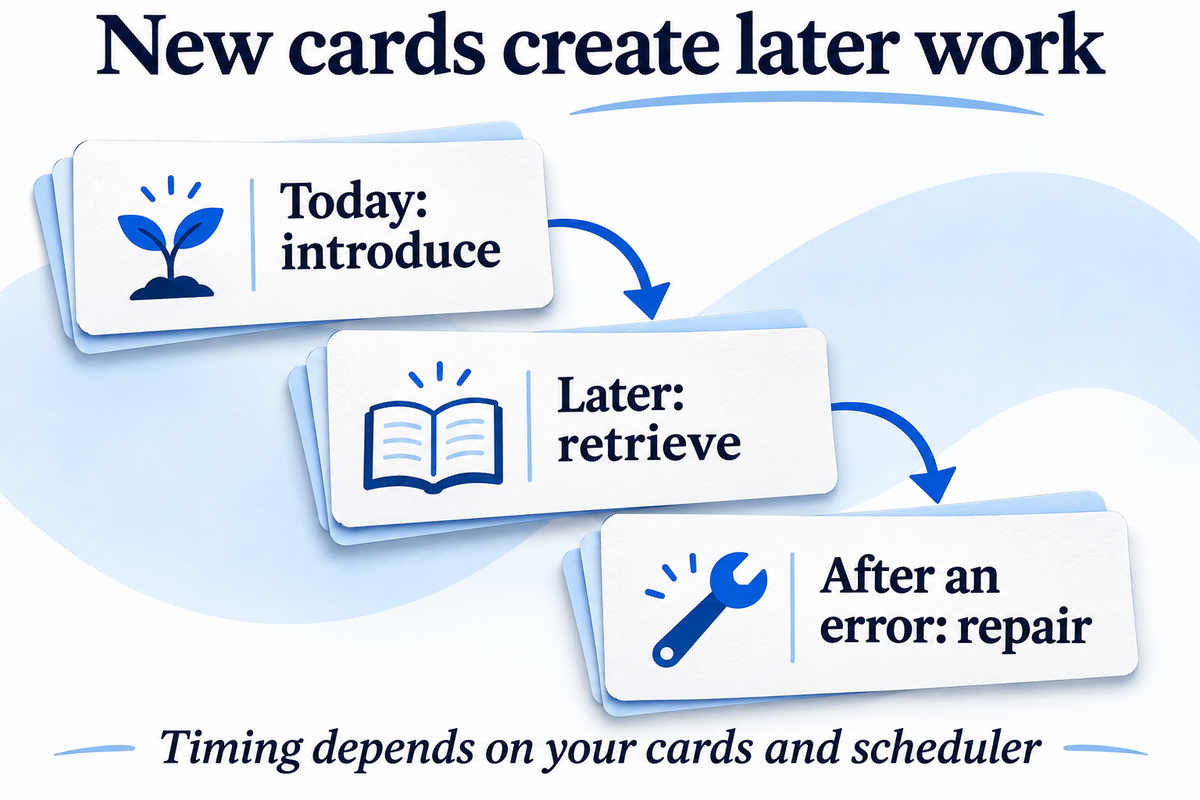
If the initial work for one new card took thirty seconds, five minutes could fit ten cards. At sixty seconds each, it would fit five; at ninety seconds, it would fit three complete cards. This is only today's capacity. It does not pay for the later attempts those cards will create, and it assumes the cards are already prepared.
Use elapsed work rather than the speed of clicking the answer button. If you spend two minutes understanding a diagram and another minute fixing its question, those three minutes belong in the budget. If you have only five minutes available in total, an honest session may contain reviews and no new material at all.
The review-load math: yesterday's cards return
To make the accumulation visible, consider a deliberately simple twenty-eight-day model. You introduce the same number of cards every day. Each new card takes sixty seconds of initial work. Each returns once at one, three, seven and fourteen days after introduction, and each later attempt takes twenty seconds.
These four follow-up dates are invented for arithmetic. They are not a recommended schedule and do not reproduce Anki, FSRS or Memly. Every attempt succeeds. There are no missed days, extra same-day attempts, existing backlog or card-writing time. The model also stops after four follow-ups, so it cannot estimate long-term maintenance.
For ten new cards a day, day one contains only ten minutes of initial work. On day two, the first group returns: ten new cards plus ten later attempts take thirteen minutes and twenty seconds. By day fifteen, four earlier groups return that day. Ten new cards plus forty later attempts take twenty-three minutes and twenty seconds.
| New cards each day | Day 1 minutes | Day 15 later attempts | Day 15 total minutes |
|---|---|---|---|
| 5 | 5.0 | 20 | 11.7 |
| 10 | 10.0 | 40 | 23.3 |
| 20 | 20.0 | 80 | 46.7 |
Minutes are rounded to one decimal in this table. For example, the last cell is (20 × 60 + 80 × 20) ÷ 60 = 46⅔ minutes. The same daily totals persist through day twenty-eight under these fixed assumptions. They are not a claim that a real deck stabilizes on day fifteen.
The lesson is the accounting, not the multiplier. A first day with twenty new cards can look manageable because no earlier groups have returned yet. A more realistic plan asks what happens when new work and returning work share the same session. If your material needs more attempts or takes longer, this particular table will understate your work.
You can inspect every day in the twenty-eight-day example CSV and reproduce it with the Python calculation. The script uses only Python's standard library. Its assumptions file lists what is omitted. Change the inputs to explore arithmetic scenarios, while keeping them separate from a prediction of your own learning.
Use a short observation period to choose your limit
A daily limit is a planning control you can revise. Choose a small trial amount that fits the time left after reviews. Then record several ordinary days before increasing it. A week can reveal an immediate overload; it is still too short to establish the eventual workload of a growing deck.
- Write down the minutes you can actually use today, including other course work you must finish.
- Complete or assess the existing review workload before admitting more new cards.
- Keep the trial amount small enough that you can check answers and repair confusing prompts.
- Record new cards, elapsed review time and any work you left unfinished.
- Recheck the limit as older groups return, after a missed day, and when the subject changes.
Use the blank seven-day worksheet for your own observations. It contains no example learner records. Track card creation separately, then subtract that time from the same overall study budget if you create and study cards in one session.
If reviews are repeatedly unfinished, reduce or pause new introductions. If you consistently finish with time to check difficult answers, a small increase may be worth testing. Avoid treating a single unusually easy session as evidence that you can permanently double the workload.
What Anki's daily limit does—and does not do
Anki's official deck-options manual describes New Cards/Day as a limit on introductions. It is not a limit on total study minutes. Review limits are separate, and limiting the number displayed does not mean the remaining due work disappeared.
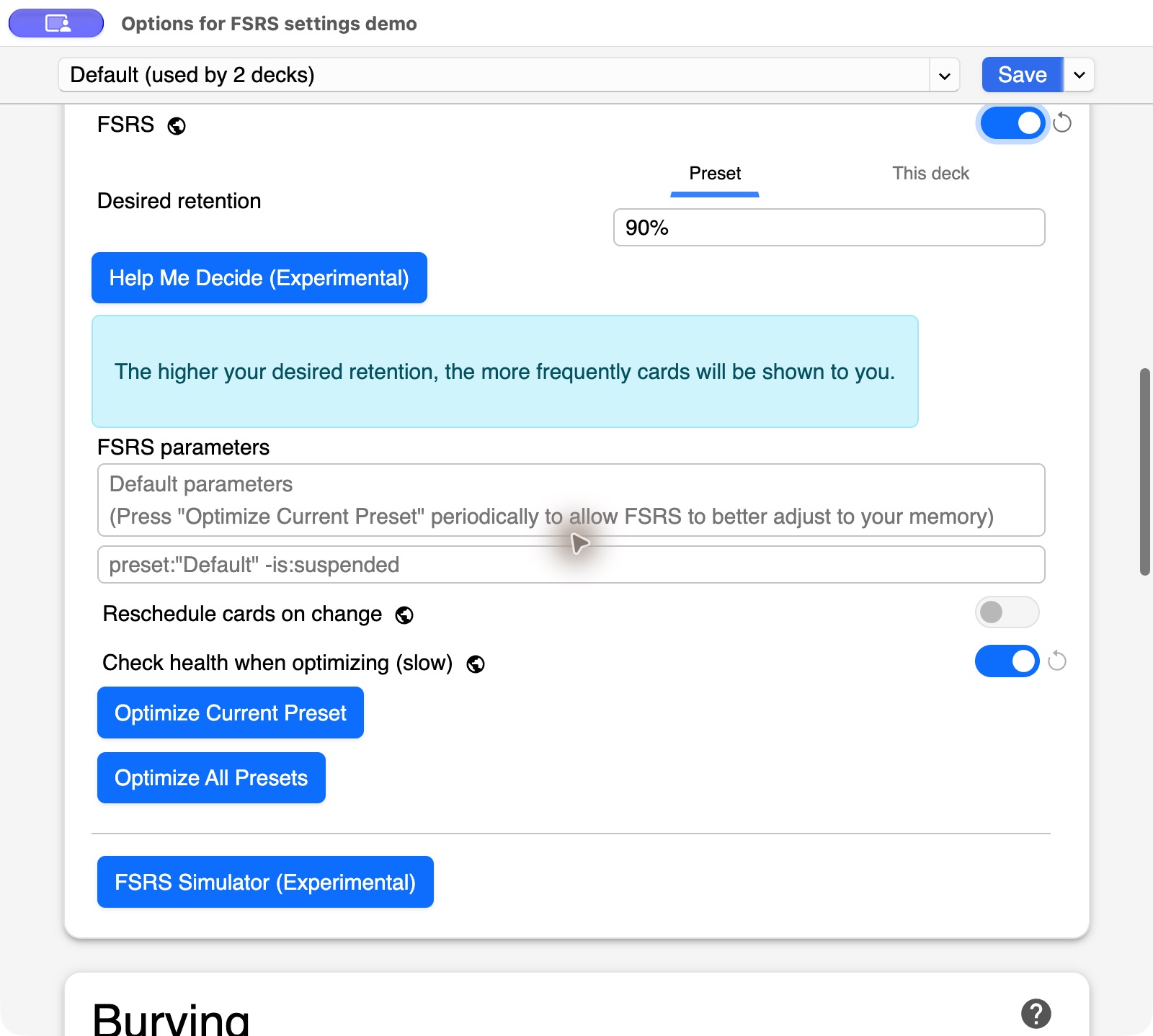
The manual also recommends stopping new introductions when an overdue backlog has built up. Check whether you are changing a shared preset, a particular deck or a today-only limit before saving settings. These are documentation-based distinctions, not a report of changing a reader's configuration.
For the separate question of desired retention, see our Anki FSRS settings walkthrough. A retention target, a new-card limit and your available time are different controls. Raising a target does not create extra time for reviews, and a new-card quota cannot guarantee a particular pass rate.
Keep cards small enough to diagnose the problem
When one card takes far longer than the rest, inspect it before lowering every limit. Does the front ask for several unrelated answers? Is the source explanation incomplete? Are you trying to memorize a result before understanding the worked example? A quota cannot fix those problems.
For example, "Explain the whole chapter" has no clear stopping point. A prompt about one relationship can be checked. If you need both the relationship and its exceptions, make the boundary explicit or separate the questions. Our card-writing guide develops this process.
Some topics still require longer work: solving an unfamiliar problem, writing an argument or interpreting a new diagram. Reserve time for those tasks too. Completing a flashcard queue is not evidence that you can perform every task on an exam.
Questions about daily new-card counts
Is twenty new flashcards a day too many?
It depends on your material, existing deck and available time. In our invented model it requires 46.7 minutes on day fifteen, before card creation or errors. That number belongs to the model, not to every person studying twenty cards. Measure your own work and use a lower limit when returning cards crowd out checking or other study.
Should I double the quota after missing yesterday?
First inspect what is already due and how much time remains. Doubling new introductions adds another group that will return later. Resume a manageable amount rather than using new cards to compensate for an unfinished review queue.
Can I generate a large deck and study only a few cards?
Creating cards and introducing them are different steps. A large prepared deck is not a requirement to study it all today. Check the content before relying on it, decide what matters next and use your app's available controls to keep the studied portion manageable. This article does not test a specific product's bulk-generation or quota-setting workflow.
Start with one time budget and one small batch. Record what the work actually costs, then revisit the number when those cards return.
