


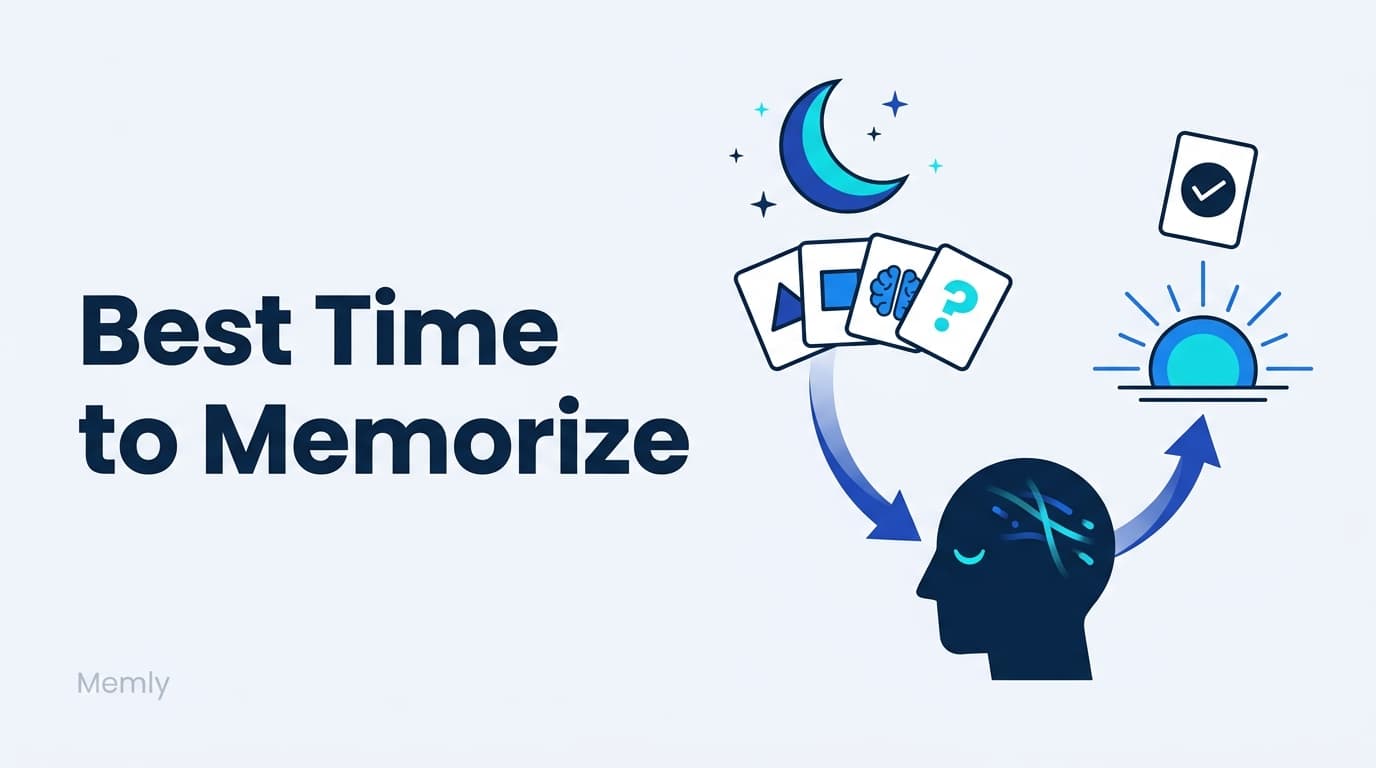
The time you study can affect how alert you feel and how easily the session fits around sleep. A short review before bed is one option, but it should not delay bedtime or replace a time when you concentrate better. The useful question is which routine helps you learn and still get enough sleep.
The "morning person vs night person" debate is folklore, and it is also the wrong question. Cognitive science points at a different variable entirely, and that variable is what decides how much of the hour survives the night.
The short version: the golden time for memorization is right before sleep. Learn your cards, add nothing else on top, and go to bed. Then test yourself on the same material the next morning. The pair of "memorize at night, consolidate in sleep, recall in the morning" squeezes the most memory out of the same study time.
Why memorizing before sleep sticks better
Reason 1: memories are consolidated during sleep
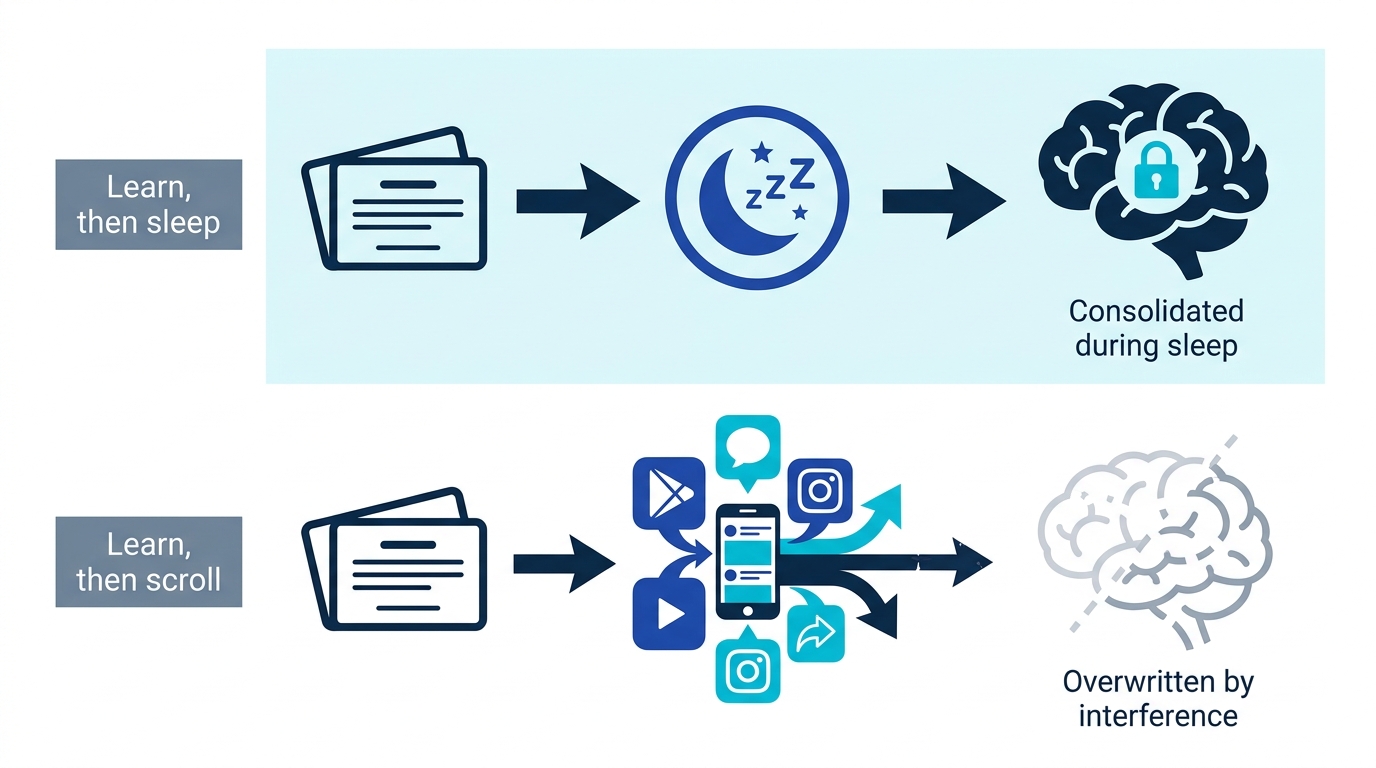
A memory is not finished the moment you learn it. A large body of research shows that what you learn is organized and consolidated into long-term memory while you sleep. Material learned right before bed has the shortest distance between learning and consolidation. Pairing memorization with sleep is close to handing your new knowledge directly to the save process.
Reason 2: nothing comes after it to overwrite it
Before a memory settles, a flood of new information interferes with it. Memorize at noon and everything that follows (classes, conversations, your phone) becomes an interference source. Before sleep, nothing follows. It is the time of day with the least interference by design.
"Morning type or night type" is not the point
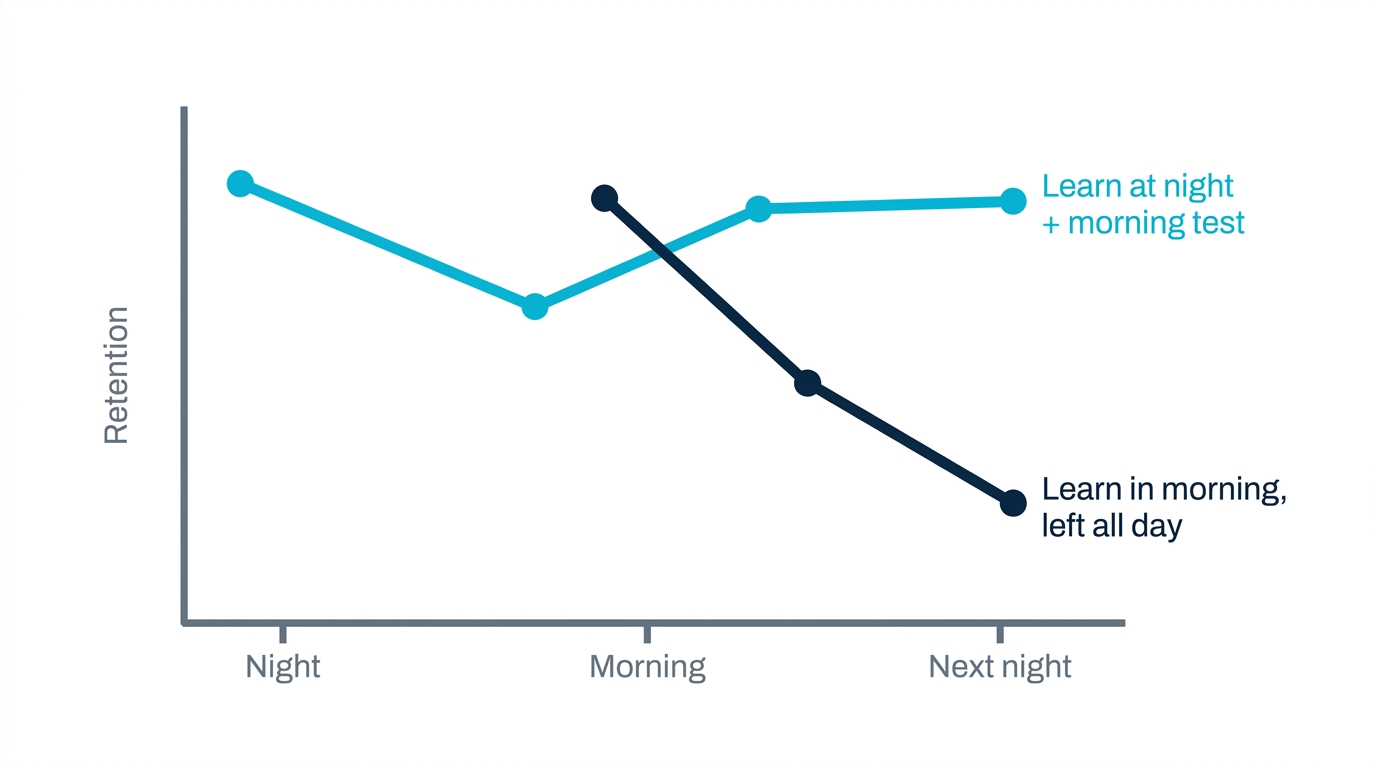
The old debate about whether memorization is better in the morning or at night misses the real variable: your position relative to sleep, not the clock. Right before sleep favors input (memorizing). Right after waking, with a rested and uncluttered head, favors output: recall practice and problem solving. Memorize new material in the morning and leave it until night, and it absorbs a full day of interference instead.
One more thing matters just as much: memorizing alone is not enough. In Dunlosky's 2013 review of study techniques, the top-rated methods were practice testing and spaced review. The before-sleep session only completes itself when it is paired with a morning recall test.
The golden routine: 10 minutes at night, 5 in the morning
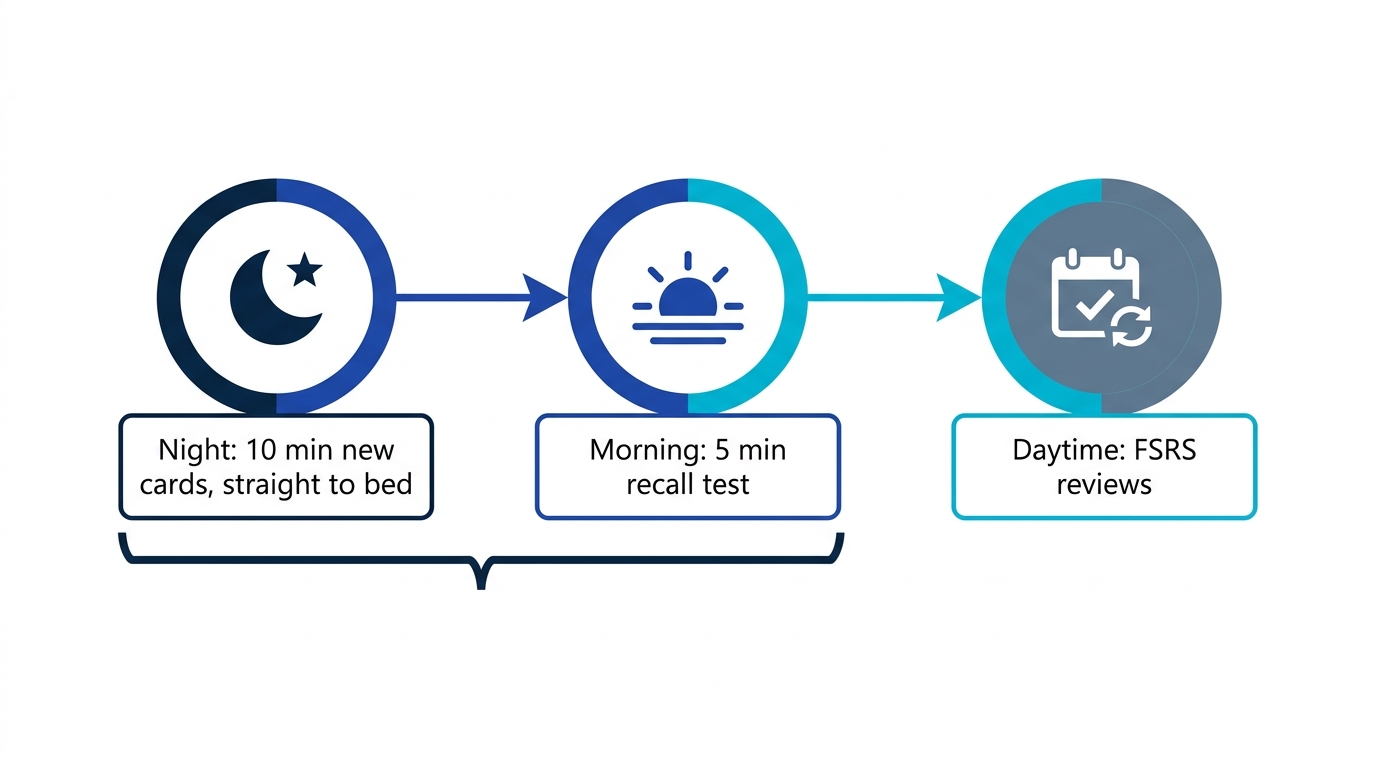
Fifteen minutes in total, split across the two ends of a single night.
| Time | What to do | Why |
|---|---|---|
| Night (10 min before bed) | Learn new cards, then sleep immediately | Shortest path to consolidation, zero interference |
| Morning (5 min after waking) | Recall test on last night's cards | Retrieving the freshly consolidated memory strengthens it further |
| Daytime gaps | Answer the reviews FSRS schedules | Maintain older cards exactly when they start to fade |
At night: learn it, close it, sleep
The biggest enemy of the before-sleep session is the phone after it. Watching videos right after memorizing erases the zero-interference advantage you just created. Close the app, then straight to bed. That one habit changes what the same ten minutes are worth.
In the morning: recall, don't reread
The morning step is not rereading last night's pages; that only builds recognition. Look at the front of each card and try to produce the answer yourself. Whatever you miss will simply come back around tonight.
The worst pattern: skipping sleep entirely
"If before sleep is best, why not stay up all night memorizing?" Because that inverts the whole mechanism: an all-nighter deletes the consolidation step that makes before-sleep learning work. We break down why crammed knowledge evaporates in Why All-Nighters Don't Work: Sleep and Memory.
Reviewing "whenever you feel like it" is the other quiet leak. The right moment to revisit a card differs per card and per memory. As we covered in The Best Time to Review: Just Before You Forget, that bookkeeping belongs to an algorithm.
Memly automates "learn at night, test in the morning"
- Night: cards from a photo: photograph a textbook page or upload a PDF or text, and AI generates question-and-answer cards. Your ten minutes go to learning, not card-making.
- Morning: the test is waiting: the FSRS spaced repetition algorithm queues last night's cards and any due reviews automatically.
- Web, iOS, and Android: the phone on your nightstand doubles as the night tool and the morning tool.
For the full picture of AI-assisted memorization, see the pillar guide AI-Assisted Memorization: How It Works and the Best Tools.
Tonight, just swap the order of two things
Try a short review before bed only if it fits your routine without delaying sleep. Compare what you can recall the next day with a session at another time. Keep the timing that lets you study attentively and sleep enough.
One action: tonight, put ten minutes of cards immediately before sleep, and tomorrow morning see how much comes back. Let AI make the cards. Memly is free to try, no credit card required.
