



An all-nighter gives you more time awake, but takes away sleep before the exam. You may also find that material learned in a rush is hard to recall later. This article explains why sleep belongs in a study plan and how to prioritise if tonight is the only preparation time left.
Why is all-nighter memory so fragile? The answer lives in the relationship between sleep and memory.
The short version: memory is not finished when you learn something; it is organized and consolidated in your brain while you sleep. Skipping sleep deletes that consolidation step. Even the night before, "narrow the scope, practice recall, and sleep at least a few hours" beats staying up until morning.
Why crammed memories vanish within a week
Learning and consolidating are two different steps
Most people treat memorization as a single event: push it into your head and done. But memory has a second act. A large body of research shows that information taken in during the day is organized and stabilized into long-term memory during sleep. Cramming all night and walking straight into the exam is like a factory loading raw material, shutting down the processing line, and shipping anyway.
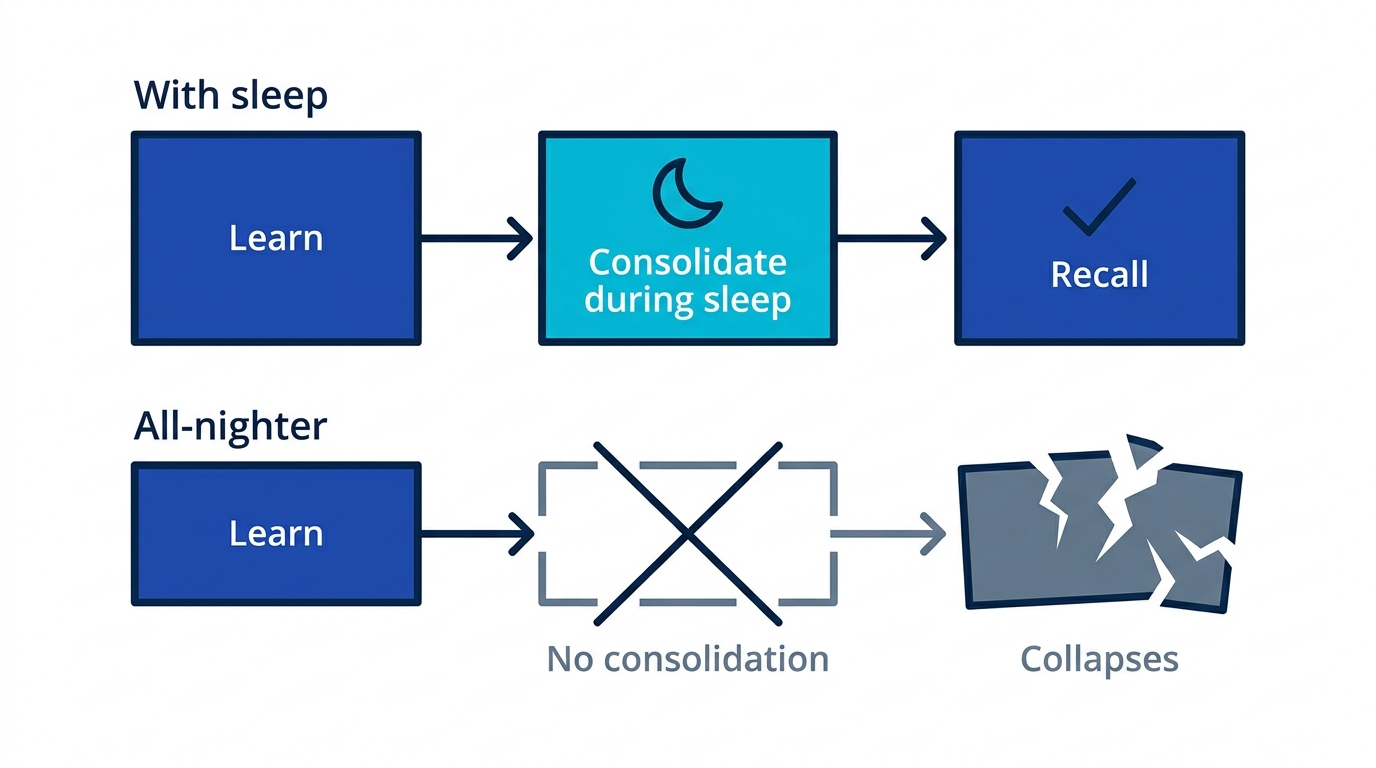
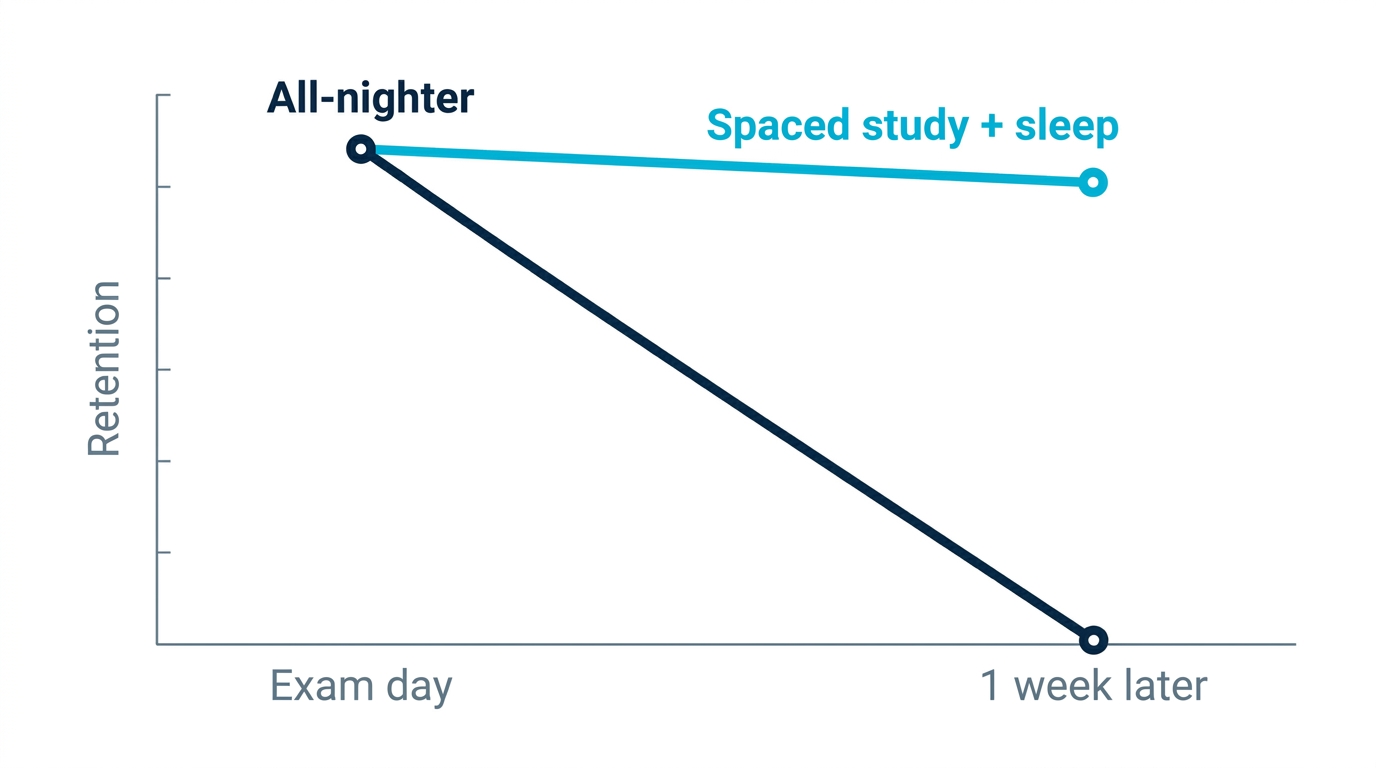
The "I've got this" feeling right after a cram session is mostly short-lived recognition: material looks familiar enough to eliminate a wrong option or two. But unconsolidated memory collapses within days, sliding down Ebbinghaus's forgetting curve with an extra handicap attached.
And your brain underperforms on exam day too
Sleep deprivation does not just block consolidation; it directly cuts attention, judgment, and working memory during the exam itself. Your ability to retrieve what you learned drops, and so does your ability to reason through unfamiliar questions. The all-nighter attacks both the storing step and the using step at once. It is a doubly bad bet.
| All-nighter | 3 days out + sleep | |
|---|---|---|
| Memory on exam day | Fragile recognition | Stable recall |
| Focus on exam day | Sharply reduced | Intact |
| Retention after a week | Near zero | Most of it kept |
| Asset for the next exam | Start from scratch | Compounds |
The bottom row is the one that compounds. Everything above it decides one exam; that row decides every exam after it.
If tonight is all the time you have: the damage-control protocol
Principles do not take exams; you do. If the exam is tomorrow, replace the all-nighter with "narrow, recall, sleep":
- Cut the scope to 30% (30 minutes): past papers and whatever the teacher emphasized, restricted to "likely tested and I can't do it yet." Trying to cover everything is how the night is lost.
- Recall, don't reread (2-3 hours): turn that narrowed material into questions and practice answering from memory. Photograph the pages and let AI make the cards so zero minutes go to card-writing.
- Sleep, even just a few hours: past a certain point, an hour of sleep is worth more points than an hour of cramming, because it preserves the consolidation step.
- One morning pass over the cards you missed: a short retrieval session after waking locks in the night's work.
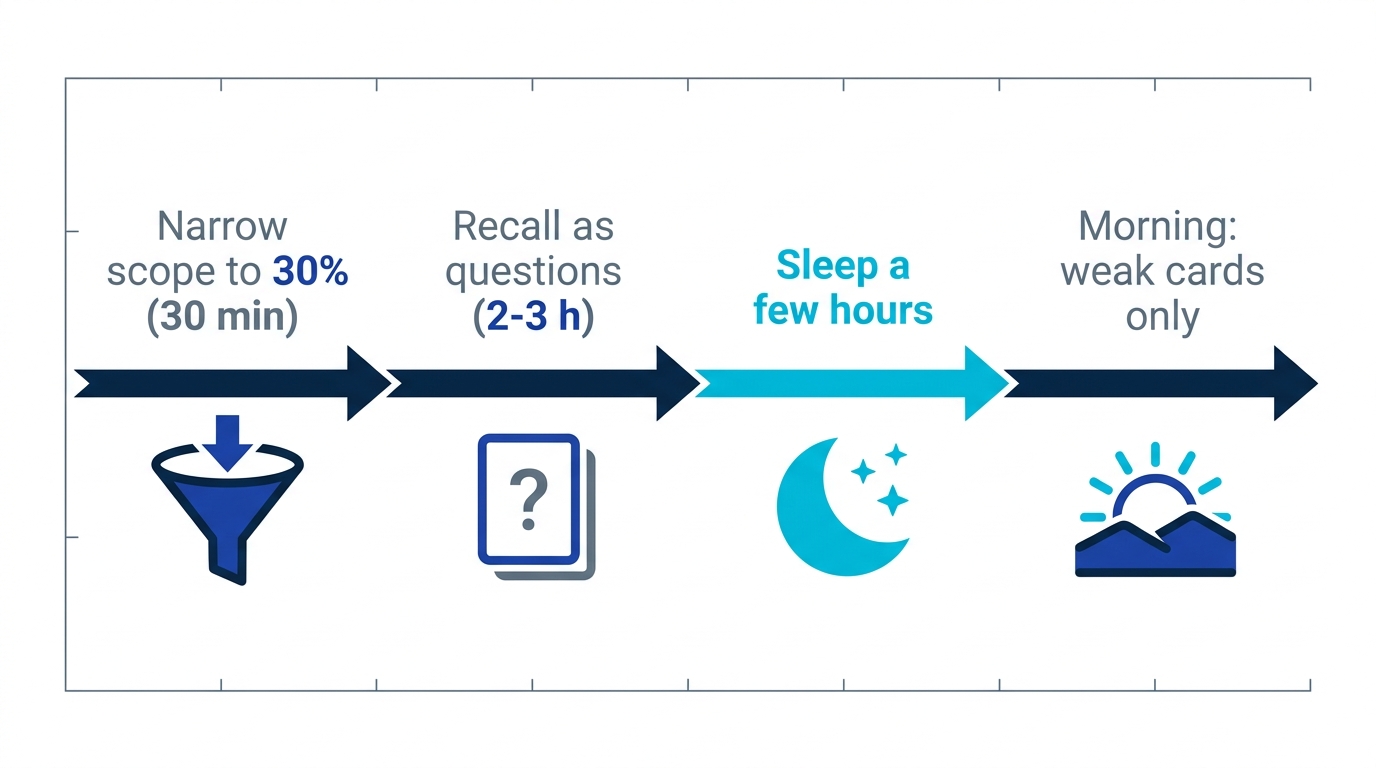
Step 3 is the one that feels like surrender. It is also the only step on the list that does anything for next week. For the same routine on an ordinary night, see the best time of day to memorize.
And if you have three days instead of one, there is a proper plan for that: Exam in 3 Days? The Science-Backed Way to Cram.
The permanent fix: a system that makes re-cramming unnecessary
All-nighters do not repeat because you are weak-willed. They repeat because nothing in your life manages daily review for you. When you cannot see what to review or when, nothing happens until a deadline forces it.
Memly takes over exactly that management. Photograph handouts or textbook pages and AI turns them into question-and-answer cards; the FSRS spaced repetition algorithm then serves you only the cards you are about to forget, every day. Your job shrinks to a few minutes of answering. It runs on Web, iOS, and Android, so a commute becomes review time. For the timing science, see The Forgetting Curve and When to Review; for the full system, see AI-Assisted Memorization: How It Works and the Best Tools.
Whether tonight was your last all-nighter
After this exam, choose one regular review slot for the next course. Even a small session between classes can reduce how much material is left for the final night. If you miss a day, resume with the most important items rather than trying to make up every minute.
If you are changing it, do one thing tonight: photograph the first handout of your next exam's material and turn it into cards. That single act moves the next pre-exam night away from cramming and toward sleeping. Memly is free to try, no credit card required.
