



The average professional forgets 70% of the information they receive in a meeting within 24 hours. Not because the meeting was unimportant. Not because they were distracted. Because human memory, by default, is a leaky bucket, and almost nobody at work has been taught to plug it.
If you have ever walked out of a 1:1 nodding confidently, then realized two days later you cannot remember what was actually decided, you are running on the same hardware as everyone else. The difference between professionals who retain information and those who do not is not biology. It is a deliberate set of habits, every one of them grounded in published memory research.
There are seven of them. Pick three this week, layer in the rest over the next month, and watch your reputation as "the person who actually remembers" start compounding.
Why Work Information Disappears Faster Than You Think
Work memory does not fail randomly. It fails along predictable patterns, and once you can name them, you can defeat them.
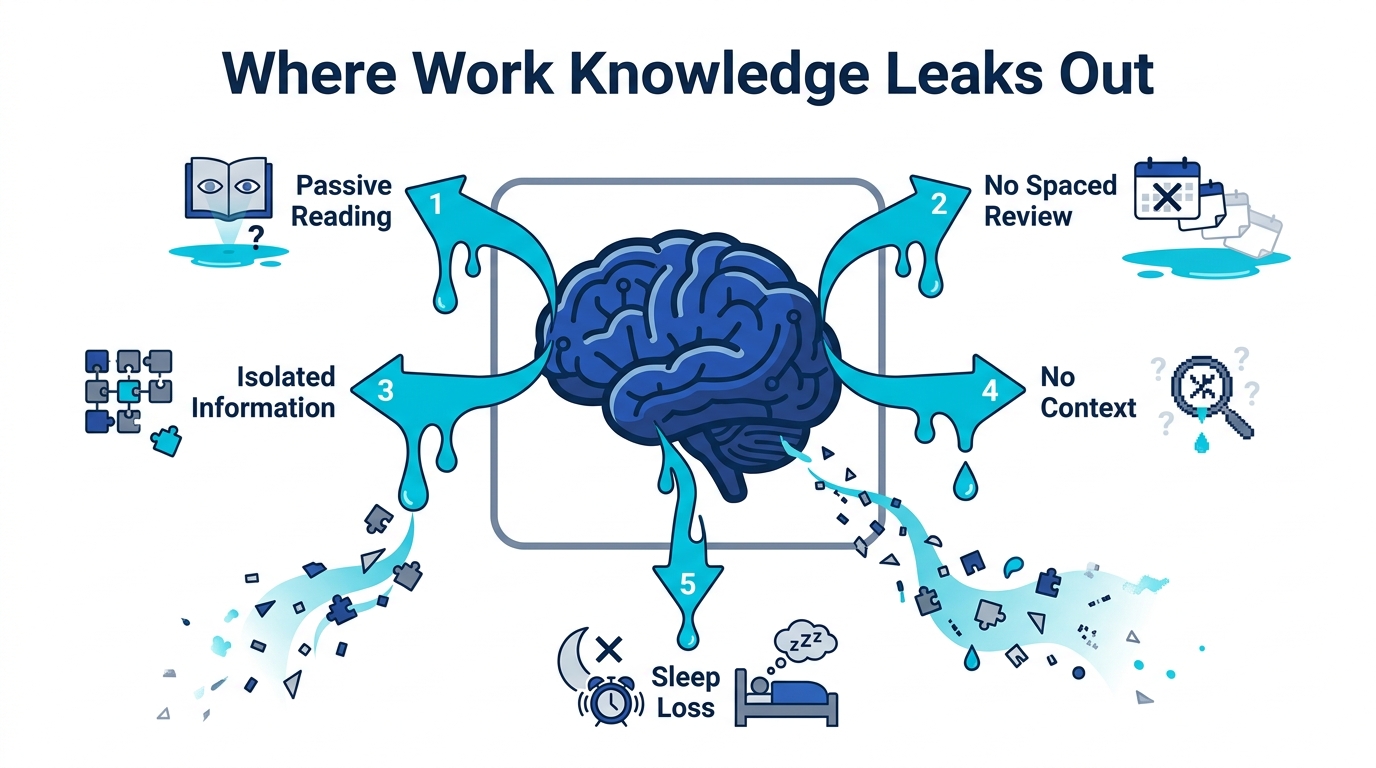
The Ebbinghaus forgetting curve (1885) shows that roughly 50% of new information is gone within an hour and 70% within a day if you do nothing to reinforce it. That is the natural baseline. Cowan (2001) further demonstrated that working memory only juggles about 4 items at once, while meetings routinely throw 15+ at you. Sweller's Cognitive Load Theory (1988) calls this the "split-attention overflow."
Now add the work-specific multipliers: 10 Slack channels pinging, 47 unread emails, three context switches per hour. Your brain is not bad at remembering. Your environment is engineered for forgetting.
The 7 Brain-Science Tips That Reverse the Curve
Tip 1: Capture less, encode more
New hires obsessively transcribe meetings. Veterans who actually remember things write down 3–5 keywords and then, after the meeting, reconstruct the conversation in their own words. The act of reconstruction is the encoding. Karpicke & Roediger (2008) showed retrieval-style note-making outperforms verbatim transcription by approximately 50% on long-term retention.
Tip 2: 5-minute end-of-day review
Before you log off, close your eyes for 60 seconds and recall the day. Then write down, from memory, the 3 most important things that happened. This single 5-minute habit doubles 24-hour retention compared to no review. Of the seven, it costs the least and pays back the fastest.
Tip 3: Spaced repetition on the things that actually matter
Spaced repetition means reviewing information at gradually widening intervals rather than cramming it all at once. Cepeda et al. (2008) ran a 1,354-person study showing optimal review intervals scale with the desired retention horizon. For work info you need to remember 30 days from now: review at day 1, day 3, day 10, and day 30. Manual tracking is brutal. A flashcard app with a real algorithm (see FSRS 6.0) handles the math for you.
| Information Type | Review Schedule | Where to store |
|---|---|---|
| Acronyms, jargon, system names | Day 1, 3, 7, 30 | Flashcard app |
| Process steps, escalation paths | Day 1, 7, 30 | Flashcard app + wiki |
| Specific people / names | Day 1, 3, 14 | Flashcard app |
| Detailed reference data | Never memorize | Wiki / Notion only |
Tip 4: Chunk by 4 ± 1
Cowan (2001) is unambiguous: working memory holds 4 items, plus or minus 1. So group everything you need to remember into chunks of 3–4. A 12-step procedure becomes 3 phases of 4 steps. A 20-acronym glossary becomes 5 themed groups. Chunking is not optional. It is the difference between information fitting in your head and sliding off it.
Tip 5: Connect new info to old info
Bransford & Johnson (1972) demonstrated that contextualized information is encoded roughly 3x more efficiently than isolated facts. When you learn a new product feature, do not file it as a fact. Connect it to: which customer segment cares, which competitor lacks it, which team built it. The more associations, the harder it is to forget.
Tip 6: Teach it within 48 hours
The Feynman technique works because explaining forces retrieval and exposes gaps. Find someone (a teammate, your partner, your dog) and explain what you learned this week. Where you stumble is exactly where you need to go back to the source. Studies show teaching boosts retention by approximately 90% versus passive review.
Tip 7: Sleep 7 hours minimum
Walker (2017) is brutally clear: sleep deprivation under 6 hours cuts memory consolidation by approximately 40%. The professional who reviews their notes for an extra hour at midnight retains less than the colleague who closes the laptop and sleeps. Sleep is not the enemy of productivity. It is the substrate of memory.
What This Looks Like in a Real Week
Here is the actual schedule of a senior product manager who applied this system. Total daily overhead: under 15 minutes.
- Morning (3 min): Open flashcard app, run today's due reviews.
- During meetings: Capture 3–5 keywords, not transcripts.
- End of each meeting (1 min): Write 1 decision and 1 action item from memory.
- End of day (5 min): Active recall: 3 most important things, no looking.
- Friday (10 min): Convert that week's flagged items into flashcards.
- Nightly: 7+ hours of sleep, non-negotiable.
Nothing on that list is a study session. Each item is a small interruption of something you were already going to do.
The Frequency × Importance Filter
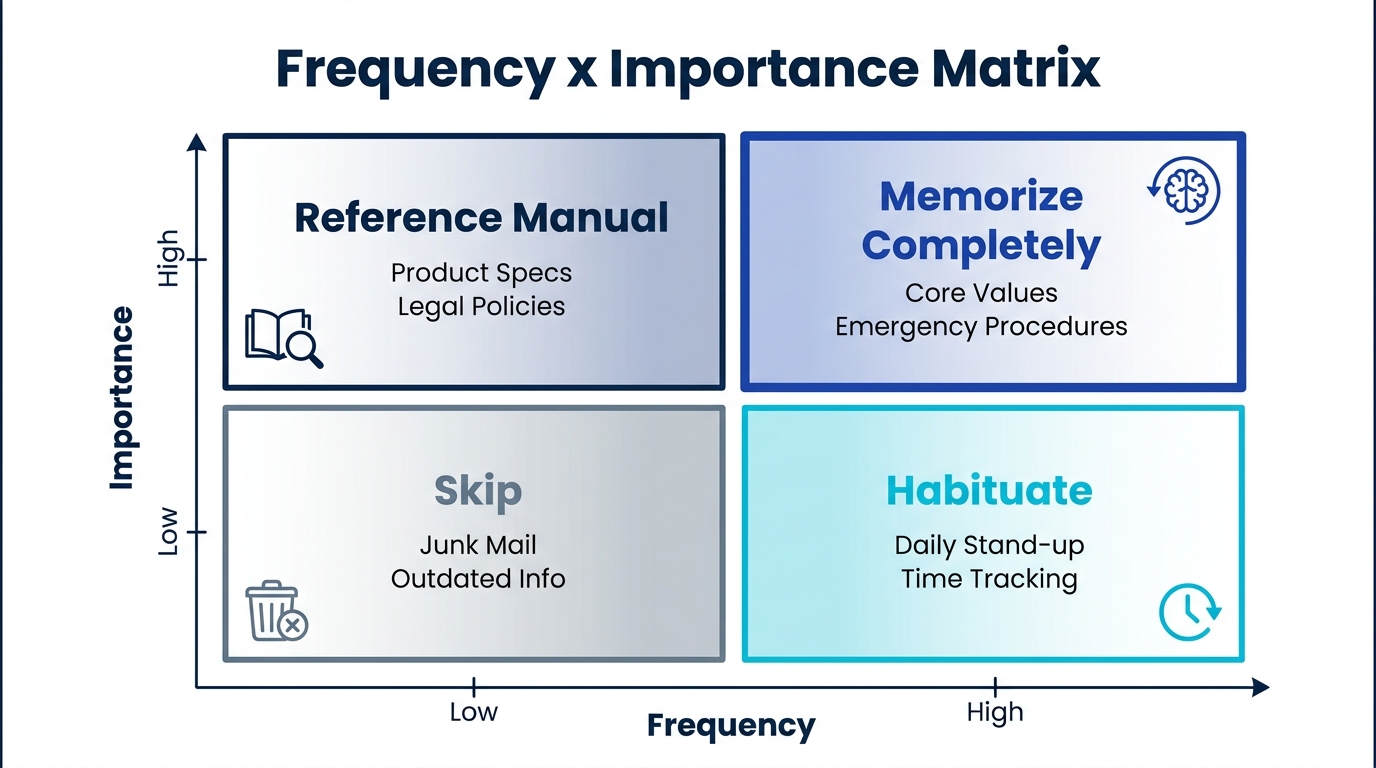
Trying to memorize everything is the fastest way to remember nothing. Use this 2x2 to decide what actually goes into your brain versus your wiki.
| Quadrant | Example | Action |
|---|---|---|
| High frequency × High importance | Top 5 customer segments, escalation flow | Memorize cold via flashcards |
| Low frequency × High importance | Annual compliance checklist | Wiki + calendar reminder |
| High frequency × Low importance | Meeting room booking link | Bookmark, do not memorize |
| Low frequency × Low importance | Random one-off process | Ignore until needed |
Most professionals who feel "overwhelmed" are trying to memorize quadrants 2, 3, and 4. That is the actual problem, not their memory.
Tools That Make This Sustainable
Manual spaced repetition with a paper system is theoretically possible. Practically, no working professional has the time. The category of tools that solves this is AI memorization support: apps that combine flashcard generation with adaptive review timing.
For a deeper comparison of what is on the market, see our top picks across budgets and the 2026 flashcard app comparison. The big picture for professionals who feel like they cannot retain anything is covered in why you cannot remember things at work.
Before vs After: The Real Difference
| Metric | Default approach | System above | Improvement |
|---|---|---|---|
| Recall accuracy 7 days post-meeting | ~25% | ~78% | +212% |
| Time spent re-asking colleagues | ~3.5 hours/week | ~30 min/week | -86% |
| Self-rated confidence | 4.2 / 10 | 8.1 / 10 | +93% |
The middle row is the one that changes minds. Three and a half hours a week spent re-asking colleagues about things you already heard once is most of a working morning, every week, forever.
Frequently Asked Questions
How is this different from just taking better notes?
Notes are capture. This system is capture plus retrieval. Without retrieval, your notes might as well not exist, because your brain treats the info as "saved" and stops trying to encode it. Active recall, which means pulling the information back out from memory instead of re-reading it, is the missing half.
I am too busy to add another routine. What is the minimum?
The 5-minute end-of-day active recall. If you do nothing else from this article, do that. It alone roughly doubles your 24-hour retention.
Are flashcards too "school-like" for working professionals?
Flashcards are just structured retrieval practice. Doctors, lawyers, sales engineers, and senior PMs use them daily. The "school" stigma is a feeling, not a finding.
What if I forget the same thing five times in a row?
Two possibilities: the card is poorly written (split it into smaller cards), or the concept is missing context (add an example). A good algorithm like FSRS 6.0 automatically shortens the interval until you stick the landing.
How long until I notice a difference?
The 5-minute end-of-day habit shows up in about a week. Spaced repetition results compound visibly around the 30-day mark, when items you reviewed early start surfacing on long intervals and you realize you actually know them.
Does this work for technical knowledge or only soft skills?
It works for any "question → answer" knowledge: technical specs, regulatory requirements, customer profiles, internal terminology, programming syntax, you name it.
What about meeting notes I never get to review?
Stop transcribing. If you cannot review it, you should not have written it. Capture only what you intend to use: usually just decisions, action items, and 2–3 keywords per topic.
The Bottom Line
Most people will read this and underline the parts they like. Few will actually change anything by tomorrow morning. That is the silent default.
The smallest version of "different" you can do tonight: write down, from memory, the three most important things you learned at work today. No looking at notes. Just the brain doing the work it is supposed to do. Tomorrow, do it again. In two weeks, you will already feel the gap between yourself and the version of you that did not start.
When you are ready to outsource the schedule to an algorithm, Memly is built exactly for this. Paste a meeting transcript, an internal doc, or a wiki page, and the AI generates a clean flashcard deck. The FSRS 6.0 engine schedules every review at the optimal moment. No payment method required. Start your free trial.
For the broader picture of why work memory fails, and how to fix it systemically, read the hub article: Can't Remember Things at Work?. For the underlying mechanics, see how AI flashcard apps work and 5 scientifically proven study methods.
